
Scared of Technical Rounds? How to Turn ChatGPT Into a Strict Mock Interviewer
Table of Contents
Introduction
Let me paint a picture that every single fresher knows too well.
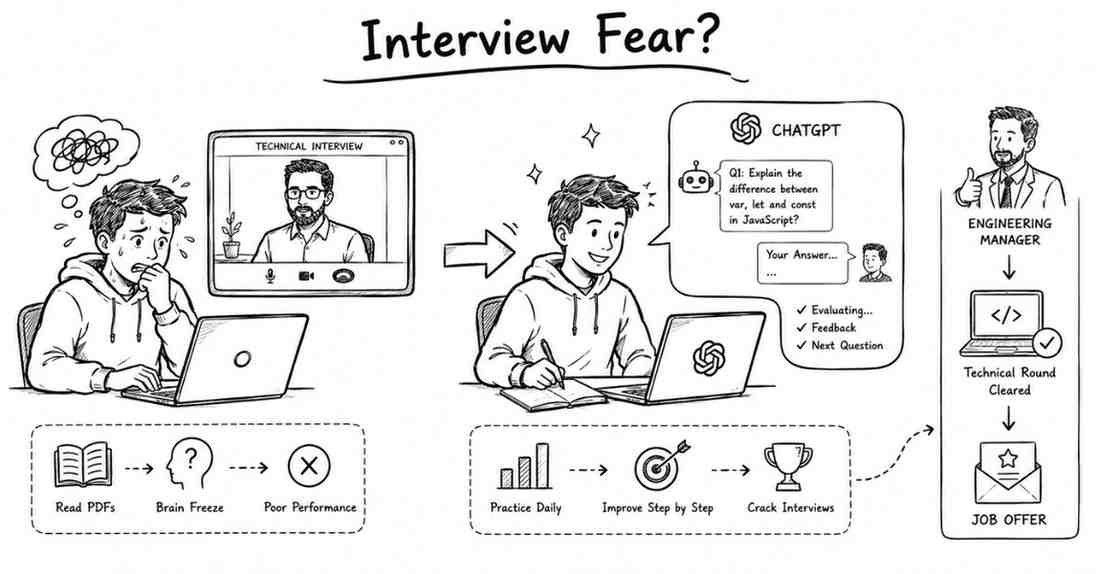
You passed the resume screening. You passed the aptitude test. Now, you are sitting in a virtual waiting room on Microsoft Teams or Zoom. Your palms are sweating. Your heart is beating so fast you can hear it in your ears. In exactly two minutes, a Senior Engineering Manager is going to join the call and grill you on your technical skills.
You spent the last three nights reading a PDF titled “Top 100 React.js Interview Questions.” You memorized the definitions. But the moment the interviewer joins, looks at you, and says, “Explain the virtual DOM and how it impacts memory allocation,” your brain goes completely blank. You stutter. You mix up your words. You fail the interview.
Why does this happen? Why do students who get 9.0 CGPAs fail entry-level technical interviews?
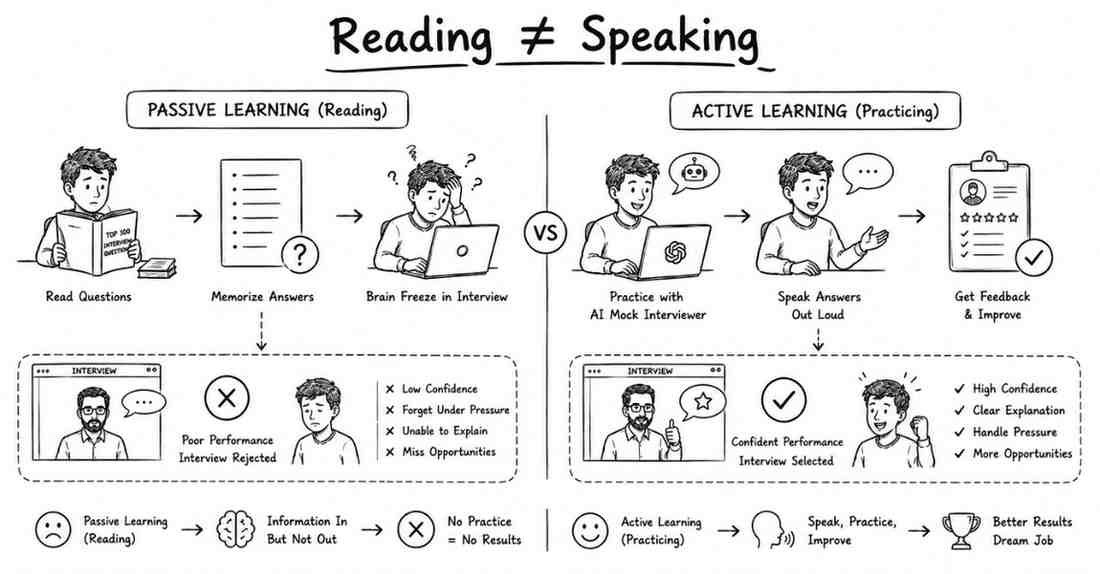
It happens because Reading is not Speaking. Traditional interview preparation is completely broken. Reading a list of questions and answers is passive learning. But an interview is an active, high-pressure performance. You don’t fail because you lack knowledge; you fail because you lack practice under pressure.
In 2026, you don’t need to beg a senior to take a mock interview for you. You have the most advanced AI in human history sitting in your pocket. In this comprehensive guide, I am going to show you how to use a secret “Mega-Prompt” that will transform ChatGPT into a ruthless, strict Senior Technical Manager. It will ask you live questions, wait for your answers, and grade you out of 10.
Let’s eliminate your interview fear once and for all.
Chapter 1: The Trap of "Passive" Interview Preparation
Before we hack the AI, we need to fix your preparation strategy.
When most freshers get an interview call, they go straight to Google and type: “Interview questions for Junior Data Analyst.” They find a blog post, read the questions, read the answers, nod their heads, and think, “Yeah, I know that.”
Here is the harsh truth: Knowing the answer in your head is useless if you cannot articulate it clearly with your mouth.
When you are in an interview, you are battling two things:
- Cognitive Load: Trying to retrieve the technical information from your brain.
- Performance Anxiety: Trying to sound confident, maintain eye contact, and speak professional English.
When you combine these two, your brain crashes. The only way to prevent this crash is to practice speaking the answers out loud to a dynamic entity that can judge you. You need a feedback loop. You need someone to tell you, “Your answer was 60% correct, but you forgot to mention this critical concept.”
That is exactly what we are going to train ChatGPT to do.
Chapter 2: The ChatGPT "Mega-Prompt" (The Core Hack)
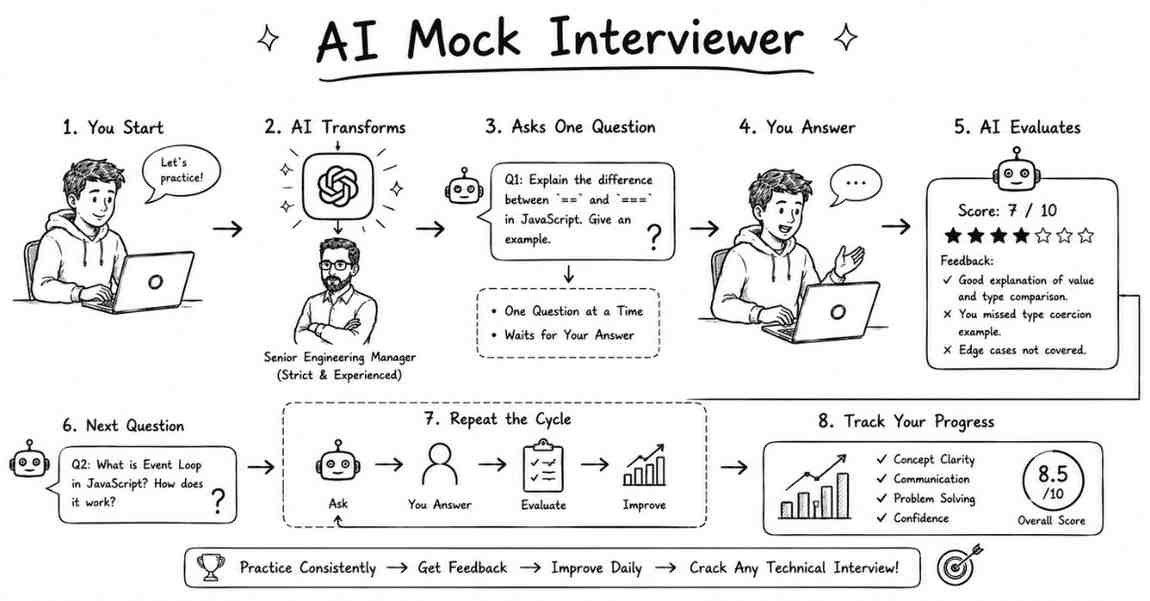
If you just go to ChatGPT and say, “Take my interview,” it will give you a list of 10 questions all at once. That is useless. It feels like an exam paper, not a conversation.
We need ChatGPT to act like a human being. We need it to ask one question, wait patiently for your response, evaluate what you said, correct your mistakes, and then ask the next question based on how well you did.
To achieve this, we use a technique called Persona Prompting.
Open a fresh chat in ChatGPT. If you have access to the ChatGPT mobile app, this is even better because you can use the Advanced Voice Mode to actually speak to it like a real phone call.
Copy and paste this exact Mega-Prompt. (Make sure you edit the bracketed text to match your specific role).
The Ultimate Mock Interviewer Prompt:
“Act as a strict, highly experienced Senior Engineering Manager at a top-tier tech company. You are interviewing me for a [Insert Role, e.g., Junior Full Stack Developer] position. >
Here is my tech stack: [Insert Skills, e.g., React.js, Node.js, MongoDB, JavaScript ES6+].
We are going to conduct a technical mock interview. You must follow these strict rules:
- Ask me ONLY ONE technical question at a time. Do not give me a list of questions.
- Wait for me to type (or speak) my answer. Do NOT generate the answer for me.
- After I answer, you must do three things:
– Grade my answer out of 10 based on technical accuracy and clarity.
– Give me harsh, constructive feedback on what I missed or how I could have explained it better.
– Ask me the next technical question.
- Start with basic conceptual questions and progressively get harder. Include at least one scenario-based problem solving question.
Do you understand the rules? If yes, introduce yourself briefly and ask me the very first question.”
What Happens Next?
The moment you hit enter, ChatGPT transforms. It will say something like:
“Hello, I am the Senior Engineering Manager. Let’s get started. For your first question: Can you explain the difference between var, let, and const in JavaScript, and tell me a scenario where you would explicitly choose not to use const?”
Now, you are in the hot seat. You have to answer.
Chapter 3: How to Execute the Mock Interview Correctly
Having the prompt is only 50% of the battle. How you use it determines whether you will actually improve or just waste your time.
If you want to completely destroy your interview anxiety, you must follow the Rules of Engagement:
1. Do Not Cheat
When ChatGPT asks you a question, do not open a new tab and Google the answer. In a real interview, you cannot Google. If you don’t know the answer, you must practice saying, “I am not entirely sure about the deep mechanics of that, but based on my understanding…” Let ChatGPT grade you poorly. That is the point of a mock interview.
2. Use Voice Mode (The 2026 Superpower)
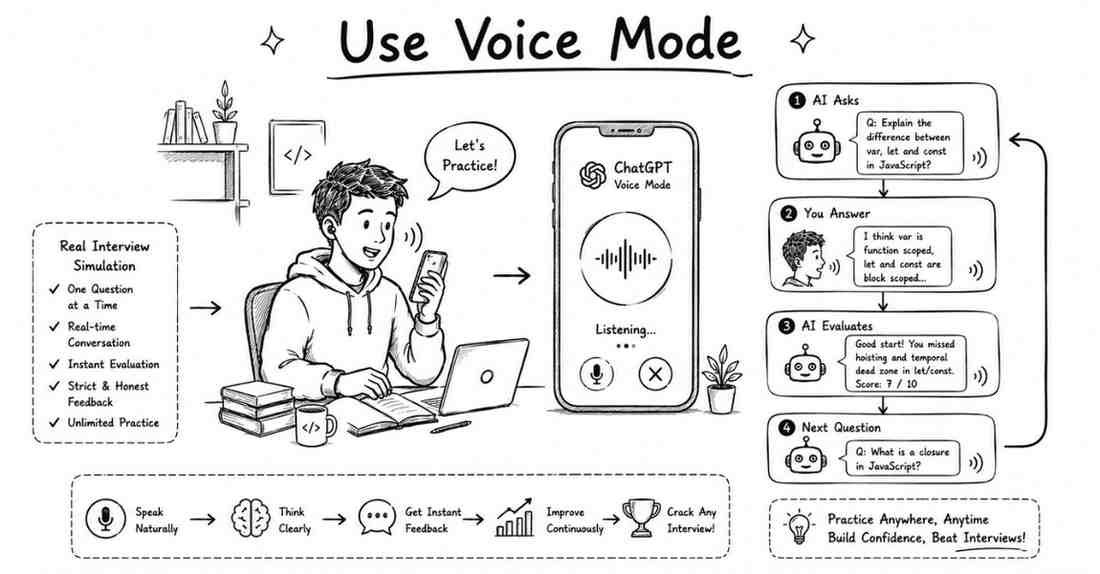
If you are typing your answers to ChatGPT, you are only practicing your typing skills. Interviews are verbal. Open the ChatGPT app on your smartphone, paste the prompt, and click the Headphone Icon (Voice Mode). Put your phone on the desk, look at the wall, and speak your answers out loud. When you finish speaking, ChatGPT will reply with a human voice, grade you, and ask the next question. This creates a 99% realistic simulation of a telephonic or Teams interview round.
3. Practice Scenario-Based Questions
The prompt is designed to ask you scenario questions. For example, instead of asking “What is a database index?”, the AI might ask, “Our e-commerce website’s search query is taking 5 seconds to load. How would you optimize the database to fix this?” These are the exact types of questions product companies ask in 2026. Practice thinking out loud and breaking the problem down step-by-step for the AI.
Chapter 4: The Top 20 Technical Questions for 2026
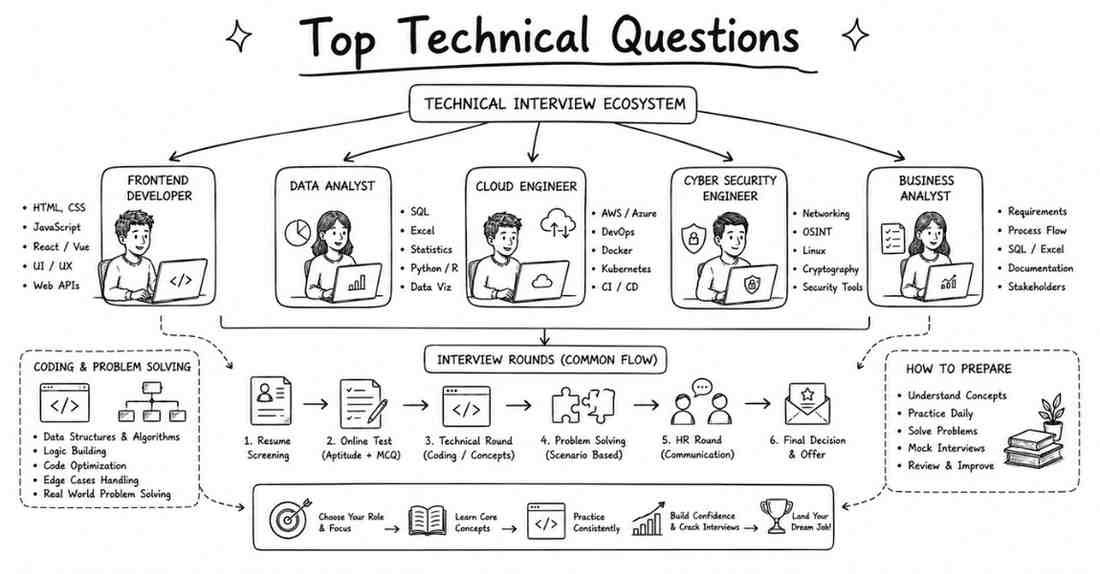
To give you a head start, I have analyzed thousands of interview experiences from top product and service-based companies. While every interview is different, the core fundamentals remain the same.
Here are the highest-frequency technical questions you should be prepared to answer in 2026, broken down by domain. Use these to test yourself against ChatGPT.
For Frontend / Full Stack Developers
- The Core Framework: Explain the Virtual DOM. How does React’s reconciliation algorithm actually work under the hood?
- State Management: When would you choose Context API over Redux, and vice versa?
- JavaScript Engine: Can you explain the Event Loop, Call Stack, and Web APIs in JavaScript? How does JS handle asynchronous code if it is single-threaded?
- Performance: Your React application is rendering extremely slowly. What steps would you take to debug and optimize it? (Hint: Memoization, Lazy Loading).
- Security: How do you protect a web application from Cross-Site Scripting (XSS) and Cross-Site Request Forgery (CSRF) attacks?
For Data Analysts / Scientists
- SQL Mastery: Explain the difference between INNER JOIN, LEFT JOIN, and FULL OUTER JOIN. What happens if you left join two tables on a column containing NULL values?
- Window Functions: Can you write a SQL query using ROW_NUMBER() or RANK() to find the second highest salary in every department?
- Python/Pandas: How do you handle missing data (NaN) in a large pandas DataFrame? When would you choose imputation over dropping the rows?
- Visualization: If you need to show a trend over time, would you use a bar chart, a pie chart, or a line chart? Why?
- Business Logic: We noticed a 15% drop in daily active users on our app last week. Walk me through your step-by-step analytical process to find out why.
For Cloud & Cyber Security Engineers
- Cloud Architecture: You need to design a highly available web architecture on AWS/Azure that can survive an entire data center going offline. How do you do it?
- Networking Basics: What exactly happens behind the scenes when you type google.com into your browser and press Enter? (DNS, TCP handshake, HTTPS).
- Cyber Defense: What is the difference between asymmetric and symmetric encryption? When would you use which?
- Vulnerability: Explain SQL Injection to me as if I were a non-technical CEO. How do we prevent it?
- Serverless: What are the pros and cons of using AWS Lambda (serverless) versus provisioning a dedicated EC2 server?
For Non-IT to IT / Enterprise Roles (Workday, Business Analyst)
- Agile Methodology: Explain the difference between Agile and Waterfall. What are the key ceremonies in a Scrum sprint?
- Requirements Gathering: A client gives you a very vague requirement: “Make the software faster.” As a Business Analyst, how do you extract the actual technical requirements from them?
- ERP Systems: Why do large global companies pay millions of dollars for Workday or SAP instead of building their own internal HR/Payroll software?
- Data Compliance: What is GDPR, and why is it critical when configuring an HR enterprise system?
- Stakeholder Management: The developers say a feature will take 3 weeks, but the client demands it in 1 week. As the BA, how do you handle this conflict?
Chapter 5: How to Handle the "I Don't Know" Moment
No matter how much you prepare, a senior interviewer will eventually ask you a question that completely stumps you. This is done on purpose. They want to see how you react when you hit a wall. Do you panic? Do you lie? Or do you problem-solve?
When ChatGPT (or a real interviewer) asks you a question you do not know, do not try to fake an answer. Senior engineers can spot a fake answer in 3 seconds, and it destroys your credibility.
Instead, use the Graceful Pivot Technique.
Script 1: When you know a little bit, but not the whole concept.
“To be completely honest, I haven’t implemented [Concept] deeply in my projects yet. However, from my theoretical understanding, it relates to [mention whatever small part you know]. If I were given this problem on the job, my first step would be to consult the official documentation to understand the exact syntax.”
Script 2: When you have absolutely no idea.
“I am not familiar with that specific term/technology. However, in my recent project, I solved a similar problem using [Mention a technology you DO know]. Could you tell me a bit more about how your team uses [Unknown Concept]? I am highly eager to learn it.”
When you answer like this, you show the interviewer three things:
- You are honest and have high integrity.
- You know how to research and solve problems independently.
- You have a growth mindset.
You can literally tell ChatGPT: “Ask me a question that is incredibly difficult so I can practice saying ‘I don’t know’ professionally.”
Conclusion: Your Action Plan for Today
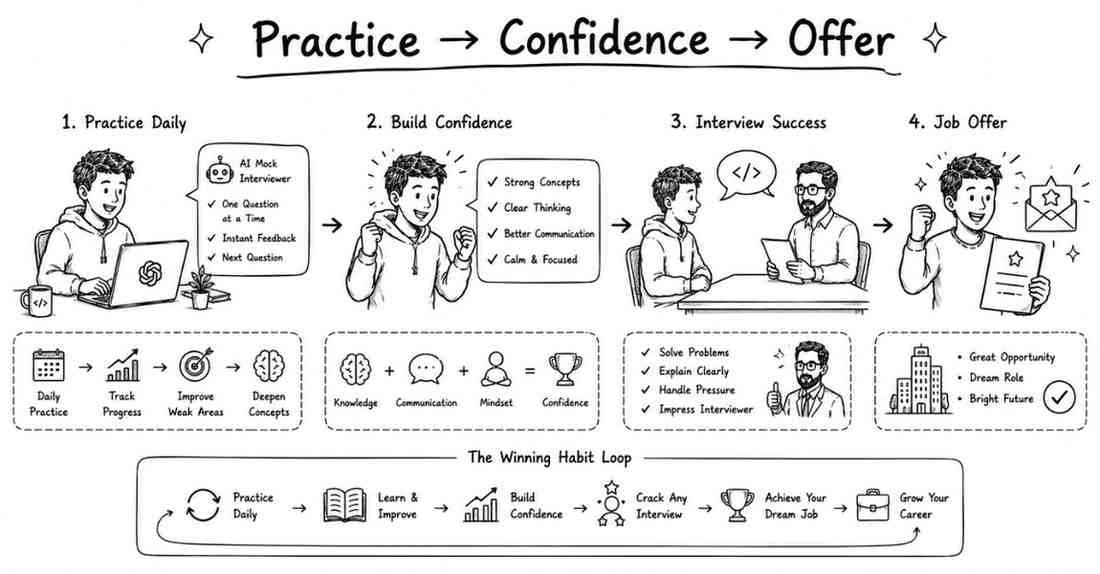
Technical interviews are intimidating, but they are not a mystery. They are standardized tests. If you practice them enough times, the fear vanishes, and muscle memory takes over.
Let’s review your action plan to crack your technical round:
- Stop Reading, Start Speaking: Close the PDFs. You will not learn how to ride a bicycle by reading a book about bicycles.
- Use the Mega-Prompt: Copy the prompt from Chapter 2 and initiate a session with ChatGPT.
- Use Voice Mode: Put your phone on the desk and speak your answers out loud. Simulate the real environment.
- Learn from the Grades: Do not get discouraged if ChatGPT gives you a 4/10. Read its feedback, understand what you missed, and ask it to test you on the same concept tomorrow.
- Master the Pivot: Practice saying “I don’t know” gracefully.
When you do this for 30 minutes a day for a week, you will walk into your real interview with unbreakable confidence. You won’t be praying for easy questions; you will be ready for the hard ones.
What’s Next in the “Job Ready 2026” Series?
You have cleared the technical round. Your code is solid, your concepts are clear, and the Tech Manager gives you a thumbs up.
But you are not hired yet. You have to face the final boss: The HR Round. The HR round is where highly technical students fail because they lack soft skills. The very first question the HR will ask you is, “Tell me about yourself.” If you start talking about your hobbies, your hometown, or reading your resume line-by-line, you will lose the offer.
In Episode 10: The “Tell Me About Yourself” Hack, I am going to give you the psychological Past-Present-Future Framework. I will provide you with exact, word-for-word scripts that will impress any HR manager in the first 60 seconds and set the tone for a guaranteed job offer.
👉 Action Item for Today: Open ChatGPT right now, paste the Mock Interviewer prompt, and complete a 15-minute mock interview. Face the fear today so you don’t have to face it in the real interview tomorrow.
If you are consistently scoring low on your mock interviews because your technical foundation is weak, it is time to stop applying and start upskilling. At Frontlines Edutech, our curriculum ensures that your technical fundamentals are deeply rooted, so you never have to memorize answers—you simply understand how the technology works. See you in the next post!