
CAREER PROGRESSION & ADVANCEMENT STRATEGIES
Table of Contents
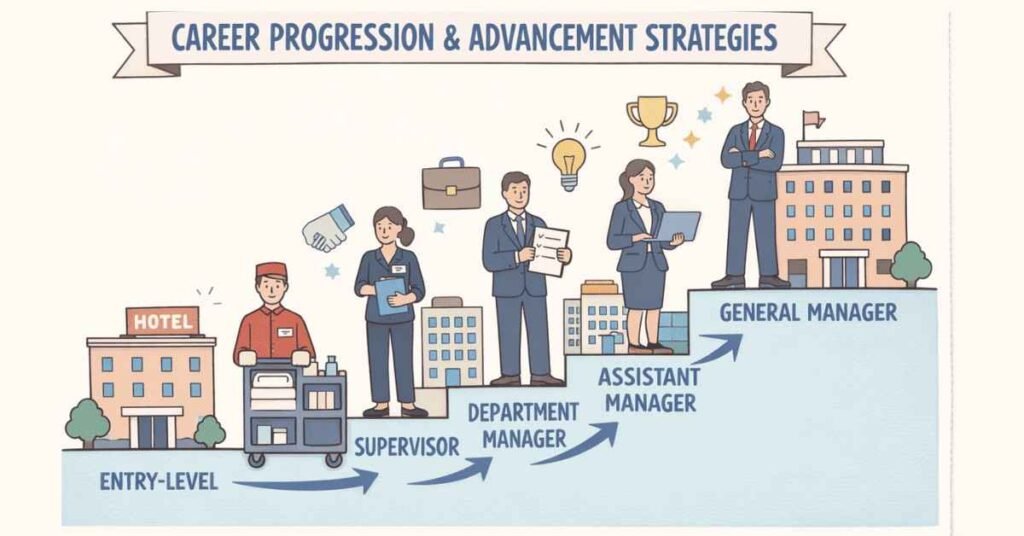
Accelerating Your Hospitality Career: Strategic Progression Framework
Understanding Career Progression in Hospitality
Career progression in hospitality differs from traditional corporate structures. Rather than automatic advancement based on tenure, hospitality promotion is merit-based, performance-driven, and often accelerated when you demonstrate capability. The positive side: exceptional performers can advance from entry-level to manager within 5-7 years. The challenging side: mediocre performers plateau quickly regardless of tenure.
Understanding career progression mechanics helps you make strategic decisions that accelerate advancement rather than defaulting to passive trajectory.

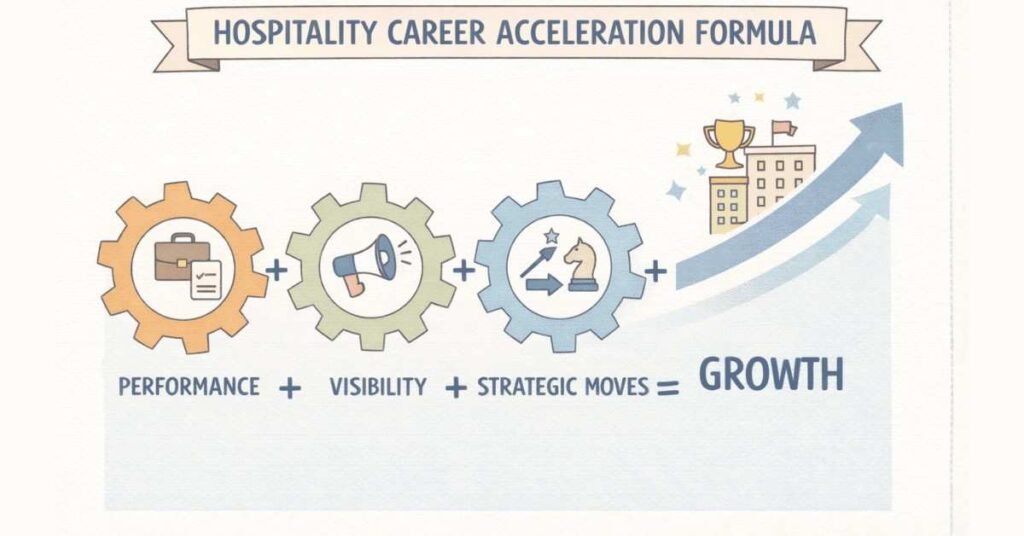
The Hospitality Career Acceleration Formula
Advancement speed = Performance × Visibility × Strategic Moves × Continuous Learning
Each component is equally important:
Performance (40% of acceleration):
- Consistently exceeding role expectations
- High guest satisfaction scores
- Contributing to team and departmental goals
- Handling challenges effectively
- Building reputation for reliability
Visibility (20% of acceleration):
- Senior management knowing your name and contributions
- Taking on visible projects
- Presenting ideas in forums
- Mentoring others (shows leadership)
- Being recognized for contributions
Strategic Moves (20% of acceleration):
- Choosing roles that build your resume
- Moving to higher-category properties at key points
- Lateral moves that broaden skill sets
- Changing jobs for 30-50% raises when raises at current job are 5-10%
- International experience for global trajectory
Continuous Learning (20% of acceleration):
- Certifications that justify advancement
- Language skills that expand market
- Leadership development
- Industry knowledge (trends, best practices)
- Digital skills that future-proof you
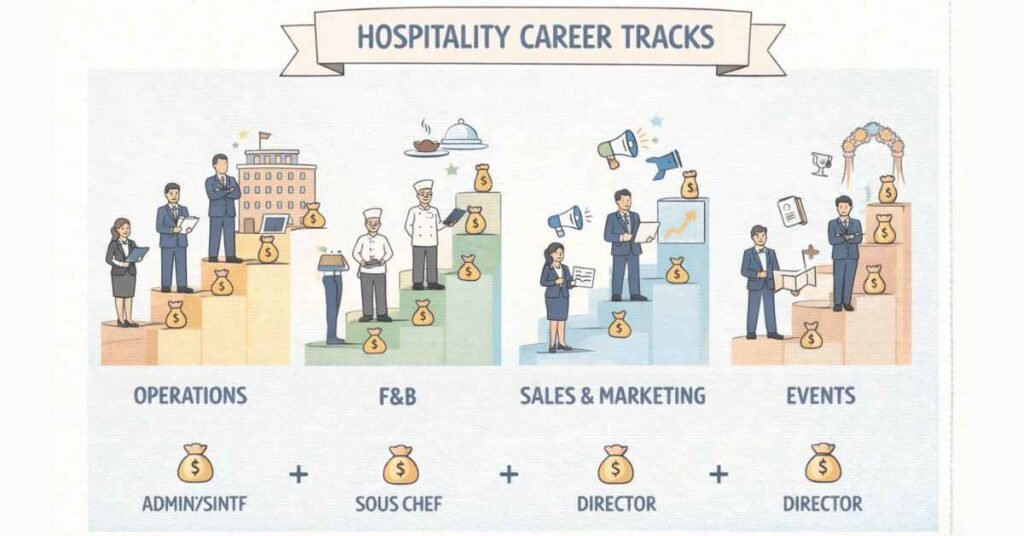
Proven Career Pathways by Function
Operations Track (Fastest Growth Potential)
Entry → Front Desk Executive → Senior Executive → Shift Manager → Asst. Operations Manager → Operations Manager → Director of Operations → General Manager
Timeline: 10-12 years to GM level
Salary progression: INR 20K → INR 3,50K+ monthly
Why it’s fast: Operations managers control all departments, making them GM-ready quickly
F&B Track (High Earning Potential)
Kitchen Trainee → Chef de Partie → Sous Chef → Executive Chef → F&B Director → GM (less common but possible)
Timeline: 12-15 years to director level (F&B managers rarely become GMs)
Salary progression: INR 12K → INR 2,50K+ monthly
Why it’s strong: High revenue responsibility, significant team management
Sales & Marketing Track (Fastest to High Salary)
Sales Executive → Sales Manager → Senior Sales Manager → Director of Sales & Marketing → GM
Timeline: 8-10 years to director level
Salary progression: INR 25K base + bonus → INR 2,50K+ + significant bonus
Why it’s lucrative: Direct revenue generation justifies premium compensation early
Revenue Management Track (Most Specialized)
Revenue Analyst → Revenue Manager → Senior Revenue Manager → Director of Revenue → VP of Revenue
Timeline: 7-10 years to director level
Salary progression: INR 40K → INR 2,00K+ monthly
Why it’s valuable: Critical business function, highly specialized skills command premium
Event Management Track (Entrepreneurial Path)
Event Coordinator → Event Manager → Senior Event Manager → Event Director or Independent Event Company Owner
Timeline: 5-8 years to director level
Salary progression: INR 20K → INR 2,00K+ monthly (varies for independent)
Why it’s appealing: Path to entrepreneurship, creative control, project-based work
Strategies for Accelerating Your Advancement
Strategy 1: Build Deep Expertise in Your Function
Don’t jump between departments randomly. Become expert in your chosen function (operations, F&B, sales, etc.). Deep expertise makes you valuable, promotable, and commands higher salary.
Example path: Master front office operations completely (2-3 years) → Demonstrate readiness for shift manager → Move to shift manager → Develop leadership skills → Transition to operations management
Strategy 2: Expand Horizontally Before Moving Up Vertically
Before seeking promotion within same hotel, work across different departments. This broadens perspective and makes you better manager later.
Example: Front office executive → brief stint in housekeeping → back to front office but with operations awareness → ready for management
Strategy 3: Change Jobs Strategically for Salary Growth
Career progression isn’t just advancement within one property. Strategic job changes often provide larger jumps:
- Year 2: Current employer gives 5-8% raise (from INR 20K to INR 21.5K)
- Year 2 (external move): New employer offers INR 28K (40% increase) for your experience
Key: Move to different property/chain, not different function. Stay in your expertise area, just change employer or location.
Strategy 4: Target Properties That Develop Talent
Some hotels are known for developing future leaders. These properties:
- Have formal management training programs
- Actively promote from within
- Invest in staff development
- Are part of major chains with growth opportunities
- Have clear advancement pathways
Research this during interviews. Ask: “How many of your managers started as entry-level staff here?”
Strategy 5: Seek Mentorship from Senior Leaders
Mentors accelerate your learning and open doors. Identify potential mentors:
- Your direct manager
- Director-level leaders in your property
- Industry contacts
- Professional associations
Informal approach: “I admire your career path. Could we grab coffee occasionally? I’d value your perspective on advancing in hospitality.”
Strategy 6: Develop Skills Your Next Role Requires
Don’t wait for promotion to develop required skills. Identify skills your next role needs and start developing them now.
Next role: Shift Manager? Develop:
- Leadership and team management skills
- Decision-making under pressure
- Knowledge of all hotel departments
- Financial understanding
- Conflict resolution
Start developing these while in current role. When you apply for promotion, you’re already ready.
Strategy 7: Build Your Professional Brand
Your reputation precedes you. Build it intentionally:
- Consistency: Same high standards every shift
- Reliability: Show up, deliver, follow through
- Attitude: Positive, solution-focused, team player
- Results: Deliver measurable outcomes
- Growth: Continuously improving
When promotion opportunities arise, your reputation positions you as obvious choice.
Strategy 8: Take on Visible Projects
High-visibility projects expose you to senior leadership and demonstrate capability:
- Leading departmental improvement initiatives
- Presenting at staff meetings
- Training new staff (shows leadership)
- Managing special events
- Representing department in cross-functional projects
These projects give you visibility and experience simultaneously.
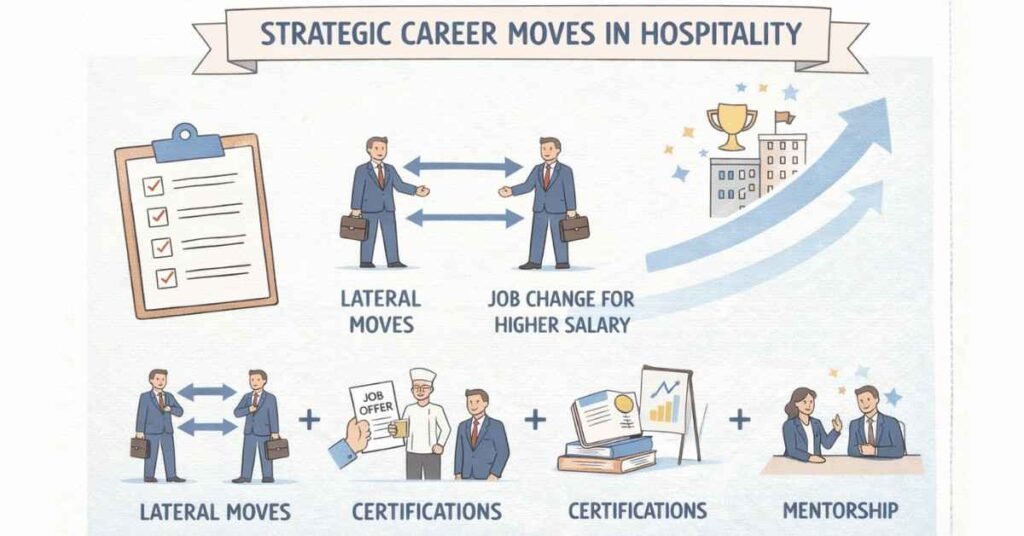
Certifications That Accelerate Advancement
Beyond role experience, certifications justify promotion and salary increases:
For Operations Track:
- Certified Hotel Administrator (CHA)
- Hotel Management certification
- Leadership development programs
For Sales/Revenue:
- Revenue Management Professional certification
- Digital Marketing certification
- Sales Leadership programs
For F&B:
- Executive Chef certification
- Sommelier certification (if beverage focus)
- F&B Management certification
For All Roles:
- PMS system certifications
- Google Analytics certification
- Project management certification
- Leadership coaching certification
Cost: INR 20,000-2,00,000
Impact: Justifies 10-25% salary increase, accelerates promotion consideration
The 90-Day Promotion Evaluation Framework
When seeking promotion, managers evaluate:
Technical Competence (35%):
- Can you perform the new role? Have you demonstrated these skills?
- Track record in similar responsibilities
Leadership Capability (30%):
- Can you manage people effectively?
- Do people respect and follow you?
- Decision-making quality
Business Impact (20%):
- Have you driven measurable results?
- Do you understand how to generate revenue/savings?
- Strategic thinking demonstrated?
Cultural Fit (15%):
- Do you align with company values?
- Can you represent the organization well?
- Team player or problematic?
To get promoted, score 8+/10 on each dimension. Weak areas prevent advancement regardless of strength elsewhere.
Red Flags: When It's Time to Move On
Sometimes advancement requires leaving current employer:
- No Clear Path: You’ve excelled but no manager positions available
- Limited Salary: Current employer won’t match market rates
- Stalled Growth: 2+ years without promotion or significant raise
- Culture Mismatch: Values don’t align with organization
- Limited Learning: No longer developing new skills
- Discriminatory Practices: Bias in advancement decisions
If 2+ of these apply, start looking. Loyal employers reciprocate with advancement and competitive pay. If they don’t, your next opportunity likely awaits elsewhere.
International Progression: Global Career Track
For ambitious professionals, international experience accelerates career:
- Gap Filling: Gain experience in different market, different hotel system
- Salary Jump: International roles often pay 2-5x Indian salaries
- Global Experience: Valuable credential for multinational chains
- Network Building: Relationships with international professionals
Timeline: 3-5 years in India → 2-3 years international → senior roles in multinational companies globally
Your 5-Year Advancement Plan Template
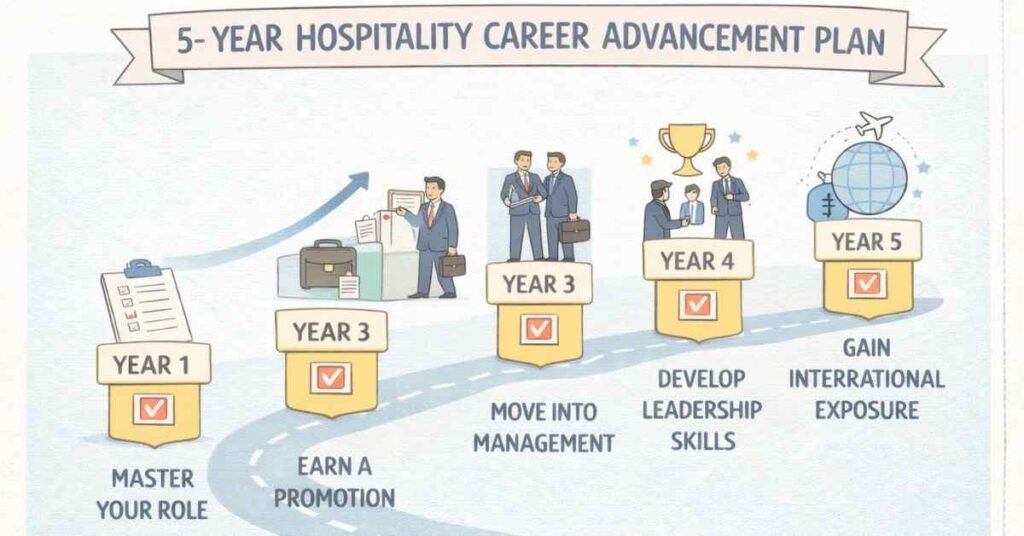
Year 1:
- Master current role completely
- Identify next role clearly
- Build relationship with potential mentor
- Complete 1-2 relevant certifications
Year 2:
- Demonstrate readiness for advancement through performance
- Develop skills required for next role
- Take on visible projects
- Seek formal feedback on readiness
Year 3:
- Apply for promotion or lateral moves
- If promotion unavailable, evaluate external opportunities
- Expand network in hospitality industry
- Build professional brand
Year 4:
- Advance into management or specialist role
- Continue learning for next level
- Mentor junior staff (leadership development)
- Build cross-functional relationships
Year 5:
- Established in new role, excelling
- Clear path to next progression visible
- Consider international opportunity or specialist expertise
- Plan 5-10 year trajectory