
Blockchain Developer Career Path : Core Development Guide
Table of Contents
Introduction: Building the Foundation of Decentralization
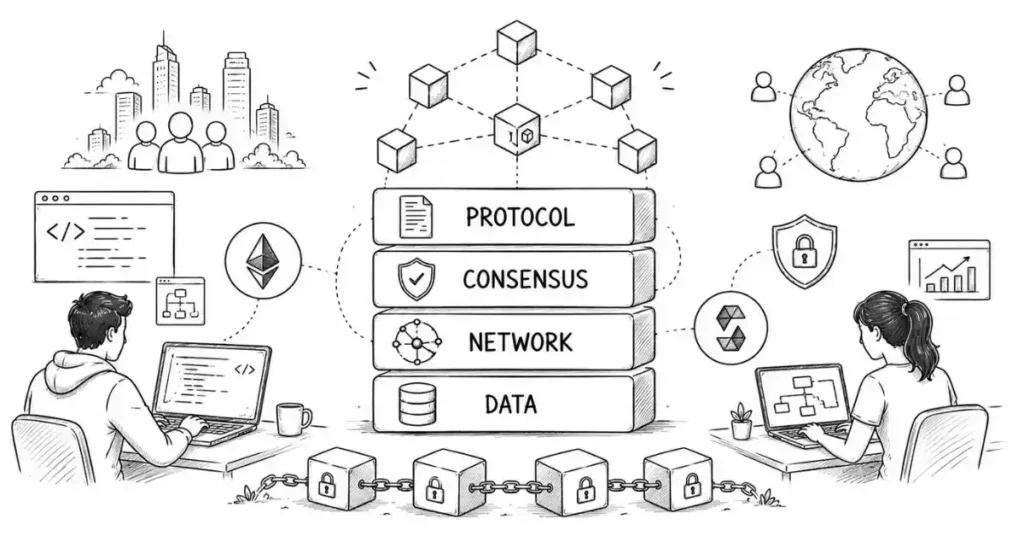
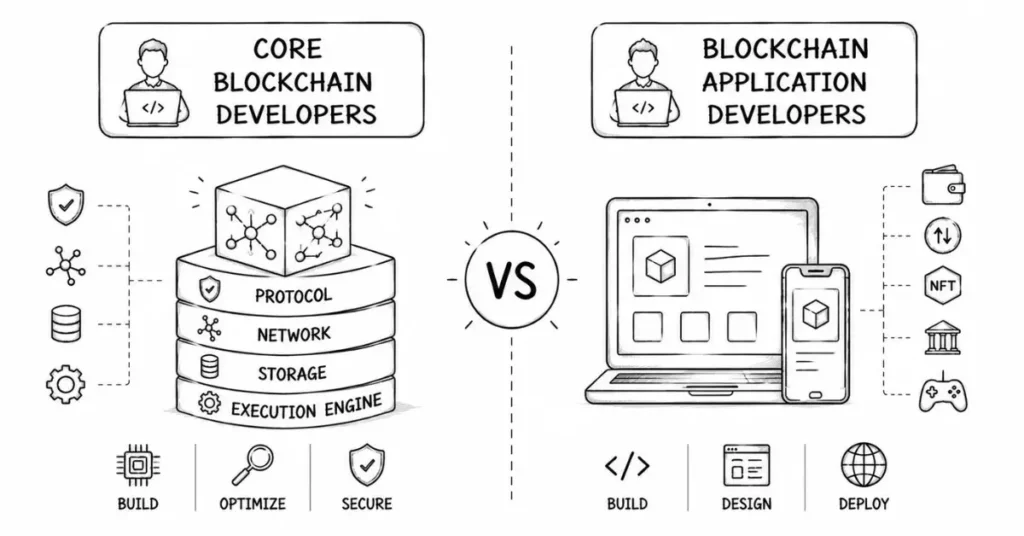
Imagine being the person who builds the actual roads and highways of the digital world, not just the cars that drive on them. That’s what core blockchain developers do they create the fundamental infrastructure that powers cryptocurrencies, decentralized applications, and entire digital economies. While application developers build things users directly interact with, core developers work on the blockchain protocol itself: the consensus mechanism, network architecture, security features, and performance optimization.
Core blockchain development represents one of the most technically challenging and highest-paying specializations in the blockchain industry. In India, experienced core blockchain developers earn ₹15-25 lakhs annually, with senior architects commanding ₹25-35 lakhs or more. International opportunities pay even more substantially, with positions often offering $80,000-150,000+ annually.
This career path demands deep computer science knowledge data structures, algorithms, cryptography, networking, and distributed systems. It’s not the easiest entry point into blockchain (application development is more accessible), but for those willing to master these fundamentals, core development offers exceptional career rewards and the satisfaction of working on technology that could reshape the global financial system.
In this comprehensive guide, you’ll learn exactly what core blockchain developers do, the skills required, how to build your knowledge systematically, and how to break into this elite tier of blockchain careers. Whether you’re a computer science student fascinated by distributed systems or a software engineer wanting to work on cutting-edge protocol development, this guide provides your roadmap.
Core Developer vs. Application Developer: Understanding the Difference
What Core Blockchain Developers Actually Do
Core blockchain developers work on the blockchain protocol itself—the foundational software that makes the blockchain function. Their responsibilities include:
Consensus Mechanism Implementation: Building and optimizing how nodes agree on the state of the blockchain. This includes implementing Proof of Work, Proof of Stake, or more advanced consensus algorithms like Practical Byzantine Fault Tolerance.
Network Protocol Development: Designing how nodes communicate with each other, propagate transactions and blocks, and maintain network health. This involves peer-to-peer networking, gossip protocols, and network topology optimization.
Cryptographic Implementation: Implementing cryptographic functions for hashing, digital signatures, zero-knowledge proofs, and encryption. Security depends entirely on correct cryptographic implementation.
Performance Optimization: Improving transaction throughput, reducing block propagation time, optimizing memory usage, and enhancing overall protocol efficiency. Core developers might work on layer 2 scaling solutions like rollups and state channels.
Security Auditing: Identifying and fixing security vulnerabilities in the protocol itself. Unlike application bugs that might affect one dApp, protocol bugs can compromise the entire blockchain.
Examples of core development work include:
- Contributing to Bitcoin Core (the reference implementation of Bitcoin protocol)
- Developing Ethereum client software like Geth or Prysm
- Building new Layer 1 blockchains like Solana or Avalanche
- Creating Layer 2 scaling solutions like Polygon or Optimism
What Application Developers Do
Application developers build decentralized applications (dApps) that run on existing blockchains. Their work includes:
- Writing smart contracts in Solidity for Ethereum-based applications
- Building DeFi protocols like lending platforms or decentralized exchanges
- Creating NFT marketplaces and gaming applications
- Developing Web3 frontends that connect to smart contracts
The key distinction: Application developers use blockchains as platforms (similar to how web developers use the internet as infrastructure), while core developers build the blockchain platforms themselves (similar to how networking engineers built the internet’s underlying protocols).
Which Path Should You Choose?
Choose core development if you:
- Have strong computer science fundamentals and enjoy low-level programming
- Are fascinated by distributed systems, cryptography, and protocol design
- Want to work on fundamental infrastructure rather than applications
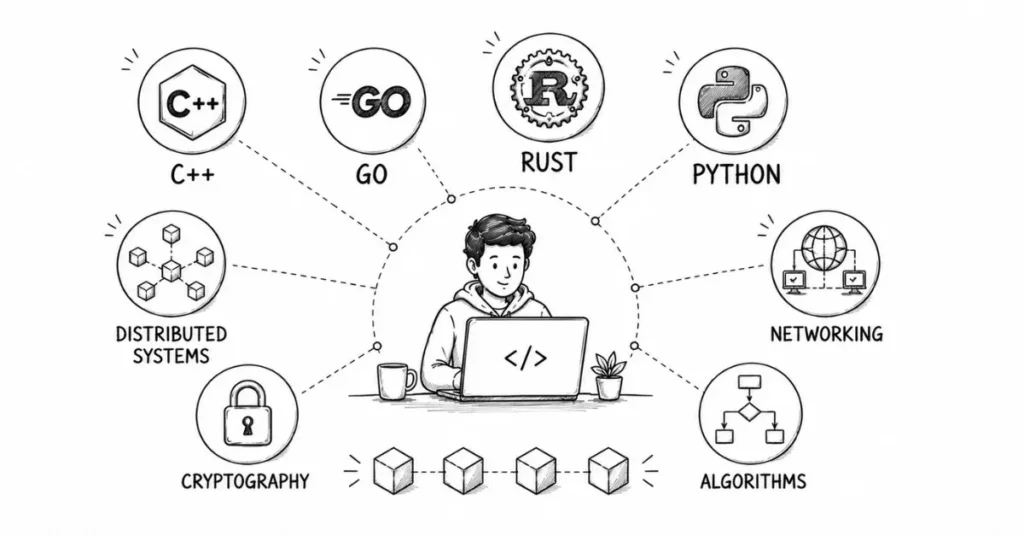
- Are comfortable with languages like C++, Go, Rust, or Python
- Enjoy reading research papers and implementing academic concepts
Choose application development if you:
- Want faster entry into blockchain careers with more available positions
- Prefer building user-facing products and features
- Are comfortable with JavaScript, Solidity, and web development
- Want to work in DeFi, NFTs, gaming, or specific application domains
- Prefer iterating quickly on products rather than long-term protocol work
Neither path is inherently better—they’re different specializations requiring different skills and interests. However, core development generally requires deeper computer science knowledge and pays moderately higher salaries for equivalent experience levels.
Essential Technical Skills for Core Development
Programming Languages You Must Know
C++: Bitcoin Core and many blockchain protocols are written in C++. This language provides the performance and low-level control needed for protocol development. You need strong understanding of:
- Memory management and pointers
- Object-oriented design patterns
- Standard Template Library (STL)
- Multithreading and concurrency
- Network programming with sockets
Go (Golang): Ethereum’s Geth client and Hyperledger Fabric use Go extensively. Go combines performance with simpler syntax than C++, making it popular for blockchain infrastructure. Focus on:[]
- Goroutines and channels for concurrency
- Interface design and composition
- Standard library packages
- Network programming
- Testing frameworks
Rust: Increasingly popular for blockchain development, Rust appears in Solana, Polkadot, and various cryptographic libraries. Rust’s memory safety guarantees prevent entire categories of bugs. Learn:
- Ownership and borrowing system
- Lifetimes and references
- Pattern matching and error handling
- Async programming
- Cargo package manager
Python: While not used for performance-critical protocol code, Python is valuable for:
- Prototyping algorithms before implementing in lower-level languages
- Building testing frameworks and simulation tools
- Creating data analysis and monitoring tools
- Scripting deployment and maintenance tasks
Most core developers know at least two of these languages deeply, typically C++/Go or Go/Rust combinations.
Computer Science Fundamentals
Data Structures and Algorithms: Core developers must deeply understand:
- Hash tables and Merkle trees (fundamental to blockchain structure)
- Graph algorithms (for analyzing network topology)
- Sorting and searching algorithms (for transaction ordering)
- Time and space complexity analysis
- Algorithm optimization techniques
Practice these through LeetCode or HackerRank, focusing on medium-to-hard problems. Core development interviews typically include challenging algorithmic problems.
Distributed Systems: Blockchain is fundamentally a distributed system, requiring understanding of:
- CAP theorem and consistency models
- Consensus algorithms (Paxos, Raft, Byzantine Fault Tolerance)
- Leader election and coordination
- Clock synchronization and ordering events
- Fault tolerance and recovery mechanisms
Read “Designing Data-Intensive Applications” by Martin Kleppmann for excellent distributed systems foundation.
Cryptography: Core developers need practical cryptography knowledge:
- Hash functions (SHA-256, Keccak, BLAKE)
- Public-key cryptography (RSA, ECDSA, EdDSA)
- Digital signatures and verification
- Zero-knowledge proofs (increasingly important)
- Cryptographic security best practices
Take Stanford’s Cryptography course on Coursera for solid theoretical foundation combined with practical implementation.
Networking: Understanding network protocols is essential:
- TCP/IP fundamentals and socket programming
- Peer-to-peer network architectures
- Network propagation and latency
- DoS protection and network security
- Protocol design and specification
Blockchain-Specific Knowledge
Consensus Mechanisms: Deep understanding of how blockchains achieve agreement:
- Proof of Work: Mining, difficulty adjustment, longest chain rule
- Proof of Stake: Validator selection, slashing conditions, finality
- Byzantine Fault Tolerant consensus: PBFT, Tendermint
- Hybrid approaches and emerging consensus mechanisms
Economic Security: Understanding the economic incentives that secure blockchains:
- Game theory and Nash equilibria
- 51% attacks and defense mechanisms
- Fee markets and transaction prioritization
- Validator rewards and penalties
- Long-range attacks and checkpointing
Scalability Approaches: Knowing how blockchains scale:
- Layer 1 scaling: Sharding, increasing block size, parallel execution
- Layer 2 scaling: State channels, plasma, rollups (optimistic and ZK)
- Cross-chain communication and interoperability
- Trade-offs between scalability, security, and decentralization
Learning Path: From Beginner to Core Developer
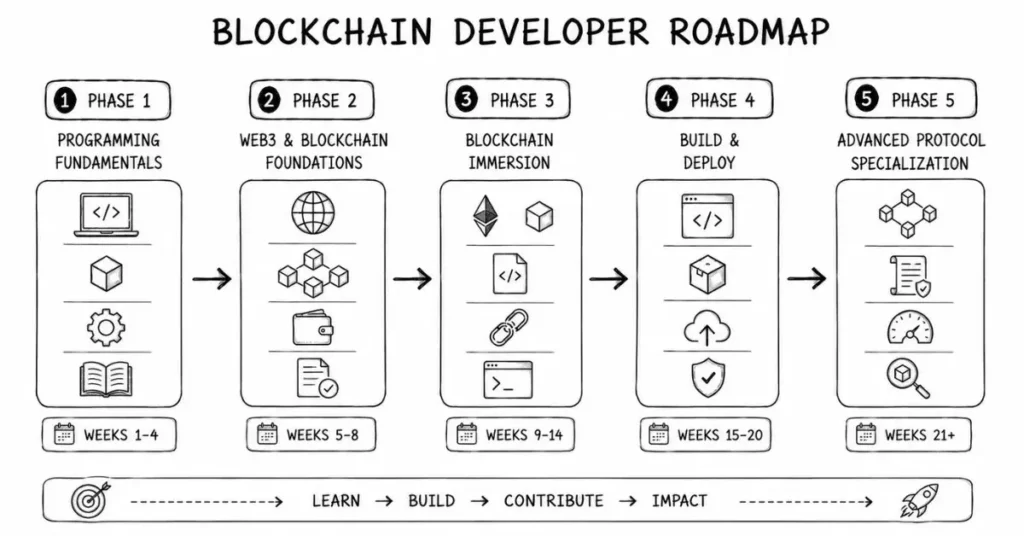
Phase 1: Foundation Building (1-4 Months)
Month 1: Programming Proficiency
If you’re not already strong in C++, Go, or Rust, choose one and reach intermediate proficiency:
- Complete a comprehensive course (Coursera, Udemy, or official language documentation)
- Build 3-5 projects: command-line tools, simple servers, data processing applications
- Focus on clean code, testing, and documentation
- Practice on HackerRank or LeetCode (50+ easy/medium problems)
Month 2-3: Computer Science Fundamentals
- Take a data structures and algorithms course (MIT OpenCourseWare or similar)
- Read “Introduction to Algorithms” (CLRS) or “Algorithm Design Manual”
- Complete 100+ coding problems across different difficulty levels
- Study distributed systems basics through papers and courses
Month 4: Cryptography Foundations
- Complete Stanford’s Cryptography I course on Coursera
- Implement basic cryptographic primitives (don’t use in production!)
- Understand why “roll your own crypto” is dangerous
- Study blockchain-specific cryptography (Merkle trees, ECDSA)
Phase 2: Blockchain Immersion (5-8 Months)
Month 5-6: Bitcoin Protocol Deep Dive
- Read Bitcoin whitepaper multiple times until fully comprehended
- Study Bitcoin Core codebase on GitHub
- Set up a Bitcoin node and explore its operation
- Read “Mastering Bitcoin” by Andreas Antonopoulos
- Understand UTXO model, Script language, consensus rules
Month 7-8: Ethereum and Smart Contracts
- Study Ethereum whitepaper and yellow paper (technical specification)
- Understand Ethereum Virtual Machine (EVM) architecture
- Learn how smart contracts execute at protocol level
- Explore Ethereum client codebases (Geth, Prysm)
- Study Ethereum’s transition to Proof of Stake
Phase 3: Advanced Topics and Specialization (9-12 Months)
Month 9-10: Consensus and Scaling
- Study academic papers on consensus mechanisms
- Implement a simple Proof of Work blockchain from scratch
- Learn about Layer 2 solutions: understand rollup construction
- Study sharding designs and cross-shard communication
- Explore novel consensus mechanisms (Avalanche, Tendermint)
Month 11-12: Contribution and Portfolio
- Contribute to an existing blockchain open-source project
- Build a simple blockchain protocol implementing novel features
- Document your code thoroughly and write explanatory posts
- Present your work at local blockchain meetups
- Start applying to core developer positions
Total Timeline: 9-12 Months
This timeline assumes 20-25 hours weekly dedicated learning. Full-time focused learning could compress this to 6-8 months, while part-time learning might extend to 15-18 months.
Building Your Core Developer Portfolio
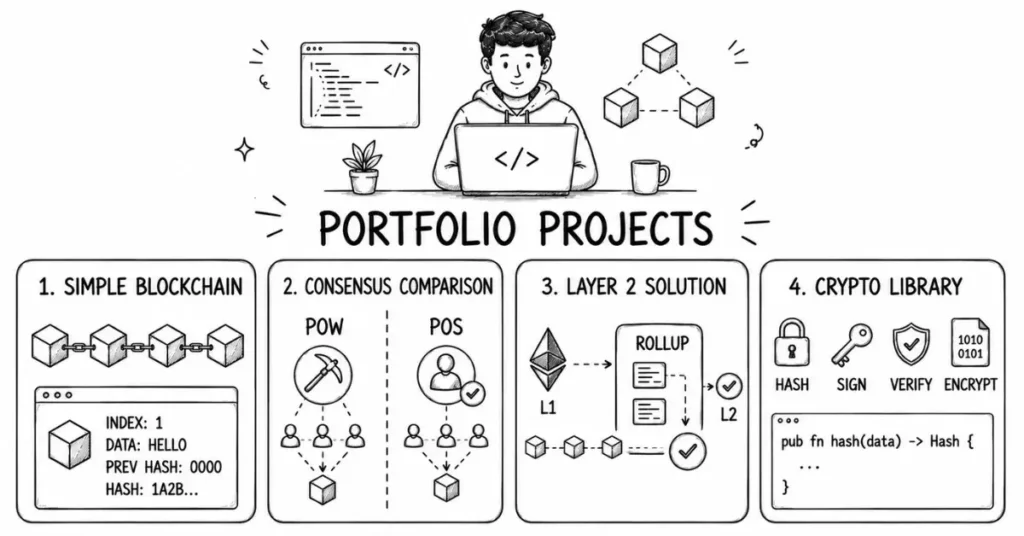
Project Ideas That Demonstrate Competence
1.Simple Blockchain Implementation
Build a working blockchain from scratch in Go or Rust:
- Proof of Work consensus with adjustable difficulty
- P2P network with node discovery and communication
- Transaction validation and mempool
- Block creation and propagation
- Chain reorganization logic
This project demonstrates understanding of core blockchain concepts. Document your design decisions and trade-offs comprehensively.
2.Consensus Mechanism Comparison
Implement and compare multiple consensus algorithms:
- Proof of Work
- Proof of Stake
- Practical Byzantine Fault Tolerance
Create benchmarks measuring transaction throughput, finality time, and network overhead. Write detailed analysis of trade-offs.
3.Layer 2 Scaling Solution
Build a simplified version of a Layer 2 solution:
- State channels for payment applications
- Optimistic rollup with fraud proofs
- Simple plasma chain
Even simplified implementations demonstrate understanding of advanced scaling concepts.
4.Cryptographic Primitive Library
Implement (for learning, not production!) core cryptographic primitives:
- Merkle tree with proof generation and verification
- ECDSA signature and verification
- Hash-based commitment schemes
Include comprehensive tests and security considerations documentation.
Open-Source Contributions
Contributing to established blockchain projects provides credibility no personal project can match:
Beginner-Friendly Contributions:
- Documentation improvements and typo fixes
- Adding test cases for existing functionality
- Code cleanup and refactoring
- Translating documentation (valuable for non-native English speakers)
Intermediate Contributions:
- Bug fixes in non-critical components
- Implementing feature requests from issue tracker
- Performance improvements in specific modules
- Improving error handling and logging
Advanced Contributions:
- Core protocol improvements
- Consensus mechanism optimizations
- Security vulnerability fixes
- New feature implementations
Start with “good first issue” labels on GitHub. Bitcoin Core, Ethereum clients, Hyperledger projects, and newer chains all welcome contributions.
Career Opportunities in Core Development
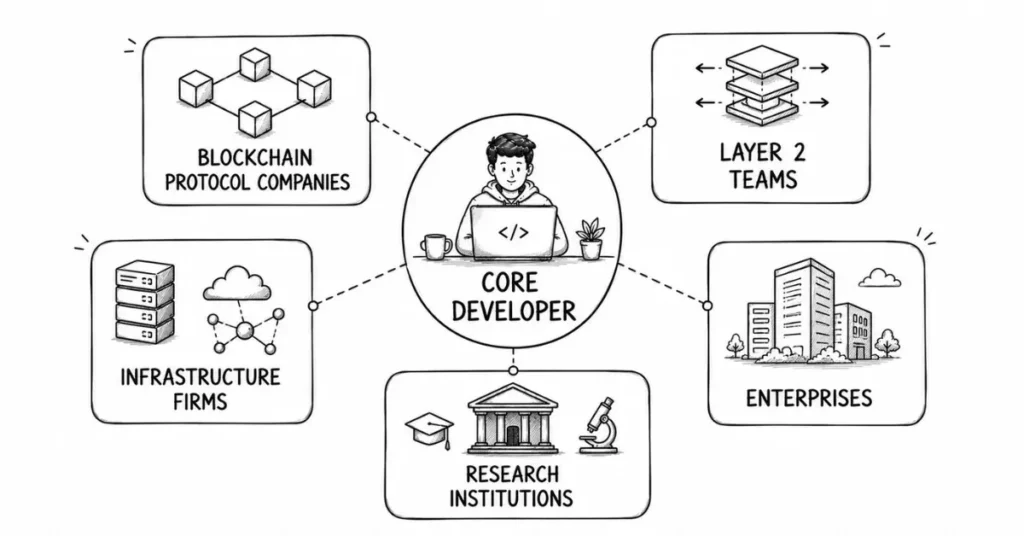
Types of Companies Hiring Core Developers
Blockchain Protocol Companies:
Companies building Layer 1 blockchains (Ethereum Foundation, Solana Labs, Avalanche, Polkadot) hire core developers to build and maintain their protocols. These roles offer:
- Salaries: ₹15-30 lakhs in India, $80,000-180,000 internationally
- Working on cutting-edge technology
- High impact—your code affects entire ecosystems
- Often remote-friendly with global teams
Layer 2 and Scaling Solution Companies:
Companies like Polygon, Optimism, Arbitrum, and StarkWare building scaling solutions need core developers understanding both Layer 1 protocols and Layer 2 architecture. Compensation similar to protocol companies with potential token upside.
Blockchain Infrastructure Companies:
Companies providing node infrastructure, indexing services, or developer tools (Infura, Alchemy, The Graph) need core developers understanding blockchain internals. These roles typically pay ₹12-22 lakhs domestically or $70,000-140,000 internationally.
Traditional Tech Companies:
Companies like IBM (Hyperledger), Microsoft (Azure Blockchain), and others building enterprise blockchain solutions hire core developers. Offers stability of large companies with blockchain work, typically paying ₹15-25 lakhs.
Research and Academic Institutions:
Universities and research labs working on blockchain consensus, cryptography, and distributed systems hire developers who can implement research prototypes. Pay may be lower (₹10-18 lakhs) but offers academic freedom and research opportunities.
Career Progression
Junior Core Developer (0-2 Years): ₹8-12 lakhs
- Work on non-critical modules under supervision
- Fix bugs and implement well-defined features
- Learn codebase and contribute to testing
Mid-Level Core Developer (2-5 Years): ₹12-18 lakhs
- Independently implement significant features
- Review code from junior developers
- Participate in architectural discussions
- Handle some protocol upgrade responsibilities
Senior Core Developer (5-8 Years): ₹18-30 lakhs
- Design and implement major protocol features
- Lead working groups on specific improvements
- Mentor junior and mid-level developers
- Represent project at conferences and in standards bodies
Principal Engineer / Architect (8+ Years): ₹30-50+ lakhs
- Set technical direction for entire protocol
- Design next-generation features and upgrades
- Coordinate with external research and development teams
- High-level architecture and strategy
Challenges Unique to Core Development
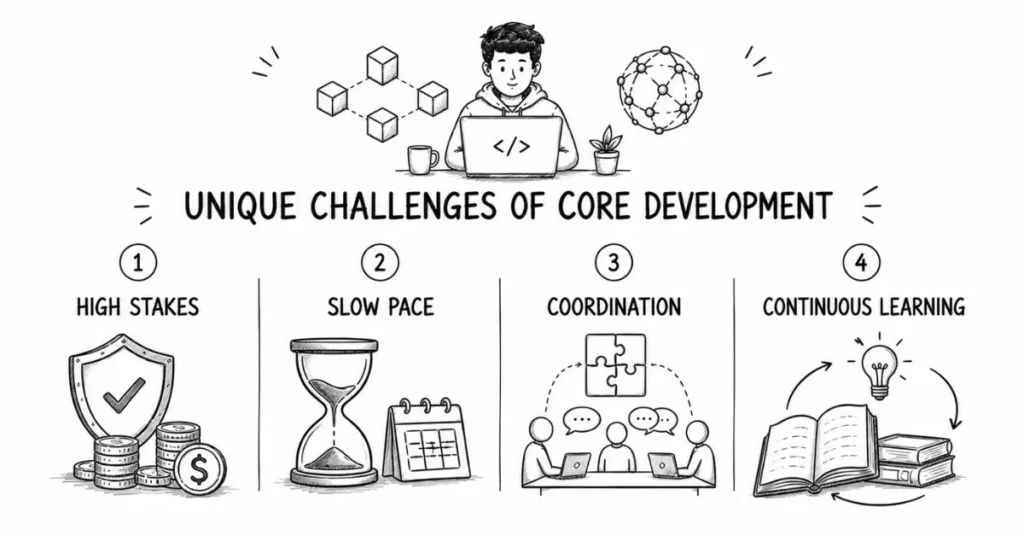
Responsibility and Stakes
Core developers carry immense responsibility. A bug in an application affects that app’s users. A bug in the protocol can affect millions of users and billions of dollars. The DAO hack, Parity wallet bug, and various consensus failures demonstrate how critical correctness is in core development.
This responsibility creates stress but also demonstrates why core developers command premium compensation. You must develop extreme attention to detail, comprehensive testing practices, and security-first thinking.
Slow Development Pace
Protocol development moves deliberately. Changes require extensive review, testing, and often consensus among multiple stakeholders. A feature you design might take 6-12 months from concept to deployment. This pace frustrates developers accustomed to rapid iteration in application development.
However, this thoroughness is necessary given the stakes. Core developers must balance innovation with extreme caution.
Coordination Complexity
Major blockchain protocols have development teams spread globally across companies and time zones. Coordination happens through GitHub, Discord, regular calls, and in-person meetings. Proposing changes requires building consensus among diverse stakeholders with different priorities.
Strong written and verbal communication becomes essential. Technical brilliance alone isn’t sufficient—you must articulate ideas clearly and build support for proposals.
Continuous Learning Burden
Blockchain protocol development evolves rapidly. Zero-knowledge proofs were niche research topics five years ago; now they’re production technology in ZK-rollups. Developers must continuously learn new cryptographic techniques, consensus mechanisms, and optimization approaches.
Successful core developers dedicate 5-10 hours weekly to reading research papers, experimenting with new technologies, and staying current with developments across the industry.
Getting Your First Core Development Role
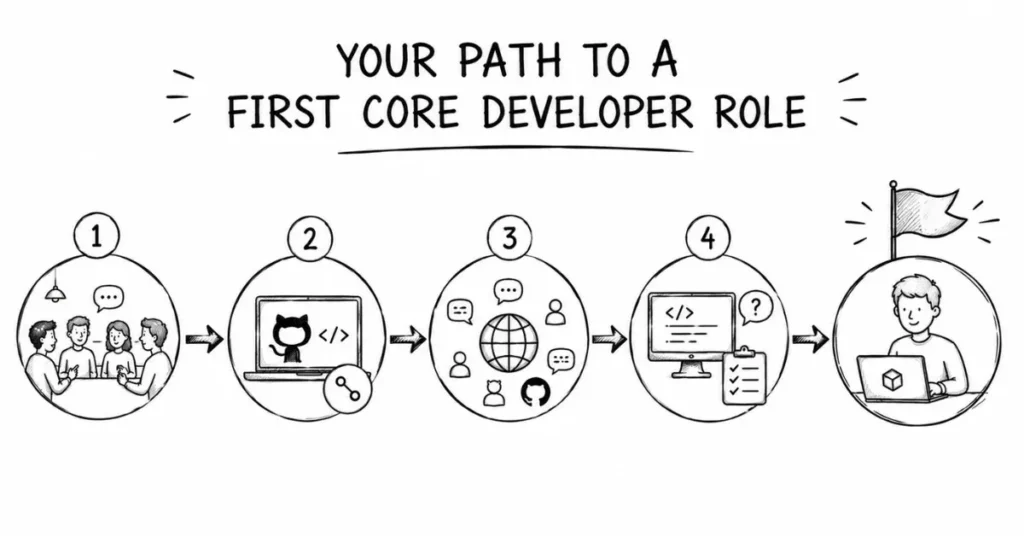
Building the Right Network
Core development roles rarely appear on standard job boards. Many positions fill through networking and referrals:
Attend Blockchain Conferences: ETHIndia, Devcon (international), and local blockchain meetups connect you with core developers and hiring managers.
Participate in Online Communities: Join Discord servers for protocols you’re interested in. Engage in technical discussions in #development channels. Answer questions and demonstrate knowledge.
Contribute to Open Source: Nothing beats having contributions to major blockchain projects on your GitHub profile. Even small contributions demonstrate initiative and ability.
Engage on Twitter: Many core developers share insights and opportunities on Twitter. Follow them, engage thoughtfully with their content, and share your own learning journey.
Preparing for Technical Interviews
Core development interviews are rigorous, typically including:
Coding Challenges: Expect hard-level LeetCode-style problems. You might implement consensus algorithms, optimize network protocols, or solve complex cryptographic problems.
System Design: Be prepared to design blockchain systems or subsystems. Questions might include:
- “Design a sharding mechanism for a blockchain”
- “How would you implement cross-chain atomic swaps?”
- “Design a fraud-proof system for an optimistic rollup”
Protocol Knowledge: Deep questions about blockchain internals:
- “Explain how Ethereum’s gas mechanism prevents DoS attacks”
- “How does Bitcoin’s difficulty adjustment algorithm work?”
- “What are the security implications of finality in Proof of Stake?”
Code Review: You might review actual blockchain protocol code and identify bugs, security issues, or potential improvements.
Preparation requires months of deep study. Practice explaining complex concepts clearly—communication matters as much as technical knowledge.
Conclusion: The Road Less Traveled
Core blockchain development represents one of the most intellectually challenging and rewarding career paths in technology. While the learning curve is steep and the responsibility immense, core developers build fundamental infrastructure shaping the future of finance, governance, and digital interaction.
This path isn’t for everyone—application development offers faster entry, more job opportunities, and equally valuable careers. But for those drawn to deep technical challenges, who want to work on fundamental computer science problems with real-world impact, core development provides unmatched opportunities.
The journey from curious beginner to employed core developer typically takes 12-18 months of focused effort. Every current core developer started exactly where you are now. The difference between those who succeed and those who don’t isn’t innate ability—it’s consistent effort toward clear goals.
Start today: Read the Bitcoin whitepaper, set up a blockchain node, or write your first lines of code in Go or Rust. These small actions compound into career-changing momentum. The blockchain ecosystem needs skilled core developers, and with dedication, you can become one of them.