
Agribusiness Careers in India: Supply Chain, Marketing & Finance Jobs
Table of Contents
Introduction
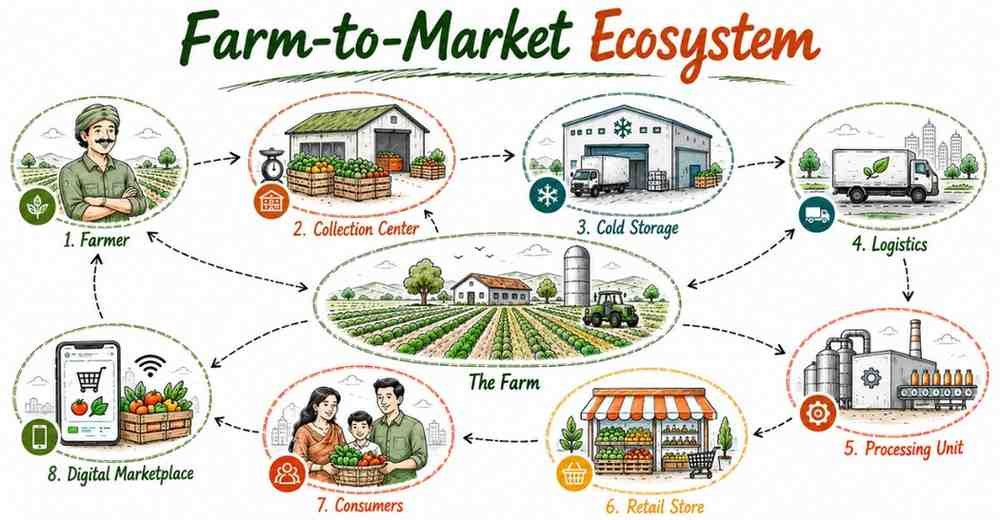
Every mango you buy at a supermarket in Hyderabad passed through at least six hands before it reached you. A farmer in Chittoor harvested it. A collection agent graded and packed it. A logistics company transported it in a refrigerated truck. A procurement executive at a retail chain negotiated the price. A supply chain analyst tracked the inventory. A rural marketing manager built the farmer relationship that made the whole chain possible.
That entire journey from farm to shelf is agribusiness.
And every person in that chain has a career.
Agribusiness is the commercial side of agriculture. It covers everything that connects food production to food consumption procurement, supply chains, commodity trading, rural marketing, agri-finance, cold chain logistics, and food processing operations. It is the largest employment category within AgriTech and agriculture combined, and it is one of the most underrated career paths for Indian graduates.
If you studied B.Sc. Agriculture and worry that your only options are teaching or government jobs, this guide will change how you think about your degree. If you are an MBA student looking for a sector with genuine growth and lower competition than FMCG or banking, agribusiness deserves serious attention.
Why Agribusiness Is One of India's Biggest Career Opportunities
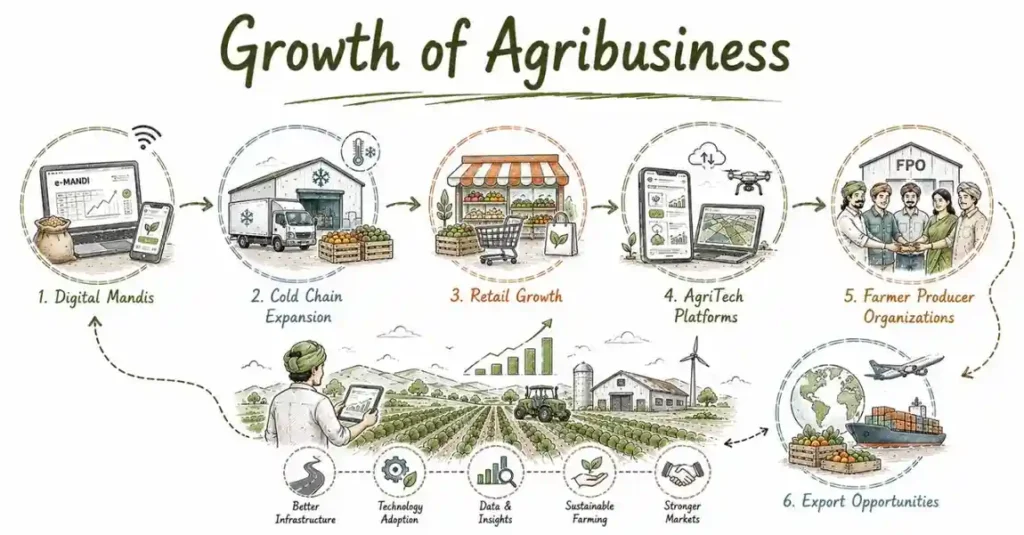
India’s food and agribusiness sector is valued at over $400 billion and is projected to reach $900 billion by 2030, according to industry estimates. It is the second-largest employer in the country after traditional farming itself.
Despite this scale, the sector is chronically understaffed with formally trained professionals. Most agribusiness operations in India have historically been run by traders and middlemen with generations of informal knowledge but no formal business training. As the sector modernises through digital procurement platforms, formalised supply chains, cold storage networks, and regulated commodity markets the demand for people with both agricultural domain knowledge and business skills has exploded.
Three developments are accelerating this right now:
eNAM and digital mandis: The National Agriculture Market (eNAM) platform is digitising commodity trading across India’s mandis. This requires people who understand both agricultural commodities and digital trading systems.
Cold chain infrastructure expansion: The government’s PM Gati Shakti and Pradhan Mantri Kisan SAMPADA Yojana programmes are funding massive cold storage and food processing infrastructure. Every new cold chain facility needs operations, logistics, and quality management professionals.
Retail and quick commerce expansion: Reliance Retail, BigBasket, Blinkit, Zepto, and Swiggy Instamart are all building direct farm-sourcing operations. They need agribusiness professionals who can build reliable farm-to-platform supply chains.
Agribusiness Career Tracks: The Full Breakdown
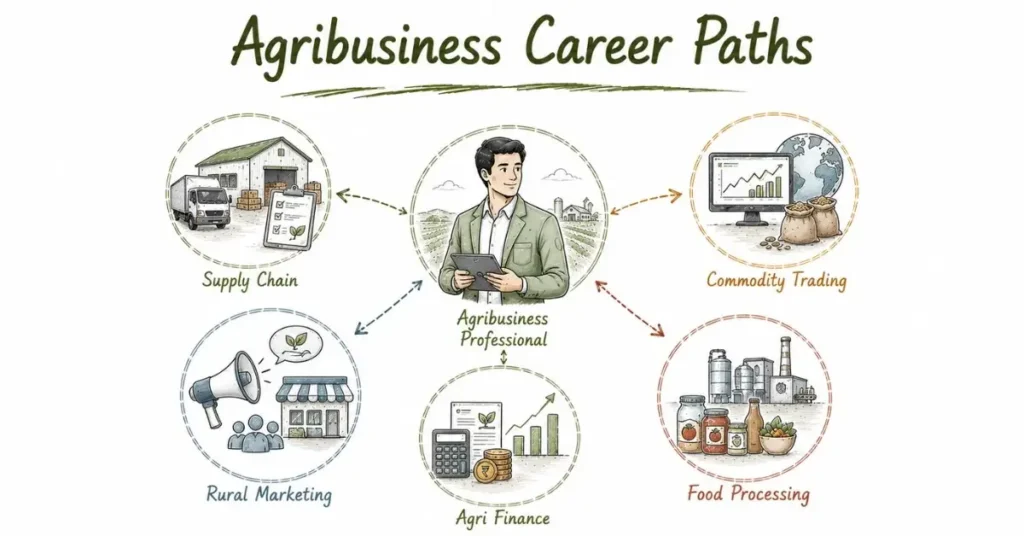
Agribusiness is not one career it is five distinct tracks that happen to work within the same sector. Understanding which one fits you is the first step.
Track 1: Supply Chain and Procurement
What it is: Managing the movement of agricultural produce from farms to processors, retailers, or exporters. This includes sourcing, grading, packing, transportation, and inventory management.
What you do day to day: Negotiate with farmer groups and FPOs for produce pricing, coordinate with logistics teams for timely pickup, manage quality checks at collection centres, track inventory across warehouse locations, resolve supply shortages during peak harvest seasons.
Who fits: B.Sc. Agriculture graduates with attention to detail, people who are comfortable working in markets and collection centres, MBA graduates with operations or supply chain interest.
Key skills: Vendor negotiation, supply chain software (SAP, Oracle SCM basics), commodity quality grading standards, cold chain operations, Excel-based inventory tracking.
Sample roles: Procurement Executive, Supply Chain Analyst, Vendor Development Manager, Cold Chain Operations Manager, Quality Assurance Officer (Agri).
Employers: Ninjacart, Waycool, BigBasket (sourcing division), Reliance Retail (farm sourcing), ITC Agri Business, NAFED, APEDA.
Salary range: ₹3.5 – ₹5 LPA (entry) | ₹8 – ₹15 LPA (mid-level manager) | ₹18 – ₹28 LPA (senior leadership)
Track 2: Commodity Trading and Markets
What it is: Buying and selling agricultural commodities grains, oilseeds, spices, cotton, sugar either physically through mandis and procurement networks, or through futures contracts on commodity exchanges like MCX and NCDEX.
What you do day to day: Track commodity price movements, analyse supply-demand data from different producing regions, execute purchase or sale decisions for your organisation, prepare market intelligence reports, manage price risk through hedging strategies.
Who fits: People with strong analytical thinking, comfort with numbers and market data, and the ability to make quick decisions under pressure. An economics or commerce background helps, but B.Sc. Agriculture graduates with commodity knowledge have a genuine advantage because they understand the production side of price movements.
Key skills: Commodity market fundamentals, futures and options basics, price forecasting, Excel and data analysis, understanding of mandi regulations and APMC rules.
Sample roles: Commodity Analyst, Agri Trader, Futures Market Analyst, Procurement Trader, Market Intelligence Analyst.
Employers: ITC Agri Business (one of India’s largest commodity traders), Louis Dreyfus (global agri trader with India operations), Olam International, Adani Agri Logistics, Ruchi Soya (Patanjali Foods), IFFCO.
Salary range: ₹4 – ₹7 LPA (junior analyst) | ₹10 – ₹20 LPA (experienced trader) | ₹25 LPA+ (senior commodity manager with strong track record)
Track 3: Rural Marketing
What it is: Designing and executing marketing strategies that reach farmers and rural consumers. This is fundamentally different from urban marketing the media, languages, trust dynamics, and decision-making processes are entirely different.
What you do day to day: Plan and execute product demonstrations at village level, coordinate with dealer and distributor networks in rural districts, organise farmer meetings and Kisan Melas, manage rural advertising campaigns (wall paintings, vernacular radio, local cable TV), gather feedback from farmer communities for product teams.
Who fits: People who enjoy fieldwork, communication, and community engagement. Regional language fluency is a genuine competitive advantage in this track if you speak Telugu, Marathi, Kannada, or any regional language natively, you are more valuable than a city-trained marketer who cannot communicate with a farmer directly.
Key skills: Rural consumer behaviour understanding, vernacular communication, distributor management, field activation planning, basic digital marketing (for hybrid rural-digital campaigns).
Sample roles: Rural Marketing Manager, Territory Sales Manager, Agri-Input Sales Officer, Field Marketing Executive, Dealer Development Manager.
Employers: Bayer CropScience India, Syngenta India, PI Industries, Rallis India (Tata), UPL Limited, Coromandel International, Dhanuka Agritech.
Salary range: ₹3 – ₹5 LPA (field officer) | ₹7 – ₹12 LPA (territory or regional manager) | ₹15 – ₹22 LPA (national rural marketing head)
Track 4: Agri-Finance and Rural Banking
What it is: Providing financial services loans, insurance, investment specifically tailored to farmers, agricultural businesses, and rural enterprises. India’s agricultural finance sector is uniquely complex, shaped by seasonal income patterns, land ownership documentation gaps, and the need to assess crop-linked repayment capacity.
What you do day to day: Assess farmer loan applications and collateral, process crop insurance claims, design microfinance products for farmer groups, monitor loan repayment health across a rural portfolio, build relationships with FPOs and cooperatives for group lending programmes.
Who fits: B.Sc. Agriculture or Economics graduates interested in finance; MBA graduates with rural development interest; commerce graduates who want to combine financial skills with social impact.
Key skills: Agricultural loan appraisal, crop insurance fundamentals (PMFBY), rural financial products, credit risk basics, working knowledge of land records (7/12 extracts, patta documents).
Sample roles: Agricultural Loan Officer, NABARD Development Assistant, Rural Banking Officer (RRB), Agri-Finance Manager, Crop Insurance Field Officer, Microfinance Executive.
Employers: NABARD, Regional Rural Banks (RRBs), SBI (Agricultural Banking division), HDFC Bank (Agri Loans), Mahindra Finance, Samunnati (agri-finance fintech), Dvara Research.
Salary range: ₹3.5 – ₹5 LPA (entry-level banking officer) | ₹7 – ₹14 LPA (branch or regional manager) | ₹16 – ₹25 LPA (senior agri-finance leadership)
Track 5: Food Processing and Agri-Business Operations
What it is: Managing operations at the point where raw agricultural produce becomes a processed, packaged food product. This includes milling, sorting, grading, preservation, packaging, and quality control operations at food processing units.
What you do day to day: Oversee production line operations, manage raw material procurement and inventory, ensure food safety and quality standards (FSSAI compliance), coordinate with supply chain teams for inbound produce and outbound product distribution, manage shift teams of workers.
Who fits: B.Tech Agricultural Engineering, B.Sc. Food Technology, or B.Tech Mechanical graduates; people comfortable with factory and operations environments.
Key skills: Food safety standards (FSSAI, HACCP, ISO 22000), production planning, quality control methods, basic engineering maintenance, warehouse and cold chain management.
Sample roles: Production Supervisor, Quality Assurance Manager, Plant Operations Manager, Food Safety Officer, Post-Harvest Technology Specialist.
Employers: Britannia Industries, ITC Foods, Nestlé India (agri sourcing), Amul (Gujarat Cooperative), Cargill India, McCain Foods India, Keventer Agro.
Salary range: ₹3.5 – ₹6 LPA (production supervisor) | ₹8 – ₹15 LPA (plant or operations manager) | ₹18 – ₹30 LPA (senior operations head)
Skills That Cut Across All Agribusiness Tracks
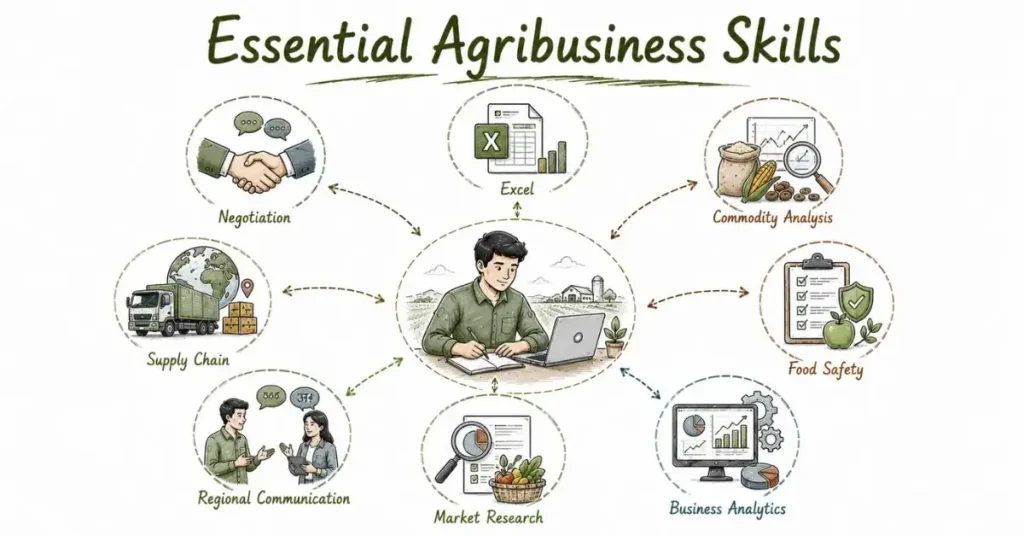
Regardless of which track you choose, five skills appear consistently in agribusiness job descriptions across India:
Negotiation: Agribusiness is fundamentally a negotiation-intensive sector with farmers, vendors, buyers, transporters, and regulators. The ability to negotiate fairly and build long-term relationships is worth more than almost any technical credential.
Commodity knowledge: Understanding how agricultural commodities are produced, graded, stored, and priced gives you a foundation that no MBA course fully covers. Read commodity market reports from APEDA, Agmarknet, and NCDEX regularly.
Regional language fluency: This point cannot be overstated. In rural marketing, procurement, and agri-finance roles, the ability to communicate directly in the farmer’s language collapses trust barriers that otherwise take months to overcome.
Excel and data analysis: Inventory reports, price tracking sheets, procurement summaries, loan portfolio analysis agribusiness runs on spreadsheets. Strong Excel skills, including pivot tables and basic financial modelling, separate competent candidates from average ones.
Regulatory awareness: APMC Act variations by state, FSSAI food safety requirements, PMFBY crop insurance regulations, eNAM trading rules agribusiness professionals who understand the regulatory environment their work operates in are consistently more effective and promotable.
Education and Certifications for Agribusiness Careers
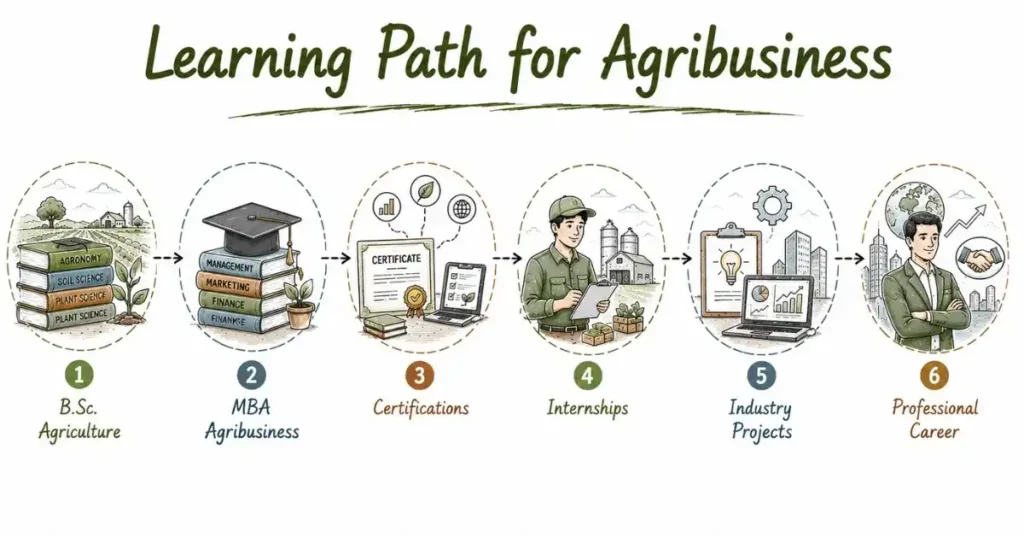
Degrees That Give You the Best Foundation
MBA in Agribusiness Management (IRMA / MANAGE / NIAM): The gold standard. If you can get into IRMA Anand or MANAGE Hyderabad, these programmes directly place graduates at ITC, Mahindra, NABARD, and leading AgriTech startups. The curriculum is specifically designed for Indian rural and agricultural business contexts.
B.Sc. Agriculture + relevant work experience: Underrated as a direct entry qualification. Many agribusiness companies particularly in procurement and rural marketing prefer domain knowledge over MBA credentials for field roles. Your degree plus two years of relevant field experience is a competitive package.
MBA (General) from a decent institution + agri specialisation electives: If you already have a general MBA or are pursuing one, take every agriculture, rural markets, and supply chain elective you can access. Supplement with MANAGE short-term programmes.
Certifications Worth Pursuing
APICS CSCP (Certified Supply Chain Professional): Internationally recognised supply chain certification. Directly relevant for procurement and supply chain roles at Ninjacart, Waycool, and large agri-corporates. Investment of ₹40,000–₹60,000 that pays back quickly in salary differential.
NCDEX Commodity Markets Certificate: A relatively affordable certification (₹3,000–₹5,000) that gives you formal grounding in commodity futures markets directly applicable to commodity trading roles.
FSSAI Food Safety Supervisor Certification: Required for operations roles at food processing units. Inexpensive (₹2,000–₹4,000) and practically useful.
MANAGE Short-Term Programmes: Subsidised 2–4 week residential programmes on agribusiness management, agri-marketing, and rural finance. One of the best value credentials available to Indian agriculture graduates. Apply directly at manage.gov.in.
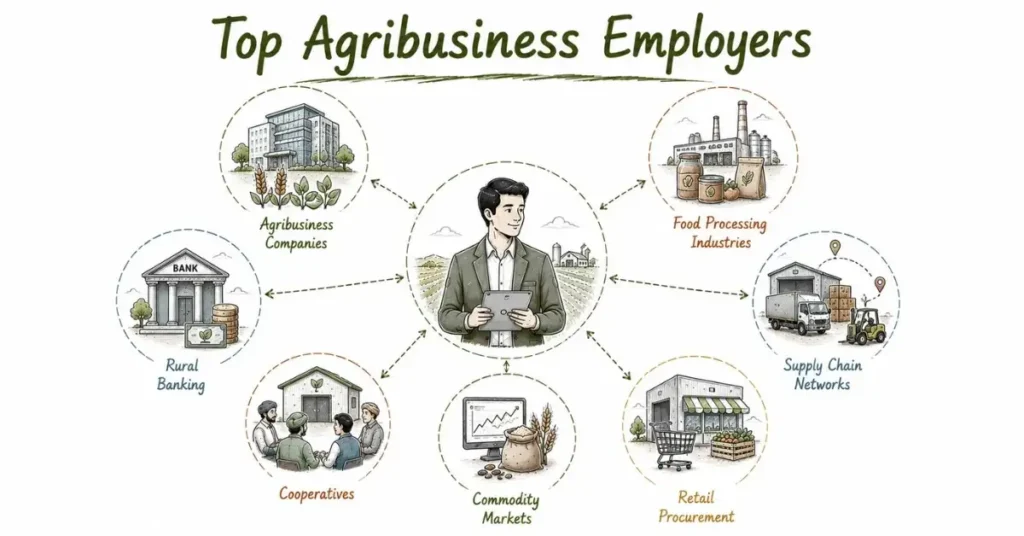
Top Agribusiness Employers in India: A Practical Guide
For Supply Chain and Procurement Roles
Ninjacart and Waycool are the most active hirers for supply chain operations. Both have structured onboarding and fast growth tracks for high performers. BigBasket’s direct sourcing division and Reliance Retail’s farm linkage programme are also strong options for procurement roles.
For Commodity Trading Roles
ITC Agri Business Division in Hyderabad is India’s most prestigious agri commodity trading employer for Indian graduates. Olam International and Louis Dreyfus offer international exposure. IFFCO and NAFED offer government-backed commodity operations careers.
For Rural Marketing Roles
The agri-input sector crop protection and seeds is the primary employer for rural marketing professionals. Bayer CropScience, Syngenta India, UPL, PI Industries, and Rallis India all have large rural sales and marketing teams with structured management trainee programmes.
For Agri-Finance Roles
NABARD remains the most respected employer in agricultural finance. Samunnati and Dvara are leading the agri-fintech space. Public sector banks especially RRBs and SBI’s agricultural banking division offer volume hiring with strong job security.
How to Get Your First Agribusiness Job in India
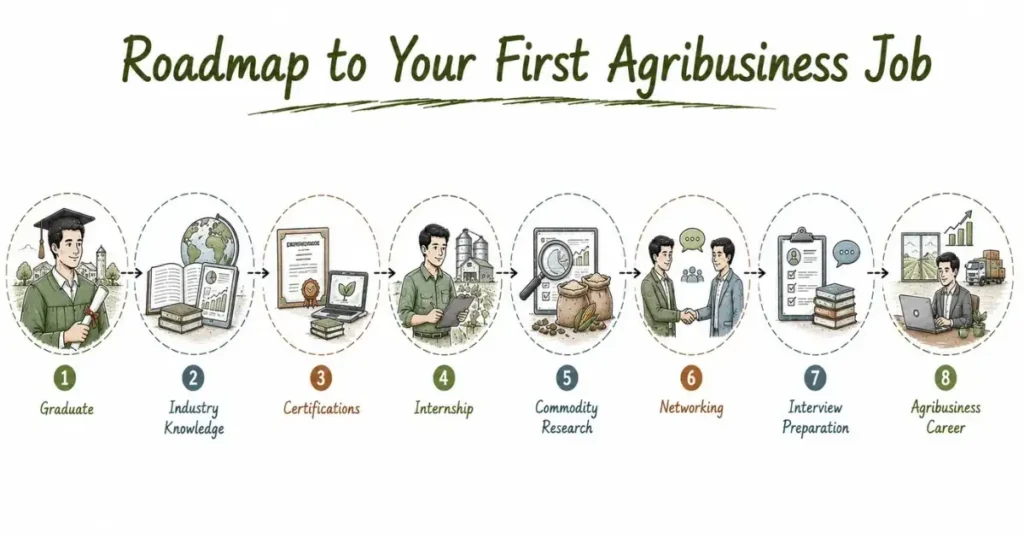
Build Your Commodity Awareness Before Applying
Spend two weeks reading commodity reports from Agmarknet (agmarknet.gov.in) and APEDA. Understand price trends for 3–4 major commodities relevant to your target company’s work. Mentioning specific commodity price dynamics in your interview demonstrates genuine sector interest that most applicants lack entirely.
Target Management Trainee Programmes
ITC, Mahindra, Rallis India, and Coromandel International all run formal management trainee programmes for fresh graduates. These are competitive but structured they offer training rotations, mentorship, and fast-track promotion paths. Application windows are typically between January and March each year. Watch their official careers pages and LinkedIn.
Use Your Regional Roots as an Advantage
If you grew up in a farming family or a rural district, say so explicitly in your application and interview. Agribusiness companies specifically value people who understand the farmer mindset from personal experience. This is a genuine advantage in a sector where most urban-educated candidates are completely disconnected from the realities of Indian farming.
Apply to FPOs and Cooperatives for First Roles
Farmer Producer Organisations and agricultural cooperatives AMUL, IFFCO, Hopcoms, Sahyadri Farms are underrated entry points into agribusiness careers. The pay may be slightly lower than startups or corporates, but the ground-level supply chain and procurement exposure is unmatched and makes you significantly more competitive for your second job.
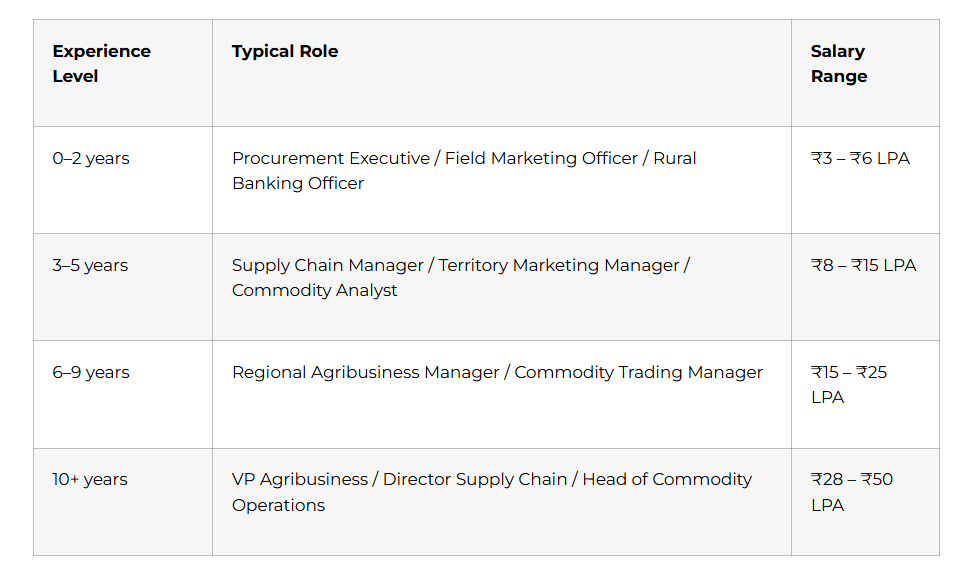
Agribusiness Salary Growth Path
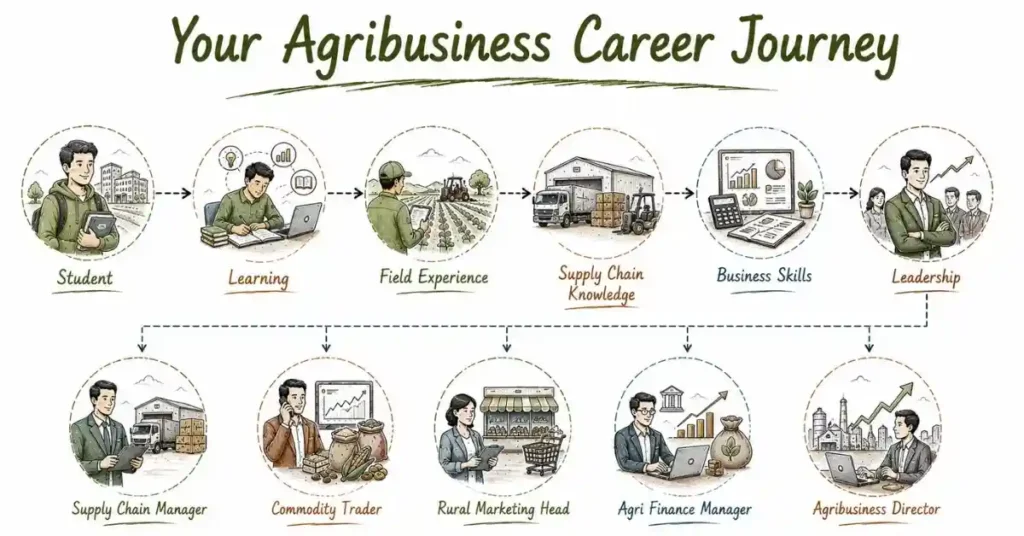
One Honest Reality About Agribusiness Careers
Agribusiness field roles especially in procurement, rural marketing, and supply chain involve significant travel. Not weekend trips. Extended stays in rural districts, early mornings at mandis, and irregular hours during harvest seasons.
This is not a warning to discourage you. It is the reason why salaries in these roles are competitive and why promotions happen faster than in desk-based careers. Companies consistently promote people who do field roles well because those people understand the sector in a way that no office-based professional ever fully can.
If you are willing to do the field work in your first three years, your career trajectory in agribusiness will be substantially faster than peers who avoided it.