Machine Learning is a branch of Artificial Intelligence that enables computers to learn patterns from data and use those patterns to make predictions or decisions. Its real-world applications include recommendation systems, spam detection, fraud detection, voice assistants, and self-driving technologies.
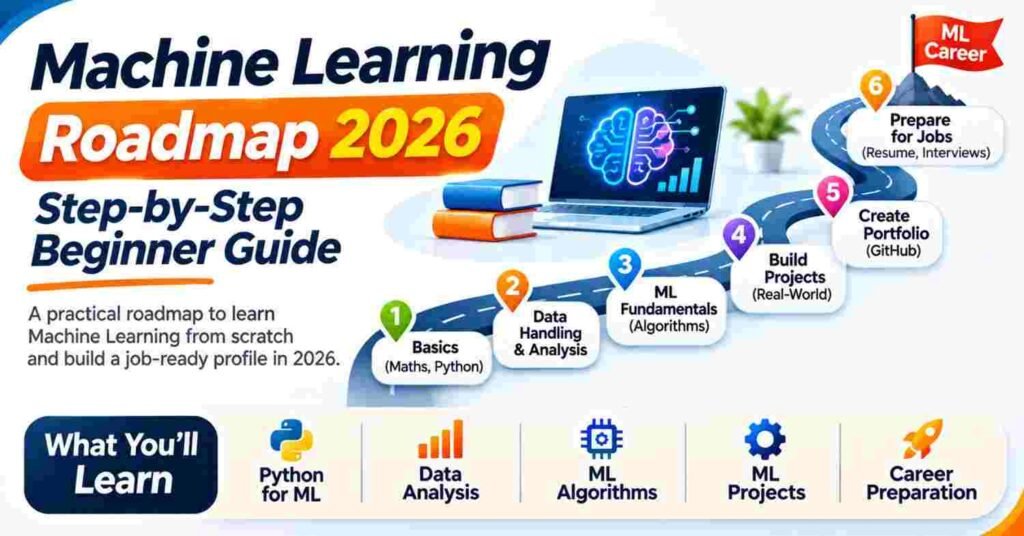
This Machine Learning Roadmap 2026 provides a structured learning path covering six major stages: Mathematics and Python Fundamentals, Data Science Tools, Machine Learning Algorithms, Deep Learning and AI Specializations, Real-World Projects, and Deployment and Career Preparation.
The roadmap begins with essential foundations such as Linear Algebra, Calculus, Probability, Statistics, and Python programming, before progressing to NumPy, Pandas, Matplotlib, SQL, Git, and GitHub.
Learners then move into supervised, unsupervised, and reinforcement learning, followed by important algorithms such as Linear Regression, Logistic Regression, Decision Trees, Random Forest, SVM, KNN, Naive Bayes, K-Means, DBSCAN, and PCA.
The Machine Learning Roadmap 2026 offers a practical path for learners who want to progress from basic programming and mathematics to advanced AI concepts, real-world projects, deployment, and career preparation.
The roadmap also introduces Deep Learning, TensorFlow, PyTorch, NLP, Computer Vision, Generative AI, LLMs, Prompt Engineering, RAG, and Fine-Tuning, helping learners understand how traditional machine learning connects with modern AI technologies.
Project-based learning is another important part of the roadmap, with examples ranging from House Price Prediction and Spam Classification to Customer Churn, Fraud Detection, Image Classification, Object Detection, Sentiment Analysis, and RAG-based Question Answering.
The final stage covers deployment using Flask, FastAPI, Streamlit, REST APIs, cloud basics, MLOps, model monitoring, CI/CD, and portfolio preparation, with career paths such as ML Engineer, Data Scientist, AI Engineer, NLP Engineer, Computer Vision Engineer, and MLOps Engineer.
The PDF concludes with an 8-month learning plan, starting with Python and mathematics and progressing through data science, machine learning, projects, deep learning, AI specializations, deployment, and portfolio development.