
Telecom Interview Questions : Technical & HR Guide
Table of Contents
Telecom Interview Questions India

Most candidates prepare for telecom interviews by googling “common interview questions” the night before. Then they walk in, get asked a scenario-based question about a live network fault they have never thought about, and freeze.
This post prepares you properly. It covers real technical questions asked across NOC analyst, network engineer, 5G deployment, and RF engineer interviews in India with explanations of what interviewers are looking for, not just the textbook answers. It also covers the HR round, which Indian candidates consistently underestimate.
How Telecom Interviews Are Structured
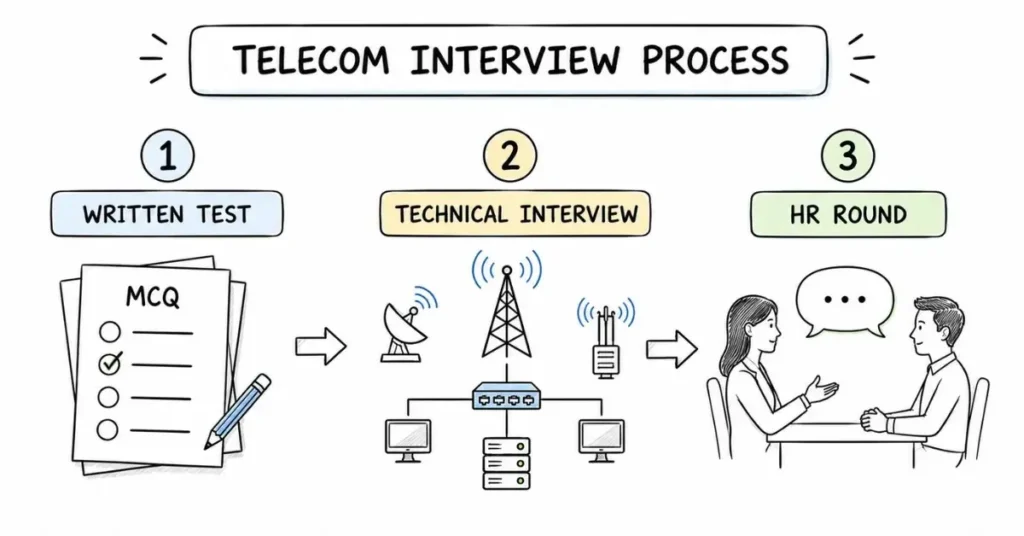
Most telecom companies in India use a 2–3 round interview process:
Round 1 — Written Test or Online Assessment
A screening test covering networking fundamentals, protocol knowledge, and sometimes logical reasoning. Companies like TCS use aptitude tests (TCS NQT). Global vendors like Ericsson use technical MCQ assessments. Clearing this is the prerequisite for everything else.
Round 2 — Technical Interview
The core evaluation. One or two interviewers — usually a senior engineer or team lead — test your domain knowledge, troubleshooting thinking, and hands-on familiarity with relevant technologies. For experienced candidates, this round is often scenario-heavy: “here is a network problem, walk me through how you would solve it.”
Round 3 — HR Interview
Behavioral and cultural fit assessment. This is not a formality. HR interviews at companies like Ericsson, Nokia, and Jio are structured around competency frameworks. Vague, generic answers fail here just as much as wrong technical answers fail in Round 2.
Technical Questions: NOC Analyst
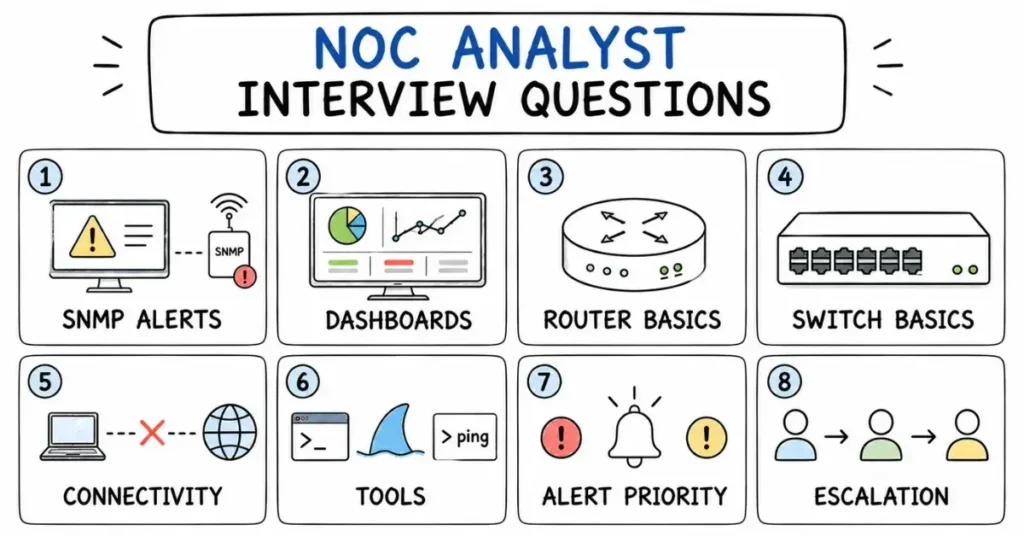
NOC analyst interviews test whether you understand how networks behave, how monitoring works, and whether you can think through problems systematically. Interviewers are not expecting deep expertise — they are evaluating whether you are trainable and genuinely understand the basics.
Q1: What is the difference between a router and a switch?
What they are looking for: Clarity, not memorization. A switch operates at Layer 2 of the OSI model — it forwards data within a local network using MAC addresses. A router operates at Layer 3 — it forwards data between different networks using IP addresses. A candidate who explains this cleanly and can give an example (“a switch connects devices in the same office LAN, a router connects that LAN to the internet”) demonstrates genuine understanding.
Q2: What is SNMP and how is it used in network monitoring?
What they are looking for: SNMP (Simple Network Management Protocol) is the standard protocol used to monitor network devices. It works by having devices send “traps” (alerts) to a monitoring system when a threshold is crossed — for example, when CPU utilization on a router exceeds 90%, or when a link goes down. NOC analysts use SNMP-based tools like IBM Netcool and Ericsson ENM to receive and process these alerts. Knowing this shows you understand what you will actually be doing every day.
Q3: A network link shows high packet loss on your monitoring dashboard. Walk me through your troubleshooting steps.
What they are looking for: A logical, step-by-step approach. The answer is not a single fix — it is a process. Start by confirming the alarm is real (not a monitoring system false positive). Check if the issue is on one link or multiple — is it isolated or part of a broader pattern? Look at the timestamps — did it start suddenly or gradually? Check both ends of the link for interface errors. Check for any recent changes (configuration push, maintenance work). Escalate to L2 with all findings documented. This kind of structured thinking is exactly what NOC managers hire for.
Q4: What is the difference between TCP and UDP?
TCP (Transmission Control Protocol) is connection-oriented — it establishes a connection before sending data, confirms delivery, and retransmits lost packets. It is used where accuracy matters more than speed: web pages, email, file transfers. UDP (User Datagram Protocol) is connectionless — it sends data without confirming receipt. It is faster and used where speed matters more than perfect accuracy: voice calls, video streaming, online gaming. In telecom, VoIP uses UDP because a slightly dropped packet in a call is less disruptive than the delay caused by retransmission.
Technical Questions: Network Engineer
Network engineer interviews go deeper — testing protocol-level knowledge, troubleshooting methodology, and hands-on configuration understanding.
Q5: Explain how OSPF works. How does it select the best path?
What they are looking for: A functional understanding, not a textbook recitation. OSPF (Open Shortest Path First) is a link-state routing protocol — every router builds a complete map of the network (the LSDB — Link State Database) and runs the Dijkstra algorithm to calculate the shortest path to every destination. Path selection uses cost as the metric — cost is calculated from interface bandwidth (higher bandwidth = lower cost). If two paths have equal cost, OSPF performs equal-cost load balancing. Strong candidates mention the difference between OSPF areas, the role of the DR/BDR in broadcast networks, and how LSAs are flooded.
Q6: What is BGP and why does telecom specifically use it?
BGP (Border Gateway Protocol) is the routing protocol that connects different autonomous systems — different networks run by different organizations. The entire internet runs on BGP. In telecom, service providers use BGP to exchange routing information with other operators, internet exchanges, and enterprise customers. Unlike OSPF (which is designed for a single organization’s internal network), BGP is designed for scale — it handles millions of routes across the global internet. Candidates who understand the difference between eBGP (between different organizations) and iBGP (within one organization) and can explain why telecom networks need both score well here.
Q7: What is MPLS and what problem does it solve?
MPLS (Multiprotocol Label Switching) is a technique that speeds up network traffic by using short labels instead of long IP addresses to make routing decisions. In a traditional IP network, every router has to look up the destination IP address in its routing table for every packet — a time-consuming process at scale. MPLS assigns a label to each packet at the network entry point, and subsequent routers switch packets based on the label rather than performing a full IP lookup. This makes large carrier networks faster and more efficient. MPLS also enables VPNs (Virtual Private Networks) that allow operators to provide isolated, private network services to enterprise customers over shared infrastructure.
Q8: A BGP session between two routers keeps going down and coming back up. How would you troubleshoot this?
What they are looking for: Scenario-based questions test real-world thinking. Start by checking the BGP hold timer — if packets are not exchanged within the hold time, the session drops. Check the physical interface — is there intermittent packet loss on the underlying link? Check for CPU spikes on the routers — high CPU can prevent BGP keepalive packets from being sent on time. Check logs on both routers for error messages. Verify the BGP configuration (correct neighbor IP, ASN, and authentication if configured). This kind of systematic answer demonstrates you have thought about real network problems, not just studied for exams.
Technical Questions: 5G Deployment Engineer
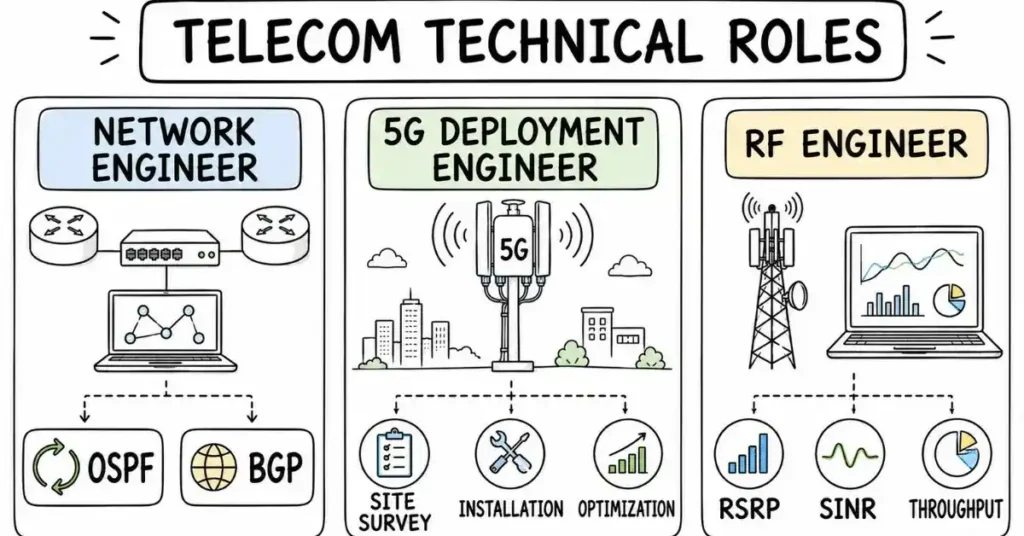
5G deployment interviews focus on practical knowledge of 5G architecture, gNodeB configuration, and acceptance testing processes.
Q9: What is the difference between 5G NSA and 5G SA?
NSA (Non-Standalone) 5G uses 5G radio but relies on a 4G core network for control functions. It was the first deployment model because it allowed operators to add 5G radio to existing 4G infrastructure without rebuilding the core. SA (Standalone) 5G has its own dedicated 5G core network (5GC). SA enables advanced 5G features that NSA cannot support — network slicing, ultra-low latency URLLC applications, and network exposure for enterprise APIs. Most Indian operators initially deployed NSA and are progressively moving to SA as their 5G cores mature.
Q10: What happens during a 5G NR cell site acceptance test (SAT)?
What they are looking for: Practical awareness of the deployment process. An SAT verifies that a newly configured gNodeB is working correctly before it goes live. Typical checks include: confirming the site registers on the Operations and Maintenance (O&M) system; verifying S1/NG interface connectivity to the core; checking that the cell is broadcasting correct SSBs (Synchronization Signal Blocks); running a UE (user equipment) attach test to confirm end-to-end data connectivity; verifying neighbor cell relationships for handover; and confirming KPI baselines (throughput, signal levels) meet design targets. Candidates who can walk through this sequence show genuine understanding of deployment work.
Q11: What is beamforming and why is it important in 5G?
In 4G, antennas broadcast signals in wide, fixed patterns covering a sector. In 5G, Massive MIMO antennas use beamforming — they focus the signal in a specific direction toward a specific user. This means stronger signal for each user, less interference between users, and higher capacity overall. In practical deployment terms, beamforming parameters in the gNodeB configuration determine how aggressively the antenna steers its beams and how many simultaneous beams it maintains. This is one of the reasons 5G needs far more precise configuration work than 4G.
Technical Questions: RF Engineer
RF interviews test signal theory knowledge, measurement tool experience, and practical optimization thinking.
Q12: What are RSRP, RSRQ, and SINR? What do they tell you about signal quality?
These are the three core KPIs in LTE and 5G NR signal measurement:
- RSRP (Reference Signal Received Power) — measures the strength of the signal from a specific cell. Tells you how strong the signal is, not whether it is usable. Typical good range in 5G: -80 dBm or better.
- RSRQ (Reference Signal Received Quality) — measures signal quality relative to total received power (including interference from other cells). Better indicator of actual service quality than RSRP alone.
- SINR (Signal to Interference plus Noise Ratio) — the ratio of the desired signal strength to the interference and noise. The most direct measure of how clean the signal is. Higher SINR = faster data speeds, fewer errors.
Q13: What is a link budget and why do RF engineers use it?
A link budget is a calculation that accounts for all gains and losses in a radio transmission path — from the transmitter, through the air, to the receiver. It determines whether a wireless link will work under given conditions. RF engineers use link budgets during network planning to decide how far apart to place towers, what antenna height to use, and what transmission power is needed to achieve the required coverage. Key parameters in a 5G link budget include transmit power, antenna gain, path loss (using models like COST-231 or 3GPP TR 38.901), shadowing margin, and receiver sensitivity.
HR Round — What Indian Candidates Get Wrong

The HR round is where technically strong candidates fail not because they give wrong answers, but because they give answers that are too generic, too vague, or clearly rehearsed without thought.
Here are the questions that matter most — with guidance on how to answer them specifically for telecom roles.
Q14: Tell me about yourself.
The most asked, most badly answered question in Indian interviews. The HR interviewer does not want your biography. They want a 90-second professional summary: where you are coming from, what you have been building (technically and professionally), and why you are here for this role specifically.
A strong answer for a fresher targeting a NOC role at Tech Mahindra: “I completed my B.Tech in ECE last year from [college]. During my final year, I focused specifically on networking — I built a multi-router OSPF network in Cisco Packet Tracer, studied for CCNA, and did a short project on 5G NR signal analysis. I am targeting NOC analyst roles because I want to start with live network exposure, and Tech Mahindra’s managed services work across multiple operator networks gives me exactly that kind of breadth early in my career.”
That answer is specific, relevant, and shows genuine research about the company. Most candidates give answers that could apply to any company in any industry. Yours should not.
Q15: Why do you want to work in telecom specifically?
Generic answer: “Telecom is a growing industry with lots of opportunities.”
Specific answer: “India’s 5G rollout is creating a talent shortage that I want to be part of solving. I specifically got interested in network engineering after understanding how 5G’s cloud-native architecture works differently from 4G — the fact that the core runs on Kubernetes makes it more like software engineering than traditional telecom, and I want to build skills at that intersection.”
The specific answer shows you have thought about the industry, not just the job.
Q16: Where do you see yourself in 5 years?
Telecom companies invest significantly in training freshers. They want to know you plan to stay long enough to return that investment. The worst answer is vague (“I hope to have grown professionally”). The best answer shows a realistic, specific career trajectory that aligns with what the company offers:
“In 5 years, I see myself as a senior network engineer specializing in 5G transport or core network. I plan to complete my CCNA in the next 6 months and move toward CCNP Service Provider within 2–3 years of getting hands-on experience. I want to grow within a company that handles real carrier-scale networks — which is exactly what a managed services role here offers.”
Q17: Are you comfortable with shift work / relocation?
For NOC roles especially, shift work is the reality. Do not say yes if you genuinely are not — it leads to short tenures and poor performance reviews. If you are comfortable with it, say so directly and briefly. If you have concerns about specific aspects, address them honestly: “I am comfortable with rotating shifts. My preference would be to eventually move to a day shift after building the initial foundation, but I understand that NOC operations run 24/7 and I am prepared for that.”
Q18: What is your salary expectation?
This question makes Indian freshers uncomfortable. It should not. Research the market range before the interview (this series’ Post 11 gives you that data). State a range rather than a single number. For a fresher with CCNA targeting a NOC role: “Based on my research, entry-level NOC analyst roles at managed services companies like this typically offer between ₹3 and ₹4.5 lakh. I am targeting that range, with my final expectation depending on the full package including variable pay and training investment.”
That answer shows market awareness without being aggressive or naive.
Practical Interview Preparation Checklist

Do these in the week before your interview:
- Revise your CCNA fundamentals — especially OSI model, subnetting, BGP vs. OSPF, TCP vs. UDP, and basic troubleshooting methodology
- Know your resume completely — every project, every certification, every tool listed. If it is on your resume, you will be asked about it
- Research the specific company — know which vendor equipment they use, which operators they serve, which cities they operate in. One company-specific question in the HR round changes the interviewer’s perception of you
- Prepare two STAR stories — Situation, Task, Action, Result — for behavioral questions like “tell me about a time you solved a difficult problem” or “describe a situation where you had to learn something quickly”
- Prepare your “Tell me about yourself” — write it out, practice it aloud three times, time it to 90 seconds
- Know your salary expectation with a range — not a number, a range, based on research
One last thing: go into the interview expecting to say “I do not know the answer to that, but here is how I would find out.” Interviewers in telecom know that freshers do not know everything. What they hire for is the ability to think clearly, ask the right questions, and learn quickly. Showing that honestly is worth more than pretending to know something you do not.