
Agriculture Government Jobs in India: ICAR, FCI, NABARD & More
Table of Contents
Introduction
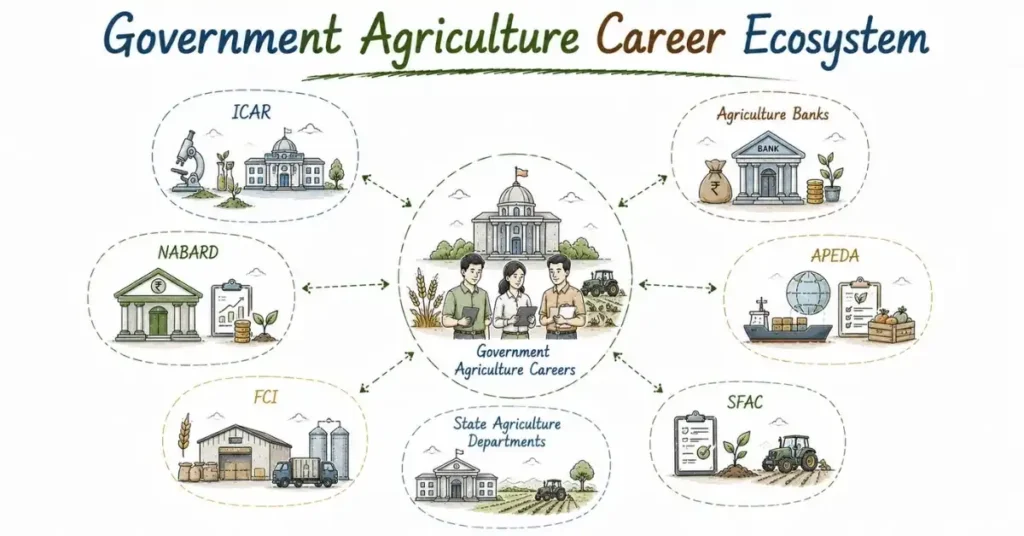
There is a reason agriculture government jobs in India remain among the most competitive in the country. The combination of job security, structured salary growth, pension benefits, housing allowance, and genuine impact on Indian farming makes them deeply attractive particularly in a sector where private sector roles can be geographically demanding and financially unpredictable at the junior level.
But government agriculture careers are not what they were ten years ago. The roles are becoming more technical, more data-driven, and more connected to modern AgriTech systems. An ICAR Scientist today works with satellite data and AI crop models. A NABARD Officer today evaluates AgriTech startup loan proposals. An FCI Management Trainee today manages digital procurement systems.
This guide covers every significant government agriculture career track in India the exam, the eligibility, the salary, the job reality, and how to prepare.
Why Government Agriculture Jobs Still Make Sense in 2026
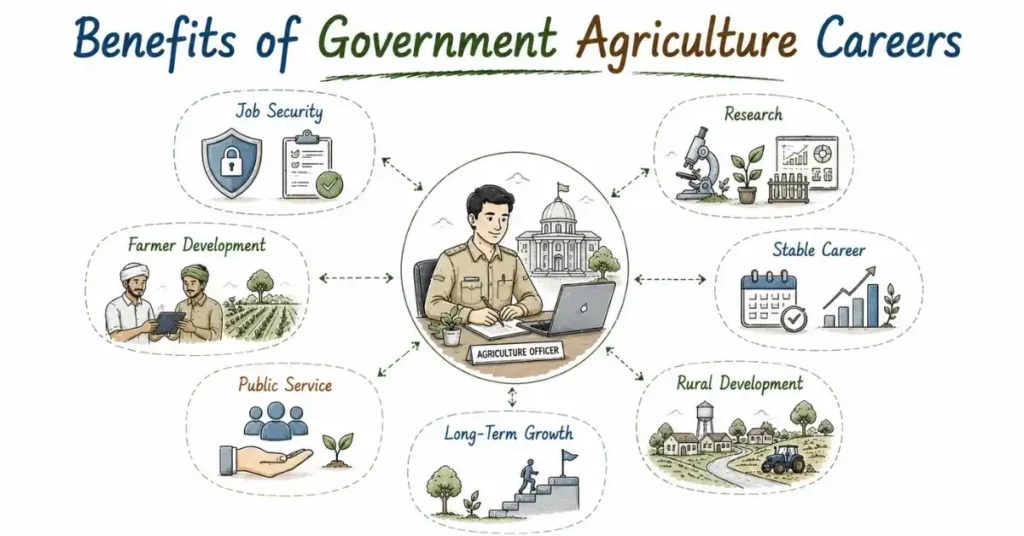
Three things the private sector in agriculture cannot consistently offer and government jobs can:
Stability across market cycles: AgriTech startups shut down. Commodity prices crash. Corporate agribusiness divisions restructure. Government agriculture careers have none of these risks. Once you clear the exam and complete probation, your position is structurally secure.
Pan-India impact at scale: A NABARD Development Assistant working in a district influences agricultural credit flows worth hundreds of crores. A state Agriculture Officer affects farming practices across thousands of farmers in their jurisdiction. Very few private sector roles at comparable experience levels touch this scale of impact.
Post-retirement security: Central government agriculture jobs come with the National Pension Scheme (NPS) and a range of post-retirement benefits that private sector careers in agriculture particularly at startups simply do not match.
The Major Government Agriculture Career Tracks
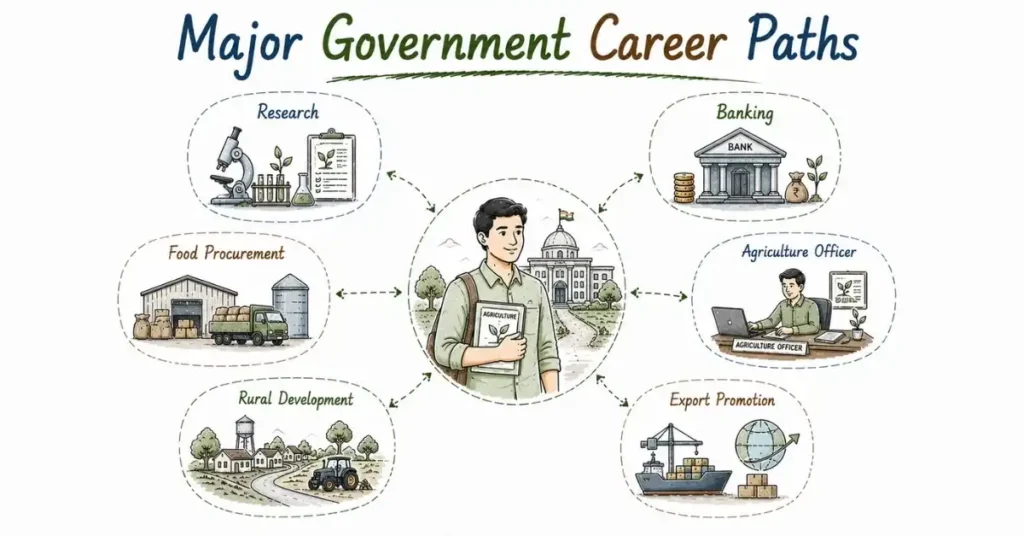
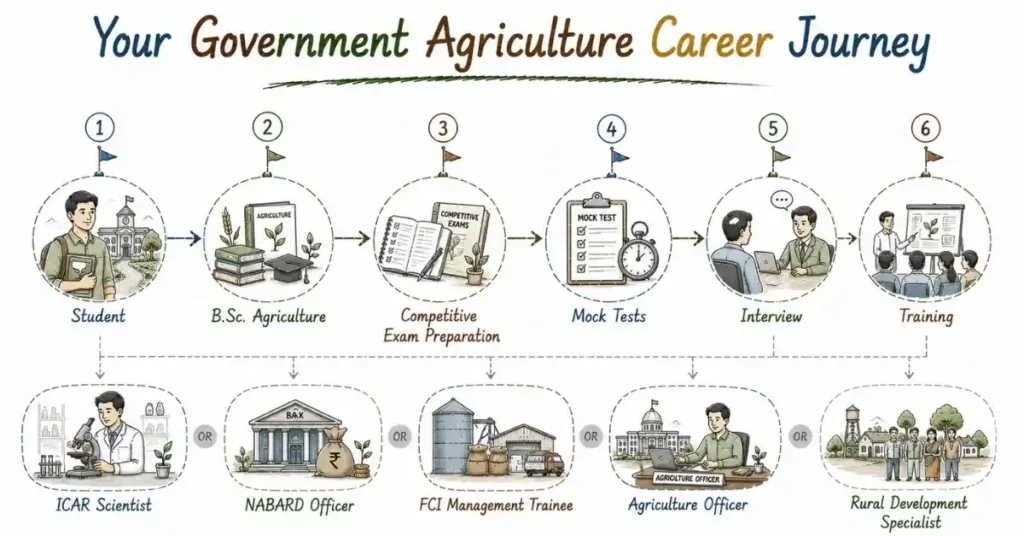
1. ICAR Indian Council of Agricultural Research
What ICAR does: ICAR is India’s apex body for agricultural research and education. It runs 102 institutes and 71 All India Coordinated Research Projects across the country covering crops, livestock, fisheries, natural resources, and agricultural engineering. If you want to do serious agricultural research in India, ICAR is the primary institutional home.
Key recruitment categories:
ICAR Scientist (Group A): The most prestigious ICAR role. Scientists conduct original research, publish findings, and guide junior researchers. Recruitment is through the ICAR’s own scientist recruitment process typically requiring a Ph.D. or M.Sc. with outstanding academic record plus research publications.
ICAR JRF/SRF (Junior/Senior Research Fellowship): Not a permanent job but a funded research fellowship that supports M.Sc. and Ph.D. students. JRF holders receive ₹31,000/month; SRF holders receive ₹35,000/month. Clearing ICAR JRF exam is highly competitive and signals strong agricultural science fundamentals to any employer.
Technical Officer / Research Associate: B.Sc. and M.Sc. Agriculture graduates can apply for technical positions at ICAR institutes without needing a Ph.D. These roles support research programmes and offer stable employment with exposure to cutting-edge agricultural science.
Exam: ICAR ASRB (Agricultural Scientists Recruitment Board) NET exam for Scientist posts; ICAR JRF exam for fellowships. Both held annually.
Salary: Scientist-B entry level ₹56,100/month basic + allowances (total CTC approximately ₹80,000 – ₹1,00,000/month with HRA and other benefits in metro postings).
Best institutes to target within ICAR: IARI (New Delhi), NBSS&LUP (Nagpur) for soil science, NRSC (Hyderabad) for remote sensing, CIAE (Bhopal) for agricultural engineering, ICRISAT collaboration programmes.
2. NABARD : National Bank for Agriculture and Rural Development
What NABARD does: NABARD is India’s apex development finance institution for agriculture and rural development. It refinances agricultural loans made by rural banks and cooperatives, funds rural infrastructure, supports AgriTech and FPO development, and runs watershed and tribal development programmes. Working at NABARD puts you at the intersection of agricultural finance, rural development, and emerging AgriTech investment.
Key recruitment:
NABARD Grade A Officer (Assistant Manager): The primary entry-level officer post. Grade A officers work across NABARD’s development, finance, and supervision functions. Posting can be anywhere in India rural district offices are common for the first posting.
NABARD Grade B Officer (Manager): Direct recruitment to a more senior level, requiring more domain expertise. Applications typically require 2–3 years of relevant experience or an exceptional academic record.
NABARD Development Assistant: A clerical-to-officer grade role. Less competitive than Grade A but still stable and meaningful work.
Exam: NABARD Grade A and B exam is conducted by NABARD independently separate from IBPS. The exam has a Phase 1 (prelims) and Phase 2 (mains + interview) structure. Economic and Social Issues, Agriculture and Rural Development, and General English are core papers. Agriculture specialists can opt for the Agriculture stream in Phase 2.
Eligibility: Graduate in any discipline for Grade A (General stream); B.Sc. Agriculture or allied disciplines for Agriculture stream posts.
Salary: Grade A approximately ₹44,500/month basic + allowances. Total monthly compensation including HRA, DA, and other benefits typically reaches ₹70,000 – ₹90,000/month depending on posting location.
Preparation tip: NABARD exam preparation requires deep understanding of agricultural credit systems, RBI monetary policy, rural development schemes, and India’s agricultural statistics. The NABARD Annual Report and RBI Report on Trend and Progress of Banking are essential reading not optional.
3. FCI : Food Corporation of India
What FCI does: FCI is responsible for procuring, storing, and distributing food grains across India rice, wheat, and coarse cereals under the National Food Security Act. It manages one of the world’s largest grain storage and distribution networks, operating across thousands of depots and procurement centres nationwide.
Key recruitment:
Management Trainee (Agriculture): One of FCI’s most sought-after entry routes for agriculture graduates. MTs rotate through procurement, storage, and distribution functions before being confirmed as Assistant Grade officers. This is a structured programme with meaningful learning.
Management Trainee (General/Technical/Accounts/Depot): Other streams for engineering, commerce, and science graduates who want to work in FCI’s operational functions.
Junior Engineer: For civil and electrical engineering graduates supporting FCI’s storage infrastructure maintenance.
Exam: FCI recruitment is conducted through NRA CET (Common Eligibility Test) scores plus FCI’s own phase 2 examination. The Agriculture stream MT exam covers crop production, post-harvest management, food grain storage, and agricultural policy.
Eligibility: B.Sc. Agriculture for Management Trainee (Agriculture); B.Tech for Junior Engineer posts.
Salary: Management Trainee on joining approximately ₹40,000 – ₹50,000/month basic. After confirmation as Assistant Grade III officer approximately ₹60,000 – ₹80,000/month total compensation.
Job reality: FCI postings are pan-India, often in procurement-heavy states like Punjab, Haryana, AP, and Telangana. The work is operationally demanding during procurement seasons (October–February for rabi crops) but offers genuine exposure to India’s food security infrastructure.
4. State Agriculture Department : Agriculture Officer / Horticulture Officer
What they do: State agriculture departments are the ground-level implementation arms of India’s agricultural development programmes. Agriculture Officers visit farmers, supervise demonstration plots, distribute government scheme benefits (PM-KISAN, crop insurance, soil health cards), and coordinate with KVKs and agricultural universities. This is arguably the most direct farmer-contact role in the entire agriculture career landscape.
Exam: Each state recruits through its State Public Service Commission TSPSC (Telangana), APPSC (Andhra Pradesh), MPSC (Maharashtra), TNPSC (Tamil Nadu), UPPSC (Uttar Pradesh), etc. The exam typically includes a written test on agricultural science, general knowledge, and regional language, followed by an interview.
Eligibility: B.Sc. Agriculture for Agriculture Officer; B.Sc. Horticulture for Horticulture Officer posts.
Salary: Varies significantly by state. Typically ₹35,000 – ₹55,000/month on joining, with state government DA, HRA, and other allowances bringing total compensation to ₹50,000 – ₹80,000/month depending on state and posting.
Job reality: Rural posting is standard sometimes in remote districts. The work is field-intensive, community-facing, and carries significant local social responsibility. The pace of promotions varies by state. Telangana and Andhra Pradesh have been relatively active in agriculture department recruitment in recent years.
5. SBI / RRB Agriculture Officer
What they do: Agricultural Officers in public sector banks assess farm loan applications, monitor agricultural credit portfolios, visit borrower farms, and support kisan credit card operations. Regional Rural Banks (RRBs) are the most active employers in this category, specifically established to serve rural and agricultural credit needs.
Exam:
- IBPS RRB Officer Scale I/II: The main recruitment exam for RRB officers. Conducted by IBPS annually. Agriculture stream officer posts are specifically available.
- SBI Agriculture Officer: SBI conducts separate recruitment for specialist agriculture officers periodically.
Eligibility: B.Sc. Agriculture for Agriculture Officer specialist posts. For general scale officer posts, any graduate is eligible.
Salary: RRB Officer Scale I approximately ₹36,000 – ₹52,000/month basic + allowances. Total compensation typically ₹55,000 – ₹75,000/month.
Why this matters for AgriTech: Rural bank agricultural officers are increasingly required to evaluate AgriTech loan proposals, assess digital farm management tools for credit risk purposes, and support eNAM-linked digital transactions. The role is becoming more technically oriented.
6. APEDA, SFAC, and Other Central Agencies
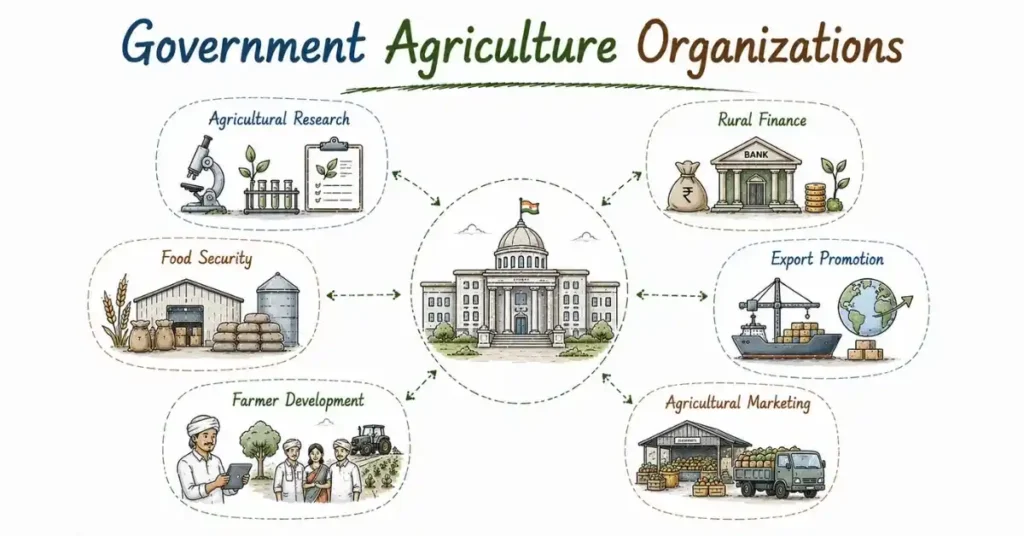
APEDA (Agricultural and Processed Food Products Export Development Authority): Recruits officers for export promotion, quality certification, and agricultural marketing roles. Strong fit for agribusiness and international trade-oriented graduates.
SFAC (Small Farmers Agri-Business Consortium): Runs FPO promotion and agribusiness development programmes. Hires project officers with agribusiness or rural development backgrounds.
NIAM (National Institute of Agricultural Marketing, Jaipur): Faculty and programme officer positions for agribusiness management and rural marketing specialists.
NHB (National Horticulture Board): Recruits for horticulture development and post-harvest management roles. Particularly relevant for horticulture and food technology graduates.
Government Agriculture Exam Preparation Strategy
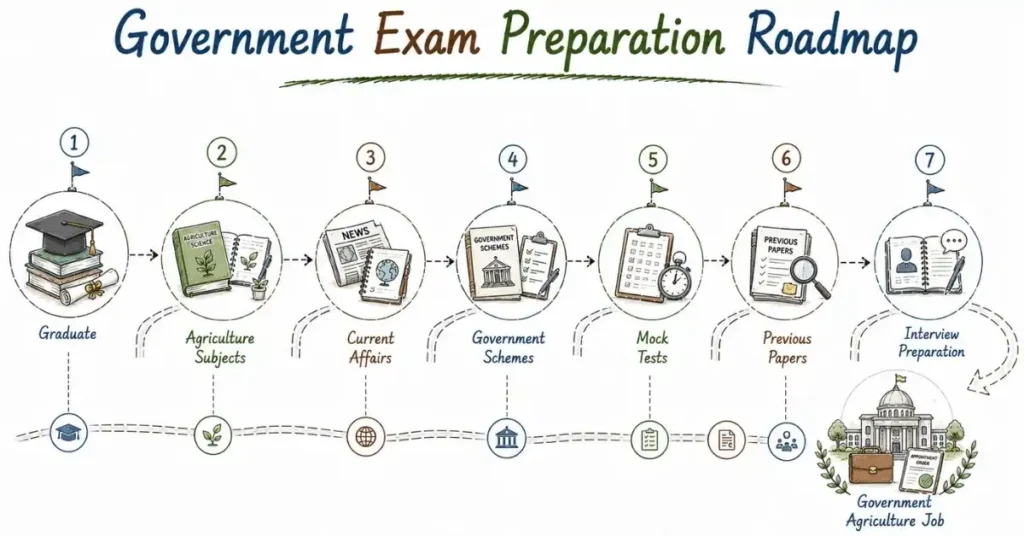
Build Your Foundation in Agricultural Science
For all agriculture stream government exams, your B.Sc. Agriculture curriculum is the primary syllabus. But standard college preparation is rarely sufficient for competitive exams. Go back to core subjects agronomy, soil science, plant pathology, agricultural economics, extension education with the specific intent of understanding concepts well enough to answer application-based questions, not just recall-based ones.
Know India’s Agricultural Statistics Cold
Every government agriculture exam NABARD, ICAR, FCI, state PSC tests knowledge of India’s agricultural statistics. Know the top producing states for major crops, India’s rank in world production for key commodities, agricultural GDP contribution, farm mechanisation data, and irrigation coverage figures. Update this knowledge annually from the Agricultural Statistics at a Glance report published by the Ministry of Agriculture.
Study Government Schemes Thoroughly
NABARD officers, state Agriculture Officers, and FCI trainees are all expected to implement government schemes. Know PM-KISAN, PMFBY, eNAM, PMKSY, RKVY, and the National Food Security Act in detail not just the name and acronym, but the eligibility criteria, benefit amounts, implementing agencies, and recent updates.
Practice Previous Year Question Papers
Every exam mentioned above has previous year papers available through publishers like Arihant and through online platforms. Solving 5–7 years of papers for your target exam is non-negotiable preparation. Pattern recognition which topics appear repeatedly, which types of questions are asked dramatically improves exam performance.
Current Affairs With Agricultural Focus
Dedicate 30 minutes daily to agricultural current affairs new policy announcements, crop production estimates (kharif and rabi advance estimates from Ministry of Agriculture), commodity price movements, AgriTech news, and RBI agricultural credit data. Sources: PIB (Press Information Bureau), Krishijagran.com, The Hindu’s agriculture coverage, and Economic Survey agriculture chapter.
Honest Comparison: Government vs. Private AgriTech Careers
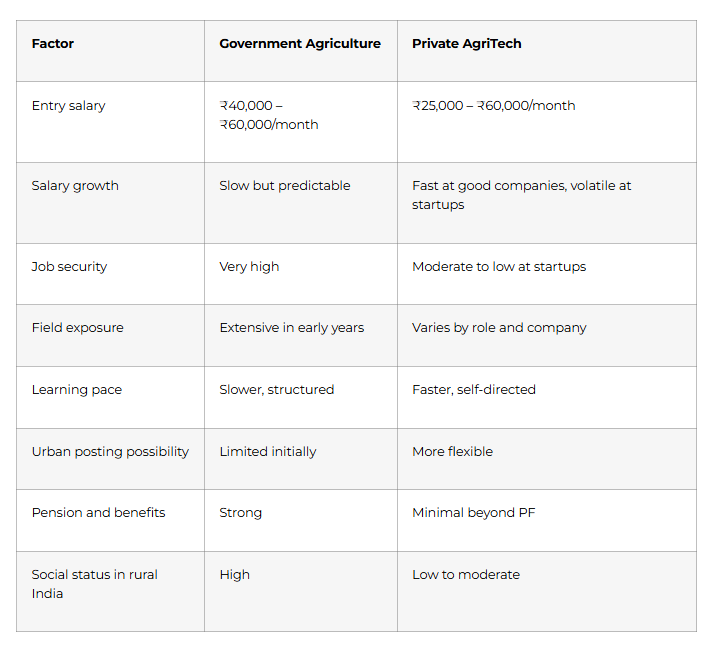
Neither path is universally better. The right choice depends on your risk tolerance, financial responsibilities, and what kind of work environment brings out your best performance.