
5G Deployment Engineer in India : Career & Skills Guide
Table of Contents
5G Deployment Engineer Job Role, Skills Required & Where to Find Work

If you want a role that puts you at the centre of the most active infrastructure project happening in India right now, 5G deployment engineering is it.
India’s 5G rollout is not slowing down. Jio and Airtel together covered 99.9% of Indian districts by end of 2025. Every one of those thousands of new 5G sites needed engineers to install, configure, test, and commission the equipment. And as the network continues to grow adding capacity, upgrading sites, deploying in new areas that work continues.
This post tells you exactly what a 5G deployment engineer does, what skills you need, what you will earn, and how to get hired.
What a 5G Deployment Engineer Actually Does
The job title sounds straightforward, but most students do not have a clear picture of what the day-to-day work looks like. Here is a realistic breakdown.
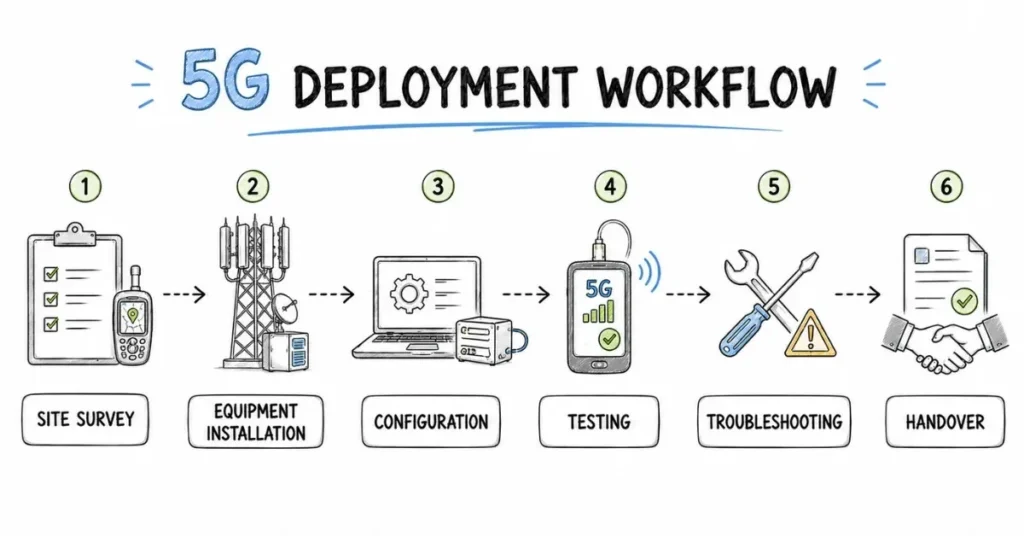
A 5G deployment engineer is responsible for making new 5G sites go live. That process has several stages:
Site survey and planning. Before any equipment goes up, someone has to assess the location — checking whether the tower structure can support the new 5G antenna, where the fiber connections will run, whether there are power supply issues. Deployment engineers either do this themselves or review the survey reports from field teams.
Equipment installation coordination. The physical installation — mounting antennas, running cables, connecting power — is often done by tower crew or field technicians. The deployment engineer’s job is to make sure the right equipment arrives, the installation follows specifications, and nothing is missed.
Configuration and commissioning. This is the most technical part. Once the hardware is in place, the deployment engineer logs into the base station (the gNodeB) remotely or on-site and configures software parameters — radio frequencies, transmit power levels, neighbor cell relationships, timing settings. This work is done using vendor-specific tools (Ericsson’s ENM, Nokia’s NetAct, Huawei’s U2000, depending on the operator’s vendor).
Integration testing. After configuration, the engineer runs a series of tests to confirm the site is working correctly — checking that the site registers to the core network, that calls and data sessions establish properly, that handovers to neighboring sites work. This is called site acceptance testing (SAT).
Troubleshooting and snag resolution. Rarely does a new site come up perfectly on the first attempt. There are usually issues — a misconfigured parameter, a hardware fault, an integration problem with the core. Deployment engineers diagnose and fix these before formally handing the site over to operations.
Documentation and handover. Every completed site needs documentation — configuration records, test results, as-built drawings. This might feel administrative, but it is important. The operations team that maintains the site for the next 10 years depends on accurate records.
The Difference Between Field Work and Office Work
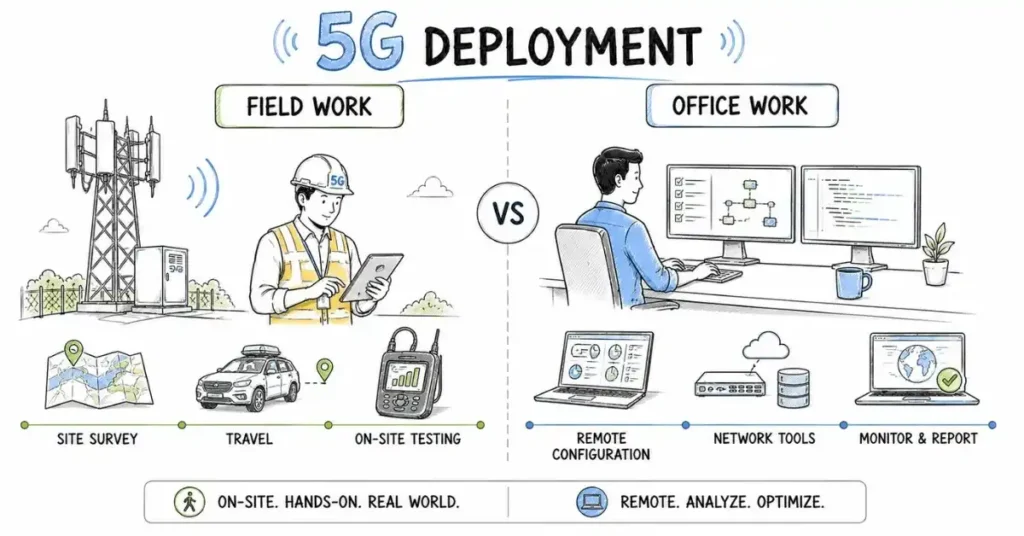
This role has both, in different proportions depending on the company and project phase.
During active deployment phases, you spend significant time in the field — visiting sites, coordinating with tower crews, running on-site tests. This means travel. In a large deployment project, a deployment engineer might visit 10–15 sites per week across a region.
During integration and optimization phases, the work shifts to remote configuration and testing — done from an office or even from home if the tools allow remote access.
If you are someone who prefers sitting at a desk all day, pure 5G deployment is probably not the right role. But if you are comfortable with a mix of field and office work, the variety is one of the things engineers in this role consistently say they appreciate about it.
The Technical Skills Employers Actually Look For
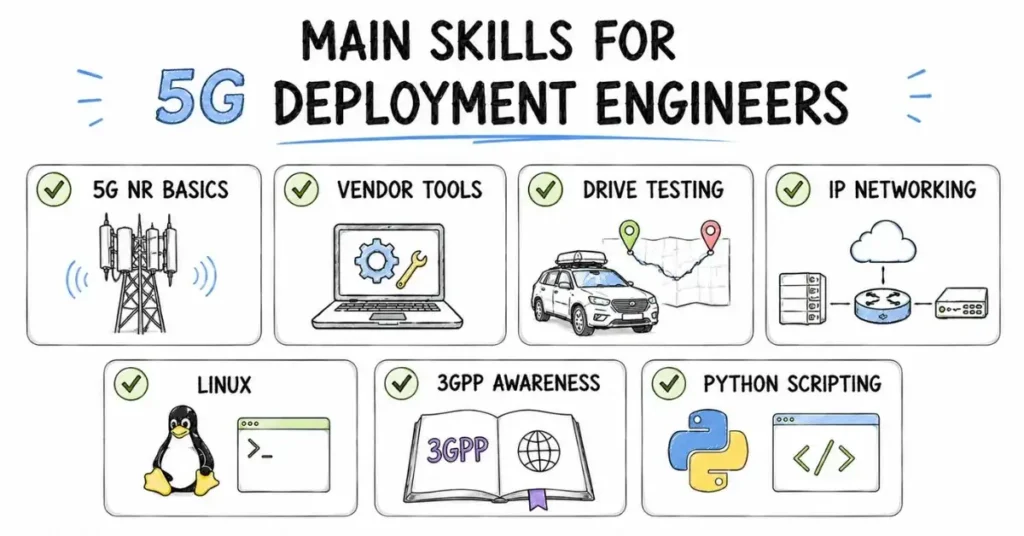
Job descriptions for 5G deployment engineers in India consistently mention the same skills. Here they are, in order of how frequently they appear:
1.Understanding of 5G NR (New Radio) fundamentals
You do not need to design the radio standard. But you need to understand what parameters you are configuring and why. This means knowing concepts like SSB (Synchronization Signal Block), beamforming, PRACH (Physical Random Access Channel), and handover procedures at a functional level.
2.Vendor-specific tool experience
The three dominant vendors in India’s 5G market are Ericsson, Nokia, and Huawei. Each has its own network management tools:
- Ericsson: ENM (Ericsson Network Manager), AMOS (Advanced MOS scripting)
- Nokia: NetAct, Nokia Network Operations
- Huawei: U2000, MAE (Mobile Autonomous Evolution)
Employers strongly prefer candidates who have hands-on experience with at least one vendor’s tools. If you do not have professional experience, Nokia and Ericsson both offer training courses that include lab access.
3.Drive testing and optimization basics
Drive testing means taking a vehicle with testing equipment around a coverage area to measure signal quality, call performance, and data speeds. Tools like TEMS (Ericsson), NEMO (Nokia-Keysight), and JDSU’s tools are industry standards. Experience with even one of these tools is a meaningful advantage.
3.IP networking fundamentals
5G sites connect to the rest of the network over IP. You do not need to be a routing expert, but knowing how IP addresses work, what a VLAN is, and how to troubleshoot basic IP connectivity issues is essential. A CCNA or CompTIA Network+ covers this adequately.
4.Linux basics
Most 5G network equipment runs on Linux under the hood. Basic command-line comfort — navigating directories, reading logs, running scripts — is increasingly listed in job requirements.
5.3GPP standards awareness
3GPP is the international body that defines how 4G and 5G work. You do not need to read every specification, but familiarity with the key ones — 3GPP TS 38.104, 38.211, 38.300 for 5G NR — shows employers you can go to the primary source when you need to understand something precisely.
6.Python scripting (increasingly common)
Automation is entering deployment work. Scripts that run acceptance test sequences automatically, pull configuration data from multiple sites, or compare as-built configuration against design specifications are becoming common. You do not need to be a programmer, but basic Python — loops, file handling, simple API calls — is increasingly valuable.
What You Will Earn
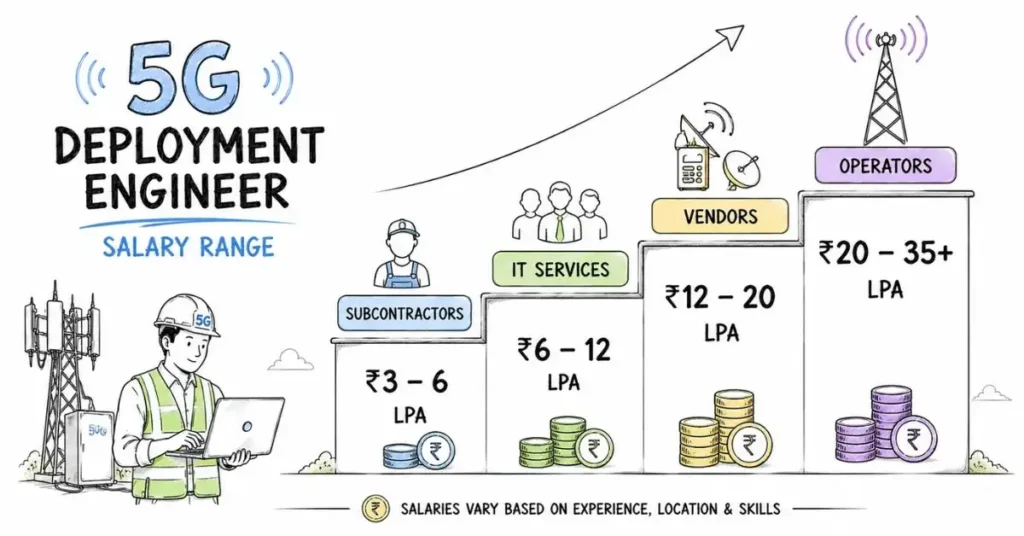
Salaries for 5G deployment engineers in India vary significantly based on company type, city, and whether the role is permanent or contract.
Company Type | Entry Level (0–2 yrs) | Mid Level (3–5 yrs) | Senior Level (6+ yrs) |
Telecom Operators (Jio, Airtel) | ₹4L–₹7L | ₹8L–₹14L | ₹15L–₹25L |
Global Vendors (Ericsson, Nokia) | ₹5L–₹9L | ₹10L–₹18L | ₹18L–₹30L |
IT Services (TCS, Tech Mahindra) | ₹3.5L–₹6L | ₹7L–₹12L | ₹14L–₹22L |
Subcontractors / Project Companies | ₹2.5L–₹5L | ₹5L–₹9L | ₹10L–₹16L |
Contract roles pay more per month than permanent roles at the same level, but without benefits, job security, or career growth support. For freshers, a permanent role at a smaller salary is almost always the better long-term move — you get training, mentorship, and a brand name on your resume.
Contract vs. Permanent Roles in 5G Deployment
This distinction matters in telecom more than in most industries. Here is the honest picture.
Project-based contract roles are common in 5G deployment because the work is project-driven. A deployment company wins a contract to deploy 5,000 sites for an operator in a specific region, hires engineers for the project duration (12–24 months), and the contract ends when the deployment is done.
The upsides: faster entry, higher monthly pay than a fresher permanent role, quick exposure to real deployment work.
The downsides: no continuity, less training and mentorship, harder to build long-term career capital.
Permanent roles at operators or global vendors offer stability, internal mobility, and structured career progression. They are harder to get as a fresher but worth targeting once you have even 6–12 months of project experience.
The smart move: start with a contract or project role to build your hands-on portfolio, then use that experience to move into a permanent role at a larger company within 18–24 months.
Which Companies Are Hiring Right Now
Telecom Operators:
- Reliance Jio — One of the largest hirers for 5G field and integration roles. Look for titles like “5G RAN Deployment Engineer” or “5G Integration Engineer” on their careers portal and LinkedIn.
- Bharti Airtel — Active on both 5G RAN and transport deployment hiring. Also hires through managed services partners.
Global Vendors (direct and through partners):
- Ericsson India — Has delivery centres in Gurugram, Bengaluru, and Chennai. Hires deployment and commissioning engineers directly and through partner companies.
- Nokia India — Strong in IP networking and 5G RAN; hires for customer delivery and professional services roles.
- Huawei India — Despite geopolitical friction at the operator level, Huawei still employs a large number of engineers in India for R&D and delivery roles.
- Samsung Networks — Growing 5G RAN presence; worth tracking for deployment roles.
IT Services and Managed Services:
- Tech Mahindra — One of the most active telecom domain employers in India; hires for managed services delivery which includes 5G deployment support.
- Tata Communications — Managed network services with 5G and enterprise connectivity deployment roles.
- Sterlite Technologies (STL) — India-headquartered company building optical and 5G infrastructure; active hiring for deployment roles.
Subcontractors and Project Companies:
- Companies like Quess Corp Telecom Division, Mouri Tech, and BSNL project vendors hire deployment engineers for field projects. These are good entry points for freshers.
How to Get Your First 5G Deployment Role With No Experience
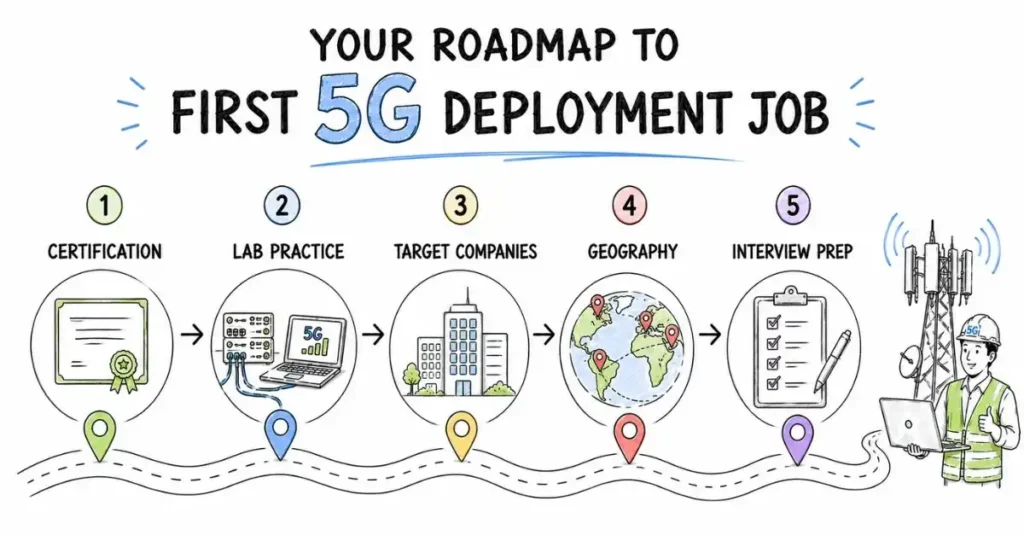
This is the practical part most guides skip.
Step 1: Get the right certification
Nokia’s 5G Associate certification or a structured 5G training course from providers like TELCOMA or Apeksha Telecom (Telecom Gurukul) gives you the foundational knowledge interviewers expect. Pair it with CCNA for the networking component.
Step 2: Build lab experience
Tools like the Amarisoft CALLBOX simulator or free 5G NR protocol training platforms let you simulate 5G radio configurations. Even a few hours of hands-on configuration practice gives you something concrete to discuss in an interview when they ask, “Have you worked with gNB configuration before?”
Step 3: Target the right companies first
Freshers get into 5G deployment most commonly through subcontractors and project companies, not directly at Ericsson or Jio. Once you have 12–18 months of real deployment experience documented on your resume, the larger companies become accessible.
Step 4: Know your geography
5G deployment work is concentrated in cities where rollout is active. Bengaluru, Hyderabad, Chennai, Pune, Mumbai, Delhi NCR, and Ahmedabad are the highest-activity markets. If you are willing to relocate, you open significantly more options.
Step 5: Prepare for these specific interview questions
- “Walk me through the steps to commission a 5G gNB.”
- “What is the difference between SSB and CSI-RS in 5G NR?”
- “If a newly commissioned site is not registering on the core network, what is your troubleshooting process?”
- “What is the purpose of PRACH and how is it configured?”
You do not need to answer these perfectly as a fresher. But you need to show that you understand the concepts — that you are not just someone who read the job description and applied.
One Thing Most Freshers Get Wrong
They wait until they are “ready.” They finish the certification, then decide they need another one. They build a lab, but do not apply until the lab is “more complete.”
Here is the reality: you will never feel fully ready for your first deployment role. The learning happens on the job, not before it. What you need before applying is enough foundation to be trainable — not enough to already know everything.
Get your CCNA and one 5G fundamentals course. Build one small lab exercise you can speak to. Then apply. The companies hiring freshers for deployment roles know they are hiring people who will learn on the job. They are evaluating your attitude, your learning ability, and your technical foundation — not your readiness to work independently from day one.