
Precision Farming Careers in India: Jobs, Skills & Salaries
Table of Contents
Introduction
Picture this. A farmer in Nashik gets a notification on his phone at 6 AM. It tells him that the eastern corner of his vineyard has moisture levels dropping below optimal three days before his eyes would have noticed anything unusual. He adjusts his drip irrigation remotely. He saves 40,000 litres of water that week.
Behind that notification is a career.
Someone built the sensor that detected the moisture drop. Someone wrote the algorithm that converted raw data into a farmer-friendly alert. Someone flew a drone over that vineyard last month to build the field map the system runs on. Someone trained the farmer to trust the app.
Every one of those people works in precision farming. And in India right now, there are not enough of them.
This guide tells you exactly what precision farming careers look like in India what the roles are, what skills you need, which companies are hiring, what they pay, and how you can realistically get started.
What Is Precision Farming? A Clear Definition
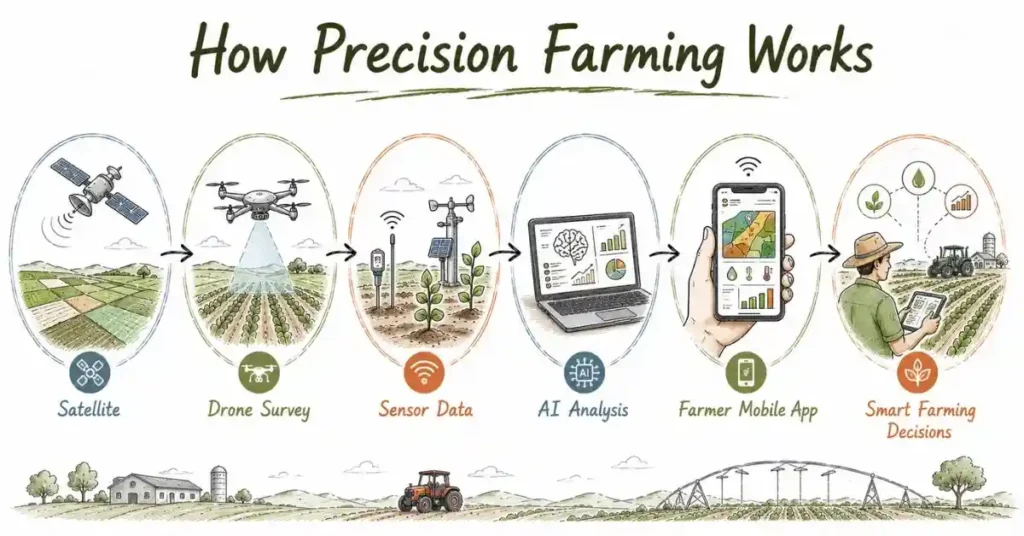
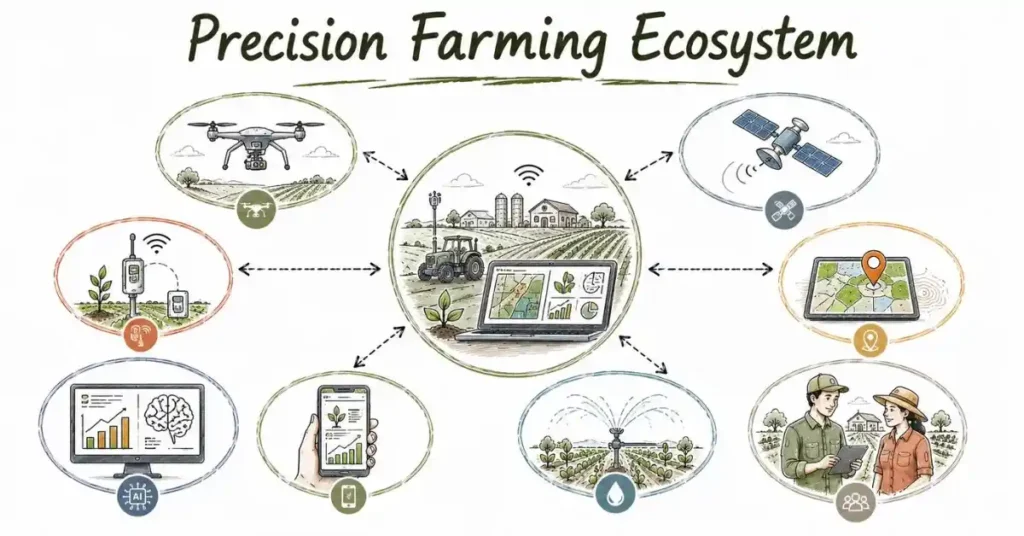
Precision farming also called precision agriculture means using data and technology to make farming decisions more accurate, efficient, and less wasteful.
Traditional farming applies inputs uniformly across an entire field. Every part of the field gets the same amount of water, fertiliser, and pesticide regardless of what each specific area actually needs. This wastes resources, increases costs, and damages soil over time.
Precision farming replaces that blanket approach with targeted decisions. It uses:
- Drones and satellite imagery to map a field and identify problem areas
- Soil sensors and IoT devices to monitor moisture, temperature, and nutrient levels in real time
- GPS-guided farm machinery to apply inputs only where and when they are needed
- Data analytics and AI platforms to interpret all this information and recommend actions
- Mobile apps to deliver those recommendations to farmers in their local language
The result is less waste, higher yields, lower costs, and better environmental outcomes. For India where water scarcity, soil degradation, and smallholder farm economics are real daily pressures precision farming is not a luxury. It is quickly becoming a necessity.
Why Precision Farming Careers Are Booming in India
Three forces are driving demand for precision farming professionals in India right now.
Government push: The Indian government’s Digital Agriculture Mission allocated ₹2,817 crore specifically toward building digital infrastructure for Indian farms including soil health monitoring, satellite-based crop assessment, and AI-powered advisory systems. Every rupee of that investment needs skilled people to implement it.
Startup funding: Indian AgriTech startups focused on precision farming SatSure, Cropin, Fasal, Intello Labs have collectively raised hundreds of crores in venture funding over the past three years. Funded companies hire. Fast.
Climate pressure: Unpredictable monsoons, water table depletion, and rising input costs are forcing Indian farmers to be more precise about every resource they use. The demand from farmers themselves for precision tools is growing which means the market for people who build and deploy those tools is also growing.
Precision Farming Career Roles in India: The Full Breakdown
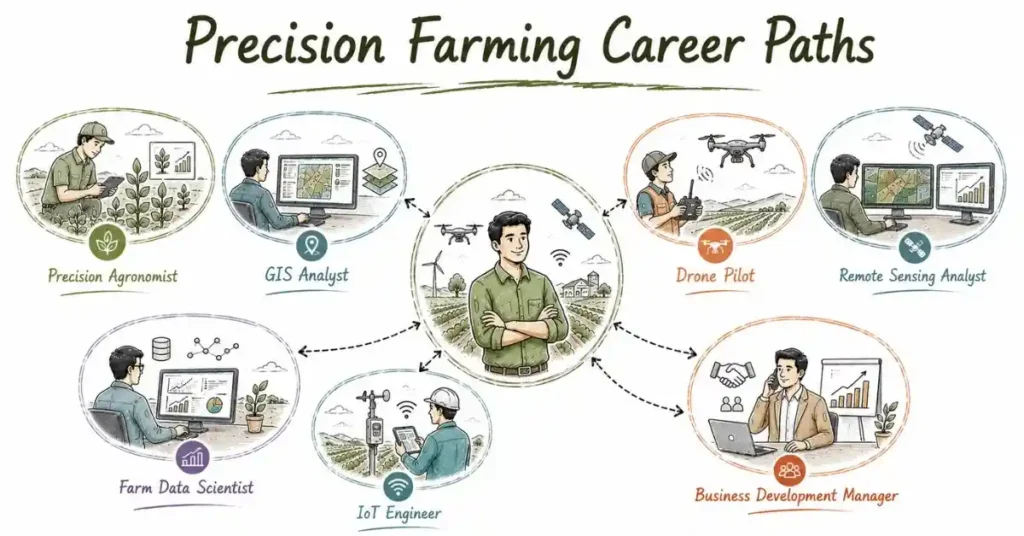
Here is an honest map of every major role in precision farming what each one actually does day to day, not just a job title.
1. Precision Agriculture Specialist / Agronomist
What you do: You are the bridge between the technology and the farm. You interpret drone images, sensor data, and satellite maps to give farmers specific, actionable advice. You spend time both at a computer analysing data and in the field validating what the data is telling you.
Who fits: B.Sc. Agriculture graduates with additional training in GIS or remote sensing. Experienced agronomists who have upskilled into digital tools.
Day in the life: Review overnight sensor data from 50 farms, flag 3 with early-stage fungal risk indicators, create field visit schedule, travel to 2 farms for on-site verification, update crop health records on the platform, join a product team call to discuss what farmers actually want from the next app update.
Employers: SatSure, Cropin, BharatAgri, AgroStar, Mahindra Agri Solutions
Salary range: ₹4 – ₹10 LPA (experience-dependent)
2. GIS Analyst (Agriculture)
What you do: You work with geographic data satellite images, field maps, topography layers to create visual analyses of agricultural land. You identify which zones of a field need attention, track crop health over seasons, and produce reports that help farmers and companies make land-use decisions.
Who fits: B.Tech graduates in Geoinformatics, Computer Science, or Civil Engineering; B.Sc. Geography graduates with GIS tool training; any graduate who has learned ArcGIS or QGIS seriously.
Day in the life: Download new satellite imagery for a client cluster of 200 farms, process it through NDVI analysis to map vegetation health, identify stress zones, generate visual reports for field teams, attend calibration meeting with drone data teams to reconcile ground-truth observations with satellite readings.
Employers: SatSure, ESRI India, ISRO (Agricultural division), Cropin, government agricultural departments
Salary range: ₹4 – ₹12 LPA
3. Drone Operator / UAV Technician
What you do: You operate agricultural drones for crop monitoring, spraying, or mapping missions over farm fields. You plan flight paths, maintain drone hardware, process aerial imagery, and ensure safe and legal operations under DGCA guidelines.
Who fits: Anyone with a DGCA Remote Pilot Certificate and a willingness to work outdoors in agricultural settings. B.Tech Electronics or Mechanical graduates have an advantage for the technical maintenance side.
Day in the life: Prepare drone equipment, check weather and airspace clearance, execute 4–6 field survey flights across a 500-acre farm cluster, upload imagery to cloud processing platform, perform basic hardware maintenance, log flight records for regulatory compliance.
Employers: IdeaForge (drone manufacturer with agri contracts), Garuda Aerospace, KisanDrones, Mahindra’s drone service units, several state government contracts through RKVY
Salary range: ₹3 – ₹8 LPA (field operators); ₹6 – ₹14 LPA (fleet managers and senior UAV pilots)
Important: You legally cannot earn money flying drones commercially in India without a DGCA Remote Pilot Certificate. This is a hard prerequisite get it before you apply.
4. Remote Sensing Analyst
What you do: You use satellite data from platforms like Sentinel, Landsat, and ISRO’s Resourcesat to monitor large-scale crop conditions, predict yields, assess drought or flood damage, and support insurance claim verification. This is a more research-oriented role that sits between pure science and practical application.
Who fits: M.Sc. graduates in Remote Sensing, Geoinformatics, or Environmental Science; B.Tech graduates with strong programming skills (Python, Google Earth Engine) who have built a portfolio in agricultural remote sensing.
Day in the life: Pull multi-temporal satellite data for a 10,000-hectare crop insurance assessment area, run change detection algorithms to identify anomalies, produce damage assessment reports for an insurance company client, calibrate models against field ground-truth data provided by agronomists.
Employers: SatSure (primary employer for this role in India), ISRO’s National Remote Sensing Centre (NRSC) in Hyderabad, Agricultural Insurance Company of India (AIC), Space Applications Centre (SAC) Ahmedabad
Salary range: ₹5 – ₹15 LPA
5. Farm Data Scientist / AI Engineer (Agriculture)
What you do: You build the models that turn raw agricultural data soil sensors, weather stations, satellite images, historical yield records into predictions and recommendations. You work on problems like yield forecasting, pest outbreak prediction, irrigation optimisation, and price trend modelling.
Who fits: B.Tech or M.Tech graduates in Computer Science, Data Science, or Electronics with strong Python, ML framework, and statistical modelling skills. Domain agriculture knowledge is a significant bonus but not always a hard requirement at hiring companies train for domain, not for technical depth.
Day in the life: Train a new crop disease prediction model on labelled drone imagery, evaluate model accuracy against held-out test data, discuss feature engineering options with agronomist colleagues, deploy updated model to production platform, review incoming data quality reports from IoT field sensors.
Employers: Cropin (heavily data science-focused), SatSure, Intello Labs, Microsoft (FarmBeats India research), IBM (Agri AI projects), Jiva.ag
Salary range: ₹7 – ₹22 LPA (one of the highest-paying precision farming roles)
6. Agricultural IoT Solutions Engineer
What you do: You design, deploy, and maintain networks of sensors and connected devices on farms. This includes soil moisture sensors, weather stations, automated irrigation controllers, and livestock monitoring devices. You handle both hardware installation and the software that collects and transmits data.
Who fits: B.Tech graduates in Electronics, Instrumentation, or Computer Science with embedded systems and IoT fundamentals knowledge.
Day in the life: Install a 20-sensor soil monitoring network on a client farm, configure data transmission to the cloud platform, troubleshoot a sensor node giving inconsistent readings, coordinate with software team to display new data fields on the farmer app, write installation documentation for field technician team.
Employers: Fasal, Stellapps (dairy IoT), Mitra (micro-irrigation IoT), Robert Bosch India (precision agriculture division), multiple agri IoT startups
Salary range: ₹4 – ₹12 LPA
7. Precision Farming Sales and Business Development Manager
What you do: You sell precision farming products and services drone services, crop advisory platforms, sensor packages, GIS analysis subscriptions to farmers, farmer producer organisations (FPOs), and agricultural corporations. This is a relationship-intensive role requiring both technical understanding and strong communication skills.
Who fits: B.Sc. Agriculture or B.Tech graduates with good interpersonal skills, comfort with rural travel, and genuine interest in farmers’ problems. People who can explain a soil moisture sensor to a 60-year-old farmer in his local language are genuinely rare and valuable.
Day in the life: Travel to 3 FPO meetings in a district, demonstrate drone mapping service to a group of 40 farmers, negotiate a seasonal service contract, coordinate with technical team on a custom package for a large farm, file weekly sales pipeline report.
Employers: Every precision farming product company needs sales. SatSure, Cropin, AgroStar, BharatAgri, and Mahindra Agri Solutions all have dedicated field sales teams.
Salary range: ₹4 – ₹10 LPA base + performance incentives (total can reach ₹14–₹16 LPA for strong performers)
Skills You Need for a Precision Farming Career
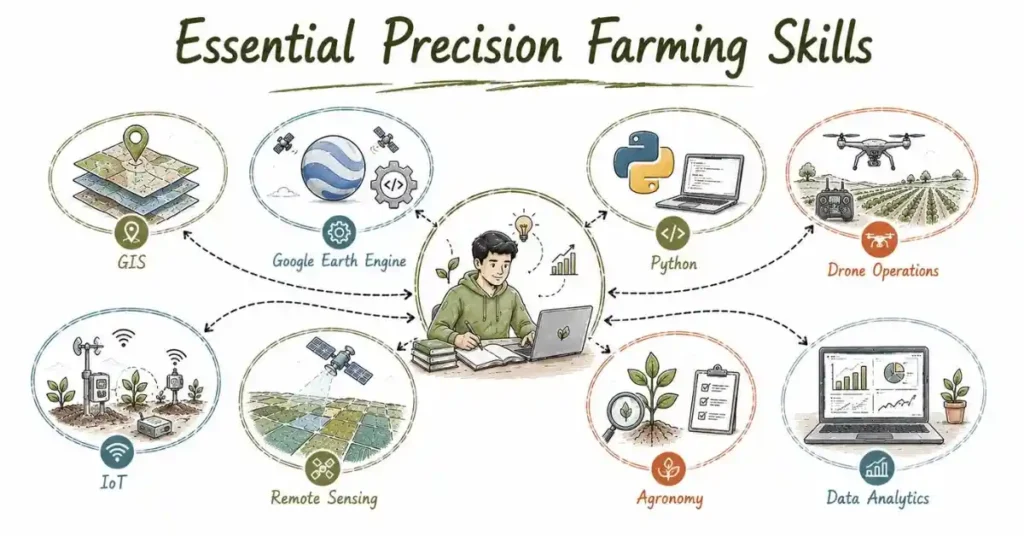
Technical Skills
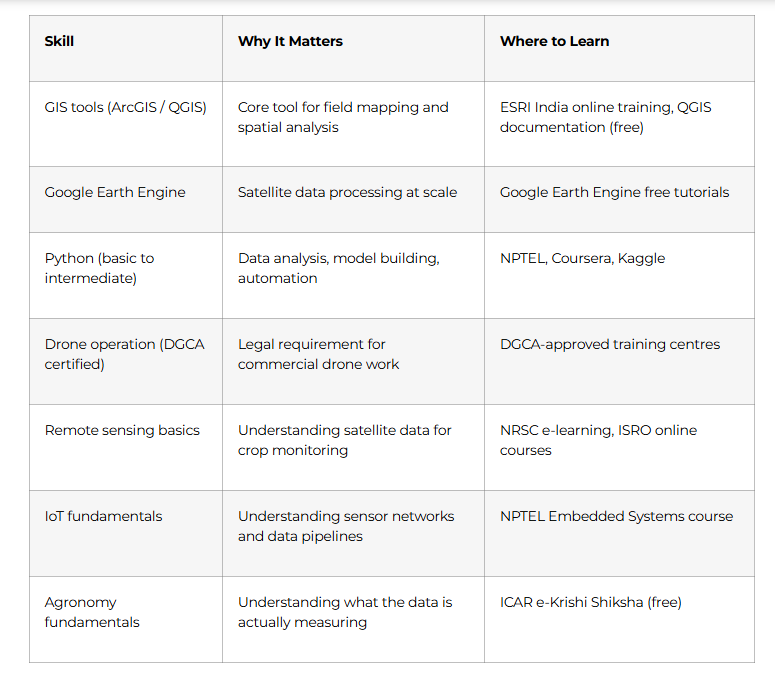
Soft Skills That Precision Farming Employers Specifically Look For
Farmer communication: Can you explain what NDVI means to a farmer in Telugu or Marathi without using the word NDVI? That skill is worth more than a certification.
Field adaptability: Precision farming field work happens in all weather, across uneven terrain, in locations far from cities. Employers will probe for this in interviews.
Attention to data quality: Bad sensor data produces bad recommendations. The discipline to flag anomalies, question outliers, and maintain data integrity is fundamental to every precision farming role.
Cross-functional collaboration: In most precision farming companies, agronomists, developers, and business teams work closely together. Your ability to translate between technical and non-technical colleagues is a genuine career accelerator.
Top Precision Farming Companies in India: Where to Apply
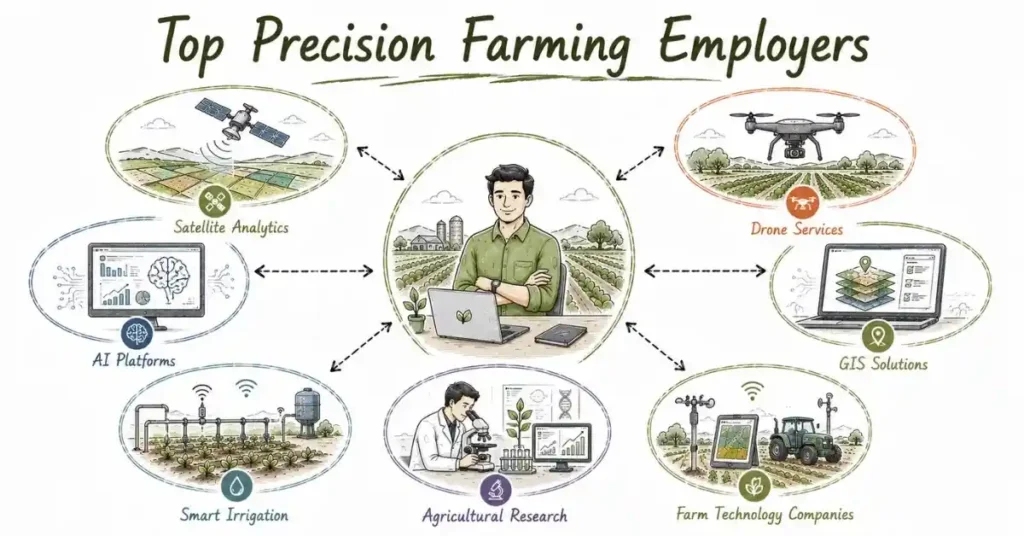
SatSure: Bengaluru-based satellite analytics company working on crop monitoring and agricultural insurance verification. Strong data science and remote sensing team. One of India’s most technically sophisticated precision farming employers.
Cropin: Bengaluru-based digital agriculture platform working with large agri-corporations and governments globally. Strong product and data science hiring. Their SmartFarm platform monitors millions of acres across multiple countries.
Fasal: Pune-based IoT precision irrigation company. Strong hardware-software integration team. Focused on high-value crops grapes, pomegranate, strawberry in Maharashtra and Karnataka.
BharatAgri: Pune-based AI crop advisory platform. Strong mobile product and agronomy team. Particularly active in hiring agronomists who want to work with technology.
Intello Labs: Gurugram-based computer vision company applying AI to agricultural produce quality grading. Unique intersection of precision technology and post-harvest supply chain.
ESRI India: Indian subsidiary of the global GIS leader. Hires GIS analysts and solutions engineers with agricultural remote sensing applications.
Mahindra Agri Solutions: Large corporate with precision farming services embedded in their broader agri-business. More structured entry-level programmes than startups.
ISRO / NRSC Hyderabad: For research-oriented candidates. The National Remote Sensing Centre runs agricultural monitoring programmes and recruits scientists and research associates.
How to Get Your First Precision Farming Job in India
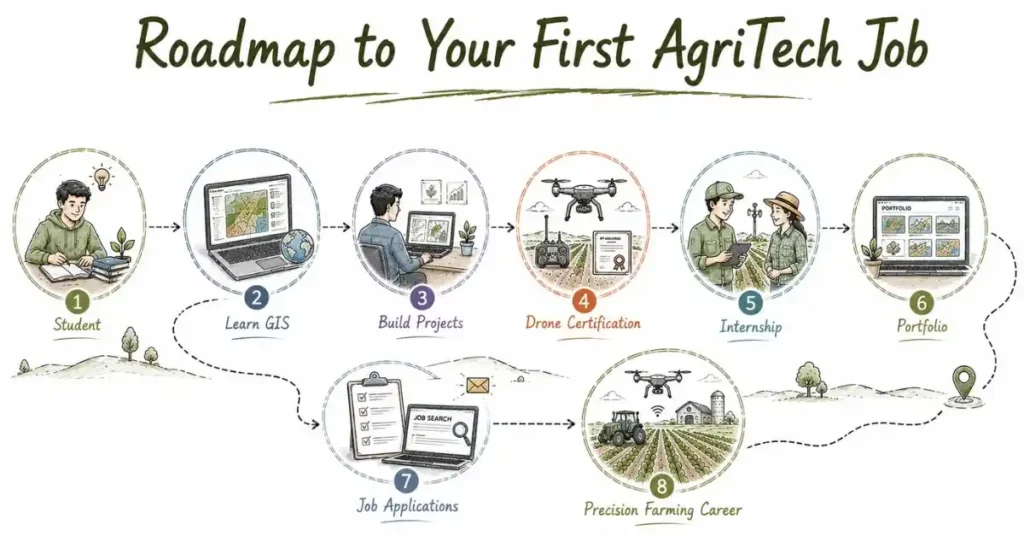
If You Are a Fresh Graduate
Step 1: Get one concrete technical credential. Either complete a GIS certification (ESRI or QGIS-based) or get your DGCA drone pilot certificate. Do not try to do both at once.
Step 2: Build one visible project. Map your own locality using QGIS and publish the result. Analyse publicly available NDVI data for a farm district and write a one-page interpretation. These demonstrate applied ability, not just theoretical knowledge.
Step 3: Apply specifically, not broadly. Write a targeted application to three companies rather than mass-applying to 50 with a generic CV. Name their product. Show you understand their specific approach.
If You Are an Experienced Agronomist Upskilling
Your advantage is domain knowledge do not downplay it. Lead with your crop and soil expertise in every application. The technical skills are learnable; your 5 years of field experience reading crop stress is not.
Target roles with “Senior” or “Lead” in the title even at your first precision farming job. Companies will pay for experience but only if you position yourself correctly.
If You Are a Tech Graduate Pivoting Into AgriTech
Take three weeks to complete ICAR e-Krishi Shiksha free modules on crop management and soil health. This basic domain knowledge transforms your interview performance. Then apply for IoT Engineer, GIS Analyst, or Data Scientist roles where your technical skills are the primary qualification and agricultural knowledge is secondary.
Salary Growth Path in Precision Farming
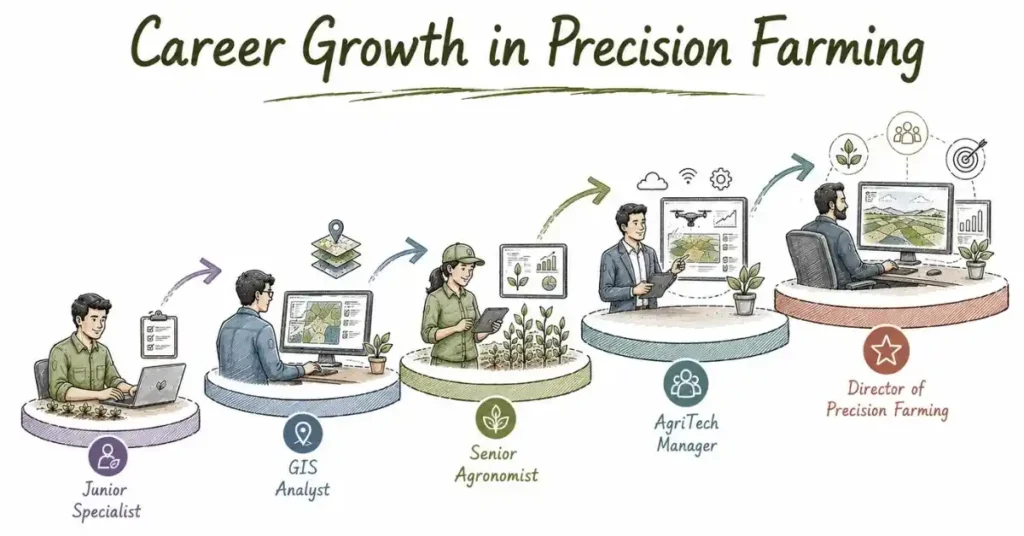
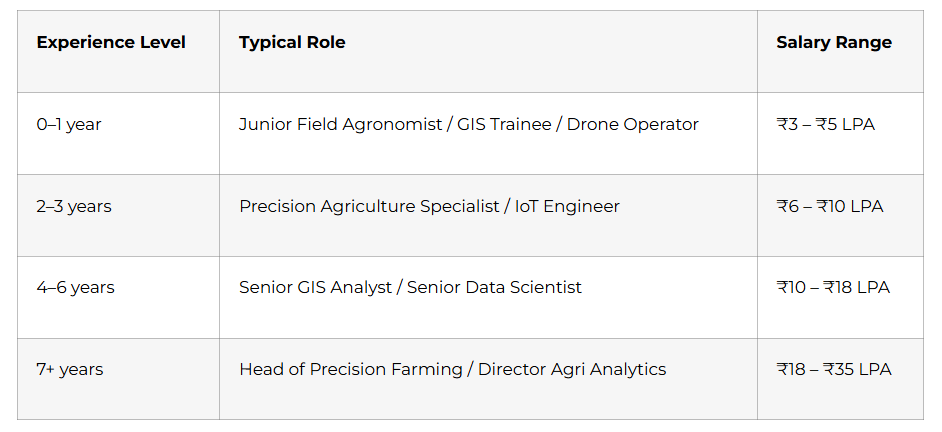
Salary growth in precision farming is faster than traditional agriculture roles because the talent pool is smaller. People who combine domain agronomy knowledge with technical skills are particularly scarce and that specific combination commands premium compensation.
One Honest Reality Check
Precision farming in India is still in its early-to-mid growth phase. You will not find the same volume of job postings as in IT or banking. In any given month, there may be 200–400 active precision farming job listings nationally on LinkedIn and Naukri combined.
What this means for you: quality of application matters far more than volume. One well-researched, targeted application to SatSure or Fasal where you demonstrate you understand their technology and their farmer context will outperform 100 generic applications every time.
The market is small but growing fast. Get in early, build genuine skills, and the career trajectory is strong.