
Blockchain Programming Skills : Essential Languages Guide
Table of Contents
Introduction: Which Languages Actually Get You Hired?
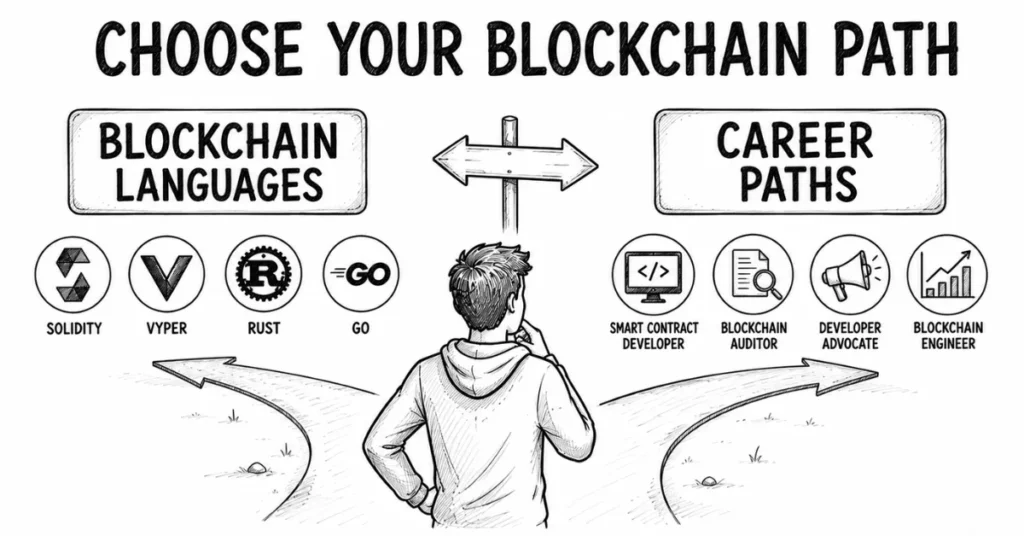
Every aspiring blockchain developer faces the same early decision: which programming language should I learn first? The answer determines not just your learning path but your career trajectory which blockchain ecosystem you join, what roles you qualify for, and how much you earn. Choose wisely and you’re in demand across hundreds of companies. Choose poorly and you’ve invested months learning a language with limited job market relevance.
In 2026, blockchain programming has a clear hierarchy. Solidity remains the dominant smart contract language, used across Ethereum and all EVM-compatible chains. Rust powers the highest-performance blockchain systems including Solana and Polkadot. Go is the language of blockchain infrastructure Ethereum’s Geth client, Hyperledger Fabric, and many enterprise blockchain systems are built with it. Python and JavaScript serve as supporting languages for tooling, testing, analytics, and frontend development.
Understanding this landscape before investing hundreds of learning hours is the difference between a targeted career-building investment and scattered effort without clear payoff. This guide explains every major blockchain programming language, who should learn each one, what jobs it unlocks, and gives you a clear learning sequence based on your starting point and career goals.
The Blockchain Language Stack: A Complete Overview
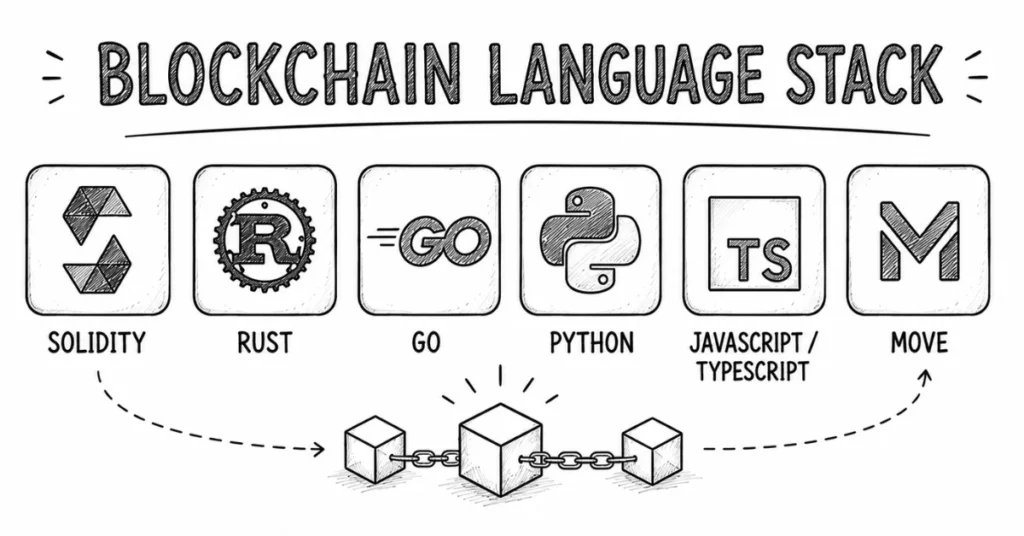
Solidity: The Smart Contract Standard
Solidity was designed specifically for the Ethereum Virtual Machine (EVM) in 2014 by Ethereum core developer Gavin Wood. It remains the single most important language for smart contract development in 2026.
What Solidity is used for:
- Smart contract development on Ethereum
- dApp logic on all EVM-compatible chains: Polygon, Arbitrum, Optimism, Avalanche C-Chain, BNB Smart Chain, Fantom
- NFT contracts (ERC-721, ERC-1155)
- DeFi protocols (AMMs, lending, yield farming)
- DAO governance contracts
- Token creation (ERC-20)
Why learn Solidity:
Every blockchain job posting for smart contract development lists Solidity. Learning Solidity opens opportunities across the entire EVM ecosystem—not just Ethereum but every chain using the same virtual machine architecture. A single Solidity codebase can deploy to a dozen chains.
Syntax and Learning Curve:
Solidity’s syntax resembles JavaScript and C++ with blockchain-specific additions. For developers already familiar with JavaScript, the learning curve is moderate—approximately 4–6 weeks to write basic contracts, 3–4 months to write production-quality code. For complete beginners, 6–8 months to employable level.
Salary impact:
Smart contract developers with strong Solidity skills earn ₹8–25 lakhs in India, with international positions paying $60,000–150,000.
Learning Resources:
- CryptoZombies (free, gamified Solidity tutorial)
- Solidity documentation (official, comprehensive)
- Cyfrin Updraft (free, project-based curriculum)
- Patrick Collins’ Solidity course on YouTube (free, 32+ hours)
- Buildspace projects (free, build real projects)
Rust: The Performance Powerhouse
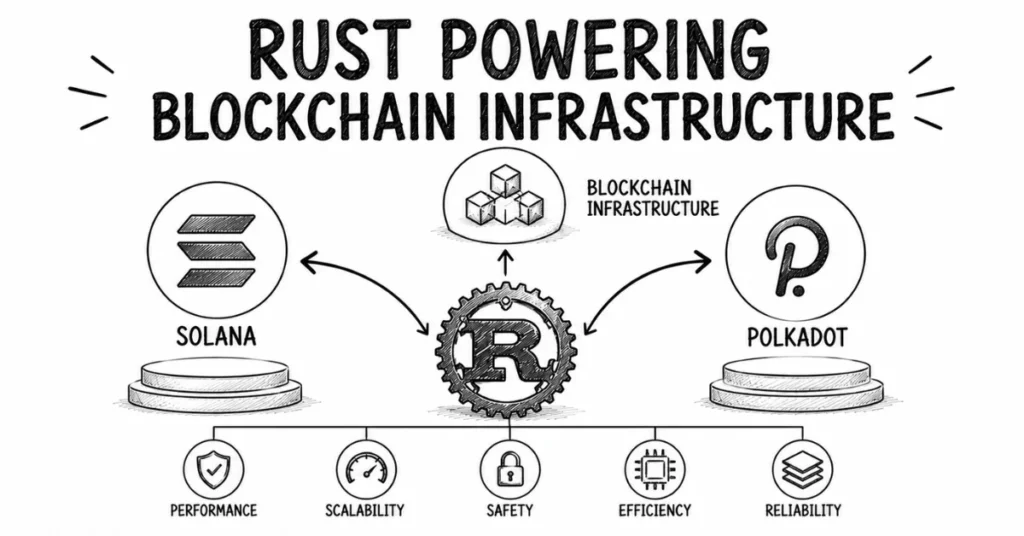
Rust has become the second most important blockchain language, powering some of the highest-throughput blockchain platforms in existence.
What Rust is used for:
- Solana smart contracts (programs): Solana is built in Rust, and its smart contracts (called “programs”) are written in Rust
- Polkadot/Substrate: Polkadot’s Substrate framework for building custom blockchains uses Rust
- Near Protocol: Smart contracts in Rust
- Blockchain core infrastructure: Building blockchain nodes and protocol implementations
- WebAssembly (WASM) contracts: New EVM alternatives supporting WASM use Rust
Why Rust commands a premium:
Rust is genuinely difficult to learn—its ownership model and borrow checker are unlike any other language. This difficulty creates a supply shortage of skilled Rust developers, driving compensation significantly above Solidity developers.
Salary impact:
Rust blockchain developers earn ₹12–30 lakhs in India, with international remote positions at $80,000–180,000—reflecting the scarcity premium.
Learning Curve:
Rust has a steep learning curve—typically 6–9 months before writing production-quality blockchain code. Prior experience with C++ or systems programming helps significantly.
Who should learn Rust:
- Developers targeting Solana development (massive ecosystem)
- Those interested in building blockchain infrastructure (not just dApps)
- Developers willing to invest time for premium compensation
- Computer science graduates comfortable with low-level memory concepts
Learning Resources:
- The Rust Book (official, free online)
- Rustlings (interactive exercises)
- Solana Cookbook (Rust for Solana specifically)
- Anchor Framework documentation (high-level Solana development)
Go (Golang): The Infrastructure Language
Go was developed by Google and has become the preferred language for blockchain infrastructure—building the nodes, protocols, and systems that run blockchain networks.
What Go is used for:
- Ethereum Geth Client: The most widely used Ethereum node implementation is written in Go
- Hyperledger Fabric: The most popular enterprise blockchain platform uses Go for chaincode (smart contracts)
- Cosmos SDK: Building custom application-specific blockchains
- Cross-chain communication: Building blockchain bridges and relay systems
- Blockchain APIs and services: Building high-performance backend services for blockchain applications
Why Go for blockchain:
Go’s combination of performance, simplicity, and excellent concurrency support makes it ideal for distributed systems—which is exactly what blockchains are. Its statically typed nature prevents many classes of bugs, its goroutines enable efficient concurrent processing, and its clean syntax is accessible to developers coming from Java or Python.
Salary impact:
Go blockchain developers earn ₹10–22 lakhs in India, with infrastructure roles at major companies paying ₹25–40 lakhs. Enterprise blockchain positions using Hyperledger Fabric actively hire Go developers.
Who should learn Go:
- Developers targeting enterprise blockchain (banks, supply chain companies)
- Those interested in building blockchain infrastructure rather than dApps
- Backend engineers transitioning to blockchain
- Developers interested in Cosmos ecosystem and cross-chain development
Learning Resources:
- Tour of Go (official interactive tutorial)
- Go by Example (practical code examples)
- Hyperledger Fabric documentation (Go chaincode)
- Cosmos Academy (Cosmos SDK development)
Python: The Analyst and Tooling Language
Python isn’t a primary smart contract language, but it plays crucial supporting roles across blockchain development, research, and analytics.
What Python is used for:
- Blockchain analytics: Data analysis, on-chain metrics, tokenomics modeling
- Smart contract testing: Brownie framework uses Python for Ethereum testing
- Algorithmic trading: Building crypto trading bots and backtesting systems
- Machine learning for crypto: Predictive models for prices, anomaly detection
- Blockchain scripting: Automating blockchain interactions with Web3.py
- DeFi protocol research: Modeling economic systems and running simulations
Python’s blockchain advantage:
Python’s ecosystem is unmatched for data work—pandas, NumPy, matplotlib, scikit-learn—making it the dominant language for quantitative crypto research and analytics. For non-developers entering blockchain, Python provides a gentler learning curve than Solidity while opening doors in analytics, research, and trading.
Salary impact:
Python blockchain developers (analytics/quant focus) earn ₹10–20 lakhs in India. Python combined with blockchain knowledge positions you strongly for crypto analyst, tokenomics, and quant trader roles.
Who should learn Python:
- Analytics professionals entering blockchain
- Aspiring crypto quantitative analysts
- Tokenomics specialists
- Blockchain researchers and academics
- Anyone building trading bots or market analysis tools
JavaScript/TypeScript: The Frontend and Tooling Standard
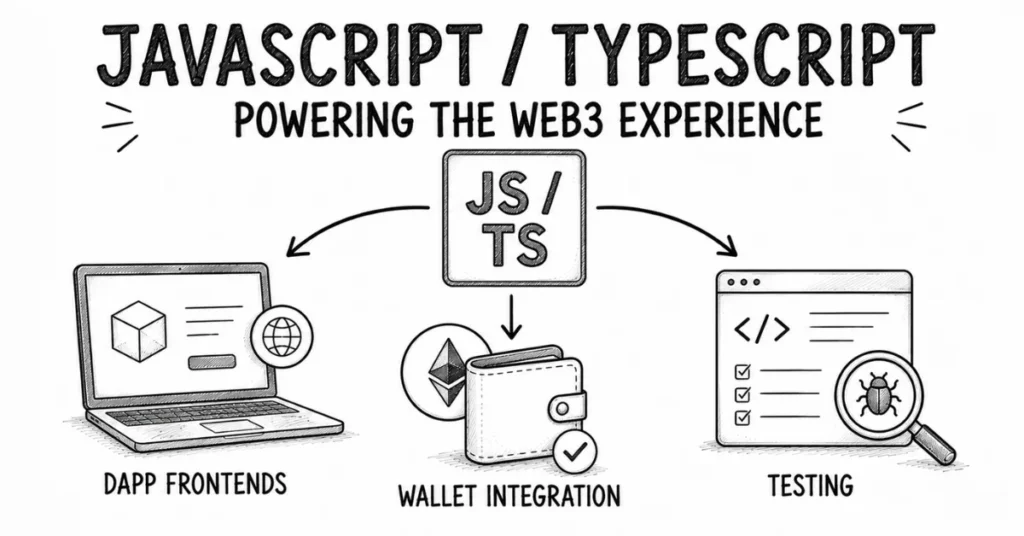
JavaScript (and its typed superset TypeScript) remains essential for building the user-facing layer of blockchain applications.
What JavaScript is used for:
- dApp frontends: React.js applications connecting to smart contracts
- Web3 libraries: ethers.js and web3.js (the primary libraries for interacting with Ethereum from JavaScript)
- Smart contract testing: Hardhat and Truffle both use JavaScript/TypeScript for test scripts
- Node.js backends: Server-side services supporting blockchain applications
- Wallet integration: MetaMask and WalletConnect integration code
The ethers.js and web3.js importance:
These two libraries are how virtually every dApp frontend communicates with blockchain networks. Any developer building user interfaces for blockchain applications must know them. ethers.js has become the more popular choice in 2026 for its cleaner API and comprehensive documentation.
Salary impact:
JavaScript blockchain developers (fullstack Web3) earn ₹8–18 lakhs in India. TypeScript specifically is increasingly required for professional-grade Web3 development.
Who should learn JavaScript:
- Frontend developers transitioning to Web3
- Fullstack developers wanting to build complete dApps
- Anyone building smart contract testing suites
- UI/UX developers entering blockchain
Move Language: The Emerging Contender
Move is a newer smart contract language developed by Meta (Facebook) for the Diem blockchain, now used by Aptos and Sui—two high-performance Layer 1 blockchains gaining significant traction.
What Move offers:
- Resource-oriented programming model preventing accidental token duplication
- Formal verification capabilities built into language design
- Strong safety guarantees reducing smart contract vulnerabilities
- Growing ecosystem with significant venture capital backing
Career relevance: Still emerging but worth monitoring. Aptos and Sui have attracted billions in funding and developer interest. Move developers are extremely scarce, commanding premium rates.
Who should consider Move:
Developers willing to bet on newer ecosystems for early-mover advantages. Not recommended as a first language, but valuable as a specialization after Solidity or Rust mastery.
Language Combinations by Career Path
Different blockchain careers require different language combinations:
Career Role | Primary Language | Supporting Languages | Learning Priority |
Smart Contract Dev | Solidity | JavaScript/TypeScript | Solidity first |
Solana Developer | Rust | TypeScript | Rust foundation required |
Enterprise Blockchain | Go | Java, JavaScript | Go + Hyperledger |
DeFi Protocol Engineer | Solidity + Rust | Python | Both ecosystems |
Blockchain Analyst | Python | SQL, JavaScript | Python analytics focus |
Web3 Frontend Dev | JavaScript/TypeScript | Solidity (reading) | JS/TS foundation |
Blockchain QA Engineer | JavaScript/TypeScript | Solidity (reading) | Testing frameworks |
Blockchain Researcher | Python | Rust, Solidity | Python modeling |
Recommended Learning Sequences
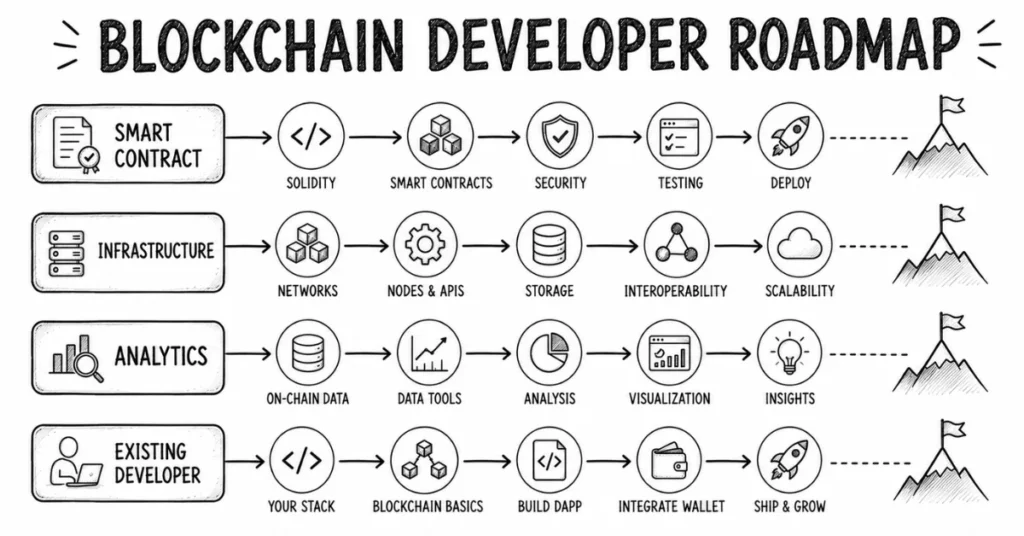
For Complete Beginners
Sequence A: Smart Contract Focus (6–8 Months)
- JavaScript fundamentals (4–6 weeks) — foundation for testing and frontend
- Solidity basics with CryptoZombies (4 weeks)
- Hardhat development environment (2 weeks)
- Build 3 practice projects (6 weeks)
- Smart contract security basics (4 weeks)
- Portfolio project + job search (4 weeks)
Sequence B: Infrastructure Focus (8–12 Months)
- Go fundamentals from Tour of Go (4–6 weeks)
- Blockchain and distributed systems concepts (4 weeks)
- Hyperledger Fabric development (6–8 weeks)
- Enterprise blockchain project (8 weeks)
- Advanced Go patterns for blockchain (4 weeks)
- Portfolio + job applications (4 weeks)
Sequence C: Analytics Focus (5–6 Months)
- Python fundamentals (4–6 weeks)
- pandas and data analysis (4 weeks)
- Blockchain fundamentals and on-chain data (3 weeks)
- Dune Analytics and SQL (3 weeks)
- Tokenomics modeling project (4 weeks)
- Portfolio + job search (4 weeks)
For Existing Developers
Web Developer (JavaScript background):
Add ethers.js (1 week), then Solidity (6–8 weeks). You’re qualified for Web3 frontend roles within 3 months and fullstack Web3 roles within 5–6 months.
Backend Developer (Java/C++ background):
Go is most accessible (similar paradigms). Add Hyperledger for enterprise blockchain or learn Rust for high-performance blockchain. Timeline: 3–4 months to first blockchain role.
Data Scientist (Python background):
Add blockchain fundamentals and Web3.py (3–4 weeks), then specialize in on-chain analytics with Dune and Glassnode. Timeline: 2–3 months to analytics roles.
India-Specific Language Demand
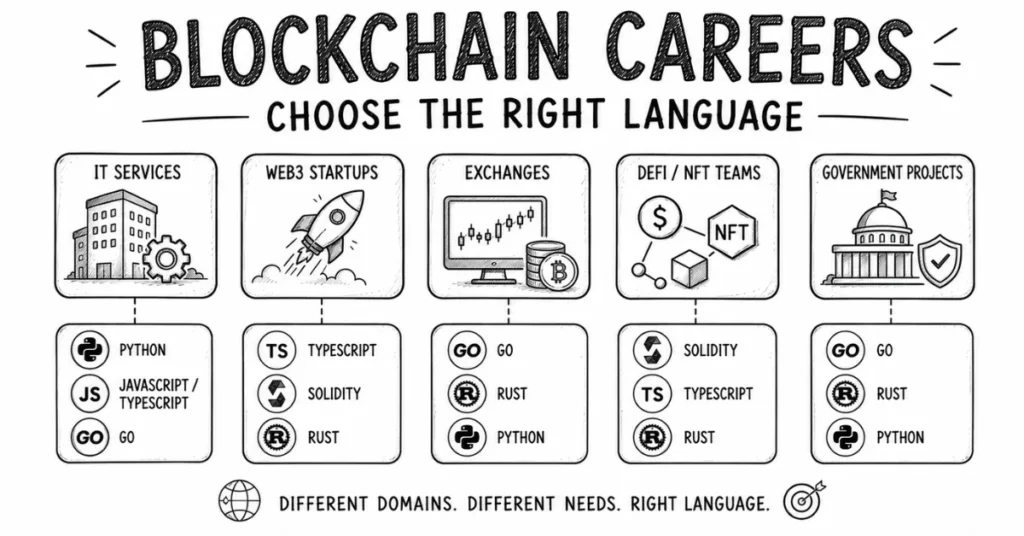
India’s blockchain job market shows specific language preferences by sector:
IT Services (TCS, Infosys, Wipro, HCL): Primarily Go and Java for Hyperledger Fabric enterprise blockchain projects serving banking and supply chain clients.
Web3 Startups: Solidity overwhelmingly dominant, with growing TypeScript and JavaScript requirements for fullstack roles.
Crypto Exchanges: Mix of languages—backend services in Go or Node.js, smart contract integration with JavaScript, analytics in Python.
DeFi/NFT Projects: Solidity as primary, with Rust increasingly required for protocols with Solana components or cross-chain functionality.
Government and PSU Blockchain Projects: Go and Java for Hyperledger-based implementations (National Blockchain Framework uses Hyperledger).