
Blockchain Technical Writer Career : Complete Career Guide
Table of Contents
Introduction: The Translator Between Complex Technology and Real Understanding
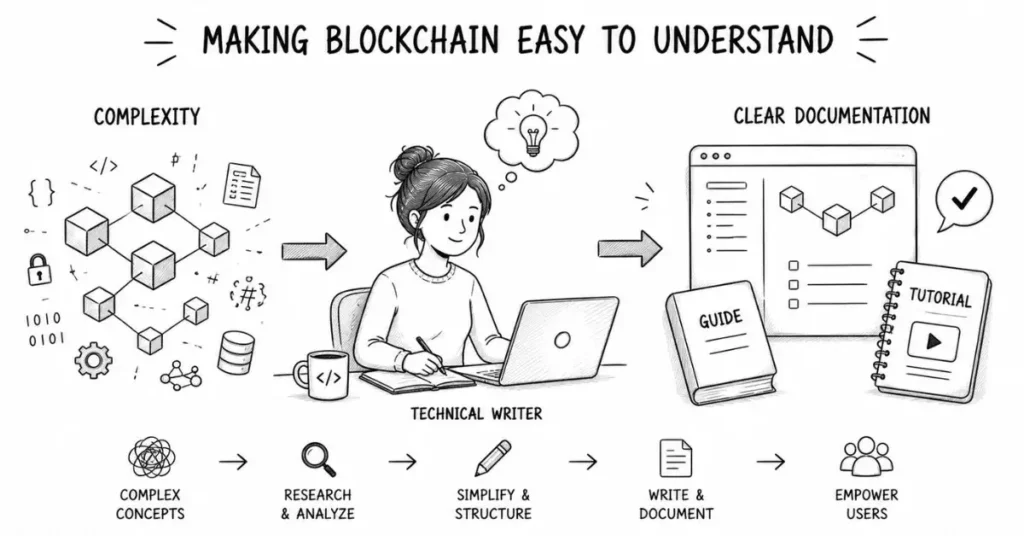
Here’s a problem that every blockchain project faces: their technology is genuinely brilliant, their smart contracts are elegantly written, their protocol design is innovative but nobody outside the development team fully understands what it does or how to use it. This gap between technical complexity and user comprehension is both the blockchain industry’s biggest adoption barrier and a significant career opportunity for skilled communicators.
Blockchain technical writers and educators are the professionals who bridge this gap. They translate complex cryptographic concepts into clear documentation, create tutorials that guide developers through their first smart contract deployment, produce educational content that helps students understand DeFi mechanics, and write the guides that enable businesses to evaluate blockchain solutions confidently.
This career path is uniquely accessible because it values clear thinking and excellent communication above deep technical development expertise. You don’t need to be a Solidity developer to explain how smart contracts work you need to understand them well enough to explain them accurately and teach others effectively. For professionals with strong writing skills who are fascinated by blockchain technology, technical writing represents perhaps the most natural entry point into the industry.
The financial rewards are competitive and growing. Blockchain technical writers globally earn $51,000–$77,000 annually, with companies like SupraOracles actively posting positions in Indian cities like Kolkata. In India, technical writers with blockchain specialization earn ₹6–15 lakhs domestically, with international remote positions accessible to those with strong English writing skills and blockchain knowledge. Developer advocates the senior evolution of technical writing roles combining documentation with community engagement earn $80,000–$150,000 at major blockchain infrastructure companies.
For teachers, content creators, journalists, or any professional with strong writing and communication skills who wants to build a blockchain career without becoming a developer, this guide provides your complete roadmap.
What Blockchain Technical Writers Actually Do
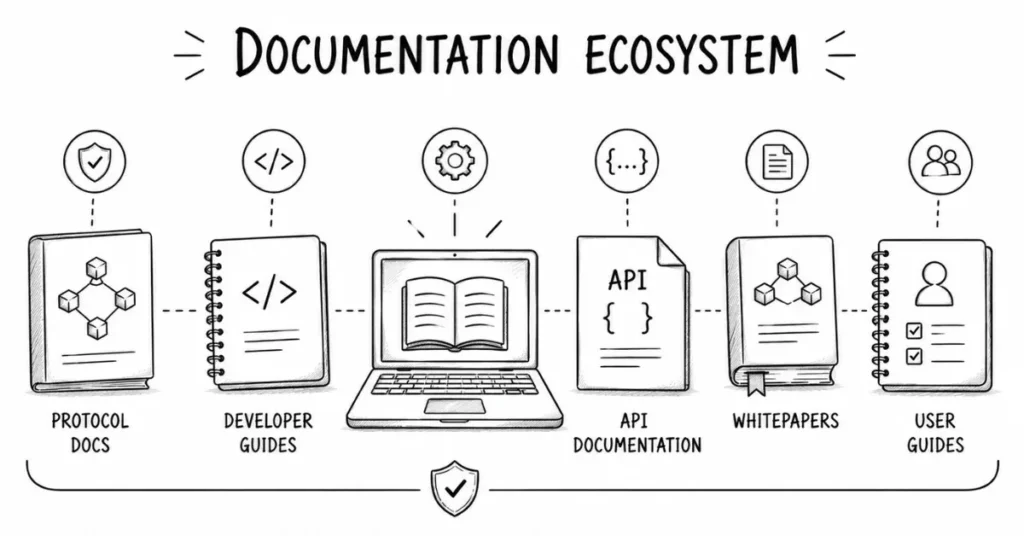
Core Documentation Responsibilities
Protocol and Smart Contract Documentation:
Every deployed smart contract needs documentation explaining what it does, how to interact with it, what parameters each function accepts, and what return values mean. Technical writers create this documentation working closely with developers.
Quality smart contract documentation includes:
- Overview: What the contract does and why it exists
- Function reference: Every function, its parameters, return values, events emitted, and potential errors
- Integration guides: How developers call this contract from other contracts or frontends
- Security considerations: Known limitations, access controls, and safe usage patterns
- Deployment information: Contract addresses across networks, ABI files
Poor documentation is one of the biggest reasons developers don’t integrate with blockchain protocols—excellent technical writers directly impact protocol adoption.
Developer Guides and Tutorials:
Step-by-step tutorials guide developers from zero to working implementation:
- “Set up your first Hardhat development environment”
- “Deploy your first ERC-20 token to Ethereum testnet”
- “Connect your React frontend to a deployed smart contract”
- “Implement MetaMask wallet authentication in your dApp”
These guides must be technically accurate (code examples must actually work), pedagogically sound (introducing concepts in logical order), and practically useful (achieving something real by the end).
API and SDK Documentation:
Blockchain infrastructure companies (Alchemy, Infura, The Graph, Chainlink) need comprehensive API documentation explaining every endpoint, parameter, and response format. This documentation directly determines how easily developers adopt their services.
Whitepapers and Technical Papers:
Blockchain projects publish whitepapers explaining their technology, economics, and vision. Technical writers often collaborate with founders and researchers to transform highly technical internal documents into polished external communications.
Quality whitepapers require:
- Accurate technical content
- Clear logical flow from problem to solution
- Accessible language for non-expert readers
- Professional presentation and formatting
- Balance between technical depth and readability
User Documentation:
Beyond developer documentation, protocols need user guides explaining how regular users interact with their products:
- “How to connect your wallet to [Protocol Name]”
- “How to provide liquidity and earn fees”
- “Understanding your portfolio dashboard”
- “How to vote on governance proposals”
These guides target non-technical users—requiring even clearer writing and careful avoidance of unexplained jargon.
The Educator Role: Beyond Documentation

Blockchain Educator Responsibilities
Blockchain educators go beyond documentation to actively teach blockchain concepts through courses, workshops, and educational content.
Online Course Creation:
Building structured learning experiences covering blockchain topics:
- Course curriculum design (what concepts in what order?)
- Video scripting and production coordination
- Quiz and assessment creation
- Project assignments and rubrics
- Course updates as technology evolves
EdTech companies serving blockchain education—including Frontlines Edutech—need educators who combine blockchain knowledge with instructional design expertise. This specific combination is relatively rare and highly valued.
Workshop and Bootcamp Facilitation:
Conducting in-person or virtual workshops for developers learning blockchain, business professionals evaluating blockchain adoption, or students beginning blockchain careers.
Workshop facilitation requires different skills than writing—real-time adaptation to audience understanding, managing group dynamics, and creating engaging interactive exercises.
Video Content Creation:
YouTube and video platforms are primary learning channels for blockchain developers. Technical educators creating video tutorials, concept explanations, and project walkthroughs build audiences that drive protocol adoption and career opportunities.
Successful blockchain YouTube channels have millions of subscribers. Even mid-tier channels (10,000–100,000 subscribers) create significant income through sponsorships and course sales.
Educational Blog Writing:
Long-form blog posts explaining blockchain concepts drive organic search traffic and establish professional credibility. Many blockchain companies maintain engineering blogs where technical writers publish educational content driving developer adoption.
Developer Advocacy:
Developer advocates combine technical writing, education, community engagement, and product feedback in a single role:
- Create content (documentation, tutorials, blog posts, videos) helping developers use the product
- Engage developer communities at conferences, online forums, and social media
- Collect developer feedback and advocate for product improvements internally
- Build personal brand as trusted expert in the ecosystem
This is the senior evolution of technical writing—developer advocates at major blockchain infrastructure companies earn $80,000–$150,000+ annually.
Required Skills for Blockchain Technical Writing
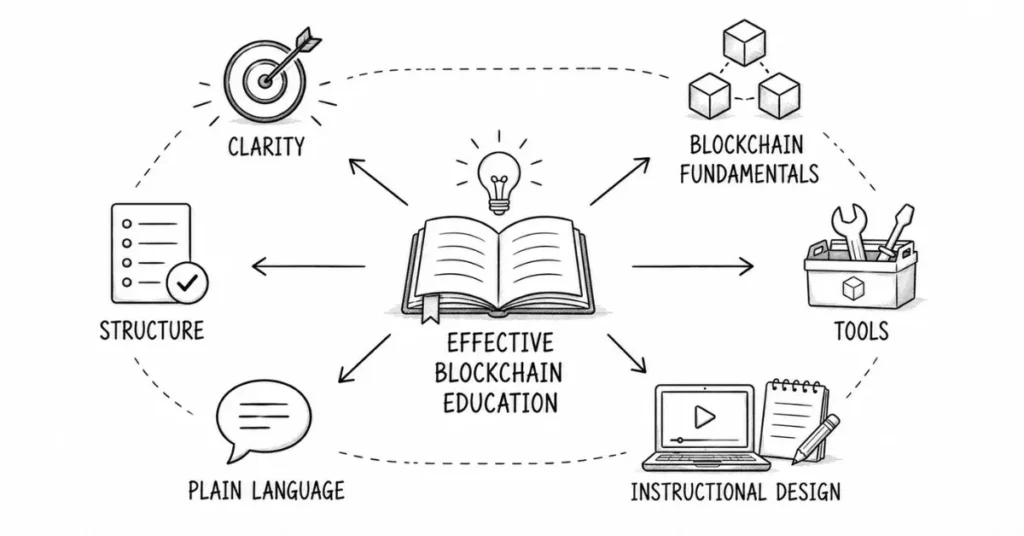
Writing and Communication Fundamentals
Technical Writing Principles:
Technical writing is a distinct discipline with specific conventions:
- Clarity over cleverness: Every sentence should have exactly one clear meaning
- Active voice: “The function returns the balance” not “The balance is returned by the function”
- Second person: “You can call this function with…” not “Users can call this function with…”
- Progressive disclosure: Introduce concepts from simple to complex
- Consistent terminology: Never use multiple terms for the same concept
- Document the why, not just the what: Explain why something works the way it does, not just how to use it
Structured Writing:
Technical documentation follows predictable structures that readers navigate quickly. Learning to use:
- Consistent heading hierarchies (H1 for topic, H2 for sections, H3 for subsections)
- Numbered lists for sequential steps
- Bulleted lists for non-sequential items
- Tables for comparative information
- Code blocks for all code samples
- Notes/warnings/tips callout boxes
Plain Language:
Blockchain is full of jargon that excludes newcomers. Exceptional technical writers explain concepts in everyday language: “A smart contract is like a vending machine—put money in, select what you want, get your item automatically without needing a shopkeeper.”
This ability to find the right analogy, the clearest everyday explanation, and the simplest accurate description is the core skill separating good technical writers from great ones.
Technical Knowledge Requirements
Blockchain Fundamentals (Essential):
You must genuinely understand what you document. Minimum required knowledge:
- How blockchains work: nodes, consensus, blocks, transactions
- What smart contracts are and how they execute
- Basic Solidity reading ability (not writing—just enough to understand code you’re documenting)
- Key blockchain platforms: Ethereum, Polygon, Solana, BNB Chain
- Common protocols: what DEXs, lending protocols, NFTs, DAOs are and how they work
- Web3 development workflow: wallets, testnets, deployment, verification
Enough to Run Code Examples:
Good technical documentation tests every code example to confirm it works. You don’t need to write complex smart contracts, but you must be able to:
- Set up a development environment
- Follow tutorials to deploy contracts
- Test API calls and confirm responses
- Identify when code examples don’t work
This “technically literate” level—not developer expertise, but genuine hands-on capability—distinguishes blockchain technical writers who produce accurate documentation from those who produce plausible-sounding but incorrect documentation.
Documentation Tools:
- Markdown: The standard format for technical documentation
- Git/GitHub: Version control for documentation alongside code
- Docusaurus/GitBook/ReadTheDocs: Common blockchain documentation platforms
- Confluence: Enterprise documentation for internal technical docs
- Notion: Increasingly popular for blockchain team documentation
For Educators:
- Learning Management Systems: Teachable, Thinkific, Graphy, Learnworlds
- Video Production: Basic video recording and editing (Loom for quick tutorials, DaVinci Resolve or Premiere for professional production)
- Slide Creation: Clear visual presentation design
- SEO fundamentals: Getting educational content discovered by students searching for blockchain learning resources
Specialization Paths Within Blockchain Technical Writing

Developer Documentation Specialist
Focuses exclusively on documentation for developers—smart contract APIs, SDK references, integration guides. Requires deepest technical knowledge but commands highest compensation.
Key Skills:
- Reading and understanding Solidity code accurately
- JavaScript/TypeScript familiarity for Web3 frontend documentation
- Understanding of blockchain development workflows
- API documentation standards and tools
Best Employers:
Blockchain infrastructure companies (Alchemy, Infura, Chainlink, The Graph), DeFi protocols with developer ecosystems, Layer 1/2 blockchain networks
Salary: ₹10–18 lakhs in India; $60,000–100,000 internationally
User-Facing Content Specialist
Focuses on documentation and content for non-technical end users—how to use wallets, interact with DeFi protocols, understand NFT purchases.
Key Skills:
- Empathy for non-technical audiences
- UX writing and microcopy skills
- User journey mapping
- Ability to translate technical processes into simple step-by-step guides
Best Employers:
Cryptocurrency exchanges (WazirX, CoinDCX), NFT platforms, consumer-facing DeFi products
Salary: ₹6–12 lakhs in India; $45,000–75,000 internationally
Educational Content Creator
Focuses on building structured learning experiences for students and professionals learning blockchain.
Key Skills:
- Instructional design principles
- Curriculum development
- Video scripting and production
- Assessment design
- SEO for educational content
Best Employers:
EdTech companies (Frontlines Edutech and similar), blockchain training providers, protocols building developer education programs, online course platforms
Salary: ₹7–15 lakhs in India; $50,000–85,000 internationally
Specific Opportunity for Frontlines Edutech:
As a blockchain career guide content creator for an EdTech company, you’re already doing this work. The skills involved in creating this master guide and subtopic series—researching blockchain career paths, writing comprehensive educational content, structuring information for student audiences—are exactly what blockchain educational content specialists do professionally. This series itself is a portfolio piece.
Developer Advocate
The senior evolution of technical writing—combining documentation, community engagement, and product representation.
Key Skills:
- All technical writing skills above
- Public speaking and conference presentation
- Community building and engagement
- Product feedback synthesis
- Social media presence and thought leadership
Best Employers:
Major blockchain infrastructure companies (Alchemy, Infura, Polygon, Chainlink, ConsenSys), Layer 1 blockchain foundations (Ethereum Foundation, Solana Foundation)
Salary: ₹15–28 lakhs in India; $80,000–150,000+ internationally
Learning Path: From Writer to Blockchain Technical Writer
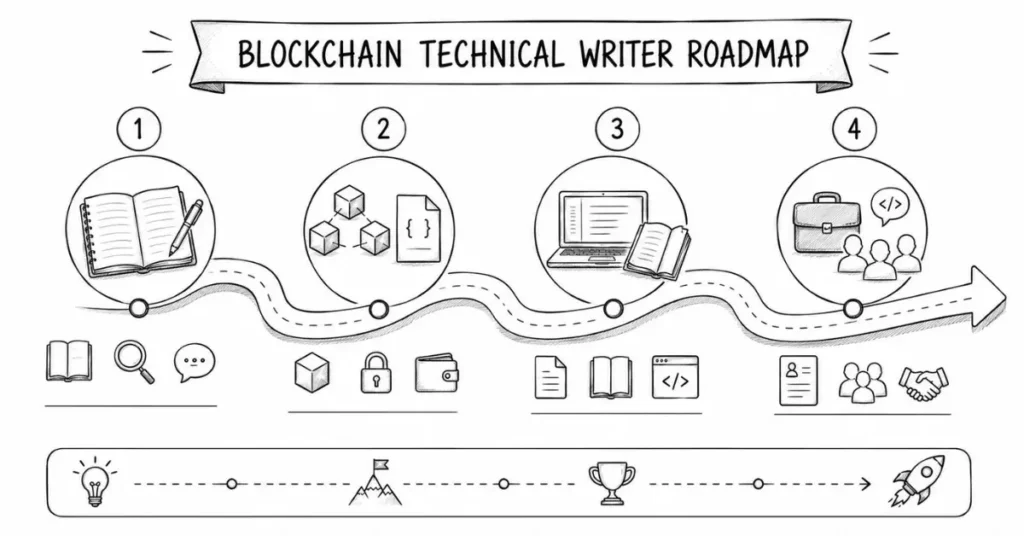
Phase 1: Technical Writing Foundations (4–6 Weeks)
If you already write professionally (content marketing, journalism, academic writing):
- Study technical writing specifically: Read “Developing Quality Technical Information” (IBM Press) or free Google Technical Writing courses
- Practice rewriting complex technical passages in plain language
- Learn Markdown syntax (2–3 hours of practice)
- Study 5–10 examples of excellent blockchain documentation (Ethereum docs, Uniswap docs, Aave docs) analyzing what makes them effective
If you’re newer to professional writing:
- Complete Google’s free Technical Writing courses (Technical Writing One and Two)
- Write 10 practice tutorials on any technical topic you know well
- Get feedback from peers and online communities
- Build writing habit with daily 500-word technical explanations
Phase 2: Blockchain Knowledge Building (4–6 Weeks)
- Complete a blockchain fundamentals course focusing on concepts rather than development
- Follow Ethereum documentation tutorials—set up MetaMask, interact with testnet, deploy a simple contract using step-by-step guide
- Use a DeFi protocol (Uniswap, Aave on testnet)—understand the user experience you’ll document
- Read documentation of 5 major protocols evaluating quality, structure, and gaps
- Join blockchain developer Discord communities and observe the questions developers ask repeatedly (these become documentation gaps you can fill)
Phase 3: Portfolio Development (4–6 Weeks)
Project 1: Improve Existing Documentation
Find a blockchain project with poor documentation (many exist). Rewrite one section of their documentation substantially improving clarity and structure. Publish your improved version on GitHub and contact the project offering your improvement.
Project 2: Create a Missing Tutorial
Identify a common blockchain development task with no good tutorial. Write it comprehensively—from environment setup through working implementation. Publish on Medium, Dev.to, or Hashnode.
Project 3: Educational Content Series
Write a 5-part series explaining a blockchain concept progressively: start from “what is blockchain” and end at “how to evaluate DeFi protocol economics.” This series demonstrates educational content design skills.
Project 4: API Documentation Sample
Document the public API of a blockchain project that lacks comprehensive documentation. Include all endpoints, parameters, responses, error codes, and usage examples.
Phase 4: Job Search and Community Building (Ongoing)
- Publish all portfolio work publicly and share in relevant communities
- Engage in blockchain developer forums helping answer documentation questions
- Apply to technical writing roles on CryptoJobsList, Web3.career, and company career pages
- Reach out directly to blockchain projects whose documentation you’ve studied
Salary Structure and Career Progression
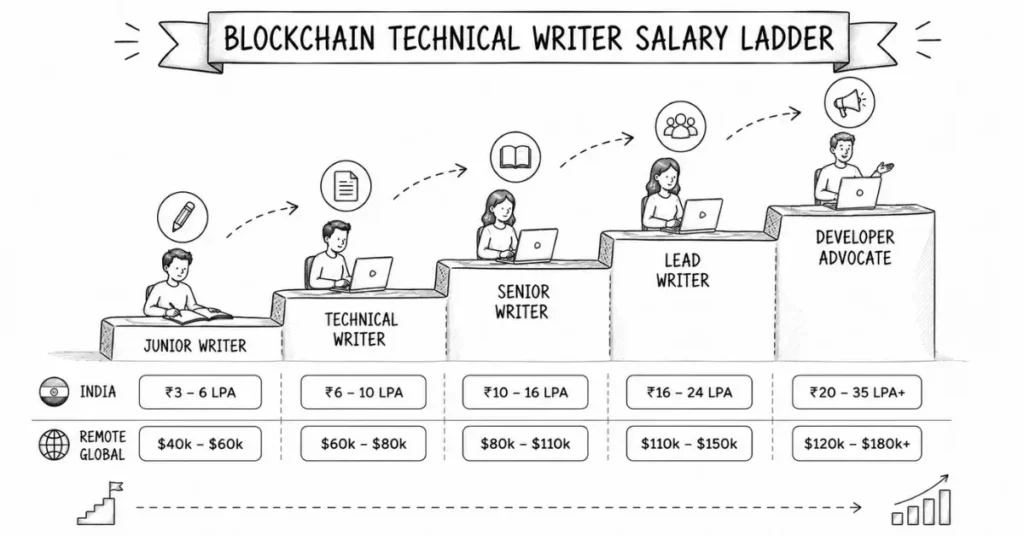
India Domestic Roles
Junior Technical Writer (0–2 Years): ₹6–9 lakhs
- Update and maintain existing documentation
- Write simple user guides and FAQs
- Create basic tutorials under direction of senior writers
Technical Writer (2–4 Years): ₹9–14 lakhs
- Create documentation from scratch for new features
- Own documentation for specific product areas
- Develop documentation standards and style guides
Senior Technical Writer (4–7 Years): ₹14–20 lakhs
- Lead documentation strategy
- Manage documentation team
- Create complex technical content independently
- Collaborate with engineering leads on documentation architecture
Lead Technical Writer / Documentation Lead (7+ Years): ₹20–30 lakhs
- Define organization-wide documentation strategy
- Build and manage technical writing teams
- Evaluate documentation tools and platforms
Developer Advocate: ₹18–32 lakhs
- Combines writing, community, and developer relations
- Higher compensation reflects broader scope and strategic impact
International Remote Roles
The most significant salary jump comes from international remote positions:upgrad+1
- Technical Writer (international): $45,000–77,000 ($51,000–$77,000 specifically for blockchain technical writers like the SupraOracles Kolkata posting)
- Senior Technical Writer (international): $75,000–110,000
- Developer Advocate (international): $80,000–150,000+
- Documentation Lead (international): $100,000–150,000
For India-based professionals, these international rates represent 3–5x domestic compensation while working remotely. Strong English writing skills—which Indian professionals typically possess—are the primary competitive advantage in accessing these roles.
Freelance and Contract Writing
Many blockchain technical writers supplement or replace salaried work with freelance projects:
Typical Freelance Rates:
- Basic documentation: ₹500–1,500 per page
- Tutorial creation: ₹3,000–8,000 per tutorial
- Whitepaper writing: ₹30,000–1.5 lakhs depending on complexity
- Full documentation overhaul: ₹1–5 lakhs per project
- Course creation: Revenue share (20–50% of course sales) or fixed fee ₹1–3 lakhs per course
Prolific blockchain technical writers with strong reputations earn ₹15–30 lakhs annually through freelance work—comparable to senior salaried positions with greater flexibility.
Building Your Personal Brand as a Blockchain Educator
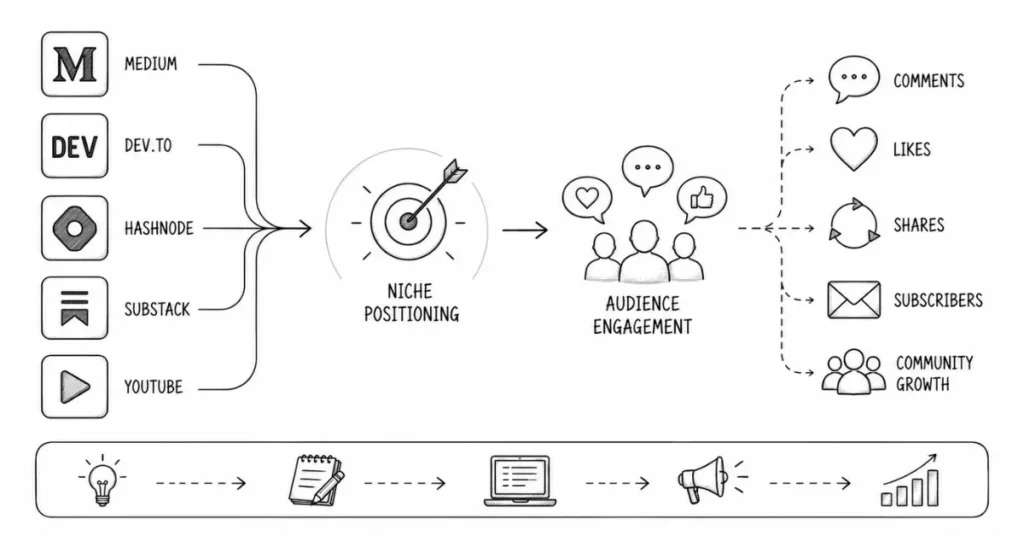
Why Personal Brand Matters More in Technical Writing Than Other Roles
For technical writers and educators, personal brand IS the resume. Employers and clients evaluate your work directly—your articles, your tutorials, your documentation samples speak more persuasively than any CV claim.
A blockchain educator who has published 50 quality tutorials, built a Medium following of 5,000 readers, and created documentation that thousands of developers use daily has a visible, verifiable track record that no amount of credential-listing can match.
Building Your Brand:
Choose Your Platform:
- Medium: Largest audience for technical blockchain content
- Dev.to: Developer-focused community highly receptive to technical tutorials
- Hashnode: Technical blogging platform with built-in developer audience
- Substack: Newsletter format building direct subscriber relationships
- YouTube: Video tutorials building visual learner audience
Consistency on one platform beats sporadic presence across many. Publish weekly on your chosen platform for 6 months—this builds both skills and audience simultaneously.
Define Your Niche:
The most effective blockchain educators own a specific niche:
- “The person who explains DeFi mechanisms most clearly”
- “The tutorial writer who makes Hardhat testing accessible to beginners”
- “The educator explaining blockchain to non-technical business audiences”
Niche ownership makes you memorable and the first person people think of for your specific subject.
Engage With Your Audience:
Respond to every comment on your articles for the first year. Answer questions in communities you serve. The reputation you build through responsive engagement creates opportunities no advertising could buy.
India-Specific Opportunity:
Blockchain education in Hindi and regional Indian languages is virtually non-existent despite enormous demand. An educator creating quality blockchain content in Hindi, Telugu, Tamil, or other Indian languages addresses an underserved market of hundreds of millions of potential learners—a genuine first-mover advantage.
Where to Find Blockchain Technical Writing Jobs
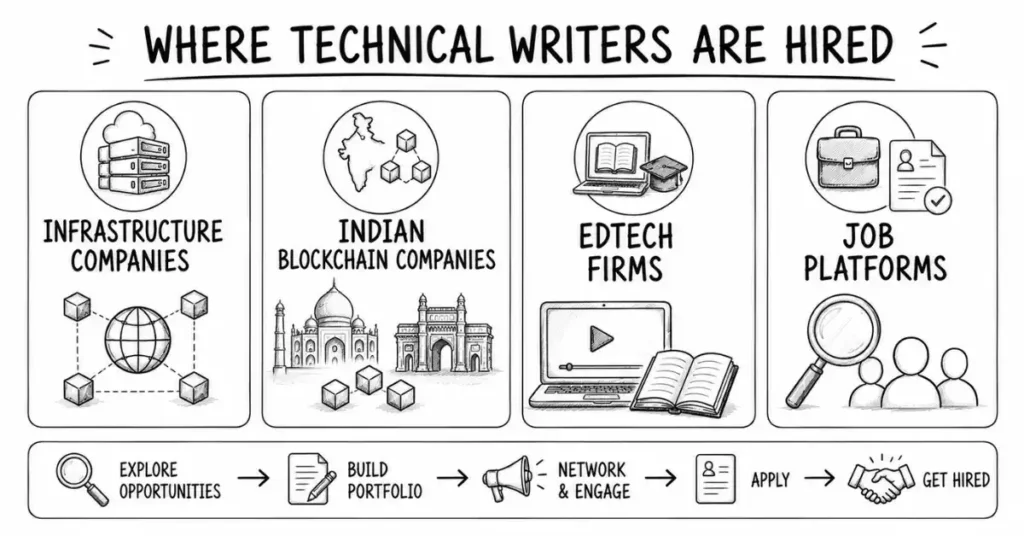
Active Hiring Companies
Blockchain Infrastructure Companies:
- SupraOracles (Kolkata): Actively posting blockchain technical writer roles at $51,000–$77,000
- Alchemy: Developer documentation team hiring globally
- Infura: API documentation writers for enterprise blockchain APIs
- Chainlink: Educational content creators and documentation writers
- The Graph: Protocol documentation and developer guides
Indian Blockchain Companies:
- Polygon: Developer relations and documentation team in Bangalore
- WazirX: Educational content for Indian crypto audience
- CoinDCX: Content and education team building
- Various blockchain startups: Technical documentation needs across the ecosystem
EdTech Companies:
- Frontlines Edutech and similar companies creating blockchain career education
- Udemy/Coursera course creation partnerships
- Blockchain Council (online certification platform)
- Henry Harvin, GUVI, and other Indian EdTech platforms with blockchain courses
Job Platforms:
- CryptoJobsList (filter: Technical Writer, Content, Documentation)
- Web3.career (filter: Non-technical, Content, Education)
- LinkedIn (blockchain technical writer, developer advocate, blockchain educator)
- Remote.co and We Work Remotely for international remote documentation roles
Challenges in Blockchain Technical Writing Careers
Challenge 1: Keeping Documentation Current
Blockchain protocols update frequently—sometimes breaking changes affect documentation every few weeks. Maintaining current, accurate documentation requires close coordination with development teams.
Solution: Build relationships with developers to receive advance notice of changes. Implement documentation-as-code workflows where documentation lives in the same repository as code—update PRs trigger documentation review. Use versioned documentation for protocols with multiple active versions.
Challenge 2: Balancing Accuracy with Accessibility
Technical accuracy is non-negotiable in blockchain documentation—incorrect information causes developer errors and, in smart contract contexts, potentially financial losses. But excessive technical precision makes documentation inaccessible to its intended audience.
Solution: Develop layered documentation: simple overview for beginners, technical reference for developers, architectural deep-dive for researchers. Different audiences get different depth levels from the same documentation system.
Challenge 3: Writing About Rapidly Evolving Technology
Blockchain technology evolves faster than most fields—what you document today may be deprecated in six months.
Solution: Structure documentation with clear version labels and “last updated” timestamps. Focus on principles over implementation details where possible. Build relationships with development teams ensuring you’re always writing about current technology, not historical versions.
Challenge 4: Demonstrating Value to Technical Teams
Engineers sometimes undervalue documentation, seeing it as lower priority than building features. Technical writers must demonstrate their contribution to developer adoption and protocol success.
Solution: Track documentation impact with metrics: tutorial page views, time spent on documentation pages, developer community questions that reference your documentation, support ticket reduction after documentation improvements. Quantified impact makes the case for documentation investment.
Conclusion: The Unsung Heroes of Blockchain Adoption
Every time a developer successfully deploys their first smart contract following a tutorial, every time a student understands DeFi mechanics because of a clear explanation, every time a business evaluates a blockchain solution using a well-written whitepaper—a technical writer made that understanding possible.
The blockchain industry’s growth depends on making complex technology accessible to the next wave of developers, entrepreneurs, and users. Technical writers and educators are the bridge builders of this adoption—and India’s exceptional English-language communication skills create a natural competitive advantage in this global career path.
With international remote positions actively posted in Indian cities like Kolkata at $51,000–$77,000, and domestic roles growing as India’s blockchain ecosystem matures, the career path is financially attractive and professionally fulfilling.
Start building your portfolio today. Write your first blockchain tutorial—explain how to set up MetaMask and get testnet ETH. Publish it on Medium. Share it in a blockchain beginner community and collect feedback. Improve it based on what new learners actually find confusing. This iterative process of writing, publishing, getting feedback, and improving is both how you build skills and how you demonstrate them to future employers.
The blockchain revolution will be explained, documented, and taught—by professionals like you who combine clear communication with technical understanding. Your technical writing career in blockchain starts with a single published tutorial.