
Aerospace Software & AI Jobs in India
Table of Contents
Introduction
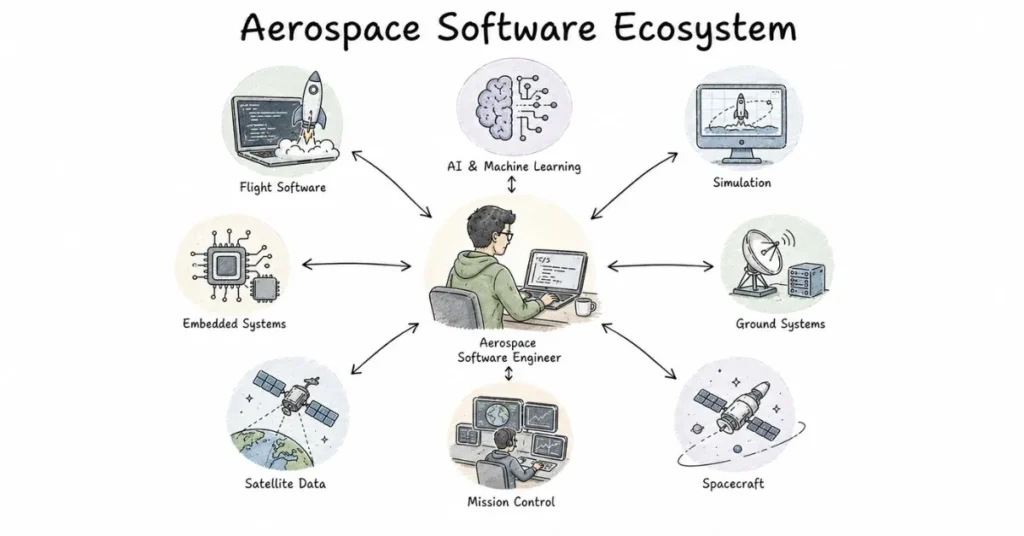
Here is something the space sector does not advertise loudly enough: some of the best software engineering jobs in India are not at Google, Amazon, or a fintech startup. They are at organisations building rockets, satellites, and space data platforms.
The reason is simple. Modern space missions run on software. A satellite’s attitude control system is a software algorithm. A rocket’s guidance and navigation logic is a software system. The platform that processes hyperspectral images from orbit and turns them into crop health maps is a software product. Even the simulation environments that engineers use to test hardware before it flies are sophisticated software systems.
India’s space sector is increasingly hungry for software engineers specifically those willing to learn the domain constraints that make aerospace software different from everything else. This guide covers what those jobs look like, who is hiring, what they pay, and how you get in.
Why Aerospace Software Is Different From Regular Software
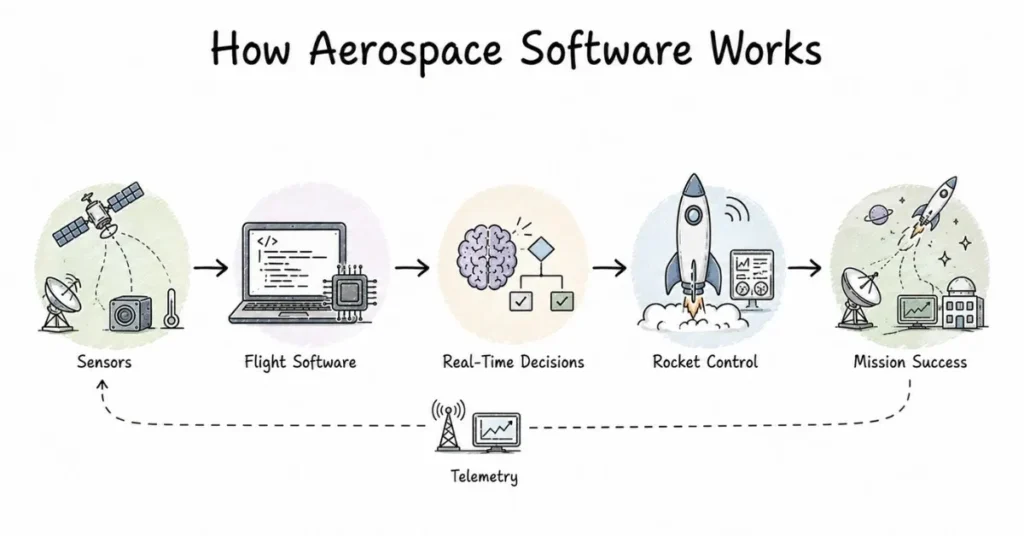
Before diving into roles and salaries, one thing needs to be said clearly: aerospace software is not the same as building a web app or a mobile product.
The difference is consequence. When a web app crashes, users get an error message. When flight software crashes mid-launch, a mission worth hundreds of crores is lost and in crewed missions, lives are at risk.
This means aerospace software is governed by a different set of engineering principles:
- Determinism: Software must behave predictably every single time. No random failures, no race conditions, no unpredictable memory allocation.
- Real-time constraints: Flight software must respond to sensor inputs and generate control outputs within microseconds. Missing a deadline is a failure.
- Fault tolerance: Software must detect errors, switch to backup systems, and continue operating often autonomously, because there is no time to wait for a human command from the ground.
- Verification and validation: Every line of code must be tested to a degree that consumer software simply never is. Code review, unit testing, integration testing, and formal verification are not optional extras they are the job.
- Standards compliance: Space software follows international standards like ECSS-E-ST-40C (European space software standard) and NASA’s NPR 7150.2 software requirements. ISRO follows its own equivalent standards internally.
If you are a software engineer who finds these constraints interesting rather than annoying aerospace software is the right field for you.
Key Job Roles in Aerospace Software and AI
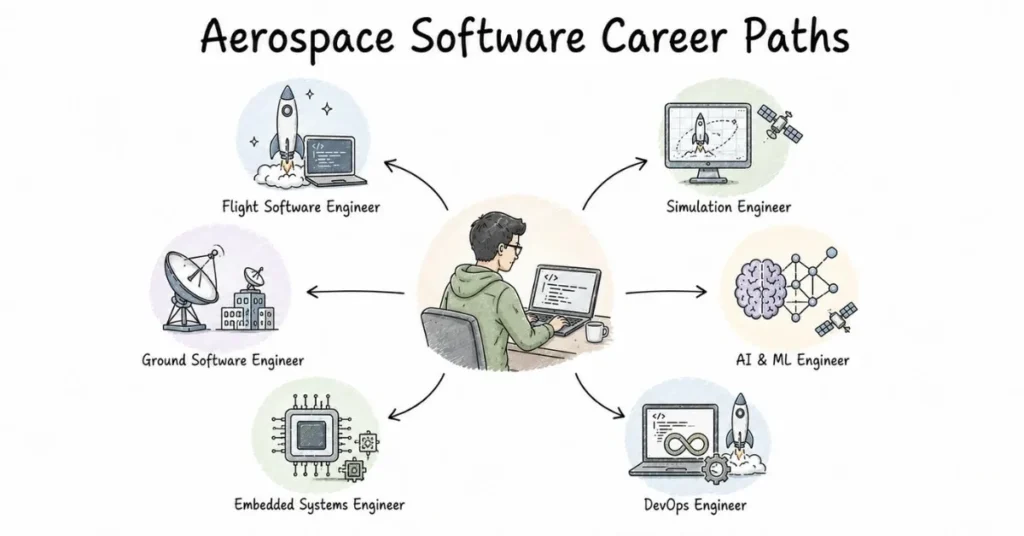
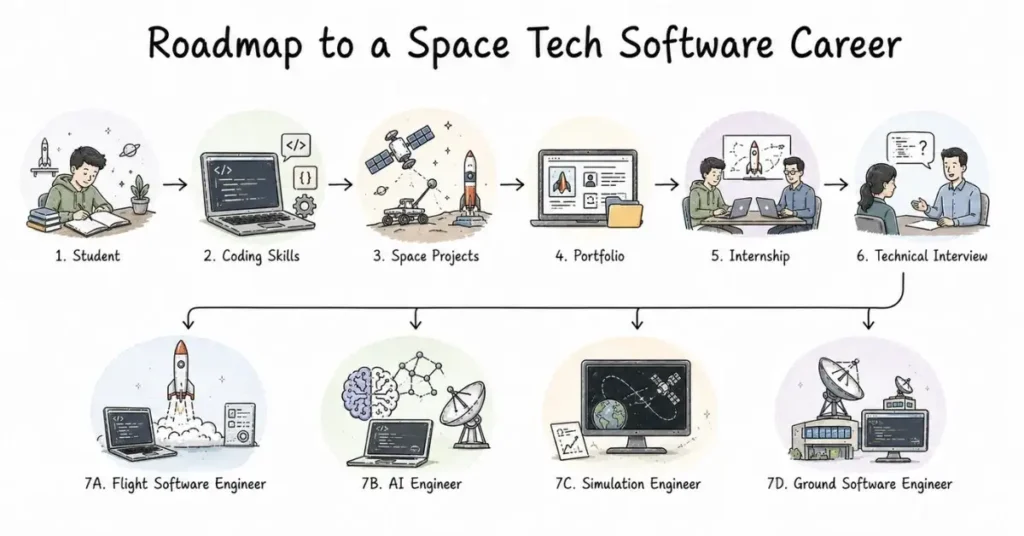
Flight Software Engineer
Flight software is the code that runs directly on a spacecraft or launch vehicle’s on-board computer. It manages every subsystem reads sensor data, executes control algorithms, manages power, handles communication with the ground, and executes mission sequences.
What you work with:
- C and C++ (the primary languages Python is not used in flight software due to runtime unpredictability)
- RTOS (Real-Time Operating Systems) FreeRTOS, VxWorks, RTEMS
- ECSS software standards
- Hardware-in-the-loop (HIL) testing
- Code coverage analysis and static analysis tools
Where this role exists: ISRO (across VSSC, ISAC, and other centres), Skyroot Aerospace, Agnikul Cosmos, Dhruva Space, Pixxel
Simulation and Modelling Engineer
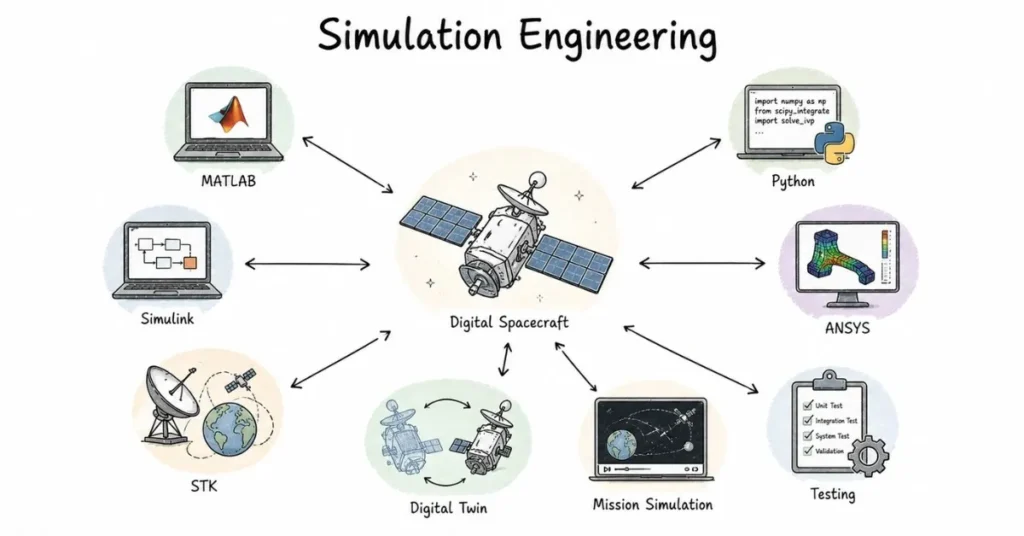
Before any hardware flies, engineers simulate it. A simulation engineer builds the software models that let designers test a propulsion system, a satellite attitude control algorithm, or a full mission sequence without building or launching anything physical.
What you work with:
- MATLAB and Simulink (the dominant tools virtually every aerospace company in India uses these)
- Python for custom simulation frameworks
- STK (Systems Tool Kit) for orbital and mission simulations
- ANSYS for coupled physics simulations (thermal, structural, fluid)
- Digital twin development building software models that mirror physical hardware in real time
Where this role exists: ISRO (all centres use simulation extensively), DRDO, HAL, L&T Technology Services, all private space startups
Ground Software Engineer
Ground software is everything that runs on Earth to communicate with, control, and receive data from spacecraft. This includes mission control systems, telemetry processing pipelines, command generation and uplink tools, and satellite scheduling software.
What you work with:
- Python and Java (more common in ground systems than flight software)
- Database systems for telemetry storage
- Real-time data streaming (Kafka, similar tools)
- CCSDS (space communication protocols)
- Containerisation (Docker, Kubernetes) increasingly used in modern ground systems
Where this role exists: ISRO (MCF Hassan for satellite operations, ISTRAC for tracking), Pixxel, Dhruva Space, SatSure, Digantara
AI and Machine Learning Engineer (Space Applications)
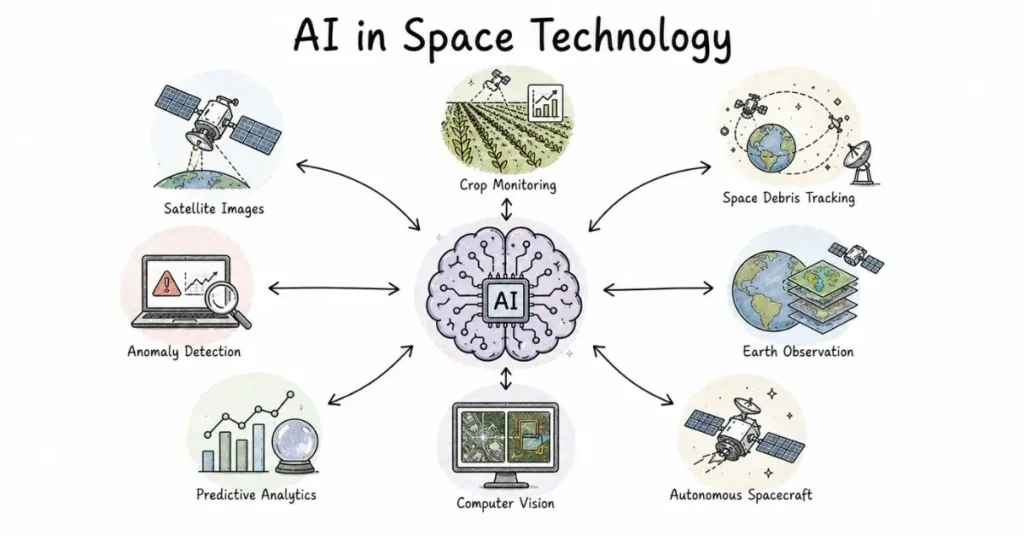
This is the fastest-growing category in India’s space software sector. AI and ML are being applied to:
- Satellite image analysis: Automatically detecting buildings, roads, crops, flooded areas, or illegal construction from satellite imagery
- Predictive analytics: Forecasting crop yields, weather events, or infrastructure failure using satellite-derived data
- Anomaly detection: Identifying unusual patterns in satellite telemetry that might indicate a developing hardware problem
- Autonomous operations: Teaching spacecraft to make decisions independently essential for deep space missions where communication delays make real-time ground control impossible
- Space debris tracking: Training models to detect and track objects in orbit using sensor data
What you work with:
- Python: PyTorch, TensorFlow, scikit-learn
- Computer vision: object detection, semantic segmentation for satellite imagery
- Time series analysis: for telemetry anomaly detection
- Cloud platforms: Google Earth Engine, AWS SageMaker
- Geospatial ML libraries: GDAL, Rasterio, TorchGeo
Where this role exists: Pixxel (strong AI team for hyperspectral data analysis), SatSure, Digantara, ISRO SAC, NRSC (growing AI research teams), defence analytics organisations
Embedded Systems Engineer
Embedded software sits between flight software and hardware it runs on the microcontrollers and processors within individual components like sensors, power management units, and communication modems.
What you work with:
- C for low-level microcontroller programming
- ARM Cortex processors (widely used in space-grade components)
- FPGA programming: VHDL and Verilog
- Communication protocols: SPI, I2C, UART, CAN bus
- Power-aware software design
Where this role exists: ISRO, BEL, Dhruva Space, Skyroot, Agnikul, Astrome Technologies
DevOps and Data Infrastructure Engineer (Space Data Platforms)
As India’s satellite data economy grows, companies like Pixxel and SatSure need engineers who can manage the enormous data pipelines that process satellite imagery at scale.
What you work with:
- Cloud infrastructure (AWS, GCP, Azure)
- Data pipeline tools (Apache Airflow, Spark)
- Container orchestration (Kubernetes, Docker)
- Large-scale storage systems for petabyte-scale satellite data
- APIs for delivering processed satellite data to end customers
Where this role exists: Pixxel, SatSure, Digantara, and increasingly ISRO as it modernises its data infrastructure
Top Employers for Aerospace Software Engineers in India
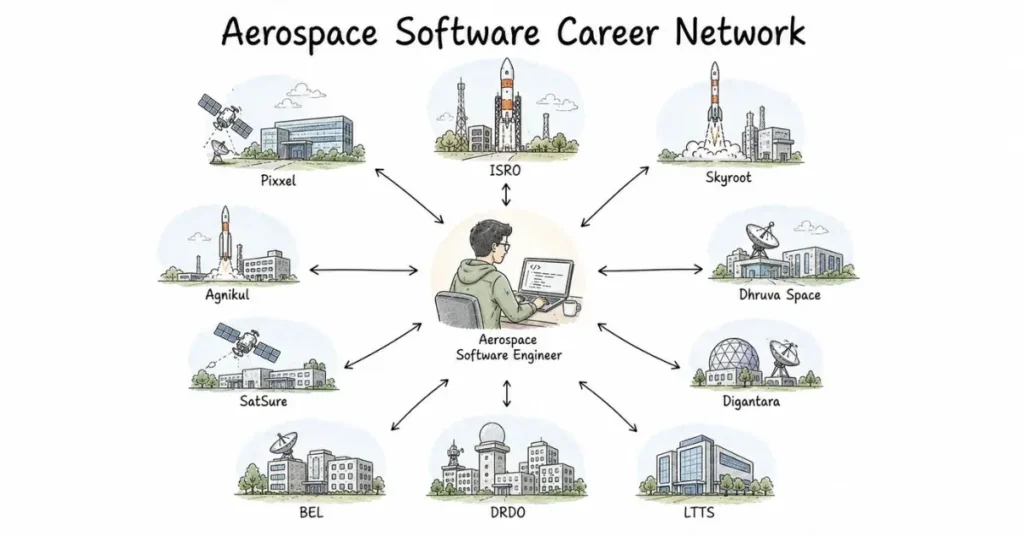
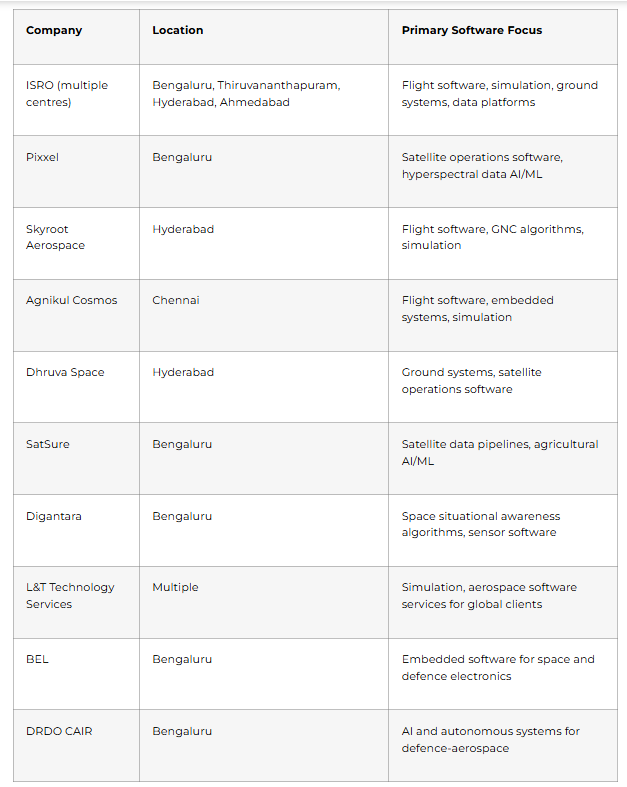
Salary for Aerospace Software Engineers in India
Software engineers in aerospace generally earn more than hardware engineers at the same experience level because they bring both software skills and domain expertise that is rare.
Experience Level | Salary Range |
Fresher (0–2 years) | ₹6–12 LPA |
Mid-level (3–6 years) | ₹15–28 LPA |
Senior (6–10 years) | ₹30–50 LPA |
Principal / Lead (10+ years) | ₹50–80 LPA |
AI/ML engineers working on satellite imagery or space data applications command a premium at the mid and senior levels ₹20–35 LPA with 3–6 years of relevant experience is realistic at companies like Pixxel or SatSure. This is comparable to AI/ML roles at well-funded product startups in other sectors.
Skills Roadmap From Software Engineer to Aerospace Software Engineer
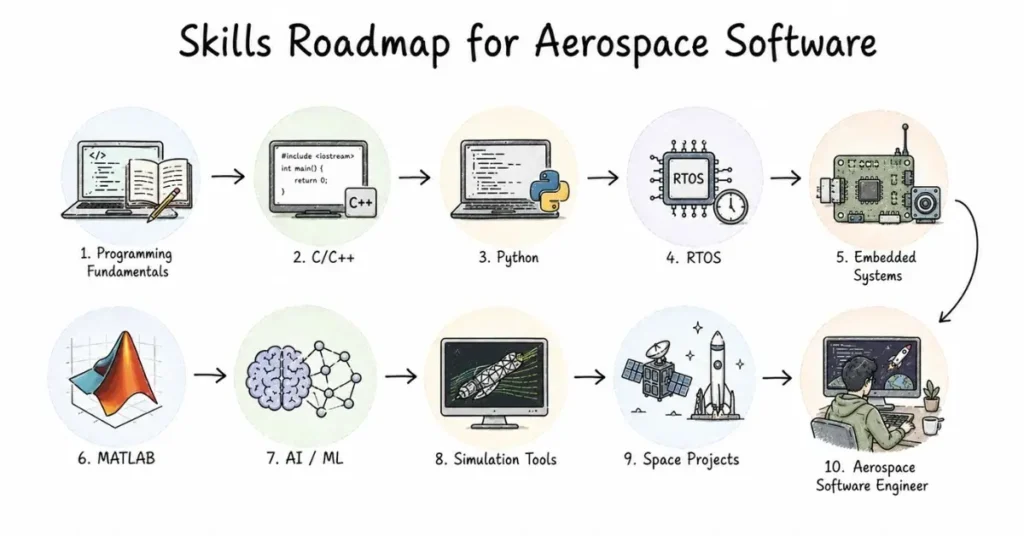
Most aerospace software engineers do not start in aerospace. They start as software engineers in IT, product companies, or web development and transition in. Here is what that transition looks like:
Foundation (what you need coming in):
- Strong C and C++ programming (not just Python)
- Understanding of operating systems concepts: process scheduling, memory management, inter-process communication
- Basic data structures and algorithms: these are tested in interviews
Domain layer (what you add for aerospace):
- Real-time systems concepts: scheduling algorithms, priority inversion, deadline management
- RTOS fundamentals: complete a hands-on project with FreeRTOS or RTEMS
- Basic orbital mechanics: understand what LEO, GEO, and transfer orbits mean
- MATLAB/Simulink: complete at least one simulation project
- Space standards awareness read ECSS software engineering standards (freely available online)
Specialisation (pick one):
For flight software: Go deep on C, RTOS, and hardware interfaces
For simulation: Master MATLAB/Simulink and Python simulation frameworks
For AI/space data: Build satellite image classification or time series anomaly detection projects using real data
How to Break In Even With a Pure Software Background
Step 1: Build one aerospace-relevant project
A satellite attitude control simulation in MATLAB. A telemetry anomaly detection model using publicly available satellite data. A crop classification project using Sentinel-2 imagery. One well-documented, substantive project immediately separates you from software engineers with no aerospace exposure.
Step 2: Learn C and real-time concepts if you only know Python or JavaScript
Flight software and embedded roles require C/C++. This is non-negotiable. If your background is web or data engineering, invest 2–3 months in C fundamentals and basic RTOS concepts before applying to flight software roles.
Step 3: Apply to satellite data companies first
Pixxel, SatSure, and Digantara have the lowest barrier to entry for software engineers transitioning into space. They care more about Python, ML, and data engineering skills which are transferable than about aerospace-specific background.
Step 4: Use open-source space software to build credibility
NASA’s GMAT, ESA’s SNAP (Sentinel Application Platform), and ISRO’s open datasets are all publicly available. Contributing to open-source aerospace software tools or building projects with them demonstrates genuine interest and initiative.
Step 5: Target L&T Technology Services for an aerospace software services entry
LTTS provides software engineering services to global aerospace OEMs. Their recruitment is large-scale and less competitive than ISRO or startups. An LTTS aerospace software role gives you domain exposure that makes subsequent moves to ISRO or startups significantly easier.
FAQs : Aerospace Software Careers in India
Q: Can a software engineer with no aerospace background get a job at ISRO?
Yes, ISRO recruits computer science engineers for software roles through ICRB. The written exam tests CS fundamentals (data structures, algorithms, operating systems, networks). Domain aerospace knowledge helps in the interview but is not required coming in ISRO expects to train engineers on space-specific practices.
Q: Is Python used in space software?
Python is used extensively for ground systems, data analysis, simulation scripts, test automation, and AI/ML applications. It is not used in flight software (the code that runs on the spacecraft itself) due to its non-deterministic runtime. Knowing Python is valuable but if you want flight software roles, you also need strong C/C++.
Q: How is AI being used in India’s space sector right now?
Actively and increasingly. ISRO uses AI for satellite image classification and change detection. Pixxel uses deep learning to process hyperspectral imagery. SatSure uses ML for agricultural yield prediction. Digantara uses AI for space object tracking. The applications are real, funded, and growing.
Q: Do aerospace software jobs require relocation to Bengaluru?
Bengaluru has the highest concentration of aerospace software jobs ISRO ISAC, Pixxel, Bellatrix, BEL, and many LTTS teams are all based there. Hyderabad has a strong second cluster ISRO NRSC, Skyroot, Dhruva Space. Chennai has Agnikul. Remote or hybrid roles are rare in this sector because most work involves access to hardware and secure facilities.