
Smart Contract Developer Guide : Solidity & EVM Skills
Table of Contents
Introduction: Writing Code That Handles Real Money
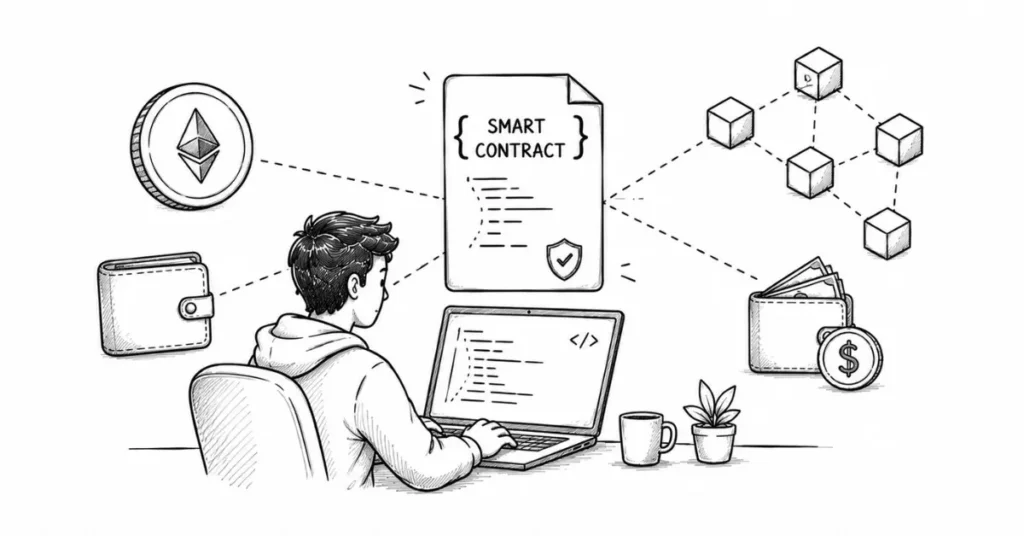
Imagine writing code where a single mistake doesn’t just crash an application it can cost millions of dollars and make headlines worldwide. That’s the reality of smart contract development. Smart contracts are self-executing programs that run on blockchains, automatically enforcing agreements without intermediaries. When you write a smart contract for a lending protocol or decentralized exchange, you’re creating code that directly manages real financial value, often millions or billions of rupees worth of cryptocurrency.
This high-stakes environment explains why smart contract developers are among the most sought-after and well-paid professionals in blockchain. In India, entry-level smart contract developers earn ₹5.5-11.4 lakhs annually, while experienced developers command ₹15-25 lakhs. International remote positions pay even more $60,000-120,000+ annually (₹50-98 lakhs) reflecting the critical nature of this skillset.intellipaat+2
The good news? Smart contract development is more accessible than core blockchain protocol development. You don’t need deep computer science knowledge or years of experience with C++ or Rust. If you know basic programming concepts and can learn JavaScript or Python, you can become a smart contract developer within 4-6 months of focused learning. The demand is enormous nearly every blockchain project building on Ethereum, Polygon, Avalanche, or other EVM-compatible chains needs smart contract developers.coursera+1
In this comprehensive guide, you’ll learn exactly what smart contract developers do, how to master Solidity (the primary smart contract programming language), understanding the Ethereum Virtual Machine, security best practices that prevent costly bugs, and how to land your first smart contract development job. Whether you’re a student choosing a career path or a developer wanting to transition into blockchain, this guide provides your complete roadmap to becoming a professional smart contract developer.
What Smart Contract Developers Actually Do
Understanding Smart Contracts
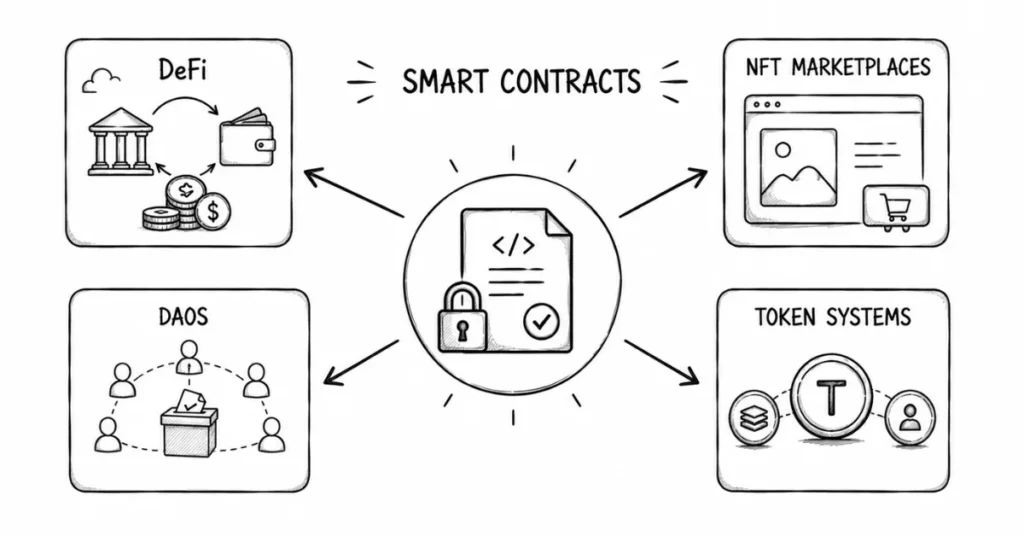
Smart contracts are programs that run on blockchain networks, automatically executing when predetermined conditions are met. Think of them as digital vending machines: you put money in (transaction), select what you want (function call), and automatically receive your product (contract execution)—no human intermediary needed.
Real-World Examples:
Decentralized Finance (DeFi): A lending protocol smart contract allows users to deposit cryptocurrency and earn interest, or borrow against their deposits. The contract automatically calculates interest rates based on supply and demand, liquidates undercollateralized positions, and distributes earnings—all without a bank or loan officer.
NFT Marketplaces: An NFT smart contract defines who owns a specific digital asset and allows ownership transfer. When you buy an NFT, the smart contract automatically transfers ownership to you and sends payment to the seller, minus marketplace fees.
DAOs (Decentralized Autonomous Organizations): DAO smart contracts enable community governance. Members propose changes, vote on proposals, and approved proposals execute automatically. No CEO or board of directors—the code enforces governance rules.
Token Systems: Smart contracts create and manage cryptocurrency tokens, defining total supply, transfer rules, and special features like burning, staking, or vesting.
Day-to-Day Responsibilities
Smart contract developers typically:
Design Contract Architecture: Plan how multiple smart contracts interact to create complete applications. A DeFi protocol might include separate contracts for token management, lending logic, price oracles, and governance—all working together seamlessly.
Write Solidity Code: Implement the designed architecture in Solidity, the primary smart contract language for Ethereum and EVM-compatible blockchains. This involves writing functions that handle deposits, withdrawals, transfers, and application-specific logic.metana+1
Test Extensively: Write comprehensive test suites covering all possible scenarios, including edge cases and potential attacks. Testing is crucial because deployed contracts typically can’t be changed—bugs persist forever unless contracts include upgrade mechanisms.
Optimize Gas Costs: Transactions on Ethereum cost “gas” (fees paid in ETH). Developers optimize code to minimize gas consumption, making contracts affordable for users while maintaining functionality.
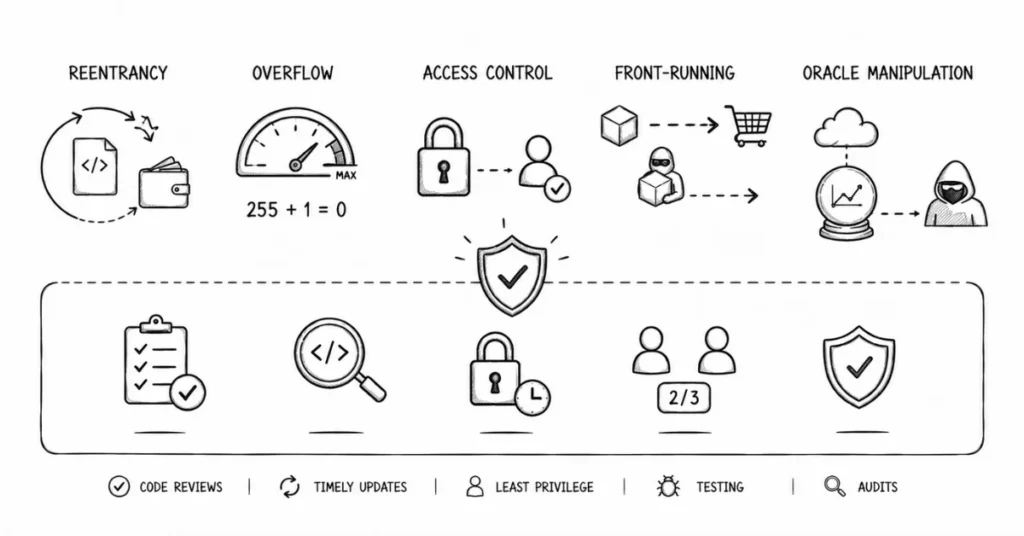
Conduct Security Audits: Review code for vulnerabilities before deployment. Common issues include reentrancy attacks, integer overflow/underflow, access control problems, and front-running vulnerabilities.
Deploy and Verify Contracts: Deploy tested contracts to blockchain networks (first testnets, then mainnet) and verify source code on block explorers so users can inspect what the contract does.
Maintain and Upgrade: Monitor deployed contracts, respond to issues, and implement upgrades when necessary (if upgrade mechanisms exist).
Mastering Solidity: The Essential Language
Why Solidity?
Solidity is the dominant smart contract language, used by Ethereum (the second-largest cryptocurrency) and dozens of EVM-compatible chains including Polygon, Avalanche, Arbitrum, and Optimism. Learning Solidity opens opportunities across this entire ecosystem.coursera+1
Solidity resembles JavaScript and C++, making it relatively approachable for developers with basic programming knowledge. The language specifically designed for smart contracts includes features for handling cryptocurrency, interfacing with blockchain state, and implementing common patterns like access control and safe math.
Core Solidity Concepts
Contract Structure:
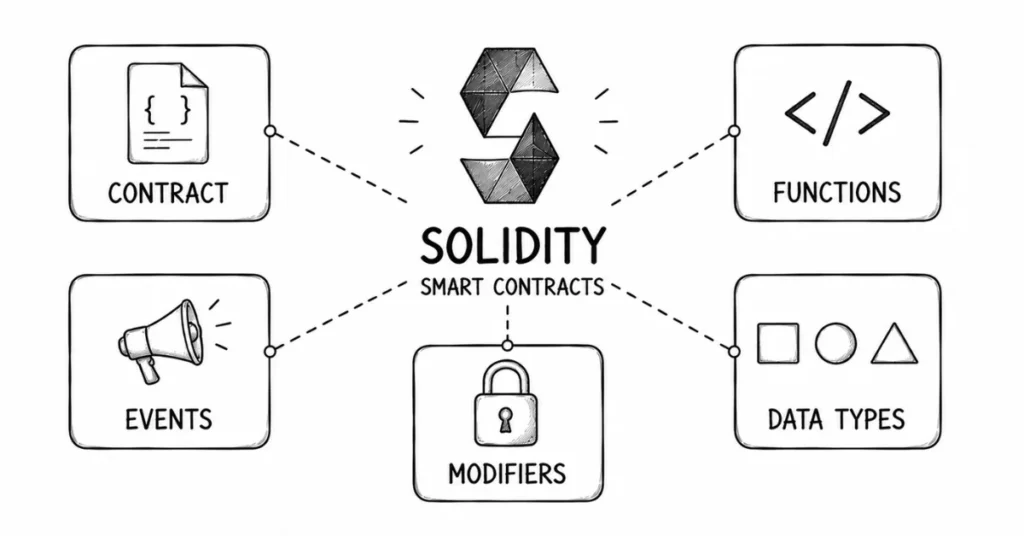
A Solidity contract is similar to a class in object-oriented programming. It contains:
- State variables: Data stored permanently on the blockchain
- Functions: Methods that can read or modify state
- Events: Logs that external applications can listen to
- Modifiers: Reusable code for access control and validation
Data Types and Variables:
Solidity includes specific types relevant to blockchain:
- Address: Ethereum addresses (20 bytes)
- Uint/Int: Unsigned and signed integers of various sizes
- Bool, String, Bytes: Standard data types
- Mapping: Hash table-like structure for key-value storage
- Array: Dynamic and fixed-size arrays
- Struct: Custom composite data types
Functions and Visibility:
Functions can be:
- Public: Callable by anyone, internally or externally
- Private: Only callable within the contract
- Internal: Callable within contract and derived contracts
- External: Only callable from outside the contract
Functions specify whether they’re:
- Pure: Don’t read or modify state
- View: Read state but don’t modify
- Payable: Can receive Ether
Inheritance and Interfaces:
Solidity supports inheritance, allowing contracts to inherit properties from parent contracts. Interfaces define standards that contracts must implement, enabling interoperability (like ERC-20 token standard).
Error Handling:
Solidity provides require(), assert(), and revert() for handling errors and reverting state changes when conditions aren’t met.
Learning Solidity: Step-by-Step Path
Week 1-2: Basics and Syntax
- Complete CryptoZombies interactive tutorial (fun, game-based learning)
- Study Solidity documentation basics
- Write simple contracts: calculators, voting systems, basic tokens
- Deploy practice contracts to Remix IDE (browser-based environment)
Week 3-4: Token Standards and Patterns
- Learn ERC-20 (fungible token standard) and ERC-721 (NFT standard)
- Study OpenZeppelin library (battle-tested smart contract components)
- Implement tokens using standard patterns
- Understand common design patterns (withdrawal pattern, checks-effects-interactions)
Week 5-6: Intermediate Concepts
- Master contract interactions (contracts calling other contracts)
- Understand gas optimization techniques
- Learn about upgradeable contracts (proxy patterns)
- Study oracle integration for external data
Week 7-8: Advanced Topics
- Explore assembly and low-level features for optimization
- Study complex DeFi mechanics (AMMs, lending pools, yield farming)
- Learn security best practices and common vulnerabilities
- Review real-world contract codebases (Uniswap, Aave, Compound)
Week 9-12: Building Portfolio Projects
- Build 3-5 complete projects showcasing different skills
- Write comprehensive tests using Hardhat or Truffle
- Deploy to testnets and document thoroughly
- Get code reviewed by experienced developers in communities
Total timeline: 3-4 months to job-ready proficiency with 15-20 hours weekly practice.
Understanding the Ethereum Virtual Machine (EVM)
What Is the EVM?
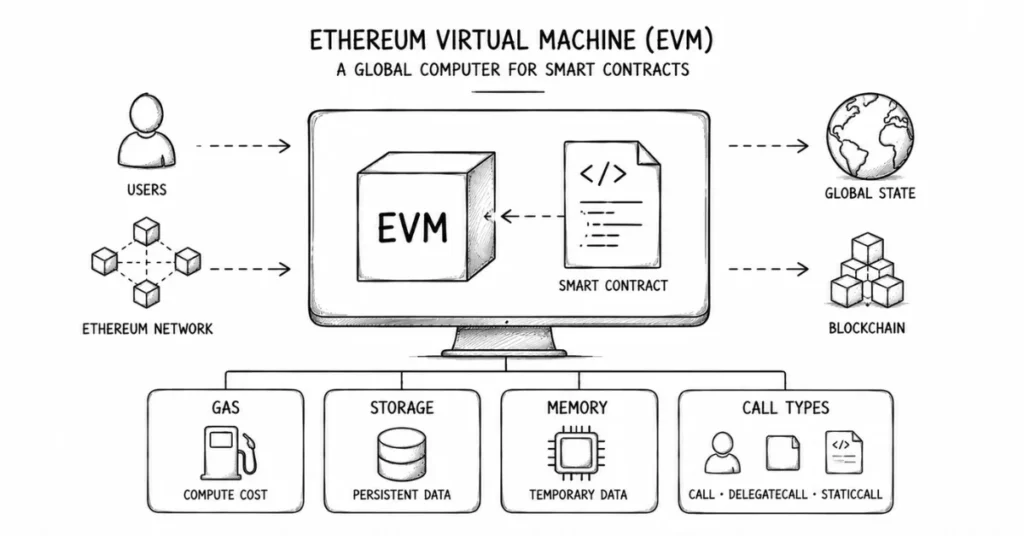
The Ethereum Virtual Machine is the runtime environment where smart contracts execute. Understanding the EVM helps you write better, more efficient contracts and debug complex issues.
Think of the EVM as a global computer distributed across thousands of nodes. When you deploy a smart contract, it compiles to EVM bytecode that executes identically on every node. This deterministic execution ensures everyone agrees on the contract’s behavior.
Key EVM Concepts Smart Contract Developers Must Know
Gas Mechanism:
Every operation in the EVM costs gas—a measure of computational work. Users pay gas fees to miners/validators for executing their transactions. Understanding gas costs helps you optimize contracts:
- Storage operations (SSTORE) are expensive (20,000+ gas)
- Reading storage (SLOAD) costs 2,100 gas (first access) or 100 gas (subsequent)
- Memory operations are cheaper than storage
- Pure computations are relatively cheap
Optimizing gas can reduce user costs by 50-70%, making your dApps more competitive.
Memory vs. Storage:
- Storage: Permanent blockchain state (expensive)
- Memory: Temporary during function execution (cheaper)
- Stack: EVM’s working memory for operations (cheapest)
Smart developers minimize storage operations and use memory for temporary data.
Call Types:
Contracts interact through different call types:
- Call: Standard external function call (can modify state)
- Delegatecall: Execute code in context of calling contract (used in proxy patterns)
- Staticcall: Read-only call that can’t modify state
Understanding call types is crucial for building complex multi-contract systems.
EVM Limitations:
- Limited stack depth (1024 items) can cause “stack too deep” errors
- No floating-point arithmetic (use fixed-point math libraries)
- No native random number generation (use Chainlink VRF or similar)
- Can’t directly access external data (need oracles)
Knowing these limitations helps you design contracts that work within EVM constraints.
Smart Contract Security: Your Most Important Skill
Why Security Is Paramount
Unlike traditional software where bugs can be patched with updates, smart contract bugs often can’t be fixed after deployment. Worse, bugs in financial contracts lead to actual money loss. The DAO hack (2016) lost $60 million, Parity wallet bug (2017) froze $150 million, and various DeFi exploits have stolen billions of dollars collectively.
Security isn’t an add-on consideration—it’s the foundation of everything smart contract developers do.
Common Vulnerabilities Every Developer Must Avoid
- Reentrancy Attacks
The most famous vulnerability, responsible for the DAO hack. Occurs when external contract calls back into your contract before the first execution completes:
text
// VULNERABLE CODE (DO NOT USE)
function withdraw() public {
uint amount = balances[msg.sender];
msg.sender.call{value: amount}(“”); // External call
balances[msg.sender] = 0; // State change after call
}
Attacker’s contract receives Ether, calls withdraw() again before balance updates, draining the contract.
Fix: Follow checks-effects-interactions pattern—update state before external calls, or use ReentrancyGuard from OpenZeppelin.
Integer Overflow/Underflow
Before Solidity 0.8.0, integers could overflow (255 + 1 = 0) or underflow (0 – 1 = 255) without errors, enabling attackers to manipulate balances or bypass checks.
Fix: Use Solidity 0.8.0+ (automatic overflow checking) or SafeMath library for older versions.
- Access Control Issues
Functions missing proper access control allow anyone to call privileged operations like withdrawing funds or minting tokens.
Fix: Use OpenZeppelin’s Ownable and AccessControl contracts. Always ask: “Who should be able to call this function?”
- Front-Running
Since transactions are public before being mined, attackers can see profitable transactions and submit competing transactions with higher gas fees to execute first.
Fix: Use commit-reveal schemes or private mempools when order matters. Design systems that minimize front-running profitability.
- Oracle Manipulation
Contracts relying on external data (price feeds) can be manipulated if oracles aren’t properly secured.
Fix: Use decentralized oracles like Chainlink, aggregate multiple sources, and implement time-weighted average prices (TWAP).
Security Best Practices
Use Battle-Tested Libraries: Don’t reinvent the wheel. OpenZeppelin Contracts provide secure, audited implementations of common patterns (tokens, access control, safe math).
Write Comprehensive Tests: Aim for 100% code coverage. Test normal cases, edge cases, and attack scenarios. Use fuzz testing to discover unexpected behaviors.
Get Professional Audits: Before launching contracts managing significant value, hire professional auditors from firms like Trail of Bits, ConsenSys Diligence, or OpenZeppelin. Audits cost ₹2-10 lakhs+ but prevent losses worth far more.
Implement Gradual Rollouts: Start with limited functionality and value. Add features and increase limits as the contract proves reliable.
Add Circuit Breakers: Include pause mechanisms that allow stopping operations if issues are discovered.
Monitor Continuously: Watch deployed contracts for unusual activity. Set up alerts for large transactions or suspicious patterns.
Development Tools and Workflow
Development Environments
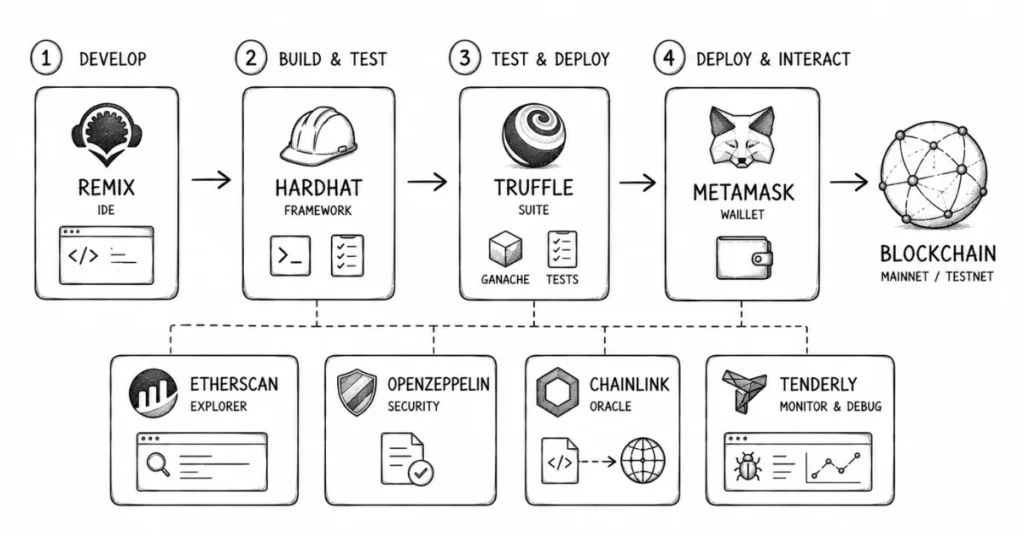
Remix IDE: Browser-based IDE perfect for beginners. Features:
- No installation required
- Built-in Solidity compiler
- Integrated debugger
- Direct deployment to networks
- Plugin ecosystem
Use Remix for learning and quick prototyping.
Hardhat: The most popular professional development environment. Features:
- Local blockchain for testing (Hardhat Network)
- Excellent debugging with stack traces
- TypeScript support
- Extensive plugin ecosystem
- Professional-grade testing framework
Most production projects use Hardhat. Learn it after mastering basics in Remix.
Truffle Suite: Comprehensive framework including Truffle (development), Ganache (local blockchain), and Drizzle (frontend library).
Essential Tools
MetaMask: Browser wallet for interacting with dApps and deploying contracts. Essential for every smart contract developer.
Etherscan: Blockchain explorer for viewing transactions, contracts, and network statistics. Use it to verify deployed contracts and debug issues.
OpenZeppelin Contracts: Library of secure, reusable smart contract components. Install via npm and inherit in your contracts.
Chainlink: Decentralized oracle network for getting external data (prices, weather, sports scores) into smart contracts.
Tenderly: Advanced debugging and monitoring platform showing detailed transaction traces and simulations.
Typical Development Workflow
- Design: Plan contract architecture, draw interaction diagrams, consider security from the start
- Implement: Write Solidity code using established patterns and OpenZeppelin libraries
- Test: Write comprehensive test suite in JavaScript/TypeScript, achieve high code coverage
- Audit Internally: Review code for common vulnerabilities, have teammates review
- Deploy to Testnet: Deploy to Goerli or Sepolia testnet, test all functionality with real transactions
- External Audit: Get professional security audit for contracts managing significant value
- Deploy to Mainnet: Deploy audited, tested contracts to Ethereum mainnet or other production networks
- Verify Source Code: Publish source code on Etherscan for transparency
- Monitor: Watch contract activity, be ready to respond to issues
Building Your Smart Contract Developer Portfolio
Essential Projects to Showcase
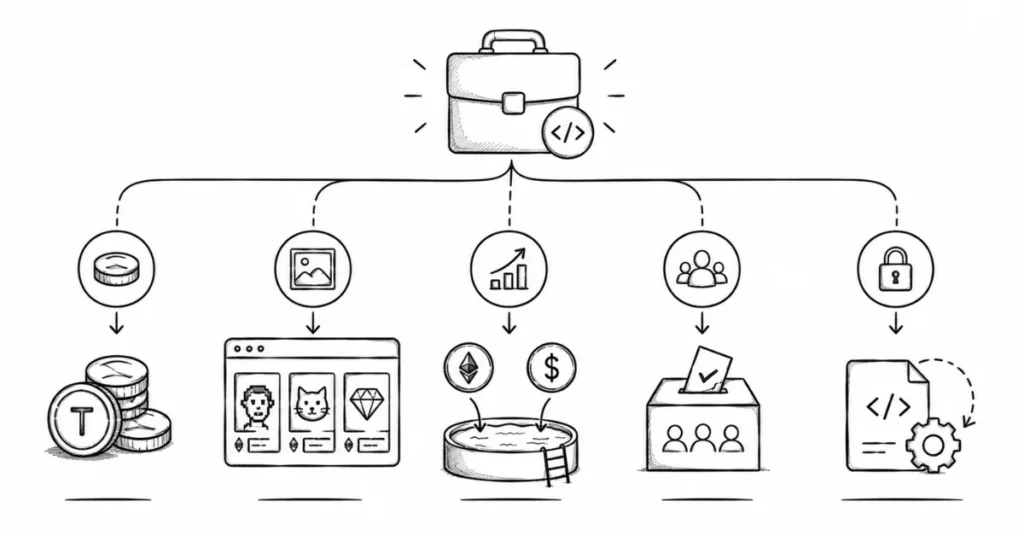
1.ERC-20 Token with Advanced Features
Create a token with:
- Standard ERC-20 functionality (transfer, approve, transferFrom)
- Additional features: burning, minting with access control, pausability
- Comprehensive test suite
- Gas optimizations
This demonstrates understanding of token standards and common patterns.
2.NFT Collection and Marketplace
Build:
- ERC-721 NFT contract with metadata
- Minting mechanism (whitelist, public mint, pricing)
- Marketplace for buying/selling NFTs
- Royalty system for original creators
Shows ability to work with NFT standards and create complete dApp ecosystems.
3.DeFi Protocol (Choose One)
- Simple DEX: Automated Market Maker (AMM) with liquidity pools and swaps
- Lending Protocol: Deposit, borrow, interest calculation, liquidation
- Staking System: Stake tokens, earn rewards, time-locked withdrawals
- Yield Aggregator: Automate yield farming across protocols
DeFi projects demonstrate advanced concepts like financial calculations, external contract interactions, and economic mechanism design.
4.DAO Governance System
Implement:
- Governance token for voting power
- Proposal creation and voting mechanisms
- Timelock for approved proposal execution
- Treasury management
Shows understanding of decentralized governance and complex authorization logic.
5.Upgradeable Contract System
Demonstrate:
- Proxy pattern implementation
- Safe upgrade procedures
- Storage layout management
- Testing upgrades
Displays advanced knowledge of contract architecture and upgrade patterns.
Making Your Portfolio Stand Out
Comprehensive Documentation: For each project, include:
- README explaining what the project does and why
- Architecture diagrams showing contract interactions
- Deployment instructions
- Security considerations and trade-offs
- Known limitations and future improvements
Test Coverage: Aim for 90%+ test coverage. Show you take security seriously by testing edge cases and potential attacks.
Gas Optimization: Document gas costs for key functions and optimizations you implemented. Show before/after comparisons.
Live Deployments: Deploy projects to testnets (Goerli, Mumbai, etc.) and include verified contract addresses in documentation.
Blog Posts: Write articles explaining interesting technical challenges you solved or concepts you learned while building projects.
Landing Your First Smart Contract Developer Job

Where to Find Opportunities
Crypto Job Boards:
- CryptoJobsList: Largest blockchain job board with smart contract positions globally
- Web3.career: Focused on Web3 development roles, many remote opportunities
- UseWeb3: Developer-focused job board with project and job listings
Indian Crypto Companies:
Indian companies actively hiring smart contract developers:
- Polygon: Leading Ethereum scaling solution, Bangalore-based
- WazirX: Major Indian crypto exchange needing DeFi developers
- CoinDCX: Growing platform expanding development team
- Liminal: Crypto custody solution requiring security-focused developers
International Remote Positions:
Global DeFi protocols, NFT platforms, and Web3 infrastructure companies hire remotely from India:
- DeFi protocols: Aave, Compound, Uniswap Labs
- NFT platforms: OpenSea, Foundation, Rarible
- Infrastructure: Alchemy, Infura, The Graph
These typically pay $60,000-120,000+ annually.
Freelance and Contract Work:
Freelance platforms for blockchain development:
- Gitcoin: Bounties and grants for open-source work
- Upwork/Toptal: Traditional freelance platforms with blockchain projects
- Direct outreach: Message projects needing smart contract help
Freelance rates for experienced developers: ₹1,500-5,000+ per hour.
Preparing for Technical Interviews
Live Coding Challenges:
Expect to write Solidity code in real-time:
- Implement an ERC-20 token
- Write a simple voting contract
- Create a multi-signature wallet
- Build basic escrow functionality
Practice writing contracts from memory without reference documentation.
Code Review:
You’ll review existing Solidity code and identify:
- Security vulnerabilities
- Gas inefficiencies
- Logic errors
- Best practice violations
Study vulnerable contracts and practice spotting issues quickly.
Architecture Questions:
Design smart contract systems on the spot:
- “How would you build a decentralized lottery?”
- “Design a token vesting system for team members”
- “Create a marketplace where users can buy/sell in-game items”
Practice explaining your design decisions and trade-offs clearly.
Security Scenarios:
Expect deep security discussions:
- “How would you prevent flash loan attacks on this lending protocol?”
- “What’s the difference between re-entrancy and cross-function re-entrancy?”
- “How do you implement secure randomness in smart contracts?”
Study common exploits and mitigation strategies.
Skills Beyond Coding
Web3 Frontend Integration: Understanding how frontends connect to smart contracts using Web3.js or Ethers.js makes you more valuable. You can build complete dApps independently.
Gas Optimization: Show you care about user experience by building efficient contracts. Highlight gas savings in your projects.
Security Awareness: Demonstrate security-first mindset. Discuss security considerations proactively in interviews.
Communication: Explain complex technical concepts clearly. Many roles involve working with non-technical stakeholders.
Career Growth and Specialization
Smart Contract Developer Career Ladder
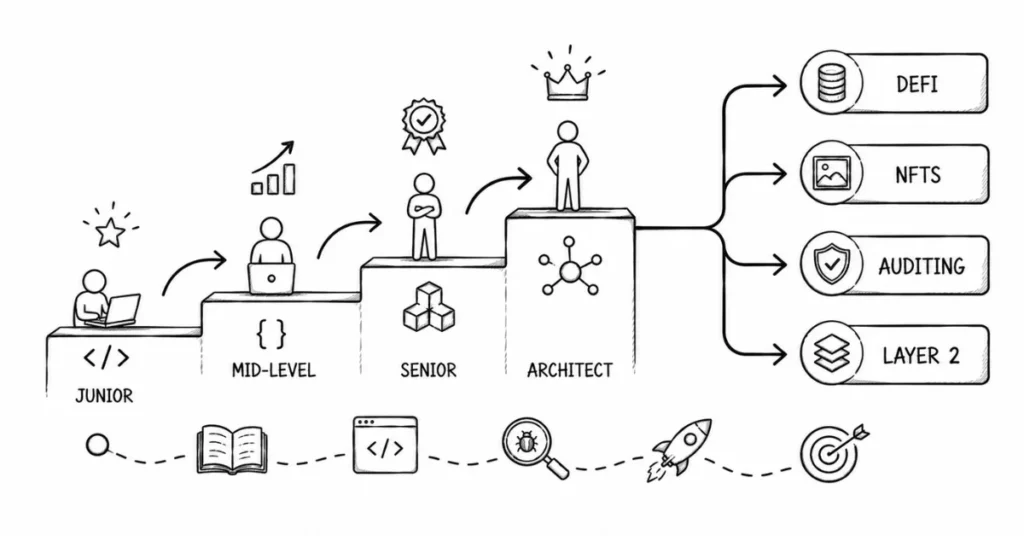
Junior Smart Contract Developer (0-2 Years): ₹5.5-11.4 lakhsupgrad+1
- Implement well-defined features under supervision
- Write tests and documentation
- Fix bugs in existing contracts
- Learn security best practices
Smart Contract Developer (2-5 Years): ₹11-18 lakhs
- Independently design and implement contracts
- Conduct security reviews
- Optimize gas costs
- Mentor junior developers
Senior Smart Contract Developer (5+ Years): ₹18-30 lakhs6figr+1
- Architect complex multi-contract systems
- Lead security initiatives
- Review and approve all contract changes
- Represent technical perspective in product decisions
Smart Contract Architect: ₹25-40+ lakhs
- Design entire protocol architectures
- Establish security standards and processes
- Strategic technical leadership
- Industry conference speaker and thought leader
Specialization Paths
DeFi Specialist: Focus on financial protocols, advanced mathematics, economic mechanism design. High demand and compensation given complexity.
NFT and Gaming Developer: Build NFT contracts, in-game economies, metaverse infrastructure. Growing field with creative aspects.
Security Auditor: Specialize in finding vulnerabilities in smart contracts. Audit firms pay ₹15-30 lakhs, plus project fees.
Layer 2 Developer: Work on scaling solutions like rollups and state channels. Cutting-edge technology with strong growth prospects.
Smart Contract Researcher: Contribute to academic research on formal verification, new programming languages, or security tooling.
Overcoming Common Challenges
Challenge 1: Learning Curve
Smart contracts introduce unfamiliar concepts: gas, storage vs. memory, blockchain state, immutability.
Solution: Learn progressively. Master basic Solidity before diving into DeFi mechanics. Build simple projects before complex ones. Allow 3-4 months for job-ready proficiency.
Challenge 2: Security Pressure
The high stakes of smart contract development create anxiety about making costly mistakes.
Solution: Follow established patterns, use OpenZeppelin libraries, write extensive tests, and get code reviewed. Start with low-value projects to build confidence before working on major protocols.
Challenge 3: Rapidly Evolving Landscape
New standards, tools, and best practices emerge constantly. Yesterday’s optimal approach may be outdated today.
Solution: Dedicate time weekly to reading about new developments. Follow key developers on Twitter, join Discord communities, read security postmortems. Treat continuous learning as part of the job.
Challenge 4: Limited Debugging
Unlike web development where you can console.log everywhere, debugging smart contracts requires specialized tools and techniques.
Solution: Learn Hardhat’s console.log for local testing, use Tenderly for transaction simulations, master events for on-chain debugging. Develop methodical debugging approaches.
Conclusion: Your Path to Smart Contract Development
Smart contract development offers one of the most direct paths into high-paying blockchain careers. With 3-4 months of focused learning, you can reach job-ready proficiency and start earning ₹6-12 lakhs annually. Within 2-3 years of experience, you’ll command ₹15-20 lakhs or land international remote positions paying $70,000-100,000+.upgrad+1
The demand for smart contract developers far exceeds supply. Every DeFi protocol, NFT project, DAO, and Web3 application needs skilled Solidity developers. This demand will continue growing as blockchain adoption expands across finance, gaming, social media, and beyond.
Start your journey today. Complete the first CryptoZombies lesson, write your first simple contract in Remix, or set up Hardhat and deploy to a testnet. These small actions build momentum toward a transformative career. The smart contracts powering tomorrow’s decentralized internet will be written by developers who decided to start today—let that be you.