
Technical Development Roles: Building E-commerce Solutions
Table of Contents
Introduction: Why E-commerce Development is Different from Regular Web Development
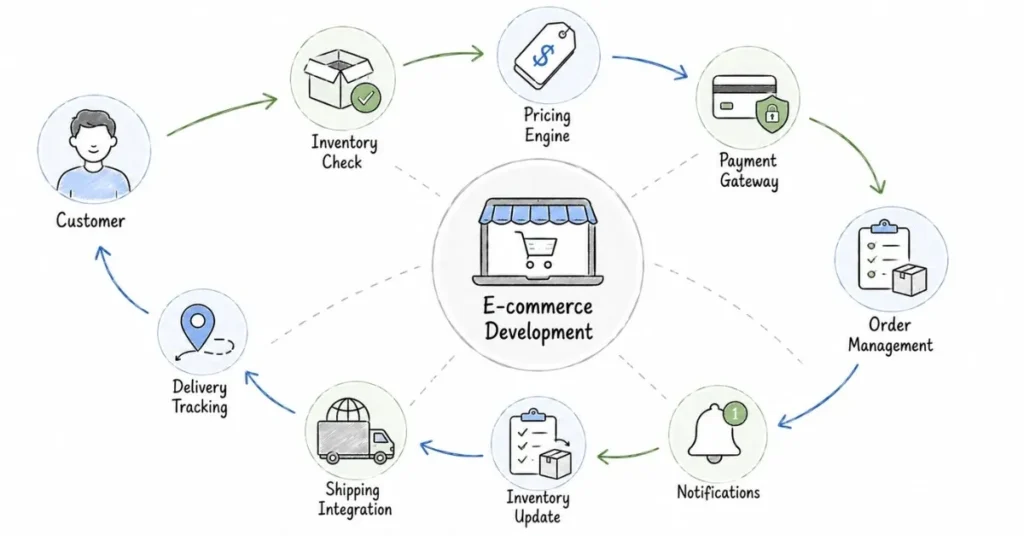
When I tell people I’m an e-commerce developer, they often say “Oh, you build websites?” Yes, but also no. E-commerce development is like building a website, a payment system, an inventory management system, a customer database, and a logistics tracker all working together seamlessly.
Think about what happens when you click “Buy Now” on any shopping site:
- System checks if product is in stock (Inventory management)
- Calculates price including discounts, taxes, GST (Pricing engine)
- Processes payment through gateway (Payment integration)
- Generates order in database (Order management)
- Sends confirmation email and WhatsApp message (Communication automation)
- Updates inventory count (Real-time sync)
- Creates shipment request with logistics partner (Shipping integration)
- Tracks delivery status (Tracking system)
All of this happens in 2-3 seconds. That’s the complexity and beauty of e-commerce development.
For developers in India today, e-commerce offers something unique: high demand, good salaries even for freshers, opportunity to work on real revenue-generating systems (your code directly impacts sales), and multiple specialization paths.
This guide breaks down every aspect of becoming an e-commerce developer in India from complete beginner to employed professional.
The E-commerce Developer Spectrum: Where Do You Fit?
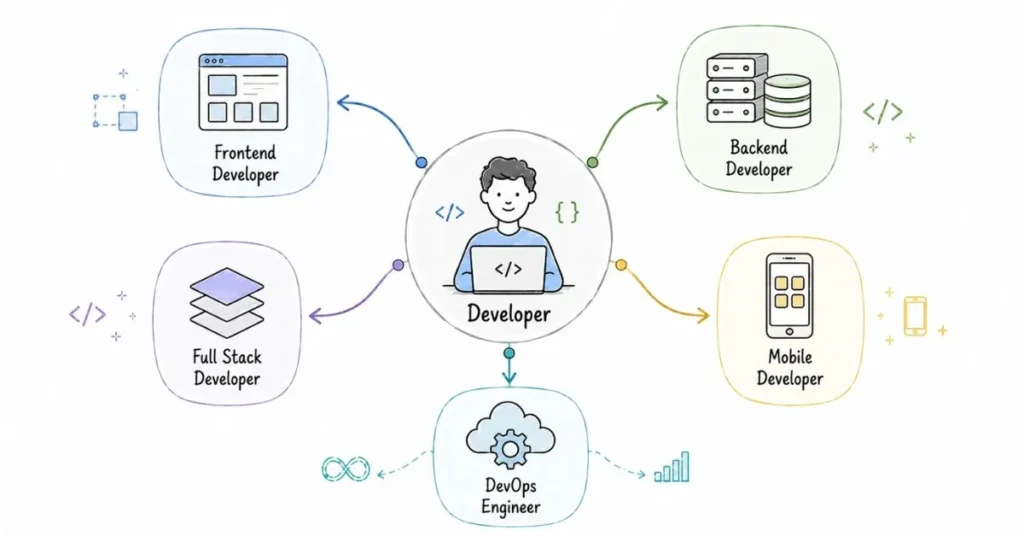
E-commerce development isn’t one job it’s multiple specializations:
Frontend Developer (What users see):
You build the visual interface product pages, cart, checkout, user dashboard. You work with HTML, CSS, JavaScript, and frameworks like React or Vue.js.
Backend Developer (What users don’t see):
You build the server-side logic database management, API development, business logic, payment processing. You work with Python, PHP, Node.js, Java, and databases.
Full-Stack Developer (Both frontend and backend):
You handle everything. High demand, but requires learning more. Common in startups where you wear multiple hats.
Mobile App Developer (iOS/Android):
You build e-commerce mobile apps. Since 80% of Indian e-commerce happens on mobile, this is extremely valuable.
DevOps Engineer (Infrastructure and deployment):
You ensure the platform runs smoothly, handles traffic spikes during sales, doesn’t crash. You work with cloud services (AWS, Azure), deployment tools, monitoring systems.
Let’s break down each path realistically:
Frontend E-commerce Developer: Making Shopping Beautiful
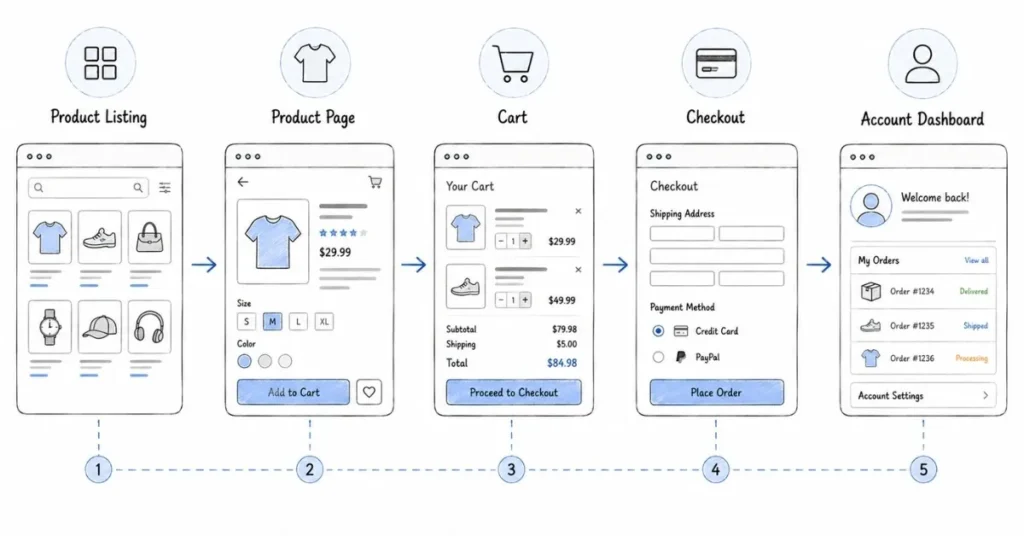
What you actually build:
Product Listing Pages:
- Displaying products in grids with filters (price range, brand, size, color)
- Sorting options (low to high price, newest first, popularity)
- Infinite scroll or pagination
- Quick view functionality
Product Detail Pages:
- Image galleries with zoom functionality
- Size guides and measurement charts
- Add to cart/wishlist buttons
- Product recommendations
- Customer reviews and ratings display
Shopping Cart:
- Adding/removing items
- Quantity adjustments
- Discount code application
- Price calculations with taxes
- Delivery estimation
Checkout Flow:
- Address forms with validation
- Payment method selection
- Order summary
- Smooth, error-free experience (every friction point here loses sales)
User Account Section:
- Order history
- Saved addresses
- Wishlist
- Profile management
A typical day for Aditya, Frontend Developer at a D2C brand in Pune:
9:30 AM: Daily standup meeting
- Discuss today’s priorities
- Blockers or issues from yesterday
10:00 AM: Work on new feature “Recently Viewed Products”
- Design already provided by UI/UX team
- Build component using React
- Fetch data from backend API
- Handle loading states and errors
- Make it mobile responsive
12:30 PM: Bug fixing from QA team feedback
- “Add to cart” button not working on Safari browser
- Investigate, fix, test across browsers
2:00 PM: Code review
- Review team member’s code for checkout page improvements
- Provide feedback, suggest optimizations
4:00 PM: Performance optimization
- Product page loading slow (3.5 seconds)
- Optimize images, implement lazy loading
- Reduce to 1.8 seconds (huge win for conversions)
5:30 PM: Documentation and preparation for tomorrow
Skills you need:
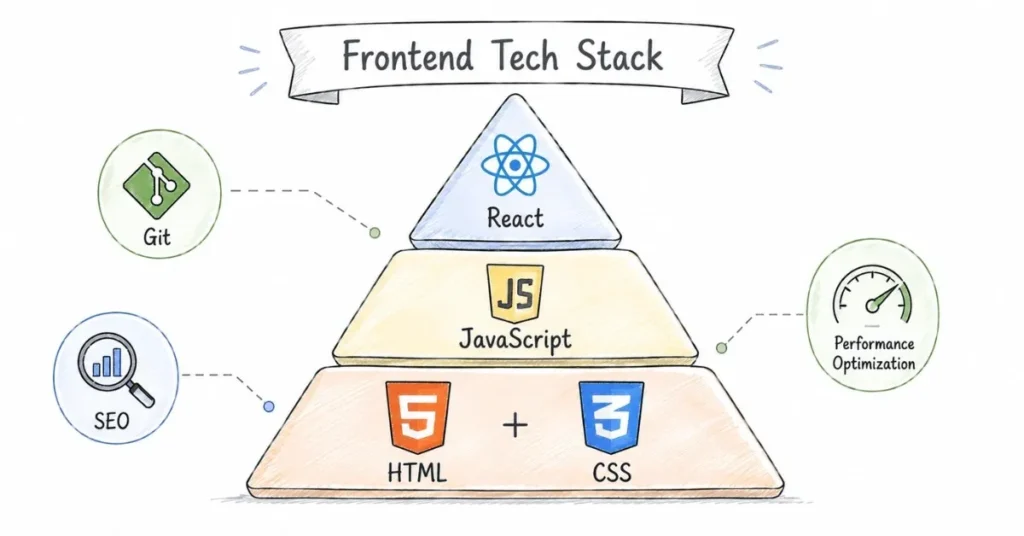
Essential (Non-negotiable):
HTML5 & CSS3:
- Semantic HTML structure
- CSS Flexbox and Grid for layouts
- Responsive design (mobile-first approach)
- CSS animations for smooth interactions
JavaScript:
- ES6+ syntax (modern JavaScript)
- DOM manipulation
- Async programming (promises, async/await)
- API calls (fetch, axios)
- Event handling
React.js (or Vue.js/Angular):
Most modern e-commerce sites use component-based frameworks. React is most popular in India.
- Components and props
- State management (useState, useReducer, Context API)
- Hooks (useEffect, custom hooks)
- Routing (React Router)
- State management libraries (Redux if needed)
Version Control (Git):
- Basic commands (clone, commit, push, pull)
- Branching and merging
- GitHub/GitLab usage
Important (Highly valuable):
Performance optimization:
- Code splitting and lazy loading
- Image optimization
- Caching strategies
- Bundle size reduction
Cross-browser compatibility:
- Testing on Chrome, Firefox, Safari, Edge
- Handling browser-specific issues
Accessibility:
- Keyboard navigation
- Screen reader compatibility
- ARIA labels
SEO basics for frontend:
- Semantic HTML for better SEO
- Meta tags management
- URL structure
E-commerce specific challenges:
Handling high traffic:
During sales (Big Billion Day, Diwali), your code must handle 10x normal traffic without breaking.
Payment integration UI:
Integrating payment gateways (Razorpay, PayU) requires handling multiple scenarios success, failure, pending states.
Real-time updates:
Stock availability changing in real-time, price updates, flash sale timers.
Multi-device consistency:
Customer starts browsing on mobile during commute, completes purchase on desktop at home cart should sync seamlessly.
Indian market specific considerations:
Mobile-first is non-negotiable:
80%+ traffic from mobile. If your site doesn’t work flawlessly on a ₹8,000 Android phone with 3G internet, you’ve failed.
Slow internet optimization:
Unlike US/Europe with fast internet, many Indian users have 3G or slow 4G. Your pages must load fast even on slow connections.
Regional language support:
Many e-commerce sites now offer Hindi, Tamil, Telugu interfaces. Building multi-language support is valuable skill.
COD (Cash on Delivery) prominence:
COD is still 30-40% of orders. Your checkout must make COD option prominent and clear.
Salary expectations:
Fresher (0-1 year):
- Tier 3 cities: ₹3-4.5 LPA
- Tier 2 cities: ₹4-6 LPA
- Tier 1 cities/Metros: ₹5-8 LPA
Mid-level (2-4 years):
- ₹8-15 LPA
Senior (5-7 years):
- ₹15-28 LPA
Lead/Architect (8+ years):
- ₹25-45 LPA
Freelance:
- ₹30,000-1.5 lakhs per project (depending on complexity)
- ₹50,000-2 lakhs monthly retainer for ongoing work
Learning roadmap (4-6 months to job-ready):
Month 1: HTML, CSS, JavaScript Basics
- Week 1-2: HTML & CSS fundamentals
- Build 3-4 static web pages
- Practice responsive design
- Resources: FreeCodeCamp, MDN Web Docs (free)
- Build 3-4 static web pages
- Week 3-4: JavaScript fundamentals
- Variables, functions, loops, conditionals
- DOM manipulation
- Build interactive projects (calculator, to-do list)
- Resources: JavaScript.info, FreeCodeCamp (free)
- Variables, functions, loops, conditionals
Month 2: Advanced JavaScript & React Basics
- Week 1-2: Advanced JavaScript
- Async programming, APIs, ES6+ features
- Fetch data from public APIs, display it
- Resources: JavaScript.info, Wes Bos courses
- Async programming, APIs, ES6+ features
- Week 3-4: React basics
- Components, props, state
- Build simple React apps
- Resources: React official docs, Scrimba React course (free)
- Components, props, state
Month 3: React Deep Dive
- Component lifecycle, hooks (useState, useEffect)
- State management (Context API, Redux basics)
- Routing with React Router
- Build 2-3 projects (weather app, movie database)
- Resources: React docs, YouTube tutorials
Month 4: E-commerce Project
- Build complete e-commerce frontend (use fake API for products)
- Product listing, filtering, sorting
- Product detail pages
- Shopping cart functionality
- Checkout flow (UI only, no real payment)
- Make it responsive and polished
- This becomes your portfolio project
Month 5-6: Job Preparation
- Version control: Learn Git and GitHub
- Portfolio website: Showcase your projects
- Resume: Highlight projects with live links and GitHub repos
- Interview prep: Practice JavaScript interview questions
- Apply for jobs/internships
Tools and technologies to learn:
Code editors:
- VS Code (most popular, free)
Design tools (to understand designs):
- Figma basics (designers provide designs here)
Browser DevTools:
- Chrome DevTools for debugging
Package managers:
- npm or yarn
Build tools (learn on the job):
- Webpack, Vite (most projects have these pre-configured)
Real success story:
Priyanka from Nagpur:
- Background: B.Sc. Physics, no coding background
- Learned web development through online resources (6 months dedicated learning)
- Built portfolio with 4 projects including e-commerce site
- Applied to 80+ jobs, got 6 interviews, 2 offers
- Started as Junior Frontend Developer at ₹4.5 LPA
- Year 2: ₹7 LPA at same company
- Year 4: Senior Frontend Developer at ₹13 LPA at a unicorn startup
Her advice: “Don’t wait for perfection. I applied for jobs when I was 70% ready. Learned the remaining 30% on the job.”
Backend E-commerce Developer: The Engine Room
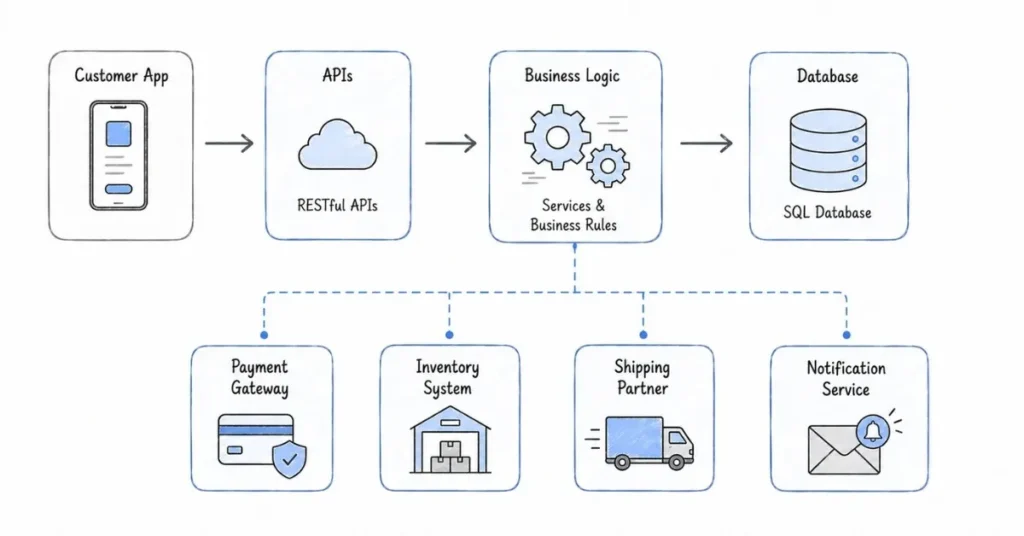
What you actually build:
API Development:
Creating APIs (Application Programming Interfaces) that frontend and mobile apps use.
Example APIs:
- GET /products – Get list of products
- POST /cart/add – Add item to cart
- POST /orders – Create new order
- GET /orders/:id – Get order details
Database Design:
Designing how data is stored and retrieved efficiently.
Tables you manage:
- Users (customer information)
- Products (product details, pricing, inventory)
- Orders (order information)
- Cart (shopping cart data)
- Reviews (customer reviews)
- Transactions (payment records)
Business Logic:
The rules that make e-commerce work:
- Discount calculations (if user buys 3 items, apply 15% discount)
- Inventory management (when product is ordered, reduce stock count)
- Order status transitions (placed → confirmed → shipped → delivered)
- Return processing logic
Payment Integration:
Integrating with payment gateways like Razorpay, PayU, CCAvenue:
- Initiating payment
- Handling callbacks (success, failure)
- Verifying payment signatures (security)
- Storing transaction records
Third-party Integrations:
- Shipping APIs (Shiprocket, Delhivery)
- SMS/Email services (Twilio, SendGrid)
- WhatsApp Business API
- CRM systems (Zoho, Salesforce)
A typical day for Rohan, Backend Developer at a marketplace in Bangalore:
10:00 AM: Daily standup
10:30 AM: Work on new feature “Wishlist”
- Design database schema for wishlist
- Create API endpoints (add to wishlist, remove, get wishlist)
- Write business logic
- Handle edge cases (what if product becomes out of stock?)
1:00 PM: Bug investigation
- Users reporting checkout failures
- Check logs, identify issue (payment gateway timeout)
- Implement retry logic with exponential backoff
3:00 PM: Database optimization
- “Orders” query is slow (taking 5 seconds)
- Add database indexes
- Optimize query
- Reduce to 0.3 seconds
4:30 PM: Code review and testing
5:30 PM: Documentation for APIs (so frontend team knows how to use them)
Skills you need:
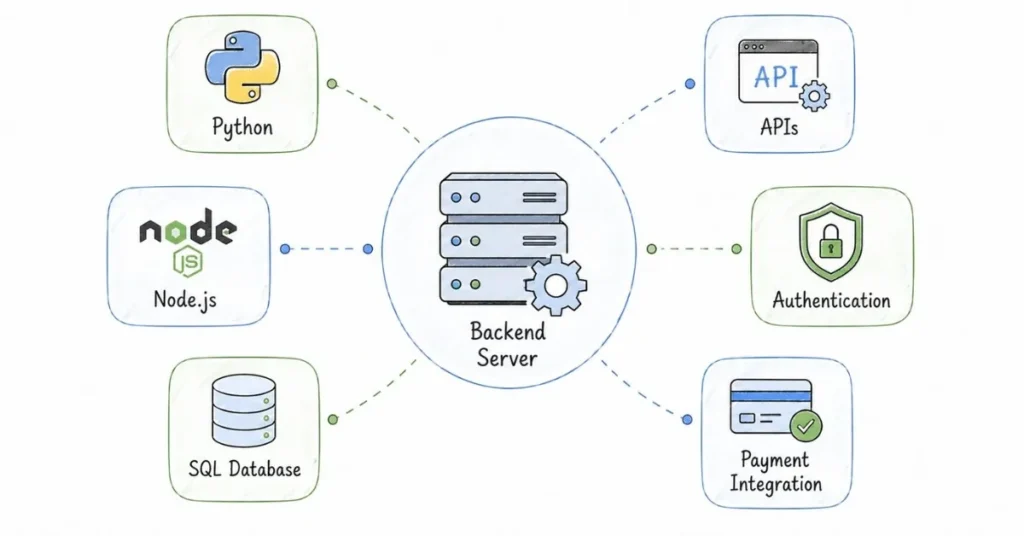
Programming language (Choose one to start):
Python:
- Most beginner-friendly
- Django or Flask frameworks for web development
- Popular in Indian startups
- Good for data-heavy applications
JavaScript (Node.js):
- Same language as frontend (advantage if you know JS)
- Express.js framework
- Fast execution
- Growing popularity
PHP:
- Powers WooCommerce, Magento
- Huge demand for PHP developers in e-commerce
- Laravel framework is modern and elegant
Java:
- Used by large enterprises
- Spring Boot framework
- Highest paying but steeper learning curve
My recommendation for beginners: Python or Node.js. Easier to learn, plenty of jobs.
Database knowledge:
SQL databases (MySQL, PostgreSQL):
- Must know: SELECT, INSERT, UPDATE, DELETE, JOIN, WHERE, GROUP BY
- Database design (relationships, normalization)
- Indexes for performance
NoSQL databases (MongoDB):
- Document-based storage
- Useful for certain use cases
- Good to know, not essential initially
API Development:
- RESTful API design principles
- JSON data format
- HTTP methods (GET, POST, PUT, DELETE)
- Authentication (JWT tokens, sessions)
- API documentation
Version Control:
- Git (essential for any developer)
Testing:
- Unit testing
- Integration testing
- API testing tools (Postman)
E-commerce specific skills:
Payment gateway integration:
Understanding Razorpay, PayU, PayTM integration flows. This is uniquely valuable in Indian e-commerce.
Inventory management logic:
Real-time stock tracking, handling concurrent orders (2 people buying last item simultaneously).
Order management systems:
Status workflows, cancellation logic, return/refund processing.
Security:
- Protecting customer data
- Preventing SQL injection, XSS attacks
- PCI DSS compliance for payment data
- Handling sensitive information (passwords, card details)
Indian market specific considerations:
COD (Cash on Delivery) complexity:
Unlike card payments which are instant, COD requires:
- Creating order without payment confirmation
- Handling delivery rejections (RTO – Return to Origin)
- Cash reconciliation with delivery partners
Multiple payment methods:
Your system must handle UPI, cards, wallets, net banking, EMI, BNPL (Buy Now Pay Later) each with different flows.
Regional logistics:
Integrating with multiple delivery partners (Delhivery for North, DTDC for South, India Post for remote areas).
GST compliance:
Calculating GST correctly, generating GST invoices, filing compliance reports.
Salary expectations:
Fresher (0-1 year):
- ₹4-7 LPA (backend typically pays slightly higher than frontend)
Mid-level (2-4 years):
- ₹9-18 LPA
Senior (5-7 years):
- ₹18-32 LPA
Lead/Architect (8+ years):
- ₹30-55 LPA
Freelance:
- ₹50,000-3 lakhs per project
- ₹75,000-2.5 lakhs monthly retainer
Learning roadmap (5-6 months to job-ready):
Month 1: Programming Language Basics
Choose Python or Node.js
For Python:
- Variables, data types, loops, functions
- Object-oriented programming
- File handling
- Resources: Python.org tutorial (free), Automate the Boring Stuff (free online)
For Node.js:
- Learn JavaScript first (see frontend roadmap Month 1)
- Node.js basics, npm
- Async programming
Month 2: Database Fundamentals
- SQL basics (SELECT, INSERT, UPDATE, DELETE)
- Joins, aggregations
- Database design principles
- Install PostgreSQL/MySQL, practice
- Resources: SQLBolt.com, Mode Analytics SQL tutorial
Month 3: Web Framework
For Python: Django or Flask
For Node.js: Express.js
- Routing, handling requests
- Connecting to database
- Creating simple CRUD (Create, Read, Update, Delete) applications
- Build: Blog or task manager app
- Resources: Official framework documentation, YouTube tutorials
Month 4: API Development
- RESTful API principles
- Building APIs with your framework
- Authentication (JWT)
- API testing with Postman
- Build: API for a to-do app or blog
Month 5: E-commerce Project
Month 6: Advanced Topics & Job Prep
Build backend for e-commerce (use existing frontend or Postman for testing)
Must-have features:
- User registration and login
- Product listing APIs
- Cart management
- Order creation
- Basic payment simulation (don’t use real payment gateway initially)
Database tables:
- Users, Products, Cart, OrdersGit and GitHub
- Deployment (Heroku or Railway for free deployment)
- Payment gateway integration (Razorpay has test mode)
- Portfolio and resume
- Interview preparation (data structures basics, system design basics)
Real success story:
Amit from Jaipur:
- Background: B.Tech Civil Engineering (not CS!)
- Learned Python and Django through online courses (5 months)
- Built 3 projects including e-commerce API
- Applied to 60+ jobs, 8 interviews, 3 offers
- Started as Backend Developer at ₹6 LPA
- Year 3: Senior Backend Developer at ₹14 LPA
- Year 5: Backend Lead at ₹24 LPA
His advice: “Non-CS background actually helped. I wasn’t arrogant about knowing everything. I learned with genuine curiosity.”
Full-Stack Developer: The Complete Package
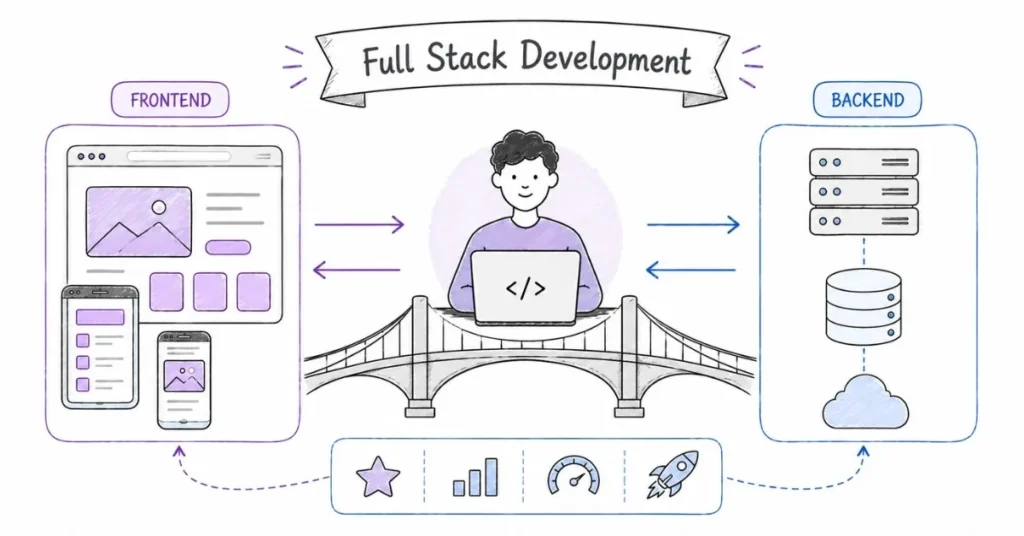
What is full-stack?
You can build both frontend (what users see) and backend (server, database, APIs). You’re like a one-person development team.
Advantages:
- Highly employable (especially in startups)
- Understand the complete picture
- Can build products end-to-end independently
- Higher salary potential
Disadvantages:
- More to learn initially
- Risk of being “jack of all trades, master of none”
- Harder to stay updated in both areas
Is full-stack right for you?
Choose full-stack if:
- You enjoy variety over deep specialization
- Want to work in startups
- Enjoy building complete products
- Can handle learning more things
Choose specialization (frontend or backend only) if:
- You enjoy going deep in one area
- Want faster initial learning curve
- Prefer focused expertise
Learning approach:
- Start with frontend (Month 1-4)
- Add backend (Month 5-8)
- Build full-stack projects (Month 9-12)
Realistic timeline: 9-12 months from zero to employable full-stack developer (with dedicated learning)
Salary expectations:
Full-stack developers typically earn 10-20% more than specialized frontend/backend at same experience level:
- Fresher: ₹5-8 LPA
- Mid-level: ₹10-20 LPA
- Senior: ₹20-35 LPA
Mobile App Development: The 80% of Indian E-commerce
Reality: 80% of e-commerce traffic in India comes from mobile apps, not websites.
Technologies:
Native development:
- iOS: Swift (for iPhone apps)
- Android: Kotlin or Java (for Android apps)
Advantages: Best performance, full access to device features
Disadvantages: Need to learn two separate technologies, maintain two codebases
Cross-platform development:
- React Native: Use JavaScript to build both iOS and Android apps
- Flutter: Use Dart language, growing very fast
Advantages: One codebase for both platforms, faster development
Disadvantages: Slightly lower performance, occasional platform-specific issues
My recommendation: Start with React Native if you know JavaScript, or Flutter if starting fresh.
What you build:
- Product browsing interface
- Search and filters
- Cart and checkout
- User profiles
- Push notifications
- Deep linking (clicking a link opens specific product in app)
- Offline functionality (viewing cart without internet)
Salary expectations:
Mobile developers are in HIGH demand:
- Fresher: ₹5-9 LPA
- Mid-level: ₹12-22 LPA
- Senior: ₹22-40 LPA
Flutter developers especially in demand (newer technology, fewer developers)
Learning roadmap:
- Month 1-2: JavaScript basics (if choosing React Native)
- Month 3-4: React Native/Flutter fundamentals
- Month 5-6: Build 2-3 apps including e-commerce app
- Month 7: Job preparation
Resources:
- React Native: Official docs, YouTube tutorials
- Flutter: Flutter.dev official tutorials, Academind course
Common Challenges and How to Overcome Them
Challenge 1: “Too many technologies, what should I learn?”
Reality: Analysis paralysis is real. People spend months deciding instead of learning.
Solution: Pick one path (frontend with React, or backend with Python/Django). Master that first. Expand later.
Challenge 2: “I don’t have CS degree”
Reality: E-commerce companies care about skills, not degrees. Many successful developers are self-taught or from non-CS backgrounds.
Solution: Build strong portfolio. Your code speaks louder than your degree certificate.
Challenge 3: “Tutorial hell – I keep watching tutorials but can’t build on my own”
Reality: Very common problem. Watching is passive, building is active learning.
Solution: After every tutorial section, close it and rebuild from scratch without looking. Build variations of what you learned.
Challenge 4: “Imposter syndrome – everyone seems better than me”
Reality: Everyone feels this. The senior developer you admire felt the same way 3 years ago.
Solution: Compare yourself to yourself yesterday, not to others. Are you better than you were last month? That’s progress.
Interview Preparation: What They Actually Ask
For Frontend Roles:
Technical questions:
- “Explain how would you implement a shopping cart in React”
- “What’s the difference between state and props?”
- “How do you optimize React application performance?”
- Live coding: Build a simple component (product card, search filter)
System design (for experienced roles):
- “Design a flash sale system that can handle 1 lakh concurrent users”
- “How would you build a recommendation system?”
Preparation strategy:
- Solve coding problems on LeetCode (50-100 easy/medium problems)
- Build projects and be ready to explain every technical decision
- Understand computer science basics (data structures, time complexity)
- Practice explaining your thought process clearly
Free vs Paid Learning: What's Worth It?
Free resources that are excellent:
- FreeCodeCamp (frontend)
- The Odin Project (full-stack)
- Official documentation (React docs, Django docs)
- YouTube (Traversy Media, Academind, The Net Ninja)
- Frontend Mentor (practice projects)
Paid resources worth considering:
- Udemy courses during sales (₹500-1,500) good structured learning
- Scrimba (interactive coding) ₹800-1,500/month
- Boot camps (₹50,000-2 lakhs) Only if you need structure and can’t self-learn
My honest take: 90% of learning can be free. Paid resources are for structured learning if you struggle with self-direction. Don’t think expensive course = better learning.
The Reality of First Developer Job
What to expect:
Salary: Don’t expect ₹15 LPA as fresher (despite what Instagram influencers show). ₹4-7 LPA is realistic for most. That’s still good for starting.
Work: You’ll fix bugs more than build new features initially. That’s how you learn the codebase.
Imposter syndrome: You’ll feel lost for first 2-3 months. Everyone does. It’s okay.
Learning curve: You’ll learn 10x more in first 3 months on job than entire learning period. Real projects teach more than tutorials.
Growth: If you’re good, salary doubles every 2-3 years in first 6-7 years of career. ₹5 LPA → ₹10 LPA → ₹18 LPA → ₹30 LPA is realistic trajectory.
Your Starting Point: 30-Day Action Plan
Week 1:
- Decide: Frontend, Backend, or Full-Stack?
- Set up development environment (VS Code, Git, Node.js/Python)
- Start first tutorial
Week 2-3:
- Follow structured curriculum (FreeCodeCamp or similar)
- Code daily (even 1 hour counts)
- Join developer communities (Reddit r/webdev, Discord servers)
Week 4:
- Build first tiny project (calculator, to-do list)
- Share on LinkedIn/Twitter (start building in public)
- Get feedback, improve
By Day 30:
You should have basic understanding of your chosen path and one tiny project built. That’s your foundation.
Next 90-120 days:
Continue learning, build 2-3 portfolio projects, apply for internships/jobs.
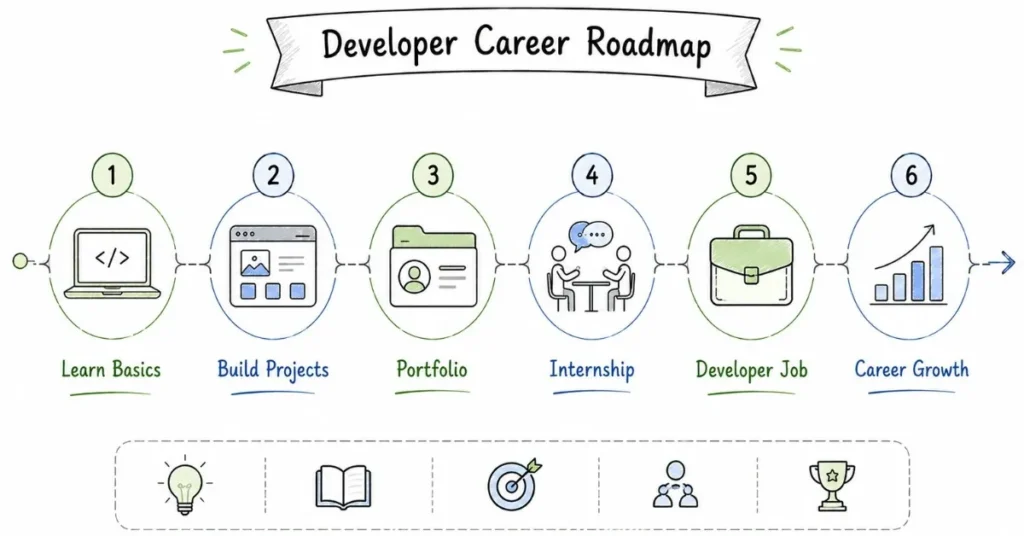
Final Truth: The Developer Job Market
Good news:
- Massive demand for e-commerce developers in India
- Startups, D2C brands, established companies all hiring
- Remote work opportunities (work from anywhere)
- Clear career growth path
Reality check:
- First job is hardest to get (100+ applications normal)
- Once you have 1-2 years experience, opportunities explode
- You need to continuously learn (technology changes fast)
- Not everyone makes it (but everyone who persists and genuinely learns does)
The differentiator:
Most people give up after 2-3 months when learning gets hard. If you persist for 6-12 months with genuine effort, you WILL get a job. Not maybe, not possibly you will.
Your e-commerce developer career starts with one line of code. Write it today.