
Entry Level Supply Chain Jobs: Career Launch Guide
Table of Contents
Introduction: Your Entry Point Into a Thriving Career
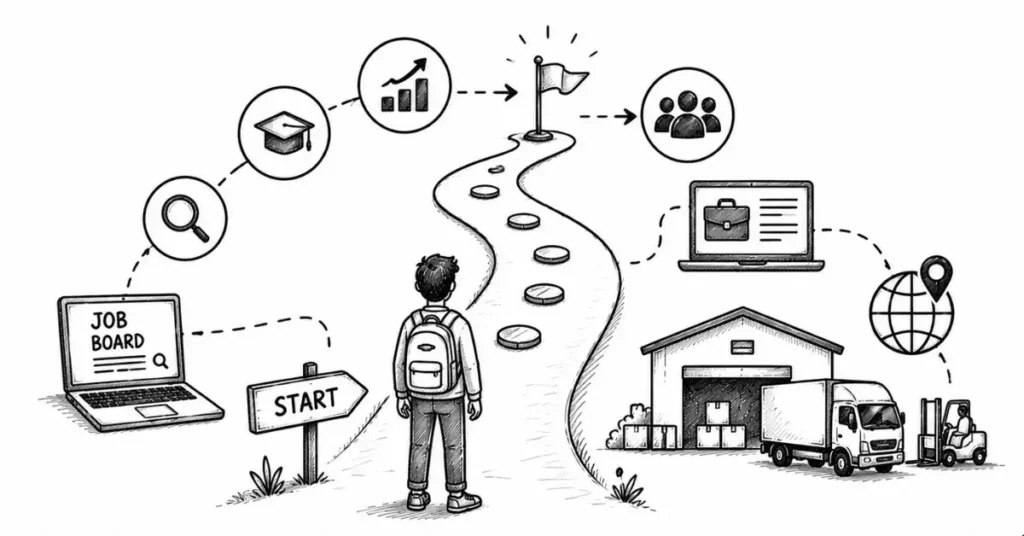
Starting a career can feel overwhelming. You’ve probably spent hours scrolling through job portals, seeing positions that require “3-5 years experience” and wondering, “But how do I get that first opportunity?”
Here’s the good news: supply chain management is one of those rare fields where entry-level opportunities are genuinely accessible, and companies are actively hiring freshers. India’s supply chain sector grew employment by 4.4% just in Q2 FY26, and this growth shows no signs of slowing. Companies desperately need talented people who understand logistics, can analyze data, and help optimize operations.
I’m going to show you exactly which entry-level roles to target, what they pay, what skills you need, and most importantly—how to land your first job even without prior experience. Whether you’re a final-year student or someone switching careers, this guide will give you a clear roadmap.
Why Entry-Level Supply Chain Jobs Are Great Career Starters
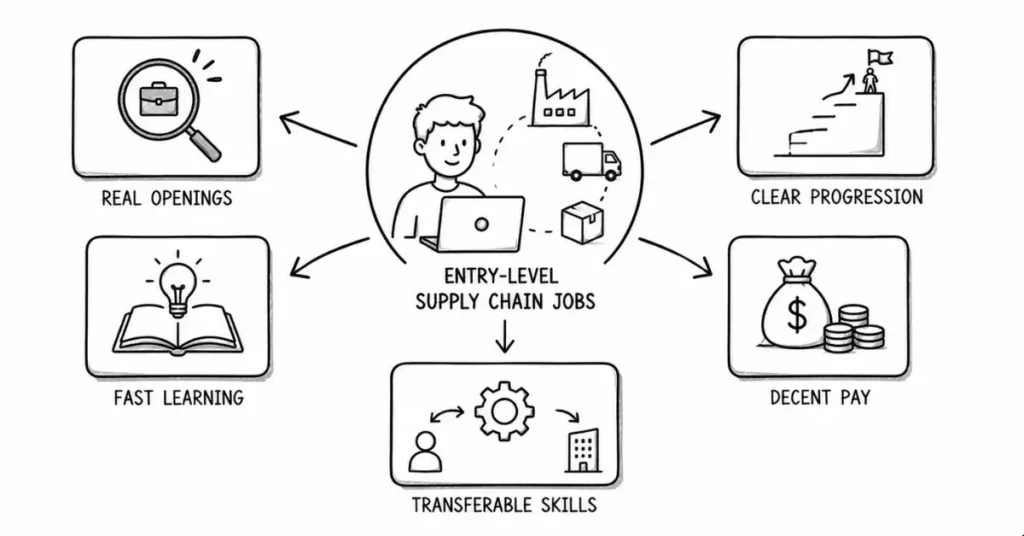
Before diving into specific roles, let’s understand why supply chain is an excellent field for beginners:
- Genuine Entry-Level Opportunities Exist
Unlike some fields where “entry-level” secretly means “3 years experience required,” supply chain companies actually hire fresh graduates. They understand that practical skills develop on the job. - Fast Learning Curve
You’ll quickly gain practical knowledge about business operations, problem-solving, and cross-functional collaboration. Within six months, you’ll understand more about how businesses actually work than many people learn in years. - Clear Progression Paths
Supply chain has well-defined career ladders. Start as a coordinator, become an analyst, advance to manager, and potentially reach director level. Your growth trajectory is visible from day one. - Reasonable Starting Salaries
While you won’t get rich immediately, entry-level supply chain salaries are respectable—typically ₹2.5-5 lakhs annually, which is competitive for fresh graduates in most Indian cities. - Transferable Skills
The analytical, coordination, and problem-solving skills you develop transfer across industries. You can move from FMCG to e-commerce, from manufacturing to pharma, without starting over.
Top Entry-Level Supply Chain Positions: What They Pay and What You'll Do
Let me break down the most common entry-level roles. Understanding these helps you target your applications effectively.
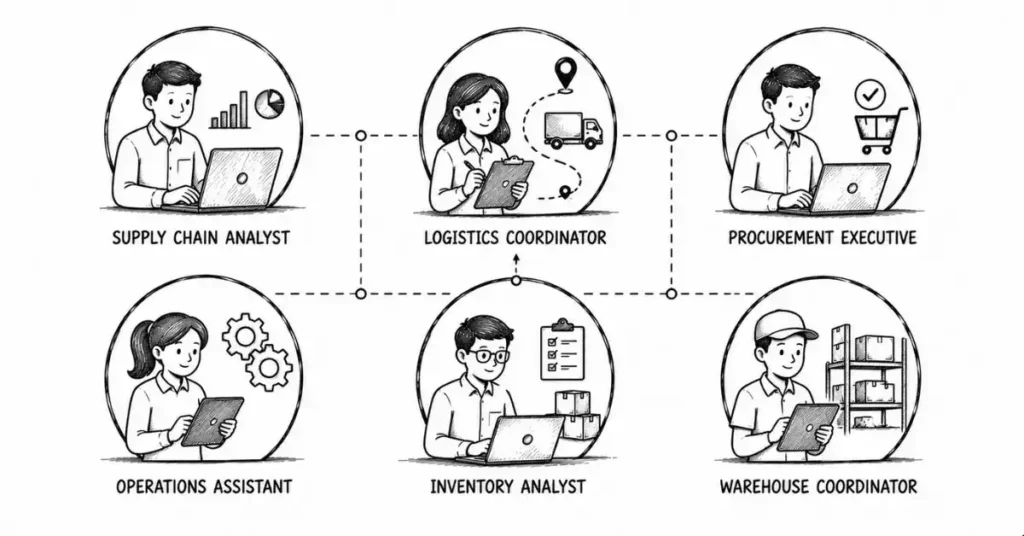
1. Supply Chain Analyst | Average Salary: ₹4.7 lakhs/year
This is arguably the best entry point for graduates comfortable with numbers and analysis.
Your Daily Work:
- Analyze supply chain data to identify trends and problems
- Create reports on inventory levels, delivery performance, costs
- Track KPIs (Key Performance Indicators) like on-time delivery rates
- Use Excel extensively—pivot tables, charts, formulas
- Assist senior analysts with forecasting and planning projects
- Participate in meetings where data informs decision-making
Real scenario: Your company notices delivery delays increasing in the Mumbai region. You’ll analyze shipment data, identify patterns (maybe delays happen more on Fridays or with a specific carrier), create visualizations showing the trend, and present findings to your manager who’ll decide corrective actions.
Best for: Analytical thinkers who enjoy working with data, solving puzzles, and seeing how numbers drive decisions.
Skills that help:
- Strong Excel skills (most important!)
- Basic statistics understanding
- Good communication to explain data insights
- Attention to detail
- Curiosity about why trends occur
Companies hiring: Flipkart, Amazon, HUL, ITC, Marico, consulting firms, 3PL companies

2. Logistics Coordinator | Average Salary: ₹3.2 lakhs/year
This role is perfect if you’re organized, enjoy coordination work, and like solving immediate problems.
Your Daily Work:
- Coordinate shipments between warehouses, vendors, and customers
- Track deliveries and follow up on delayed shipments
- Communicate with transport companies and warehouse teams
- Resolve issues like incorrect addresses or damaged shipments
- Maintain shipping documentation and records
- Update systems with shipment status
- Handle customer inquiries about delivery timing
Real scenario: A customer orders furniture that needs to ship from Bangalore to Kolkata. You’ll arrange pickup from the warehouse, book the transport, ensure proper packaging, track the shipment, coordinate delivery at the customer’s convenience, and handle any issues like address corrections or rescheduling.
Best for: People-oriented individuals who enjoy coordination, don’t mind multitasking, and can stay calm under pressure.
Skills that help:
- Excellent communication (you’ll talk to many people daily)
- Organizational skills and attention to detail
- Basic knowledge of geography and transportation routes
- Problem-solving when issues arise
- Patience when dealing with difficult situations
Companies hiring: Delhivery, Blue Dart, Gati, DHL, FedEx, e-commerce companies, manufacturing firms

3. Procurement Executive | Average Salary: ₹2.1 lakhs/year
If you enjoy negotiation and building business relationships, procurement is an excellent starting point.
Your Daily Work:
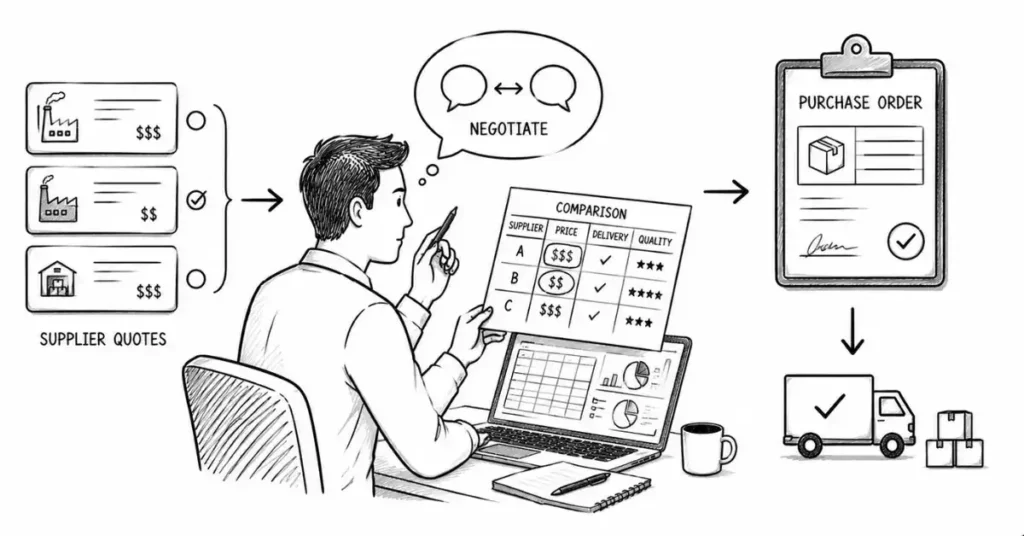
- Identify potential suppliers for various materials or services
- Request quotes and compare supplier offerings
- Assist in negotiating prices and payment terms
- Raise purchase orders in the system
- Track order status and ensure timely delivery
- Maintain supplier databases and documentation
- Coordinate with quality teams on material inspections
- Handle invoice processing and payment follow-ups
Real scenario: Your company needs 1,000 cardboard boxes for packaging. You’ll identify packaging suppliers, request quotes from 3-4 vendors, compare prices and quality, negotiate for bulk discounts, place the order, track delivery, and ensure the boxes meet quality standards when they arrive.
Best for: Relationship builders who enjoy business conversations, negotiation, and seeing how good deals impact profitability.
Skills that help:
- Communication and negotiation skills
- Basic understanding of business finance
- Attention to contracts and details
- Research skills to find good suppliers
- Assertiveness balanced with relationship-building
Companies hiring: Manufacturing companies, large corporations, hospitals, IT companies, construction firms
4. Operations Assistant | Average Salary: ₹2.4 lakhs/year
This generalist role exposes you to multiple supply chain functions—excellent if you’re still figuring out which specialization interests you.
Your Daily Work:
- Support operations managers with administrative tasks
- Maintain operational records and documentation
- Assist with scheduling production or delivery activities
- Coordinate between different departments
- Help prepare reports and presentations
- Track operational metrics and highlight issues
- Participate in process improvement initiatives
Real scenario: You work at a manufacturing plant. Daily, you’ll help schedule production runs, ensure required materials are available, track production output against targets, coordinate with maintenance when equipment needs service, and document any issues that arise.
Best for: Versatile individuals who want broad exposure before specializing, enjoy supporting team success, and are comfortable with administrative work.
Skills that help:
- Organizational and multitasking abilities
- Basic computer skills (Office suite)
- Willingness to learn different functions
- Team orientation
- Reliability and consistency
Companies hiring: Manufacturing plants, distribution centers, service companies, retail chains
5. Inventory Analyst | Average Salary: ₹2 lakhs/year
If you like organization, accuracy, and preventing problems before they occur, inventory management is rewarding.
Your Daily Work:
- Monitor inventory levels across multiple locations
- Identify items that need reordering
- Track slow-moving or obsolete inventory
- Investigate inventory discrepancies
- Maintain inventory records in systems
- Assist with physical inventory counts
- Generate inventory reports for management
- Coordinate with procurement on reorder quantities
Real scenario: You notice that a particular product’s inventory has dropped to 100 units. Historical data shows you sell 50 units weekly, and supplier lead time is 3 weeks. You’ll calculate reorder quantity (accounting for safety stock) and alert procurement to place an order before stockouts occur.
Best for: Detail-oriented individuals who enjoy organization, preventing problems, and working with systems and processes.
Skills that help:
- Strong attention to detail
- Comfort with inventory management software
- Basic math and Excel skills
- Understanding of inventory concepts (lead time, safety stock)
- Systematic thinking
Companies hiring: Retail chains, e-commerce warehouses, manufacturing companies, pharmaceutical distributors
6. Warehouse Coordinator | Average Salary: ₹2.5 lakhs/year
This hands-on role suits people who prefer physically visible work over desk-based tasks.
Your Daily Work:
- Coordinate daily warehouse activities (receiving, storing, picking, shipping)
- Maintain warehouse organization and cleanliness
- Track inventory movement within the warehouse
- Ensure safety protocols are followed
- Coordinate with trucking companies for pickups/deliveries
- Use warehouse management systems (WMS)
- Prepare shipping documents
- Conduct cycle counts to verify inventory accuracy
Real scenario: A truck arrives with 500 boxes of products. You’ll coordinate the unloading, verify the shipment matches the purchase order, update the system as items are received, direct warehouse staff on where to store items, and resolve any discrepancies like damaged boxes or incorrect quantities.
Best for: Active individuals who enjoy physical environments, coordinating teams, and seeing tangible results of their work.
Skills that help:
- Leadership and coordination abilities
- Physical stamina (warehouse work involves walking and standing)
- Safety consciousness
- Basic computer skills for WMS
- Problem-solving under time pressure
Companies hiring: Amazon warehouses, Flipkart fulfillment centers, 3PL providers, manufacturing facilities
What Do Entry-Level Supply Chain Jobs Actually Pay?
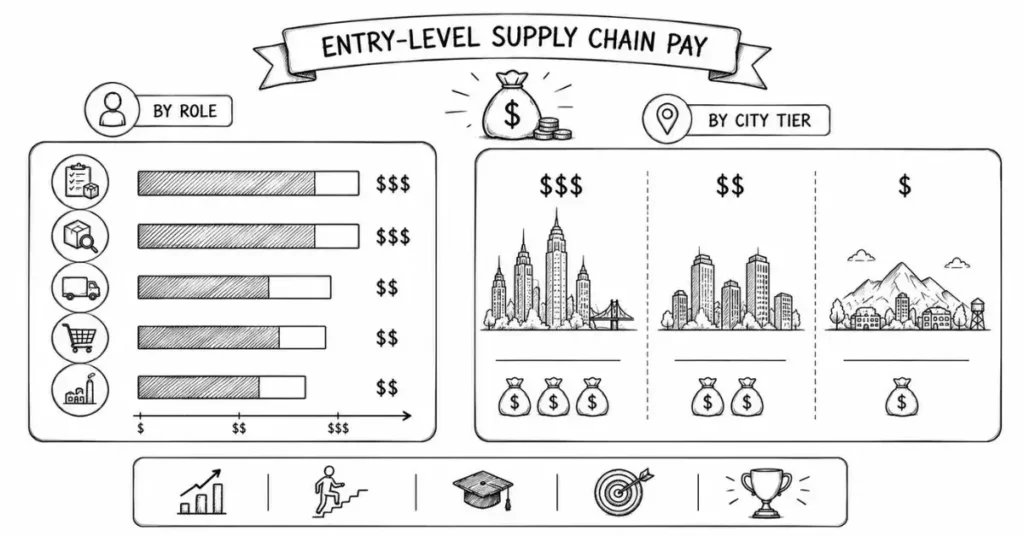
Let’s be realistic about compensation. These figures reflect actual 2026 data for Indian markets:
Metro Cities (Mumbai, Delhi, Bangalore, Hyderabad):
- Supply Chain Analyst: ₹4.5-6 lakhs
- Logistics Coordinator: ₹3-4 lakhs
- Procurement Executive: ₹2-3 lakhs
- Operations Assistant: ₹2.5-3.5 lakhs
- Inventory Analyst: ₹2-3 lakhs
- Warehouse Coordinator: ₹2.5-3.5 lakhs
Tier-2 Cities (Pune, Ahmedabad, Jaipur, Chandigarh):
Salaries typically 10-20% lower than metro cities, but cost of living is also lower.
Important factors affecting your salary:
- Company size: Large corporations and e-commerce giants generally pay more
- Industry: FMCG and consumer goods typically offer higher packages than pure logistics companies
- Your education: MBA graduates command higher starting salaries than undergraduate degree holders
- Skills: Proficiency in SAP, advanced Excel, or data analytics tools can add ₹50,000-1 lakh to offers
- Location: Same role pays differently across cities
Salary growth expectations:
Entry-level roles typically see 10-15% annual increments if you perform well. Strategic job changes after 2-3 years can boost salary by 20-30%.
Educational Requirements: What Do You Actually Need?
Good news—supply chain careers don’t demand specific degrees. Here’s what employers typically accept:
Acceptable undergraduate degrees:
- B.Tech/BE (any specialization, though Industrial Engineering is ideal)
- BBA/BBM (especially with operations focus)
- B.Com
- BA in Economics
- BSc (Mathematics, Statistics)
Postgraduate advantages:
- MBA in Operations/Supply Chain Management
- PGDM in Logistics
- Specialized supply chain certifications
The truth: For entry-level positions, your degree matters less than your skills and attitude. A B.Com graduate with strong Excel skills and supply chain knowledge (from online courses) can compete effectively with engineering graduates.
What matters more than your degree:
- Analytical and Excel skills – Non-negotiable for analyst roles
- Communication abilities – Essential for coordinator positions
- Learning attitude – Companies can train motivated candidates
- Basic supply chain knowledge – Shows genuine interest
- Internship or project experience – Even small projects demonstrate commitment
Essential Skills to Land Your First Supply Chain Job
Let me be direct about what actually gets you hired:
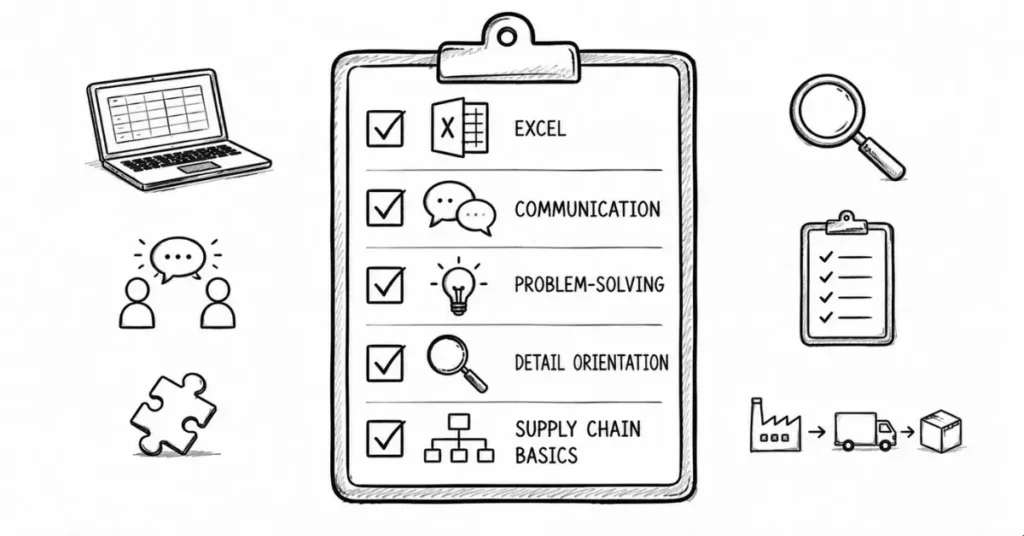
Must-Have Skills:
Microsoft Excel (Critical)
This is absolutely non-negotiable. You should confidently:
- Create pivot tables
- Use VLOOKUP and HLOOKUP
- Apply conditional formatting
- Create charts and graphs
- Use basic formulas (SUM, AVERAGE, IF statements)
- Understand data filtering and sorting
Investment: Take a comprehensive Excel course on Udemy or LinkedIn Learning (₹1,000-2,000). This investment pays for itself in your first month of salary.
Communication Skills
You’ll email suppliers, present to managers, coordinate with teams, and sometimes handle customer issues. Clear, professional communication—both written and verbal—is essential.
How to improve: Practice writing professional emails, participate in group discussions, take presentation opportunities.
Problem-Solving Ability
Supply chains face constant issues. Employers want people who can think through problems logically and propose solutions.
How to develop: Practice case studies, analyze real supply chain problems in the news, think through “what would I do?” scenarios.
Attention to Detail
Small mistakes—wrong quantities, incorrect addresses, data entry errors—cascade into big problems. Thoroughness and accuracy matter tremendously.
Basic Supply Chain Concepts
Understanding fundamentals like lead time, inventory turnover, demand forecasting, and logistics basics shows employers you’re serious.
How to learn: Read our Supply Chain Fundamentals guide, take free courses on NPTEL or Coursera, follow supply chain blogs.
Nice-to-Have Skills (Competitive Advantages):
ERP Software (Especially SAP)
Many companies use SAP for supply chain management. Even basic familiarity gives you an edge.
How to learn: SAP offers free learning trials; some institutes offer affordable SAP MM or SD courses.
Data Visualization (Tableau, Power BI)
Creating compelling visual reports from data is increasingly valuable.
SQL Basics
Understanding database queries helps when working with large datasets.
Statistics Fundamentals
Basic statistical concepts improve your analytical capabilities.
Second Language
In global supply chains, knowing languages like Mandarin, German, or Spanish can be advantageous.
How to Land Your First Supply Chain Job: Practical Action Plan
Theory is good, but let’s get practical. Here’s your step-by-step plan:
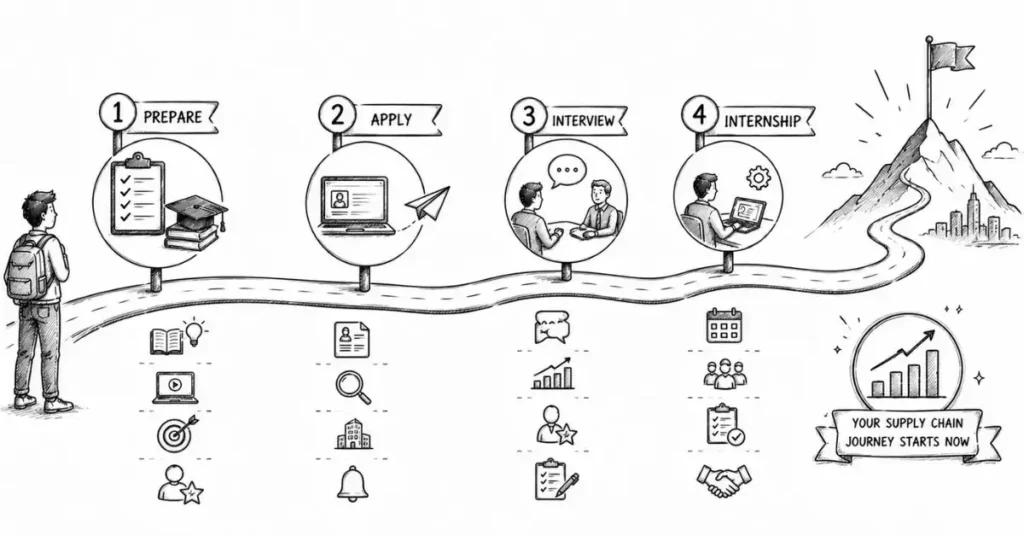
Phase 1: Preparation (8-12 weeks before applying)
Week 1-2: Build Knowledge Foundation
- Read supply chain blogs and articles daily
- Take one free introductory course (Coursera, NPTEL, edX)
- Understand basic concepts and terminology
- Follow supply chain professionals on LinkedIn
Week 3-6: Develop Hard Skills
- Master Excel through structured course
- Learn basics of one ERP system (even through YouTube)
- Practice creating reports and dashboards
- Build a portfolio of sample analyses
Week 7-8: Create Projects
- Analyze a real company’s supply chain (Amazon, Flipkart, local manufacturer)
- Create a case study showing how they could improve
- Build sample dashboards or reports
- Document your projects professionally
Week 9-12: Prepare Application Materials
- Create a strong resume highlighting projects and skills
- Write a compelling cover letter template
- Prepare answers to common interview questions
- Build your LinkedIn profile professionally
Phase 2: Application Strategy
Cast a Wide Net
Apply to 30-50 positions across multiple channels:
- Company career pages (Amazon, Flipkart, HUL, ITC, etc.)
- Job portals (Naukri, LinkedIn, Indeed, Shine)
- Campus placement (if you’re a student)
- Recruitment consultancies
- LinkedIn job applications
- Referrals through connections
Tailor Applications
Don’t send generic resumes. For each application:
- Customize your resume to match job requirements
- Reference specific company initiatives in your cover letter
- Highlight relevant projects or skills
- Show you’ve researched the company
Follow Up Strategically
After applying, find the hiring manager on LinkedIn, send a polite connection request with a brief message expressing interest. Not everyone responds, but when they do, it creates opportunities.
Phase 3: Interviewing Successfully
Common Entry-Level Interview Questions:
Technical Questions:
- “Explain the difference between supply chain and logistics”
- “How would you calculate reorder quantity for a product?”
- “What KPIs matter in supply chain management?”
- “Describe the steps in order fulfillment”
- “How would you handle a situation where inventory doesn’t match system records?”
Behavioral Questions:
- “Tell me about a time you solved a complex problem”
- “How do you prioritize when handling multiple urgent tasks?”
- “Describe a situation where you had to coordinate with different people”
- “How do you handle pressure and deadlines?”
- “Why are you interested in supply chain management?”
Preparation Tips:
- Use the STAR method (Situation, Task, Action, Result) for behavioral questions
- Prepare 3-4 stories showcasing different skills
- Research the company’s supply chain challenges
- Prepare thoughtful questions to ask interviewers
- Practice answers out loud, not just mentally
What Interviewers Actually Look For:
- Learning attitude over perfect knowledge
- Problem-solving approach over memorized answers
- Communication clarity over technical jargon
- Cultural fit alongside skills
- Genuine interest in the field
Phase 4: Internships and Entry Points
If full-time positions prove challenging, consider:
Supply Chain Internships
Even unpaid or stipend-based internships provide invaluable experience and often convert to full-time roles. Target e-commerce companies, FMCG firms, and manufacturing plants.
Contract or Temporary Roles
Staffing agencies often have short-term supply chain positions. These get your foot in the door and build experience.
Smaller Companies
While everyone targets Amazon and Flipkart, smaller companies often have less competition and offer excellent learning opportunities.
Cross-Functional Entry
Sometimes entering through related roles (customer service, sales operations, business analyst) and transitioning internally works well.
First Job Mistakes to Avoid
- Waiting for the “Perfect” Job
Your first job is about learning, not finding your dream role. Take a good opportunity even if it’s not perfect. - Obsessing Over Salary
₹3 lakhs at a company with great training beats ₹4 lakhs at a company where you’ll stagnate. Think long-term. - Being Picky About Industry
Supply chain skills transfer. Starting in manufacturing and moving to e-commerce later is perfectly fine. - Neglecting Soft Skills
Technical skills get interviews, but communication, attitude, and teamwork get job offers. - Giving Up Too Soon
Job hunting is a numbers game. Rejections are normal. Persistence matters more than perfection.
What to Expect in Your First 90 Days
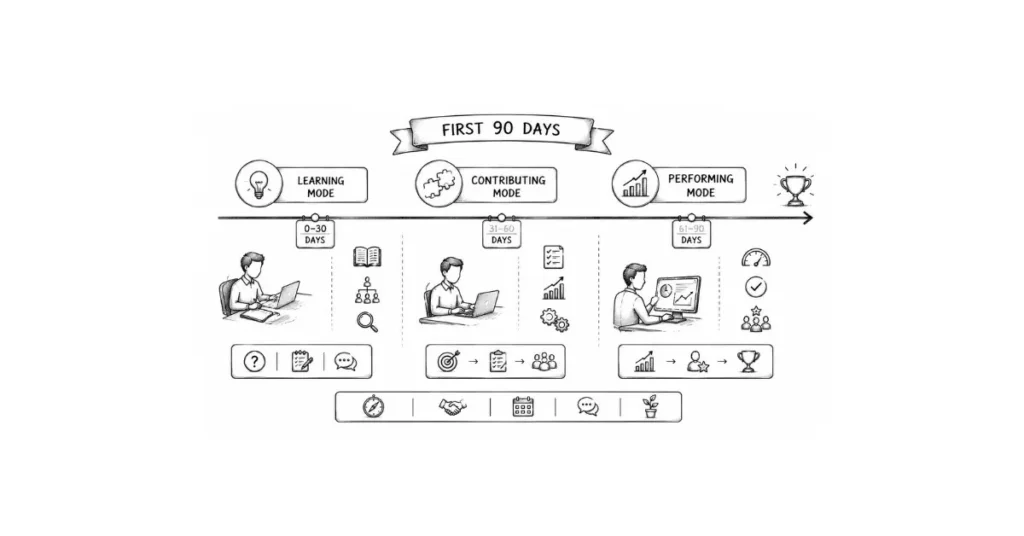
Understanding typical onboarding helps set realistic expectations:
Days 1-30: Learning Mode
- Understanding company systems and processes
- Meeting team members and stakeholders
- Shadowing experienced colleagues
- Completing assigned training modules
- Asking many questions (this is expected!)
Days 31-60: Contributing Mode
- Taking on small independent tasks
- Assisting with projects and analyses
- Beginning to add value
- Still learning but more confident
Days 61-90: Performing Mode
- Handling responsibilities independently
- Identifying improvement opportunities
- Building relationships across functions
- Demonstrating your value
Pro tip: Keep a learning journal. Document new concepts, tools, processes, and contacts. This becomes invaluable for future interviews and shows your growth.
Your Competitive Advantage: What Makes You Stand Out
In a competitive market, differentiation matters:
- Demonstrable Skills Over Certificates
Rather than just listing “Advanced Excel” on your resume, create a portfolio of actual analyses you’ve done. - Supply Chain Projects
Analyze a real company’s supply chain and present improvement recommendations. This shows initiative and practical thinking. - Technology Comfort
Young professionals often adapt to new software faster. Emphasize your tech-savviness. - Energy and Learning Attitude
Entry-level positions value enthusiasm and willingness to learn over experience. Show genuine interest. - Network Building
Connect with supply chain professionals on LinkedIn, engage with their content, attend virtual webinars. Networking creates opportunities.
The Reality Check: What Entry-Level Supply Chain Work Actually Feels Like
Let me be honest about what to expect:
The Good:
- You’ll learn incredibly fast
- Every day brings different challenges
- You’ll see direct impact of your work
- Career progression is clear and achievable
- Salary grows steadily with experience
The Challenging:
- Initial work might feel repetitive
- You’ll face pressure during busy periods
- Some days involve tedious data entry or documentation
- You might work longer hours occasionally (especially in logistics)
- Mistakes can have visible consequences (but also learning opportunities)
The truth: Like any career, supply chain has pros and cons. The first year tests your commitment. Those who persist and continuously learn find it rewarding.
Your Next Steps
You now know which entry-level supply chain roles exist, what they pay, what skills you need, and how to land them. Here’s your immediate action plan:
This Week:
- Choose 2-3 target roles that match your interests
- Assess which skills you have and which you need
- Enroll in an Excel course if needed
- Start building your LinkedIn profile
This Month:
- Complete at least one supply chain fundamentals course
- Create one substantial project or case study
- Prepare your resume and cover letter
- Begin applying to positions
Next Three Months:
- Apply to 30-50 relevant positions
- Network with supply chain professionals
- Prepare thoroughly for interviews
- Stay persistent despite rejections
The Indian supply chain sector is booming, creating thousands of entry-level opportunities. Companies need talented, motivated people. With the right preparation and persistence, your first supply chain job is absolutely achievable.
Ready to dive deeper? Explore our guides on essential supply chain skills, certification paths, and career progression to plan your long-term journey.