
Electric Vehicle & Battery Technology Careers
Table of Contents
Electric Vehicle Engineering Careers: EV Systems, Battery Tech & Charging
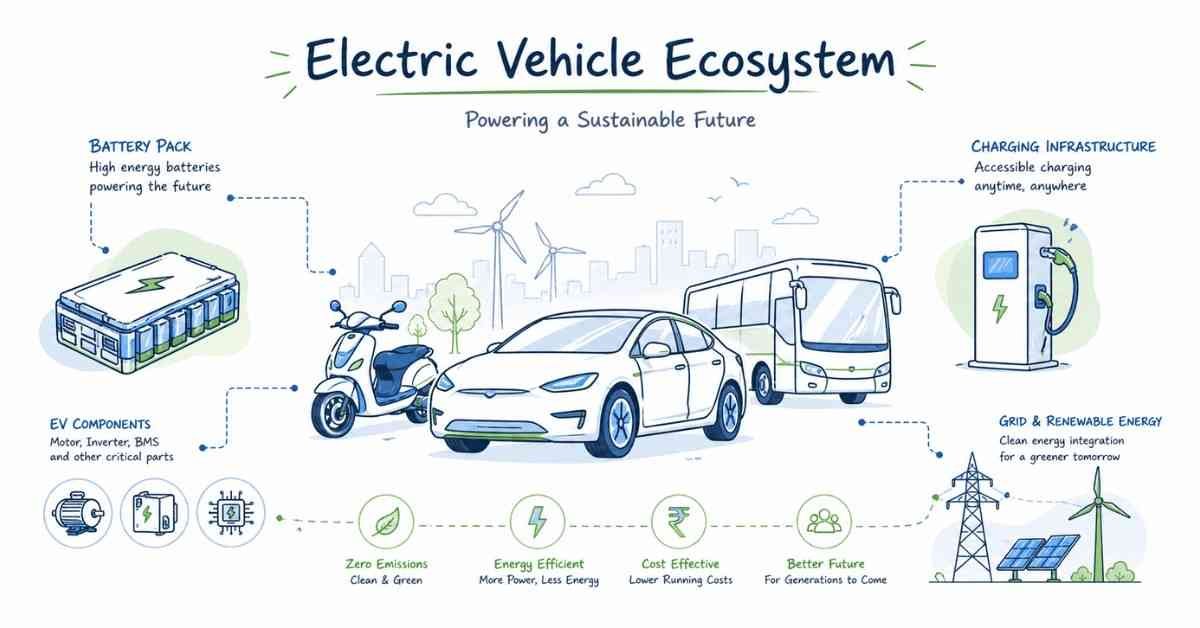
The Indian roads are transforming before our eyes. Ola electric scooters zip past traffic, Tata Nexon EVs charge at city parking lots, electric buses ply metropolitan routes, and electric three-wheelers dominate last-mile delivery. What was science fiction a decade ago is now everyday reality. And behind every electric vehicle on the road from the battery pack powering it to the charging station refueling it are electrical engineers who made it possible.
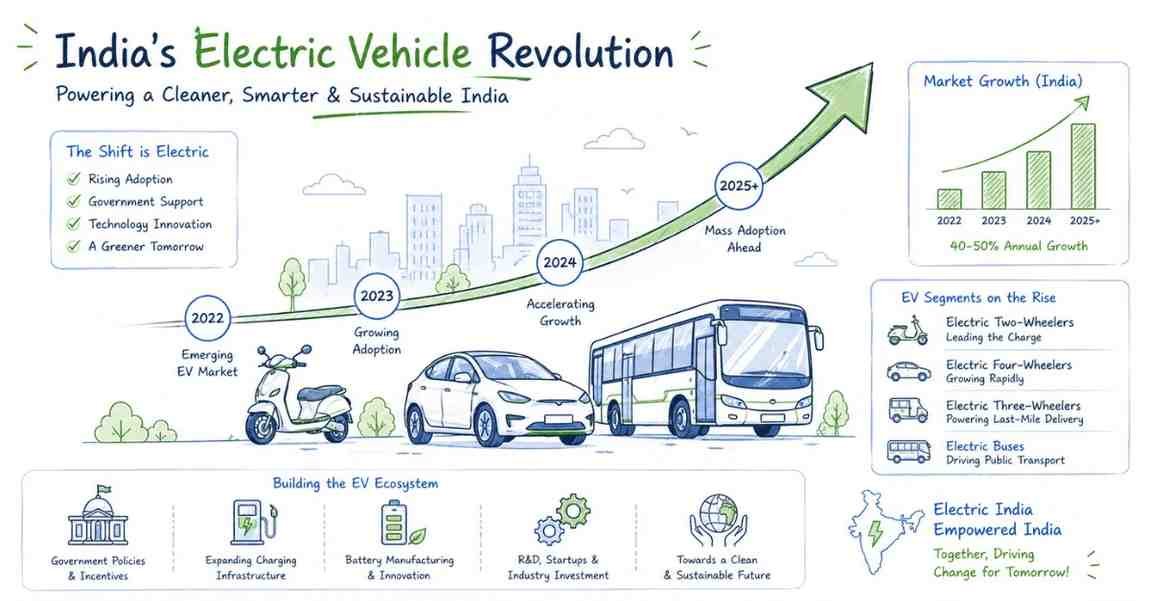
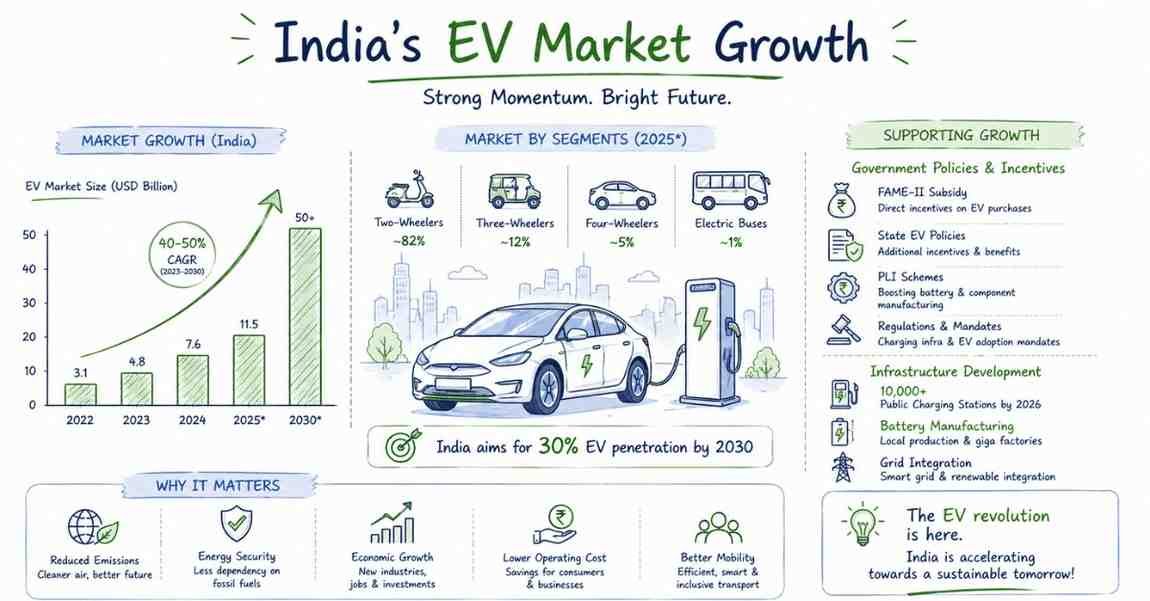
The electric vehicle revolution represents one of the most explosive career opportunities for electrical engineers in 2026. India’s EV market is growing at 40-50% annually, government policies aggressively push adoption, major automotive players invest billions, and the entire EV ecosystem from battery manufacturing to charging networks needs thousands of skilled electrical engineers.
This comprehensive guide explores EV engineering careers in India: what different roles involve, which companies are hiring, what skills you need, salary expectations, and how to position yourself for this booming sector. Whether you’re a student choosing specialization or a professional considering transition into EVs, this roadmap shows exactly how to enter and thrive in electric vehicle technology.
Why EV Careers are Exploding in India
The Numbers Tell the Story
Market Growth:
- Electric two-wheelers: 500,000+ units sold in 2025 (up from 150,000 in 2022)
- Electric three-wheelers: Dominant in several cities
- Electric four-wheelers: Growing rapidly with affordable options
- Electric buses: Government procurements driving adoption
Government Push:
- FAME-II subsidy scheme supporting EV purchases
- State EV policies with additional incentives
- Target: 30% electric vehicle penetration by 2030
- PLI schemes for battery manufacturing
- Charging infrastructure mandates
Investment Tsunami:
- Tata Motors investing ₹15,000+ crores in EVs
- Mahindra Electric scaling up
- Ola Electric’s mega factory (world’s largest scooter plant)
- Ather Energy expansion
- International players entering (Tesla evaluating India)
Infrastructure Boom:
- 10,000+ public charging stations targeted
- Battery swapping startups emerging
- Grid integration challenges creating engineering jobs
What Structural Engineers Do
Structural engineers ensure buildings and structures are safe, stable, and strong enough to carry the loads they’ll face. You’re essentially asking and answering one fundamental question: “Will this structure stand, or will it collapse?”
Your daily work involves:
- Analyzing forces acting on structures (dead loads, live loads, wind loads, earthquake forces)
- Designing structural elements like beams, columns, slabs, and foundations
- Using software like STAAD Pro, SAP2000, ETABS to model and analyze structures
- Creating structural drawings showing reinforcement details
- Reviewing contractor shop drawings
- Inspecting construction to ensure work matches design.
Types of Projects
Structural engineers work on:
- High-rise buildings: Commercial towers, residential apartments
- Bridges: Road bridges, railway bridges, pedestrian bridges
- Industrial structures: Factories, warehouses, power plants
- Special structures: Stadiums, auditoriums, amusement park rides
- Infrastructure: Metro stations, airport terminals.
Skills You Need
- Strong grasp of structural mechanics and analysis
- Proficiency in structural analysis software
- Understanding of building codes and standards (IS codes in India)
- Attention to detail (small calculation errors can have serious consequences)
- Visualization ability (imagining how structures behave under loads)
- Problem-solving skills (every project has unique challenges).
Career Prospects
Entry-level structural engineers earn ₹4-6 LPA. With 5-7 years experience, salaries reach ₹7-12 LPA. Senior structural engineers and consultants can earn ₹15-25 LPA.
Work Environment
Mix of office (design work) and site (supervision and inspection). More office-heavy than other civil engineering specializations.
Best Fit For
You’ll enjoy structural engineering if you:
- Like problem-solving and mathematical work
- Enjoy working with software and calculations
- Want to see your designs become real structures
- Prefer a mix of office and field work
- Are detail-oriented and methodical
The Engineering Opportunity
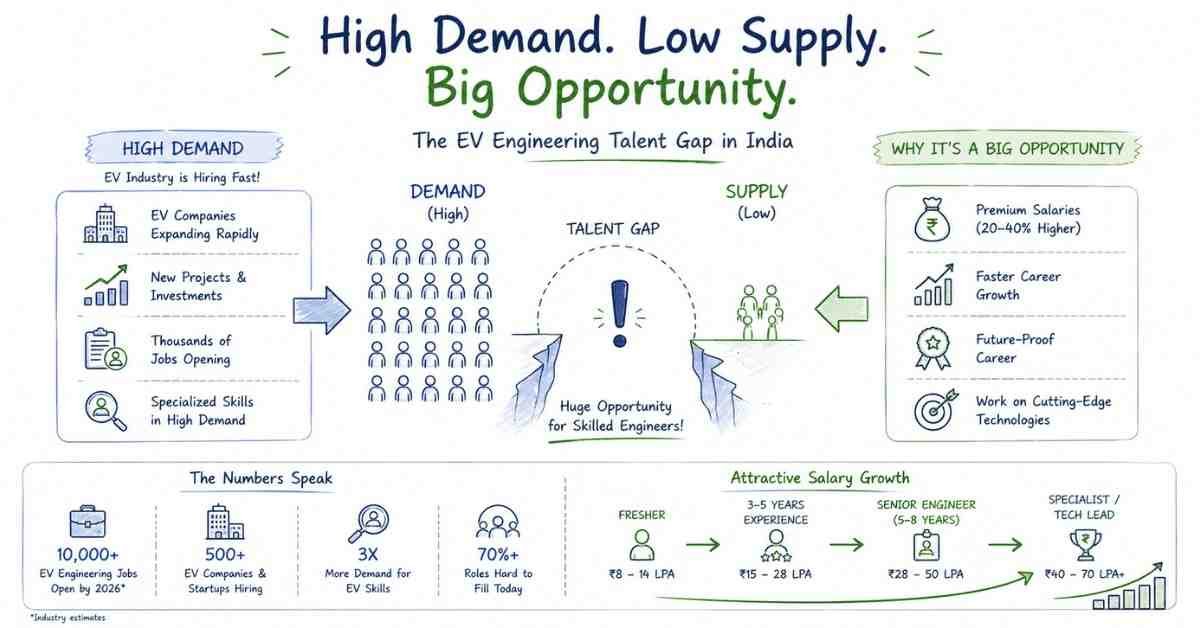
High Demand, Short Supply: Industry desperately needs electrical engineers with EV expertise. Many positions remain unfilled due to talent shortage.
Premium Salaries: EV companies pay 20-40% premium over traditional automotive for specialized skills.
Future-Proof Career: As internal combustion vehicles phase out, EV expertise becomes increasingly valuable.
Diverse Opportunities: From startups to established OEMs, from battery tech to charging infrastructure, from software to hardware.
Core EV Engineering Domains
1. Battery Technology & Battery Management Systems (BMS)
What It Involves:
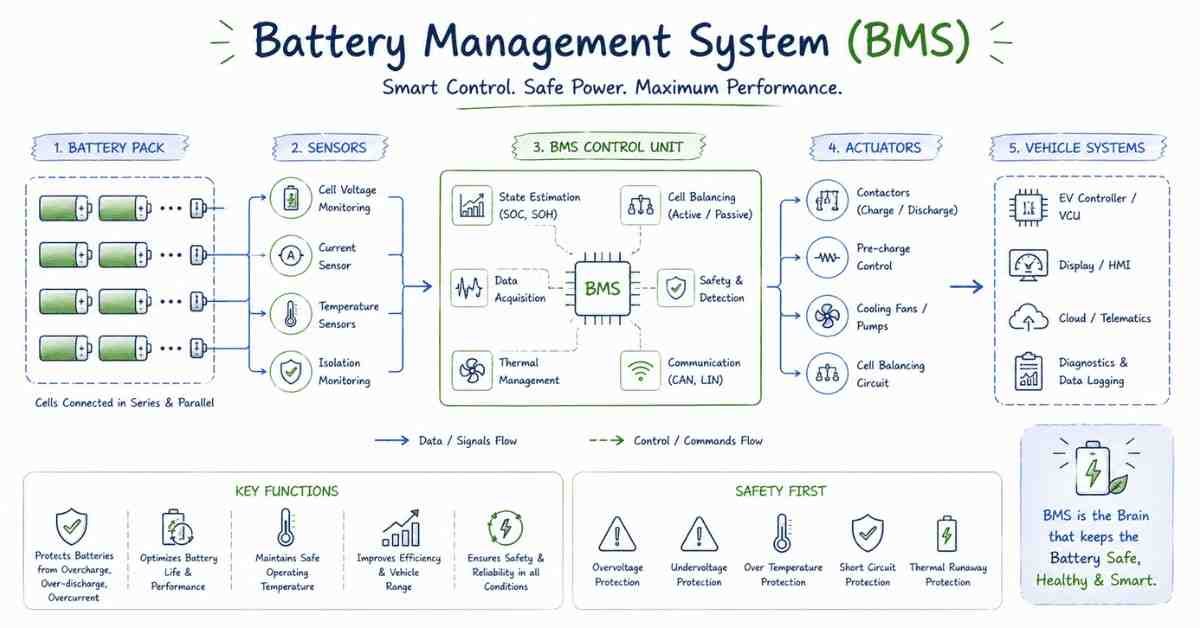
Battery technology sits at the heart of every electric vehicle. BMS engineers ensure batteries operate safely, efficiently, and reliably.
Key Responsibilities:
- Designing battery pack architecture
- Developing BMS algorithms (state of charge estimation, cell balancing, thermal management)
- Testing battery performance under various conditions
- Ensuring battery safety (overcharge, over-discharge, thermal runaway protection)
- Optimizing battery life and performance
- Battery cooling system design
- Integration with vehicle systems
Technical Areas:
- Battery Chemistry: Understanding lithium-ion variants (NMC, LFP, NCA), future chemistries
- Cell Balancing: Active vs passive balancing strategies
- State Estimation: SOC (State of Charge), SOH (State of Health) algorithms
- Thermal Management: Liquid cooling, air cooling, thermal modeling
- Safety: Fault detection, protection schemes, safety standards
- Communication: CAN bus integration with vehicle systems
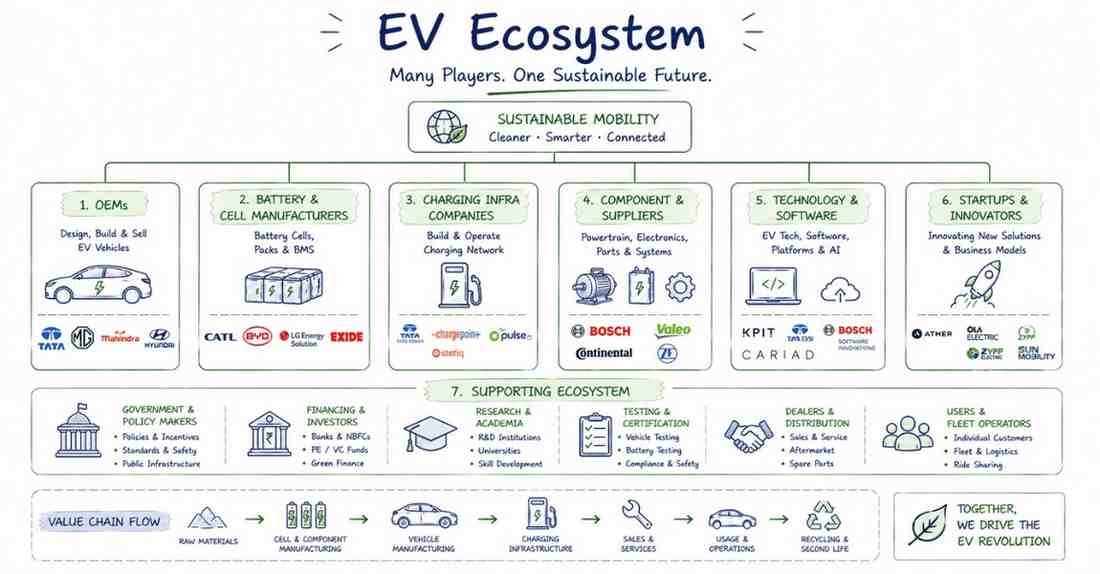
Companies Hiring:
- OEMs: Tata Motors, Mahindra Electric, Ola Electric, Ather Energy, TVS Motor
- Battery Manufacturers: Exide, Amara Raja, Reliance (entering battery manufacturing), Ola Cell
- Battery Tech Companies: Log9 Materials, Gegadyne Energy, various startups
- Engineering Services: Tata Elxsi, KPIT Technologies, Tech Mahindra
Salary Range:
- Fresher with relevant skills: ₹8-14 LPA
- 3-5 years experience: ₹15-28 LPA
- Senior BMS Engineer: ₹28-50 LPA
- Battery Tech Specialist: ₹40-70 LPA (very high demand)
Skills Required:
- Battery chemistry and cell-level understanding
- BMS algorithm development (embedded C/C++, MATLAB/Simulink)
- Control systems and estimation algorithms (Kalman filters)
- Power electronics (DC-DC converters, contactors)
- Thermal analysis (CFD basics)
- Automotive communication (CAN, LIN)
- Safety standards (ISO 26262, UL 2271, BIS standards)
- Testing tools (battery cyclers, thermal chambers)
2. Electric Powertrain Engineering
What It Involves:
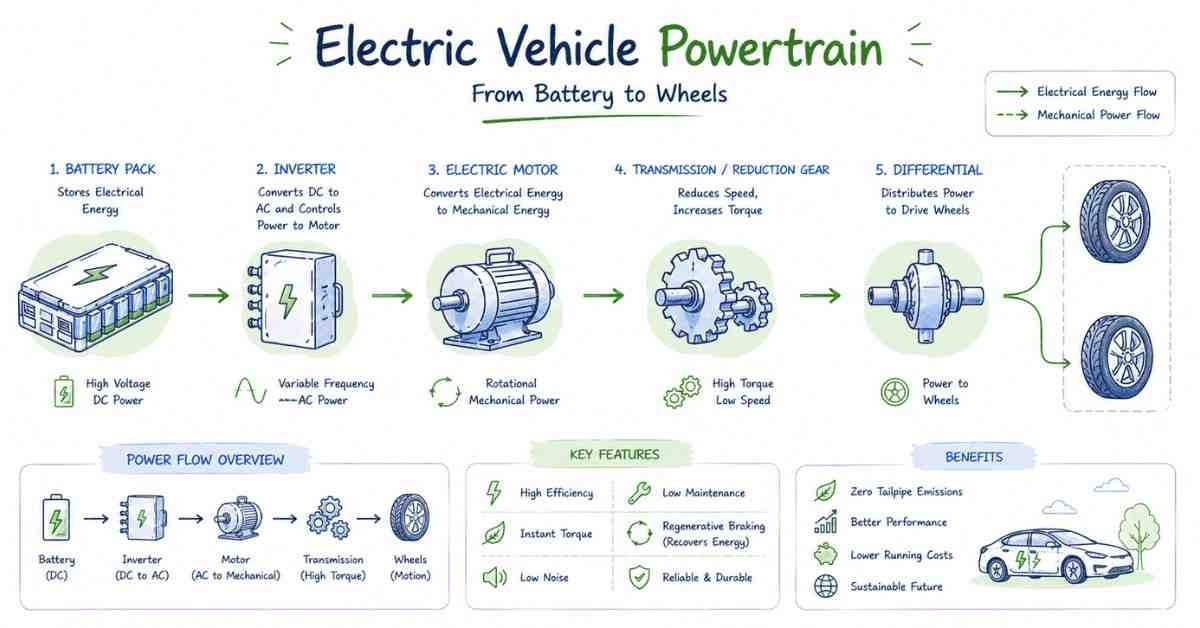
Designing and optimizing the electric motor, inverter, and transmission systems that propel the vehicle.
Key Responsibilities:
- Electric motor selection and optimization
- Inverter design and control
- Motor control algorithms (FOC, DTC)
- Powertrain efficiency optimization
- Vehicle performance calibration
- Regenerative braking implementation
- Noise, vibration, harshness (NVH) management
Technical Areas:
- Motor Technology: PMSM, induction motors, switched reluctance
- Power Electronics: Inverters, DC-DC converters, onboard chargers
- Control Algorithms: Field-oriented control, sensorless control
- Vehicle Dynamics: Understanding torque requirements, gear ratios
- Thermal Management: Motor and inverter cooling
- Efficiency Optimization: Minimizing losses across operating conditions
Companies Hiring:
- All EV OEMs (Tata, Mahindra, Ola, Ather, TVS)
- Automotive suppliers (Bosch, Continental, Dana India)
- Engineering services (KPIT, Tata Elxsi)
Salary Range:
- Fresher: ₹7-13 LPA
- Mid-level: ₹14-26 LPA
- Senior: ₹26-45 LPA
Skills Required:
- Power electronics design and control
- Motor control theory and implementation
- MATLAB/Simulink for modeling
- Embedded programming (C/C++)
- Real-time systems and microcontrollers
- AUTOSAR architecture
- Testing and validation procedures
3. EV Charging Systems
What It Involves:
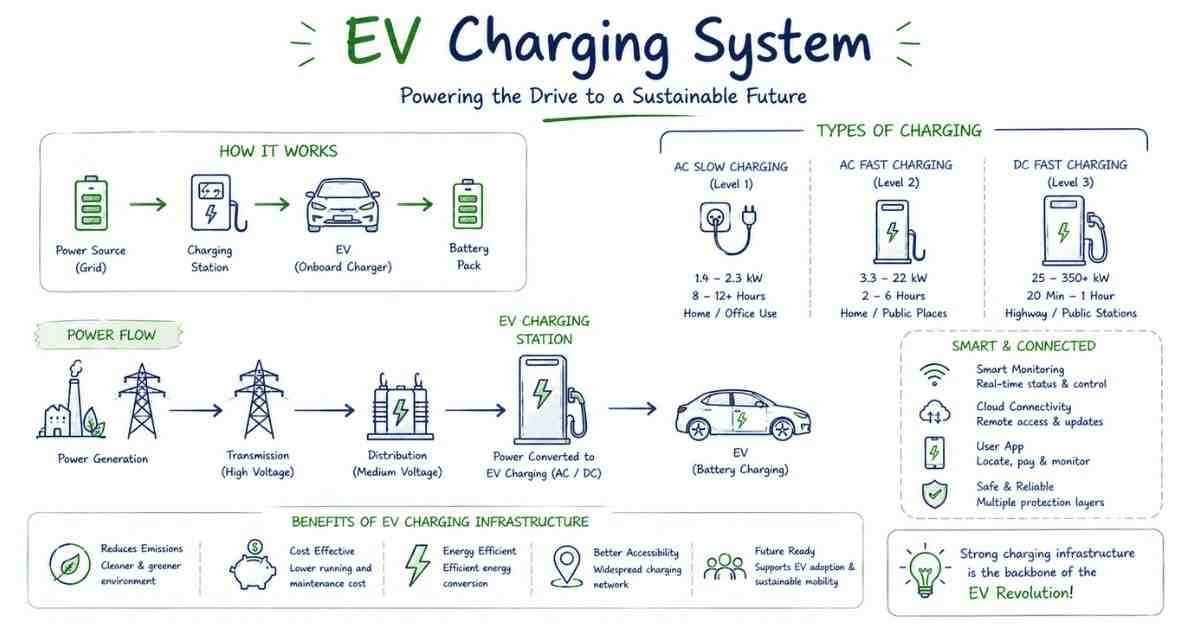
Developing onboard chargers, charging protocols, and charging infrastructure.
Key Responsibilities:
- Onboard charger design (AC-DC power conversion)
- Fast charging system development (DC fast charging)
- Charging protocols implementation (CCS, CHAdeMO, Bharat DC)
- Grid integration and power quality management
- Bidirectional charging (V2G – Vehicle to Grid)
- Charging station hardware and software
- Wireless charging research and development
Technical Areas:
- Power Electronics: High-power AC-DC, DC-DC converters
- Charging Standards: IEC 61851, CCS, CHAdeMO, GB/T, Bharat specifications
- Grid Interface: Power factor correction, harmonic mitigation
- Communication: ISO 15118, OCPP protocols
- Safety: Isolation, earth fault detection, emergency shutdown
Companies Hiring:
- Charging Infrastructure: Tata Power, Reliance BP, Fortum (India), Charge Point, Statiq
- OEMs: Building in-house charging solutions
- Startups: Kazam, BatteryPool, Sun Mobility (battery swapping)
- Equipment Manufacturers: Delta Electronics, ABB, Siemens
Salary Range:
- Fresher: ₹6-11 LPA
- Mid-level: ₹12-22 LPA
- Senior: ₹22-40 LPA
Skills Required:
- Power electronics design (high power)
- EMC/EMI design for high-power systems
- Communication protocols
- Grid codes and standards
- Safety standards and certification
- Thermal design for power electronics
4. Vehicle Control Systems & Software
What It Involves:
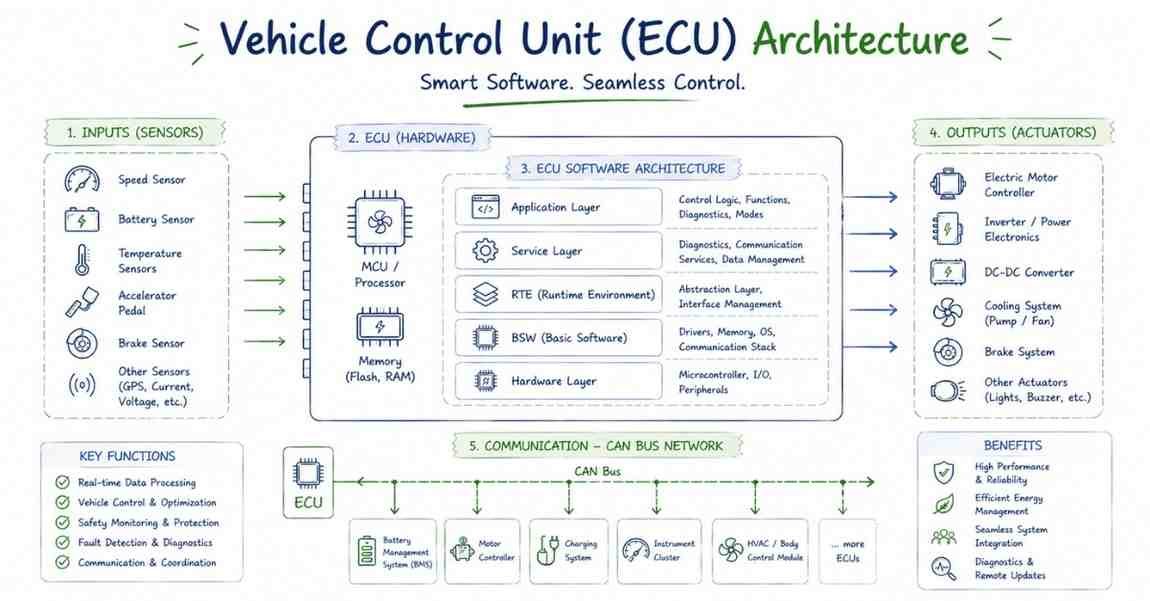
Developing embedded software that controls vehicle functions, integrates subsystems, and manages driver interface.
Key Responsibilities:
- Vehicle Control Unit (VCU) software development
- Torque distribution algorithms
- Energy management optimization
- Regenerative braking coordination
- Driver interface and displays
- Diagnostic systems
- Over-the-air (OTA) update infrastructure
Technical Areas:
- Embedded software development (C/C++)
- AUTOSAR architecture
- Model-based development (MATLAB/Simulink)
- CAN/LIN networking
- Functional safety (ISO 26262)
- Software testing and validation
Companies Hiring:
- All EV OEMs
- Automotive software companies (KPIT, Tata Elxsi, Tech Mahindra)
- Tier-1 suppliers (Bosch, Continental)
Salary Range:
- Fresher: ₹7-12 LPA
- Mid-level: ₹13-24 LPA
- Senior: ₹24-42 LPA
Skills Required:
- Strong embedded C/C++ programming
- AUTOSAR experience
- MATLAB/Simulink
- Real-time operating systems
- Automotive communication protocols
- Software testing methodologies
- Functional safety standards
5. EV Testing & Validation
What It Involves:
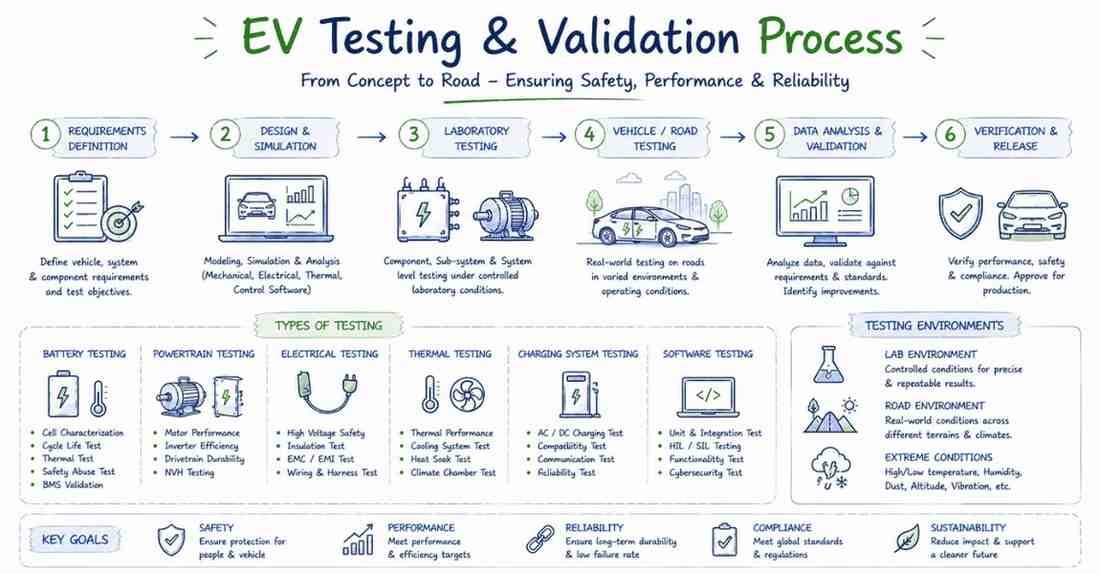
Ensuring EV systems meet performance, safety, and regulatory requirements through comprehensive testing.
Key Responsibilities:
- Battery testing (performance, safety, abuse testing)
- Powertrain testing on dynamometers
- Vehicle-level testing (range, performance, reliability)
- Charging system validation
- EMC/EMI testing
- Safety testing and certification
- Environmental testing (temperature, humidity, vibration)
Testing Types:
- Component-level testing
- System integration testing
- Vehicle validation on test tracks
- Real-world driving validation
- Regulatory compliance testing
Companies Hiring:
- All EV OEMs (dedicated test teams)
- Test facilities (ARAI, NATRIP, private test labs)
- Engineering services companies
Salary Range:
- Fresher: ₹5-10 LPA
- Mid-level: ₹11-20 LPA
- Senior/Lead: ₹20-35 LPA
Skills Required:
- Understanding of EV systems
- Test equipment operation (oscilloscopes, power analyzers, CAN tools)
- Data analysis (Excel, Python, MATLAB)
- Test standards knowledge
- Problem-solving and troubleshooting
- Documentation skills
Major Employers in Indian EV Sector
Established OEMs Electrifying
Tata Motors:
- Multiple EV models (Nexon EV, Tigor EV)
- Massive investment in EV technology
- Hiring across battery, powertrain, vehicle integration
- Locations: Pune, Mumbai, Bangalore
- Strong engineering culture
Mahindra Electric:
- Electric SUVs and commercial vehicles
- Focus on last-mile mobility solutions
- Locations: Bangalore, Pune, Chennai
TVS Motor Company:
- iQube electric scooter
- Growing electric portfolio
- Location: Hosur, Bangalore
EV-Native Startups (Unicorns and Rising Stars)
Ola Electric:
- World’s largest scooter factory
- Aggressive growth and hiring
- Developing battery cell technology in-house
- Location: Bangalore
- Startup culture with scale
- Competitive salaries and ESOPs
Ather Energy:
- Premium electric scooters
- Strong engineering focus
- Developing charging infrastructure (Ather Grid)
- Location: Bangalore
- Known for engineering excellence
Ultraviolette Automotive:
- High-performance electric motorcycles
- Emerging player
- Location: Bangalore
Battery and Components
Ola Cell:
- Battery cell manufacturing
- Part of Ola Electric ecosystem
- Massive hiring for battery engineers
Exide & Amara Raja:
- Traditional battery companies entering EV space
- Large-scale battery pack manufacturing
Log9 Materials:
- Rapid charging battery technology
- Innovative aluminum fuel cell technology
Gegadyne Energy:
- Next-generation battery technology startup
Charging Infrastructure
Tata Power:
- Largest EV charging network in India
- Expanding rapidly
Reliance BP:
- Setting up charging infrastructure
Fortum (India):
- Charging solutions provider
Statiq, Kazam, ChargeZone:
- Startup charging networks
Engineering Services & Consulting
KPIT Technologies:
- Automotive software and EV systems
- Large EV practice
- Location: Pune, Bangalore
Tata Elxsi:
- EV system integration and software
- Design and engineering services
Tech Mahindra:
- EV engineering services
- Software and systems integration
International Companies in India
Bosch India:
- Electric powertrain components
- Battery management systems
- Charging solutions
Continental India:
- EV components and systems
ABB India:
- Charging infrastructure
- Power electronics
Educational Pathways into EV Careers
For Students (During B.Tech)
Relevant Branches:
- Electrical Engineering (most direct)
- Electronics Engineering
- Mechanical Engineering (for vehicle integration roles)
- Instrumentation
Key Courses to Focus:
- Power electronics (absolutely critical)
- Electric drives and motors
- Control systems
- Battery technology (take as elective if available)
- Embedded systems
- Automotive electronics
Practical Preparation:
- Join college EV/electric vehicle clubs
- Participate in Formula Student electric vehicle competition
- Build EV conversion projects (electric bicycle/scooter)
- Internships at EV companies (even 2 months adds huge value)
- Learn battery management system development
- MATLAB/Simulink proficiency
- Embedded C programming for automotive applications
Specialized Courses and Certifications
Battery Technology:
- Online courses on lithium-ion batteries (Coursera, edX)
- BMS-specific training from specialized institutes
- Electrochemistry fundamentals
EV System Design:
- Electric vehicle specialization courses (various ed-tech platforms)
- Automotive engineering programs with EV focus
Standards and Safety:
- ISO 26262 (Functional Safety) training
- EV-specific safety standards
Software and Tools:
- MATLAB/Simulink for automotive
- AUTOSAR training
- CAN protocol and automotive networking
For Working Professionals Transitioning
From Traditional Automotive:
- Easiest transition understand vehicle systems, learn EV specifics
- Focus on power electronics and battery technology
- Leverage domain knowledge of vehicle requirements
From Power Electronics:
- Already have critical skillset
- Learn automotive-specific applications and standards
- Understand battery chemistry basics
From Embedded Systems:
- Learn automotive domain and standards
- AUTOSAR architecture essential
- Functional safety training
From Other Electrical Domains:
- Take structured EV courses
- Build projects demonstrating EV knowledge
- Network with EV professionals
- Consider internship/sabbatical at EV company to gain experience
Skills That Make You Hire-Ready
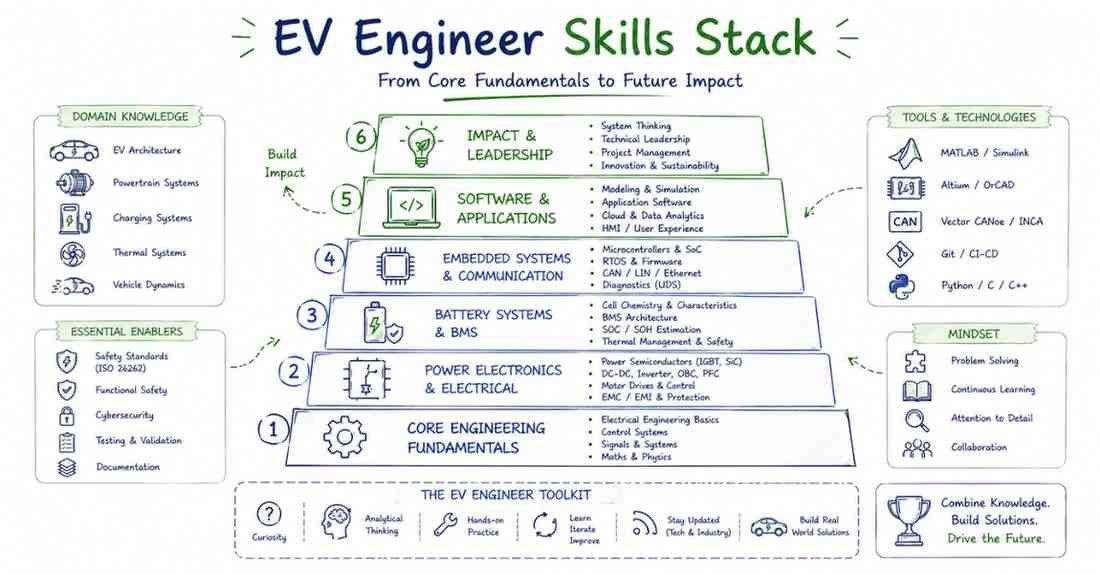
Must-Have Technical Skills
Power Electronics:
- DC-DC converter design and control
- Inverter topologies and control strategies
- High-power, high-efficiency design
- Thermal management
Battery Fundamentals:
- Lithium-ion cell chemistry and characteristics
- Battery pack design principles
- BMS architecture and algorithms
- Safety and protection
Control Systems:
- PID control and tuning
- State estimation (Kalman filtering)
- Model-based control
Embedded Programming:
- C/C++ for automotive (MISRA-C compliant)
- Real-time programming
- Microcontroller experience (ARM Cortex preferred)
Automotive Standards:
- CAN, LIN protocols
- ISO 26262 (Functional Safety) awareness
- Automotive cybersecurity basics
Software Tools:
- MATLAB/Simulink (extensively used)
- CANalyzer/CANoe (Vector tools)
- Battery simulation tools
- Circuit simulation (LTspice, PSpice)
Soft Skills Valued in EV Industry
Fast Learning: Technology evolves rapidly quick learners thrive
Problem-Solving: New technology means new problems needing creative solutions
Collaboration: EV systems are complex multidisciplinary teamwork essential
Startup Mindset: Even in established OEMs, EV divisions operate like startups
Adaptability: Standards evolving, technology changing, regulations updating
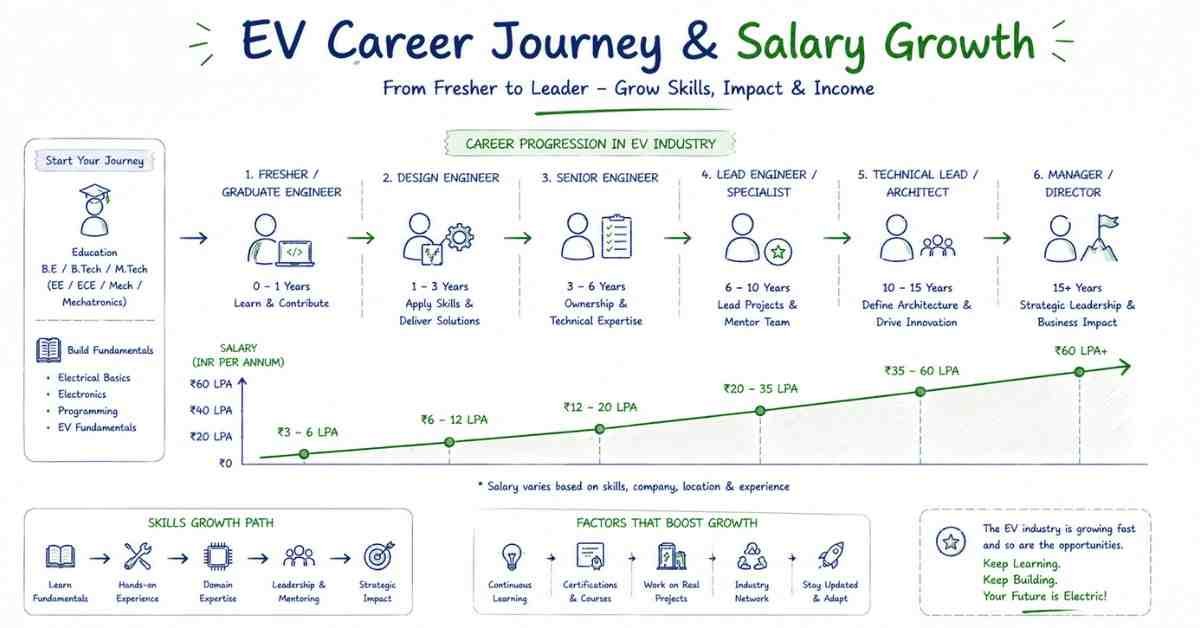
Salary Expectations in EV Sector
Fresh Graduates (0-1 Year)
Roles: Junior engineer, graduate engineer trainee
Range: ₹6-14 LPA
Factors: College tier, specific skills (BMS commands premium), company (startups vs established)
Top Offers: ₹15-18 LPA from leading EV startups for exceptional candidates
Early Career (2-4 Years)
Roles: Engineer, senior engineer
Range: ₹12-24 LPA
Premium for: Battery technology expertise, powertrain control, proven project delivery
Mid-Career (5-8 Years)
Roles: Senior engineer, lead engineer, technical specialist
Range: ₹22-40 LPA
Premium for: BMS architecture, functional safety, rare specializations
Senior (8-12 Years)
Roles: Principal engineer, engineering manager
Range: ₹35-60 LPA
Top Tier: ₹60-80 LPA for critical specializations at well-funded startups
Expert Level (12+ Years)
Roles: Chief engineer, technical director
Range: ₹60 LPA – 1.2 Cr+
Includes: ESOPs at startups, RSUs at established companies
Comparison with Traditional Automotive
EV roles typically offer:
- 20-40% premium for equivalent roles in traditional automotive
- Faster growth trajectory due to rapidly expanding teams
- Equity component at startups (can be significant value)
- Higher demand translates to better negotiation position
Career Growth and Progression
Technical Track
Years 0-3: Junior Engineer → Engineer
- Focused work on specific subsystems
- Learning tools, standards, processes
- Contributing to projects under supervision
Years 3-7: Senior Engineer → Lead Engineer
- Ownership of modules/systems
- Technical leadership of small teams
- Interface with cross-functional teams
Years 7-12: Principal Engineer → Chief Engineer
- System architecture definition
- Technical mentoring
- Innovation and patents
- Subject matter expert status
Years 12+: Technical Fellow/Director
- Technology strategy
- Cross-program technical leadership
- Industry representation
- Thought leadership
Management Track
Years 3-7: Team Lead
- Leading 3-8 engineers
- Project execution responsibility
Years 7-12: Engineering Manager
- Managing multiple teams
- Budget and resource management
- Hiring and people development
Years 12+: Senior Manager/Director/VP Engineering
- Department/division leadership
- Strategic planning
- Organizational development
Entrepreneurship Path
EV Ecosystem Opportunities:
- Battery pack design and manufacturing
- Charging solutions and services
- EV conversion services
- Component manufacturing
- Software and services for EVs
- Battery recycling and second-life applications
Future Outlook and Emerging Areas
Near-Term (2026-2028)
Battery Cost Reduction:
- Continued battery price decline enabling affordable EVs
- Engineers working on cost optimization without compromising performance
Charging Infrastructure Expansion:
- Thousands of charging stations rollout
- Fast charging technology (350kW+)
- Battery swapping gaining traction
Diverse Vehicle Segments:
- Electric commercial vehicles scaling
- Electric tractors and agricultural vehicles
- Electric construction equipment
Medium-Term (2028-2032)
Advanced Battery Chemistries:
- Solid-state batteries coming to market
- Silicon anodes for higher energy density
- New cathode chemistries
Vehicle-to-Grid (V2G):
- EVs as distributed energy storage
- Grid stabilization using EV fleets
- Bidirectional charging becoming standard
Autonomous Electric Vehicles:
- Self-driving technology in electric platforms
- Shared autonomous electric mobility
Long-Term (2032+)
Wireless Charging:
- Static wireless charging
- Dynamic charging (while driving)
Ultra-Fast Charging:
- Sub-10-minute charging becoming standard
- Ultra-high-power charging infrastructure
Circular Economy:
- Battery second-life applications
- Advanced recycling technology
- Sustainable battery materials
Getting Started: Your Action Plan
For Final Year Students
Immediate (Next 3 Months):
- Complete online course on EV fundamentals
- Learn MATLAB/Simulink if not already proficient
- Build simple BMS project using Arduino/ESP32
- Update resume highlighting relevant coursework and projects
- Apply for internships at EV companies
Before Graduation:
- Complete substantial EV-related final year project
- Attend EV industry webinars and conferences
- Network on LinkedIn with EV professionals
- Target EV companies in campus placements
- Consider specialized EV certification course
For Working Professionals
Assessment Phase (Month 1-2):
- Evaluate current skills vs EV requirements
- Identify transferable skills from current role
- Research specific EV domain of interest
- Connect with professionals in EV industry
Skill Building (Month 3-8):
- Take structured EV course (weekend/online)
- Build EV projects demonstrating capability
- Attend EV technical seminars/workshops
- Consider part-time EV-related consulting/freelancing
Transition (Month 9-12):
- Apply to EV companies highlighting relevant experience
- Be open to lateral or slight downgrade initially
- Leverage network for referrals
- Consider smaller EV startups for entry if struggling with established names
Conclusion: Electrifying Your Career
The electric vehicle revolution is not future speculation it’s happening right now on Indian roads and in Indian factories. Every major automotive company is going electric, every month brings new EV startups, and government policies ensure this trend only accelerates.
For electrical engineers, this represents a once-in-a-generation opportunity. An entire industry is being built from scratch. Traditional automotive companies are hiring aggressively to fill knowledge gaps. EV-native startups are growing at breakneck speed. Charging infrastructure needs thousands of engineers. Battery technology is evolving rapidly.
The salaries are attractive 20-40% premium over traditional automotive. The work is cutting-edge you’re literally shaping the future of mobility. The growth is exponential senior positions emerging as companies scale. And the impact is tangible every EV on the road represents cleaner air and energy independence.
Whether you’re passionate about battery chemistry, excited by power electronics, fascinated by vehicle dynamics, or interested in software control systems, there’s a place for you in the EV ecosystem.
The internal combustion engine ruled for a century. That era is ending. The electric era is beginning. And electrical engineers will build it.
The question isn’t whether to consider EV careers. The question is: are you ready to be part of the revolution transforming Indian mobility?
The road ahead is electric. So is the opportunity.