
Manufacturing & Production Engineering
Table of Contents
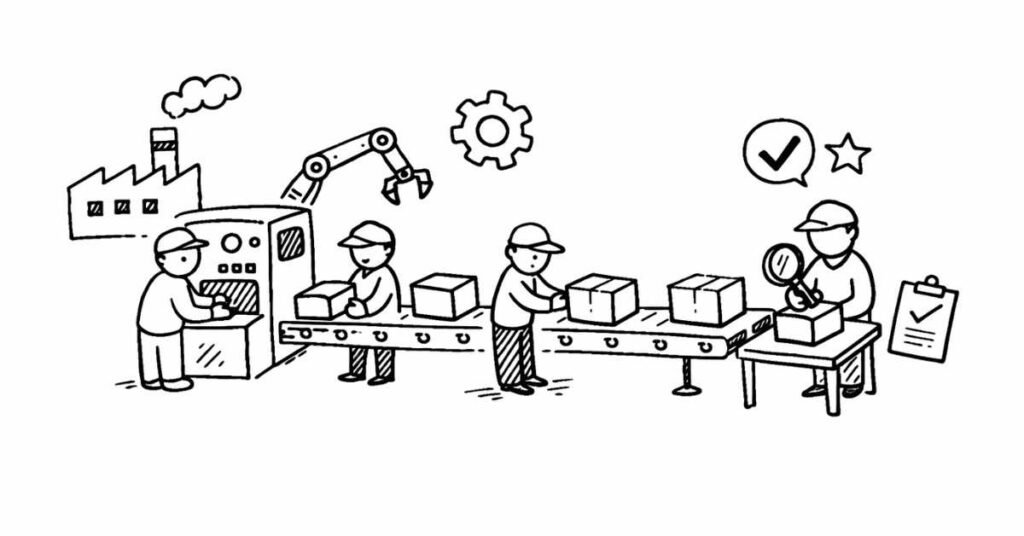
1. What Is Manufacturing & Production Engineering?
If design engineers are responsible for “what” a product looks like, manufacturing and production engineers are responsible for “how” it will be made—reliably, safely, and profitably.
In simple words, your job is to:
- Make sure the factory produces the right product.
- At the right quality.
- In the right quantity.
- At the right time.
- At the right cost.
You become the bridge between design, shop floor, quality, and management.
2. Manufacturing vs Production vs Industrial: Quick Clarity
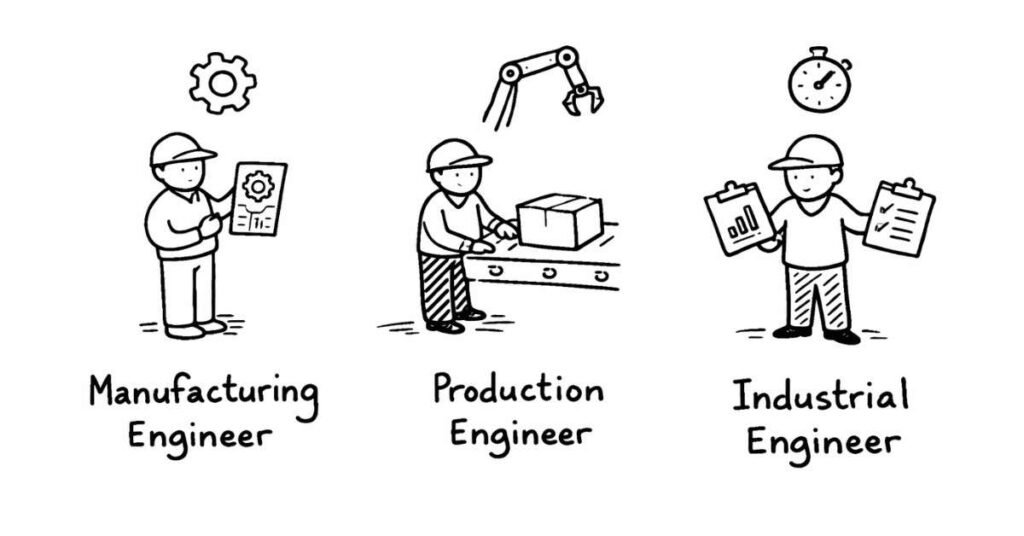
- Manufacturing Engineer: Focuses on processes and equipment—“How do we make this part efficiently?”
- Production Engineer: Focuses on daily output—“Is today’s target met with minimum downtime and scrap?”
- Industrial Engineer: Focuses on systems and optimisation—layout, time studies, productivity, ergonomics.
In smaller companies, one person may wear all these hats; in larger plants, these are separate functions that collaborate.
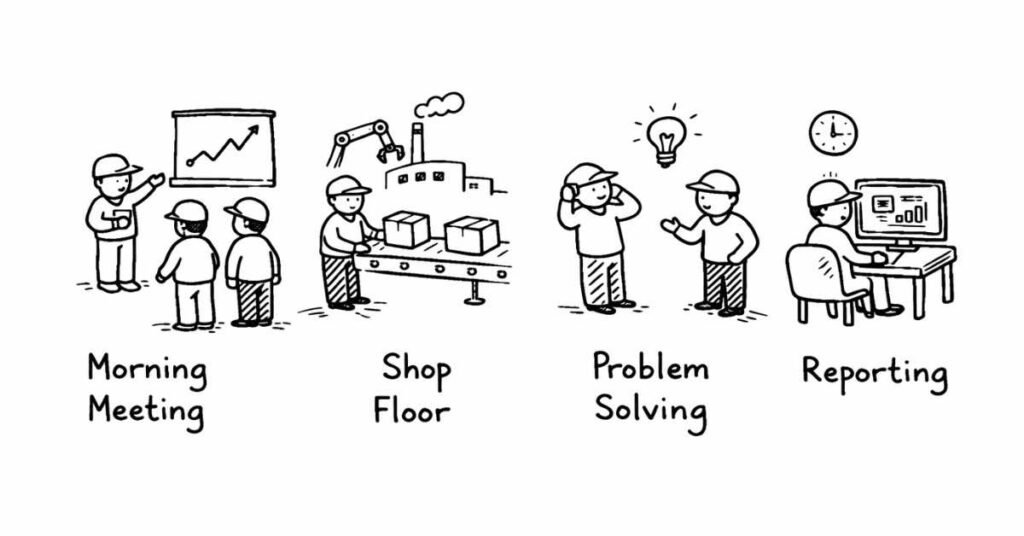
3. A Typical Day for a Production/Manufacturing Engineer
- Morning meeting: review yesterday’s production, breakdowns, quality issues, and today’s targets.
- Shop floor round: check machines, talk to operators, note any abnormalities.
- Problem‑solving: tackle recurring stoppages, bottlenecks, or high scrap at a particular station.
- Improvement work: implement a small layout change, fixture improvement, or parameter tuning.
- Meetings with design/maintenance/quality about ongoing issues.
- Documentation: updating production reports, OEE (Overall Equipment Effectiveness), downtime logs, and improvement actions.
It’s an active, on‑your‑feet role—ideal if you like practical work more than being at a desk all day.
4. Key Technical Skills for Manufacturing & Production
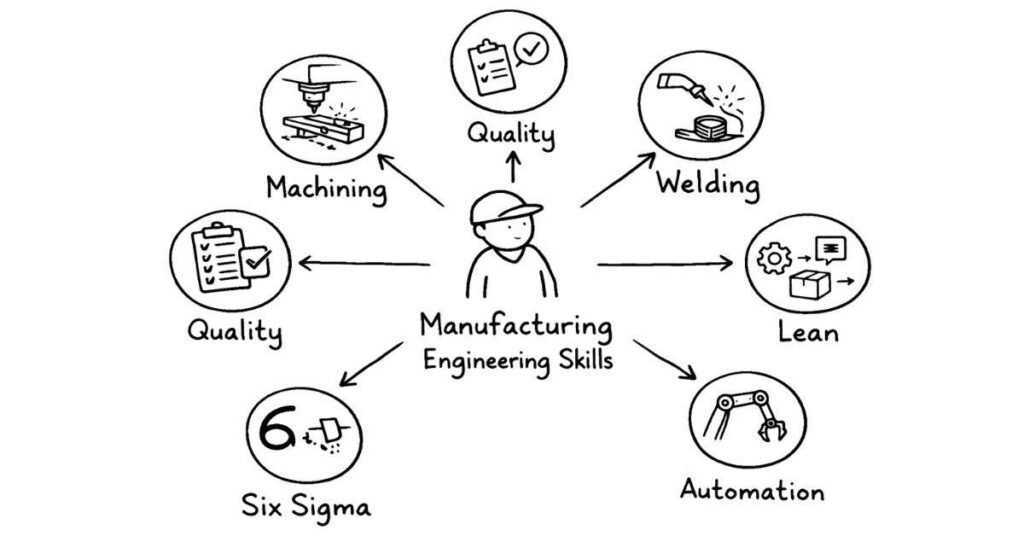
a) Process Knowledge
You don’t need to be an expert in every process, but you must understand:
- Machining (turning, milling, drilling, grinding).
- Welding and fabrication.
- Casting and forging basics.
- Sheet metal operations (cutting, bending, punching).
- Assembly methods (fasteners, press fits, adhesives).
- Basic knowledge of 3D printing (especially for tooling and prototyping).
b) Industrial Engineering Basics
- Time & motion studies.
- Line balancing (ensuring each station has similar cycle time).
- Layout design (minimising movement and congestion).
- Work standardisation (SOPs for each operation).
Inventory and material flow concepts.
c) Quality & Continuous Improvement
- Basic QC tools (Pareto chart, fishbone diagram, control charts).
- 5S and visual management.
- Root cause analysis (5 Whys, Ishikawa diagrams).
- Basic Six Sigma ideas (defects per million, variation, Cp/Cpk).
- Understanding of inspection methods and gauges.
d) Automation & Controls (Bonus but Powerful)
- Basic understanding of controllers, sensors, and actuators.
- Familiarity with PLCs and HMIs.
- Exposure to robotics or simple pick‑and‑place automation.
5. Important Soft Skills in Plant Roles
- Calm under pressure: Machines will fail, targets will slip—how you respond matters.
- People skills: You’ll manage/operators, coordinate with maintenance, negotiate with planning and stores.
- Problem‑solving: Ability to quickly diagnose whether an issue is mechanical, process‑related, or human‑related.
- Discipline: Following safety rules, ensuring others do, and maintaining process standards.
Unlike pure desk jobs, factory roles are very “people‑heavy”—you must influence others daily.
6. Common Job Roles and Responsibilities
Production Engineer
- Track daily/shift production vs target.
- Minimise unplanned downtime and scrap.
- Train operators on SOPs and safety.
- Coordinate with maintenance for planned shutdowns and urgent repairs.
Manufacturing/Process Engineer
- Define and improve machining/welding/assembly processes.
- Select and design jigs, fixtures, and tools.
- Set process parameters (feeds, speeds, temperatures, pressures).
- Support new product introduction onto existing lines.
Industrial Engineer
- Design layouts for new lines.
- Conduct cycle time and manpower studies.
- Suggest changes to reduce motion and waiting waste.
- Work on cost reduction and capacity improvement projects.
Maintenance Engineer (Closely Linked)
- Keep equipment in running condition.
- Plan preventive maintenance.
- Troubleshoot electrical/mechanical breakdowns.
- Work on reliability improvement.
In many plants, mechanical engineers rotate between production and maintenance before settling into a preferred area.
7. Work Environment: Pros & Cons (Honest View)
Pros:
- Very practical; you see physical results daily.
- Huge learning about real‑world constraints and systems.
- Strong base for future roles in operations management, plant management, or even general management.
- Often excellent job stability in core industries.
Cons:
- Shifts and long hours in some plants (especially automotive, continuous process industries).
- Physically tiring at times (standing/walking most of the day).
- High pressure around month‑end/quarter‑end targets.
- Less “glamour” compared to R&D or design work, though equally vital.
This path suits those who don’t mind dust, noise, and the smell of oil—and get satisfaction from seeing thousands of “your” parts shipped out daily.
8. Salary & Career Growth (Indicative, India)
Again, very rough bands:
- Freshers (0–2 years): around ₹3–5.5 LPA in many plants; some larger MNCs and fast‑growing firms pay more.
- 3–7 years: ₹5–10 LPA, increasing with responsibility (team‑leading, line ownership, cross‑functional projects).
- 8–15 years: ₹10–25 LPA+ when you move into roles like Production Manager, Plant Manager, Operations Head.
Engineers who combine shop‑floor experience with an MBA (Operations/SCM) often move into:
- Factory/Unit head roles.
- Corporate operations and process excellence functions.
- Supply chain and logistics optimization.
9. How to Enter and Grow in Manufacturing & Production
As a student:
- Don’t skip workshop classes; learn actual tools and machines.
- Try to get at least one internship at a plant, even a small local one.
- Visit factories during industrial visits and ask real questions about downtime, scrap, and bottlenecks.
As a fresher:
- Join a core company even if the initial salary looks modest compared to IT—if you genuinely want a manufacturing career.
- Volunteer for improvement projects, not just routine reporting.
- Learn from operators; they often know practical tricks textbooks don’t teach.
Skill upgrades over time:
- Learn structured improvement methods (Six Sigma Green Belt, lean courses).
- Get comfortable with Excel/Power BI for analysing plant data.
- If you like people and leadership, focus on team management skills early.
10. Choosing Between Design vs Manufacturing Paths
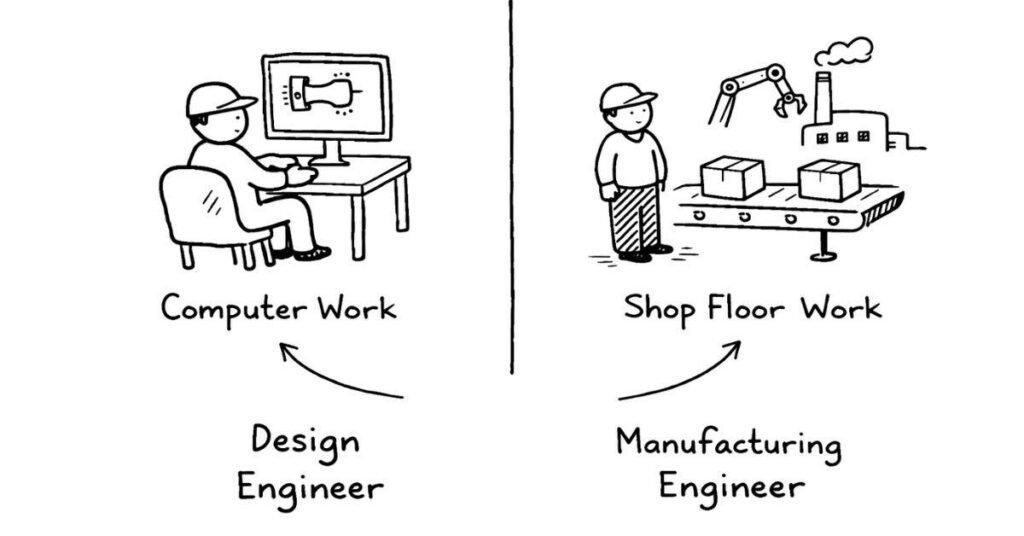
Since your master guide covers both, students will often ask: “Should I pick design or manufacturing?”
Ask yourself:
- Do you enjoy sitting at a system shaping designs, or being on the shop floor fixing flow and issues?
- Do you get more excited about a clever 3D model, or watching a line run smoothly at full capacity?
Are you more patient with detailed computer work, or more energized by talking to people and solving on‑the‑spot problems?