
Mechanical Engineering Career Guide
Table of Contents
Introduction
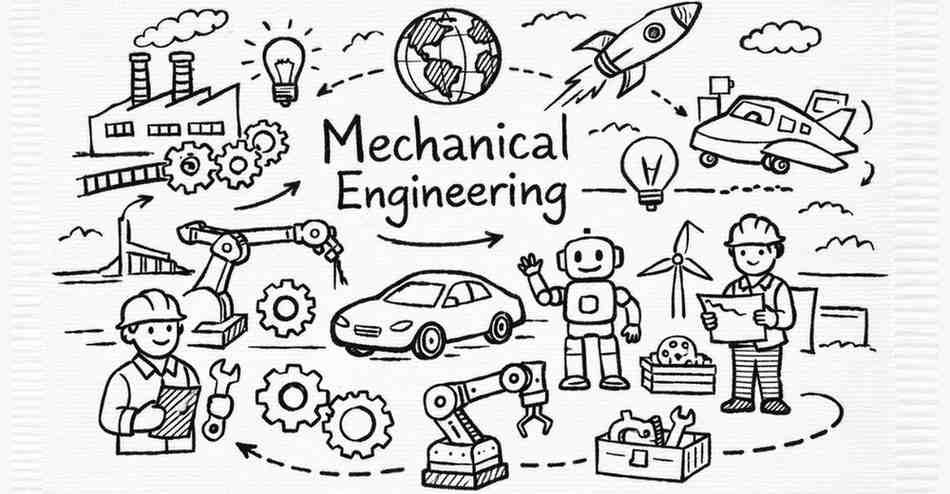
If you’ve ever wondered how cars move, machines work, or factories produce thousands of products daily you’re thinking like a mechanical engineer. This field isn’t just about fixing engines or drawing blueprints anymore. Today’s mechanical engineers are building robots, designing sustainable energy systems, and creating smart factories powered by artificial intelligence.
In India, mechanical engineering remains one of the most versatile and rewarding career paths you can choose. Whether you’re a 12th standard student deciding your engineering stream, a B.Tech graduate exploring job options, or a working professional looking to upskill, this guide covers everything you need to know about building a successful career in mechanical and industrial engineering.
The mechanical engineering landscape has transformed dramatically. Gone are the days when this field was limited to manufacturing plants and automobile workshops. Today, mechanical engineers work on cutting-edge projects—from developing electric vehicles and renewable energy systems to programming industrial robots and designing aerospace components.
Why This Guide Matters
This comprehensive guide addresses the real questions Indian engineering students and professionals ask: Which specialization should I choose? What CAD software should I learn? How much can I earn as a design engineer? Which companies are hiring? What certifications will boost my career?
Unlike generic career advice, this guide focuses specifically on opportunities available in India, salary ranges in Indian rupees, and skills that Indian employers actually demand. We’ve researched current industry trends, spoken to hiring managers, and analyzed job postings to bring you actionable insights.
Understanding Mechanical Engineering
Mechanical engineering is the branch of engineering that applies principles of physics, mathematics, and material science to design, analyze, manufacture, and maintain mechanical systems. It’s often called the “mother of all engineering disciplines” because its principles form the foundation for many other engineering fields.
Core Principles
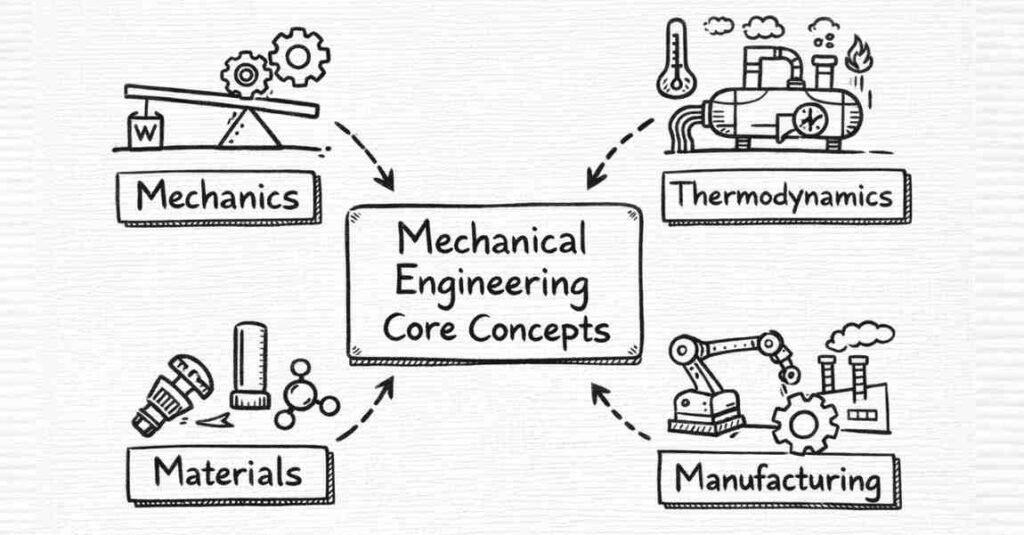
At its heart, mechanical engineering deals with anything that moves. This includes:
- Mechanics: Understanding how forces affect objects
- Thermodynamics: Managing heat and energy transfer
- Materials Science: Knowing which materials work best for different applications
- Manufacturing: Transforming raw materials into finished products
- Design: Creating efficient and innovative solutions
The Industry 4.0 Revolution
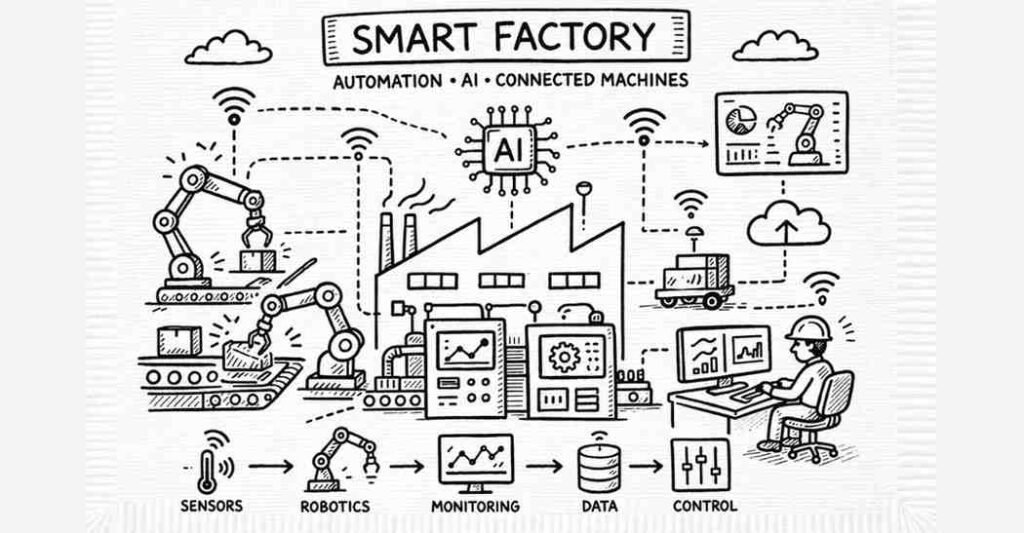
We’re currently in the midst of Industry 4.0—the fourth industrial revolution. This transformation is bringing digital technology into physical manufacturing, creating “smart factories” where machines communicate with each other, predict maintenance needs, and optimize production automatically.
For mechanical engineers, this means exciting new opportunities. You’re no longer just designing static machines; you’re creating intelligent systems that can learn and adapt. Knowledge of sensors, data analytics, and automation technologies has become just as important as traditional mechanical skills.
Mechanical vs. Industrial Engineering
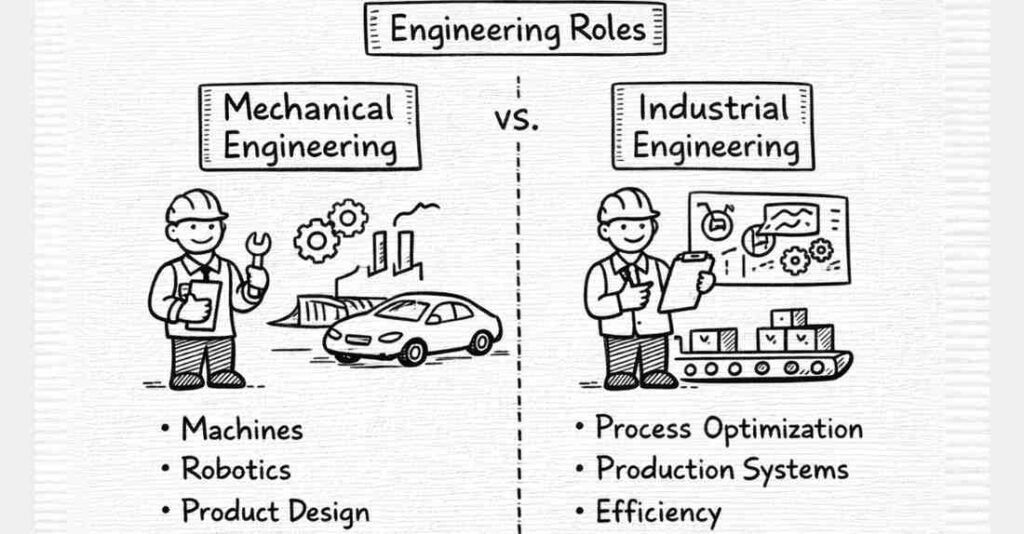
Many students confuse mechanical and industrial engineering. While related, they have different focuses:
Mechanical Engineering concentrates on designing, building, and maintaining mechanical systems—engines, machines, tools, and equipment. You work on the technical aspects of how things function mechanically.
Industrial Engineering focuses on optimizing complex processes and systems. Industrial engineers improve efficiency in factories, supply chains, and service organizations. They’re more concerned with workflow, logistics, and resource management.
However, these fields overlap significantly, especially in manufacturing environments where mechanical engineers need to understand production efficiency, and industrial engineers must grasp mechanical processes.
Educational Pathways: From 12th Standard to Advanced Degrees
Starting Your Journey After 12th
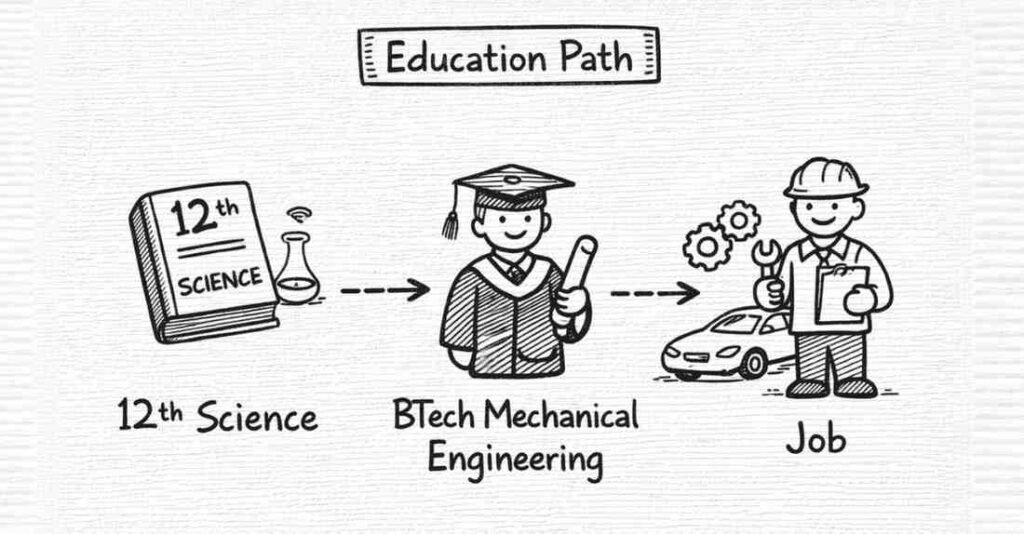
To pursue mechanical engineering, you need to complete 12th standard with Physics, Chemistry, and Mathematics. Your performance in these subjects directly impacts which colleges you can enter.
Entrance Exams:
- JEE Main: For admission to NITs, IIITs, and state government colleges
- JEE Advanced: For IITs—the most prestigious engineering institutions in India
- State-level exams: Like MHT-CET (Maharashtra), KCET (Karnataka), WBJEE (West Bengal)
- University-specific exams: BITSAT (BITS Pilani), VITEEE (VIT), SRMJEEE (SRM)
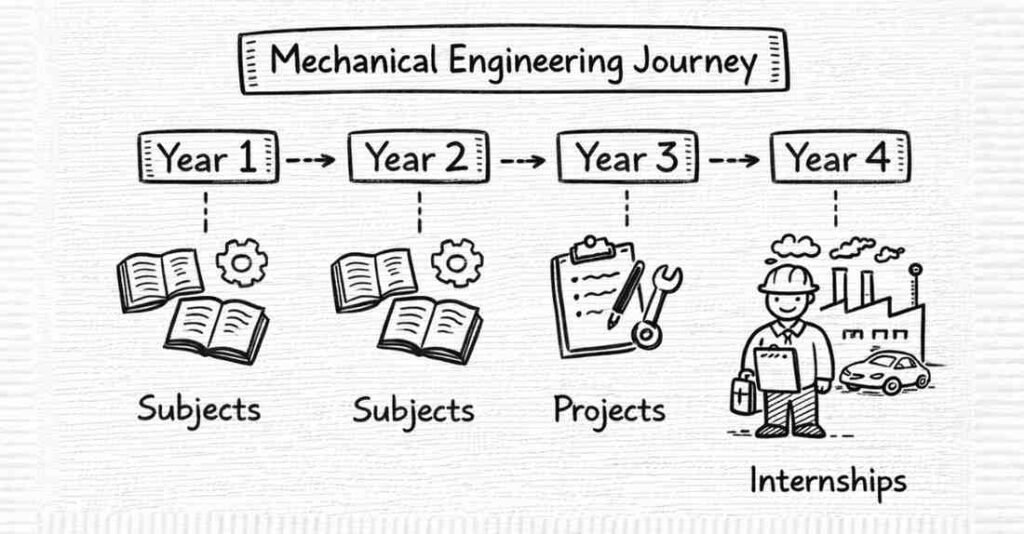
B.Tech Mechanical Engineering (4 Years)
Your undergraduate degree forms the foundation of your career. The curriculum typically includes:
First Year (Common for all branches):
- Engineering Mathematics
- Physics and Chemistry
- Engineering Drawing
- Programming Fundamentals (C/Python)
- Workshop Practice
Second Year:
- Strength of Materials
- Thermodynamics
- Fluid Mechanics
- Manufacturing Processes
- Engineering Materials
Third Year:
- Heat Transfer
- Machine Design
- Dynamics of Machinery
- CAD/CAM
- Industrial Engineering
- Elective specializations begin
Fourth Year:
- Advanced specialization courses
- Major project work
- Industrial training/internship
- Elective subjects in emerging technologies
Beyond B.Tech: M.Tech and Specializations
After completing your bachelor’s degree, you have several options:
- Direct Employment: Start working immediately, especially if you’ve secured campus placement
- M.Tech (Master of Technology): Two-year postgraduate program for deeper specialization
- Thermal Engineering
- Design Engineering
- Manufacturing Engineering
- Robotics and Automation
- Computer-Aided Design
- Production Management
- GATE Preparation: The Graduate Aptitude Test in Engineering opens doors to:
- M.Tech admission in IITs/NITs with scholarships
- PSU (Public Sector Undertaking) jobs in companies like BHEL, ONGC, Indian Oil
- Teaching positions in government colleges
- MBA: Many mechanical engineers pursue MBA to transition into management roles or technical sales
Diploma Route
If you prefer a faster entry into the workforce, consider a 3-year diploma in mechanical engineering after 10th standard. Diploma holders can:
- Get technician-level jobs immediately
- Later pursue B.Tech through lateral entry (directly into second year)
- Gain practical skills valued in manufacturing industries
Top Institutions in India
IITs (Indian Institutes of Technology): IIT Bombay, IIT Delhi, IIT Madras, IIT Kanpur, IIT Kharagpur offer world-class mechanical engineering programs
NITs (National Institutes of Technology): NIT Trichy, NIT Surathkal, NIT Warangal provide excellent education with strong industry connections
Private Universities: BITS Pilani, VIT Vellore, Manipal Institute of Technology offer quality education with good placement records
Essential Skills Every Mechanical Engineer Needs
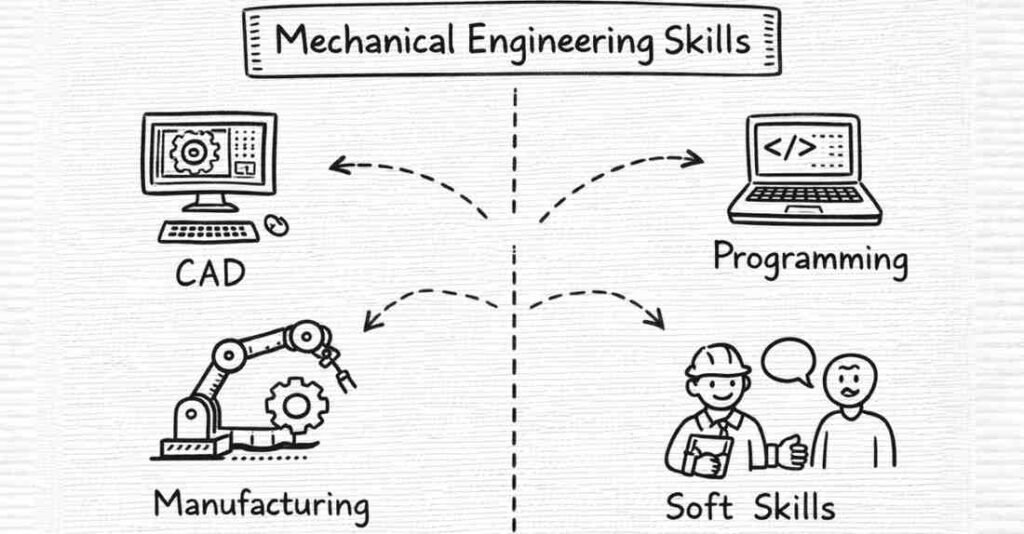
Success in mechanical engineering requires a combination of technical expertise and soft skills. Here’s what employers are actually looking for in 2026:
Technical Skills
- CAD/CAE Software Mastery
Computer-Aided Design (CAD) and Computer-Aided Engineering (CAE) tools are non-negotiable skills. You’ll use these daily, regardless of your specialization.
Must-learn tools:
- AutoCAD: Industry standard for 2D drafting and documentation
- SolidWorks: Popular for 3D modeling and mechanical design
- CATIA: Used extensively in automotive and aerospace industries
- ANSYS: For simulation and finite element analysis
- CREO (Pro/Engineer): Common in product design companies
Most employers expect proficiency in at least 2-3 of these tools. The good news? Once you master one CAD software, learning others becomes much easier because the fundamental concepts remain the same.
- Programming and Computational Skills
Modern mechanical engineers need basic programming knowledge. You don’t need to become a software developer, but understanding code helps you work with automated systems and simulation tools.
Useful languages:
- Python: For data analysis, automation scripts, and machine learning applications
- C/C++: For embedded systems and robotics programming
- MATLAB: For mathematical modeling and simulation
- PLC Programming: For industrial automation and control systems
- Manufacturing and Production Knowledge
Understanding how products are actually made is crucial. This includes:
- CNC machining processes
- 3D printing and additive manufacturing
- Casting, forging, and welding techniques
- Quality control methods
- Lean manufacturing principles
- Industry 4.0 Technologies
Stay relevant by learning about:
- Internet of Things (IoT) sensors and connectivity
- Artificial Intelligence applications in engineering
- Robotics and automation systems
- Digital twin technology
- Smart manufacturing concepts
Analytical and Problem-Solving Skills
Mechanical engineering is fundamentally about solving problems. You need strong analytical thinking to:
- Break down complex systems into understandable components
- Identify root causes of failures
- Optimize designs for cost, performance, and reliability
- Make data-driven decisions
Soft Skills That Matter
Communication: You’ll need to explain technical concepts to non-technical stakeholders, write reports, and present ideas clearly.
Teamwork: Engineering projects involve collaboration across departments—design, manufacturing, quality, and sales teams all need to work together.
Project Management: Understanding timelines, budgets, and resource allocation helps you deliver projects successfully, even early in your career.
Continuous Learning: Technology evolves rapidly. The most successful engineers dedicate time regularly to learning new tools, techniques, and industry trends.
High-Demand Specializations
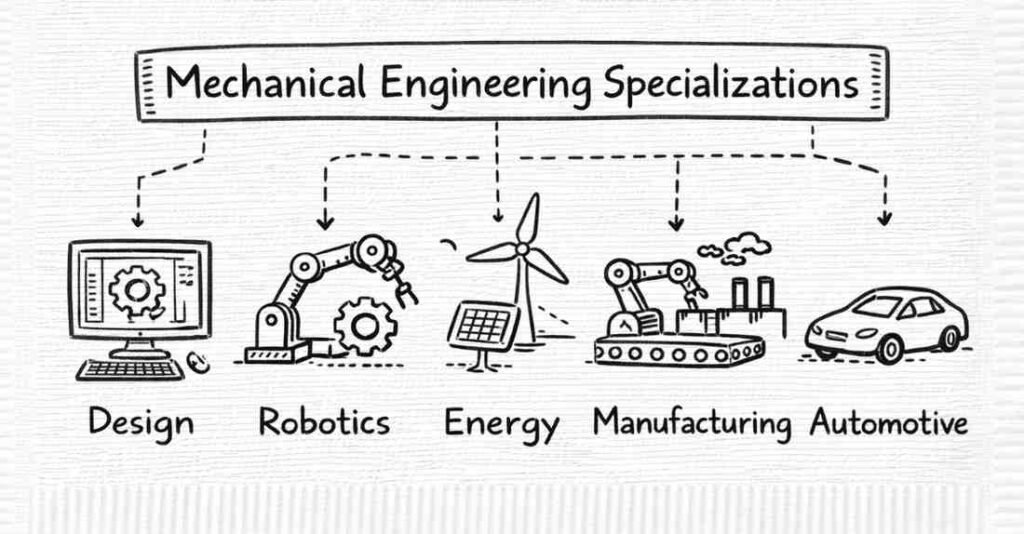
Choosing the right specialization can significantly impact your career trajectory. Here are the most promising areas:
- Design Engineering
Design engineers create the blueprints and prototypes for new products. You’ll work with CAD software to model parts, run simulations to test designs, and collaborate with manufacturing teams to bring products to life.
Key opportunities: Product design companies, automotive firms, consumer goods manufacturers, R&D departments
Average salary: ₹8.5 LPA (Lakhs Per Annum)
- Robotics and Automation
This rapidly growing field combines mechanical, electrical, and computer engineering to create intelligent machines. You’ll design robotic systems, program controllers, and integrate automation into manufacturing processes.
Key opportunities: Manufacturing automation, warehouse robotics, industrial robot manufacturers, research institutions
Growth potential: Extremely high—India’s automation market is expanding rapidly
- Energy Technology and Renewable Energy
With global focus on sustainability, energy engineers are in high demand. You’ll work on power generation systems, renewable energy installations, and energy-efficient technologies.
Key opportunities: Power plants, renewable energy companies, sustainability consulting, research organizations
Average salary: ₹6.5 LPA for power plant engineers
- Manufacturing and Production Engineering
Production engineers ensure manufacturing processes run efficiently, products meet quality standards, and costs remain controlled.
Key opportunities: Manufacturing plants, automotive production, electronics manufacturing, process industries
Average salary: ₹4-5.5 LPA
- Automotive Engineering
India’s automotive industry is booming, especially with the shift toward electric vehicles. Automotive engineers design vehicle components, test performance, and improve efficiency.
Key opportunities: Car manufacturers (Tata, Mahindra, Maruti), EV companies, automotive suppliers, research organizations
- Aerospace Engineering
Aerospace engineers design aircraft, spacecraft, satellites, and defense systems. This specialized field requires advanced knowledge and typically needs higher qualifications.
Key opportunities: ISRO, DRDO, HAL (Hindustan Aeronautics Limited), private aerospace companies, airlines
- Mechatronics
Mechatronics combines mechanical, electrical, and computer engineering to create “smart” mechanical systems—robots, automated assembly lines, and intelligent products.
Key opportunities: Automation companies, robotics firms, smart manufacturing facilities, consumer electronics
- Computational Engineering
This emerging field uses advanced mathematics and computer simulations to solve complex engineering problems without building physical prototypes.
Key opportunities: Research institutions, automotive R&D, aerospace simulation, finite element analysis specialists
Industry Sectors Hiring Mechanical Engineers
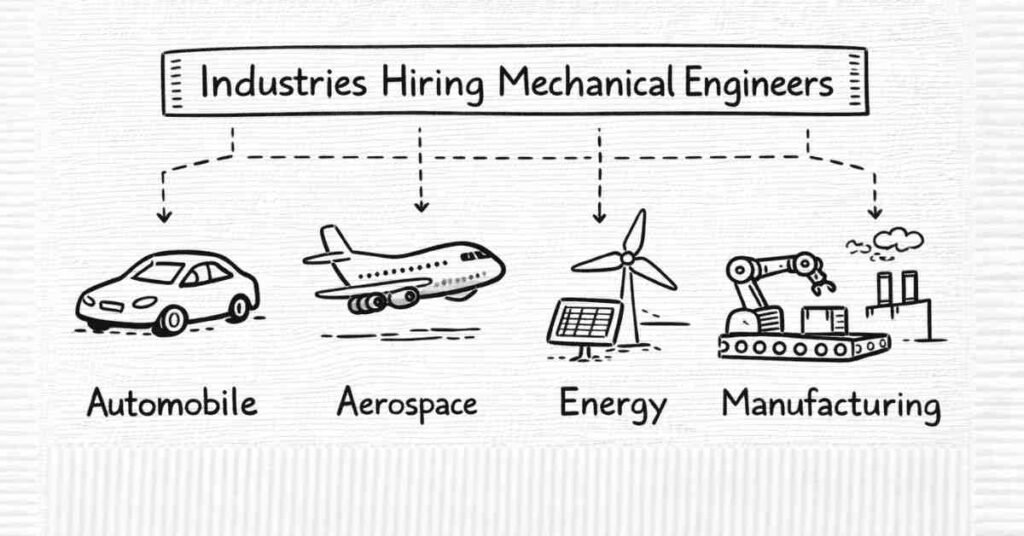
Mechanical engineering skills are valued across diverse industries. Understanding these sectors helps you target your job search effectively:
- Automobile Industry
India is one of the world’s largest automotive markets. Companies need mechanical engineers for design, testing, manufacturing, and quality roles.
Major employers: Tata Motors, Mahindra & Mahindra, Maruti Suzuki, Hero MotoCorp, Bajaj Auto, Ola Electric, Ather Energy
- Aerospace and Defense
This prestigious sector offers challenging projects and excellent job security, though competition is intense.
Major employers: ISRO (Indian Space Research Organisation), DRDO (Defence Research and Development Organisation), HAL, Bharat Dynamics Limited
- Energy and Power
India’s growing energy needs create constant demand for engineers who can design, operate, and maintain power generation facilities.
Major employers: NTPC, Power Grid Corporation, Reliance Power, Adani Power, renewable energy companies like ReNew Power
- Manufacturing and Production
The backbone of India’s industrial economy, manufacturing offers abundant opportunities across diverse products.
Major employers: Larsen & Toubro (L&T), Siemens, ABB, Bosch, Tata Steel, JSW Steel
- Oil and Gas
This sector offers some of the highest salaries for mechanical engineers, especially for roles in offshore operations and refinery management.
Major employers: ONGC, Indian Oil Corporation, Bharat Petroleum, Reliance Industries, Cairn India
- Construction and Infrastructure
As India builds new cities, metro systems, and infrastructure projects, demand for mechanical engineers in HVAC (Heating, Ventilation, and Air Conditioning) and MEP (Mechanical, Electrical, and Plumbing) roles grows.
Major employers: L&T Construction, Shapoorji Pallonji, Voltas, Blue Star, infrastructure development firms
- Consultancy and Services
Engineering consultancy firms hire mechanical engineers to provide expertise to client companies across industries.
Major employers: TCS (Tata Consultancy Services), Tech Mahindra, Infosys, Wipro—yes, IT companies increasingly need mechanical engineers for IoT and automation projects!
- Research and Development
If you love innovation and have strong academic credentials, R&D offers intellectually stimulating careers.
Major employers: CSIR (Council of Scientific and Industrial Research) laboratories, IIT research centers, corporate R&D divisions of major companies
Salary Guide: What Can You Really Earn?
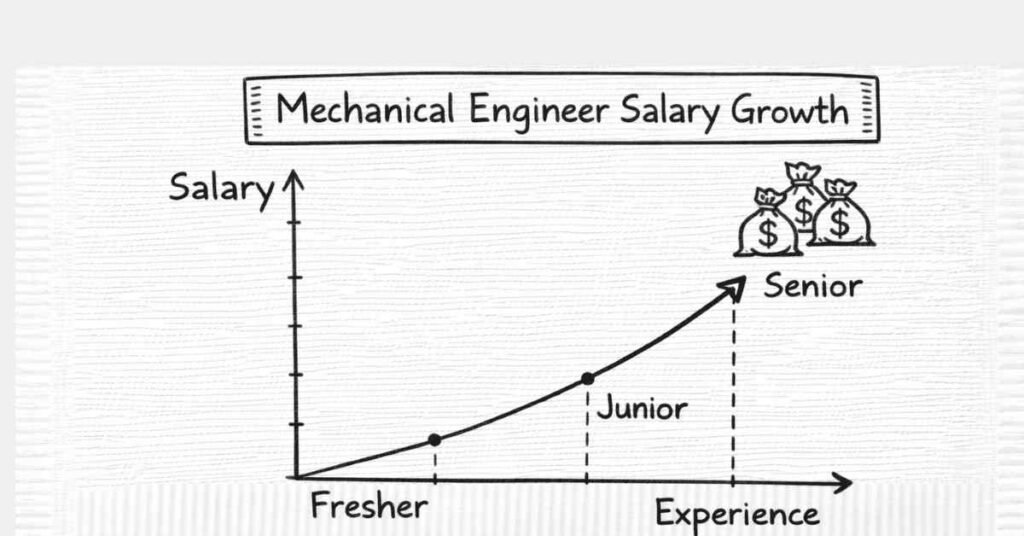
Let’s talk numbers. Salary guide is a crucial consideration, and transparency helps you make informed career decisions. Here’s what mechanical engineers earn in India across different experience levels and specializations:
Entry-Level (Freshers, 0-2 years)
- Average salary: ₹3-4 LPA
- Top companies (IIT/NIT graduates): ₹6-10 LPA
- PSU jobs through GATE: ₹5-7 LPA
Entry-level salaries vary significantly based on your college, academic performance, and the company you join. Tier-1 college graduates from IITs and NITs can expect higher starting packages.
Mid-Level by Specialization (3-7 years)
- Design Engineers: ₹8.5 LPA average
- Production Engineers: ₹4-5.5 LPA
- Power Plant Engineers: ₹6.5 LPA
- Aerospace Engineers: ₹6-12 LPA
- Automotive Engineers: ₹5-9 LPA
- Robotics Engineers: ₹7-15 LPA
Senior Level (8+ years)
- Senior Design Engineer/Manager: ₹15-25 LPA
- Plant Manager: ₹18-30 LPA
- Senior R&D Engineer: ₹20-35 LPA
- Technical Director: ₹30-50+ LPA
Factors Affecting Salary
Location matters: Metropolitan cities like Bangalore, Pune, Mumbai, and Hyderabad offer higher salaries than smaller towns, though cost of living is also higher.
Industry matters: Oil & gas, aerospace, and automotive typically pay more than general manufacturing.
Skills matter: Engineers with in-demand skills (CAD expertise, automation knowledge, certifications) command higher salaries.
Company size matters: Large MNCs and established PSUs generally offer better compensation packages than small companies, though startups might offer equity.
Certifications That Boost Your Career
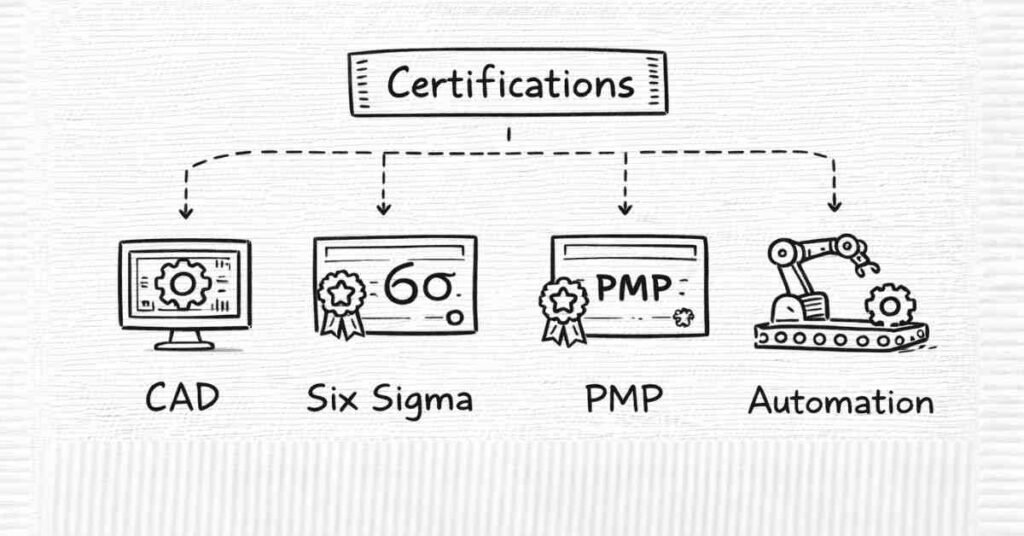
The right certifications can significantly increase your employability and earning potential. Here are the most valuable ones for mechanical engineers:
CAD/CAE Certifications
- Certified SolidWorks Professional (CSWP): Globally recognized, demonstrates advanced 3D CAD skills
- Autodesk Certified Professional: Validates AutoCAD expertise
- CATIA Certification: Valued in automotive and aerospace sectors
- ANSYS Simulation Certification: Proves finite element analysis capabilities
Manufacturing and Quality
- Lean Six Sigma (Yellow Belt, Green Belt, Black Belt): Essential for process improvement and quality roles
- Certified Manufacturing Engineer (CMfgE): Offered by SME (Society of Manufacturing Engineers)
- Quality Management Certifications: ISO 9001 Lead Auditor
Emerging Technology Certifications
- Robotics Process Automation: Various vendors offer certifications
- PLC Programming: Siemens, Allen-Bradley, Mitsubishi certifications
- MATLAB Certification: Useful for simulation and data analysis
- Additive Manufacturing Certification: Growing importance with 3D printing adoption
Energy and Sustainability
- LEED Green Associate: For sustainable design
- Certified Energy Manager (CEM): Valuable in energy sector
- Renewable Energy Certifications: Solar PV, wind energy design
Project Management
- PMP (Project Management Professional): Valuable for senior roles
- PRINCE2: Alternative project management certification
Where to Get Certified
- Online platforms: Coursera, Udemy, edX offer affordable certification courses
- Company training: Many employers sponsor certifications; always ask during job negotiations
- Professional bodies: ASME (American Society of Mechanical Engineers), Institution of Engineers India
Software vendor websites: Directly from AutoCAD, SolidWorks, ANSYS websites
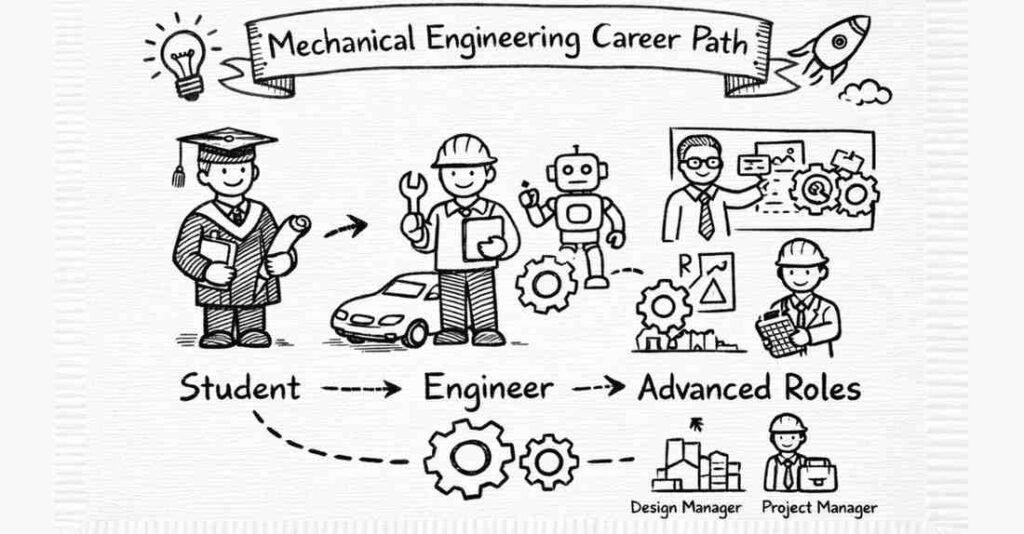
Career Growth Strategies: From Fresher to Leader
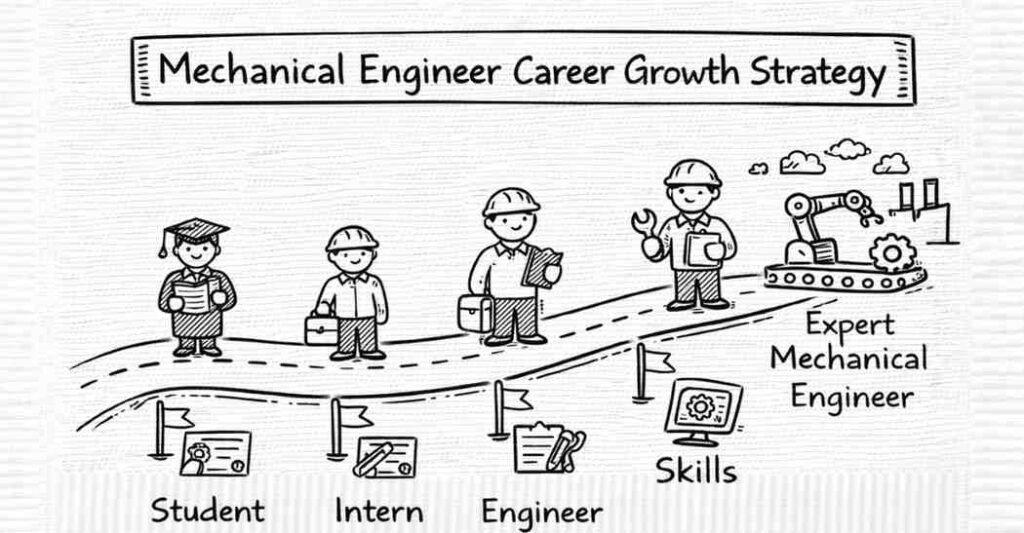
Building a successful mechanical engineering career requires strategy beyond just technical skills. Here’s how to accelerate your growth:
As a Student (Pre-Graduation)
- Secure quality internships: Don’t wait until final year. Start internship hunting after second year. Even a 2-month summer internship provides invaluable real-world experience.
- Work on practical projects: Build a portfolio of projects that demonstrate your skills. Design something using CAD, build a working prototype, or participate in competitions like SAE Baja or Formula Student.
- Learn beyond curriculum: Your college syllabus provides foundations, but employers want current, industry-relevant skills. Invest time learning the latest CAD software, programming languages, and emerging technologies.
- Build your network early: Attend technical seminars, join engineering societies (ASME, SAE), connect with alumni working in your target companies, and maintain a professional LinkedIn profile.
As a Fresher (0-3 Years)
- Be a sponge: Your first job is primarily about learning. Absorb everything—how projects are managed, how designs are validated, how teams collaborate. Ask questions without hesitation.
- Take on challenging assignments: Volunteer for projects that stretch your capabilities. You’ll learn faster and become visible to management.
- Get certified: Use your first 2-3 years to acquire professional certifications. Many companies sponsor training; take full advantage.
- Document your achievements: Maintain a record of projects completed, cost savings achieved, or process improvements implemented. You’ll need this for performance reviews and future job applications.
As a Mid-Level Professional (3-7 Years)
- Develop specialization: By this stage, you should have deep expertise in a specific area—be it automotive design, automation, or energy systems.
- Develop leadership skills: Start mentoring junior engineers, leading small teams, or managing projects. Technical skills alone won’t get you to senior positions.
- Consider higher education: If aiming for leadership or specialized technical roles, an M.Tech or MBA might be valuable. Evaluate based on your career goals.
- Switch strategically: If you need to change companies for growth, do it strategically. Each move should represent a clear upward trajectory in responsibilities, learning, or compensation.
As a Senior Professional (8+ Years)
- Build thought leadership: Write articles, speak at conferences, contribute to industry publications. Establishing expertise opens doors to consulting and leadership roles.
- Transition to management or go deeper technically: Decide whether you want to manage people and projects or become a deep technical expert. Both paths are rewarding but require different skills.
- Mentor actively: Give back by mentoring younger engineers. It’s professionally rewarding and keeps you connected to emerging trends.
- Stay technically current: Don’t let management responsibilities make you technically obsolete. Set aside time for continuous learning.
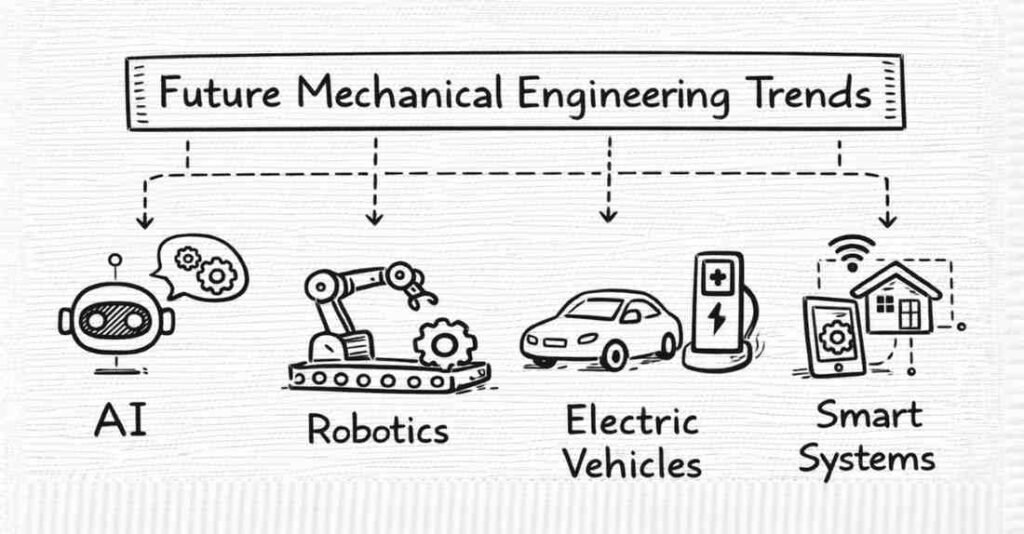
Emerging Trends Shaping the Future
Understanding where mechanical engineering is heading helps you prepare for future opportunities:
Artificial Intelligence and Machine Learning
AI is transforming mechanical engineering in several ways:
- Predictive maintenance: AI analyzes sensor data to predict equipment failures before they happen
- Generative design: AI algorithms generate optimized designs based on constraints you specify
- Quality control: Computer vision and AI detect defects faster than human inspectors
- Process optimization: Machine learning improves manufacturing efficiency
Mechanical engineers who understand AI principles will have significant advantages, even if they’re not AI specialists themselves.
Additive Manufacturing (3D Printing)
3D printing is revolutionizing product development and manufacturing:
- Rapid prototyping reduces development time from weeks to days
- Complex geometries impossible with traditional manufacturing become feasible
- On-demand production reduces inventory costs
- Customized products become economically viable
Internet of Things (IoT)
Connected devices are creating “smart” mechanical systems:
- Machines communicate operating conditions in real-time
- Remote monitoring reduces on-site maintenance requirements
- Data analytics optimize performance and energy consumption
- Predictive maintenance prevents costly breakdowns
Sustainable Engineering and Green Technology
Environmental concerns are reshaping mechanical engineering priorities:
- Electric vehicle design and battery technology
- Renewable energy systems (solar, wind, hydroelectric)
- Energy-efficient HVAC systems for buildings
- Carbon capture and storage technologies
- Circular economy and recycling engineering
Engineers with sustainability expertise will be increasingly valuable as companies prioritize environmental responsibility.
Digital Twins
Digital twin technology creates virtual replicas of physical assets:
- Test modifications virtually before implementing physically
- Simulate performance under various conditions
- Optimize operations based on real-time data
- Reduce development costs and time-to-market
Collaborative Robots (Cobots)
Unlike traditional industrial robots, cobots work alongside human workers safely:
- Smaller companies can now afford automation
- Flexible production systems adapt quickly to product changes
- Human-robot collaboration combines human creativity with robotic precision
Job Search and Interview Preparation
Landing your ideal mechanical engineering job requires strategic preparation:
Building a Strong Resume
What to include:
- Technical skills section: List CAD software, programming languages, and certifications prominently
- Projects section: Describe 3-4 significant projects with specific contributions and outcomes
- Internship experience: Even short internships demonstrate practical exposure
- Academic achievements: Include relevant coursework, CGPA (if strong), and awards
- Certifications: List all relevant professional certifications
What to avoid:
- Generic statements like “hard-working team player”
- Responsibilities without achievements
- Irrelevant personal information
- Grammatical errors or typos (have someone proofread!)
Where to Search for Jobs
Job portals:
- Naukri.com, Indeed India, LinkedIn Jobs (most popular)
- AngelList (for startup opportunities)
- Company career pages directly (often have openings not posted elsewhere)
Campus placements: If you’re still in college, campus placements provide your best opportunity. Prepare thoroughly and target multiple companies.
Networking: Many jobs are filled through referrals before public posting. Stay connected with alumni, attend industry events, and maintain an active LinkedIn presence.
Professional associations: Join ASME or SAE India; they often share job openings and host career fairs.
Technical Interview Preparation
Core subjects review: Brush up on thermodynamics, strength of materials, fluid mechanics, and machine design fundamentals. Interviewers test foundational knowledge.
CAD software skills: Be prepared for practical tests. Some companies ask candidates to complete design tasks using CAD software during interviews.
Problem-solving questions: Practice solving engineering problems systematically. Interviewers value your thought process as much as the final answer.
Project discussions: Be ready to discuss your academic and internship projects in detail. Know design decisions, challenges faced, and outcomes achieved.
Behavioral questions: Prepare examples demonstrating teamwork, leadership, handling failure, and solving conflicts. Use the STAR method (Situation, Task, Action, Result).
Company research: Understand the company’s products, recent news, and industry position. Asking informed questions impresses interviewers.
Challenges and How to Overcome Them
Being honest about challenges helps you prepare realistically:
Challenge 1: Intense Competition
Mechanical engineering is popular; many graduates compete for positions.
Solution: Differentiate yourself through certifications, project portfolios, internship experience, and specialized skills. Be willing to start with smaller companies or less glamorous roles to gain experience.
Challenge 2: Academic-Industry Gap
What colleges teach doesn’t always match industry requirements.
Solution: Supplement academic learning with online courses, certifications, and practical projects. Internships bridge this gap effectively.
Challenge 3: Rapid Technological Change
Technologies you learn today might be outdated in five years.
Solution: Develop learning agility. Focus on fundamental principles while staying current with new tools. Dedicate time weekly to professional development.
Challenge 4: Initial Salary Expectations
Entry-level mechanical engineering salaries might seem modest compared to IT jobs.
Solution: Focus on long-term potential. Specialized mechanical engineers with 5-7 years experience often earn competitively. Choose roles offering strong learning opportunities initially.
Challenge 5: Work Pressure in Manufacturing
Production and manufacturing roles often involve demanding schedules and high-pressure environments.
Solution: Develop stress management techniques. If manufacturing isn’t for you, explore design, R&D, or consultancy roles offering better work-life balance.
Final Thoughts: Your Mechanical Engineering Journey
Mechanical engineering offers incredibly diverse career possibilities. From designing tomorrow’s electric vehicles to building robots, from ensuring power plants run efficiently to creating sustainable energy solutions the opportunities are vast and rewarding.
Success in this field requires three things: solid technical foundation, continuous learning mindset, and strategic career planning. The engineers who thrive aren’t necessarily the ones with the highest grades but those who remain curious, adapt to changing technologies, and actively manage their career growth.
Whether you’re just starting your engineering journey or looking to advance your existing career, remember that mechanical engineering rewards persistence and passion. Stay technically current, build strong professional networks, and don’t hesitate to explore different specializations until you find what truly excites you.
The future of mechanical engineering in India is bright. As the country continues developing infrastructure, manufacturing, and technology capabilities, skilled mechanical engineers will remain in high demand. Your career is what you make of it use this guide as your roadmap, but chart your own unique path.