
HR CERTIFICATIONS AND PROFESSIONAL DEVELOPMENT
Table of Contents
You’re three years into your HR career as an HR Generalist, performing well but wondering how to accelerate your progression. Your manager just got promoted—she has “SHRM-CP” after her name on her email signature. A senior colleague mentioned that his PHR certification helped him land his last role. You keep seeing job postings stating “SHRM-CP or PHR preferred.” You’re starting to wonder: Do I need an HR certification? Which one? Is it worth the time, money, and effort? Will it actually help my career and salary?
These questions matter because HR certifications represent significant investments—₹40,000-80,000 for exam fees, preparation materials, and courses, plus 100-150 hours of study time. But the potential returns are substantial: certified HR professionals earn 2.9-28% more than non-certified peers and are significantly more likely to be promoted, especially early in their careers.
This comprehensive guide helps you navigate the HR certification landscape including understanding major HR certifications (SHRM-CP, SHRM-SCP, PHR, SPHR, and specialized credentials), determining which certification suits your career stage and goals, calculating the true ROI of certification investment, preparing effectively for certification exams, maintaining credentials through recertification, and exploring alternative HR development programs.
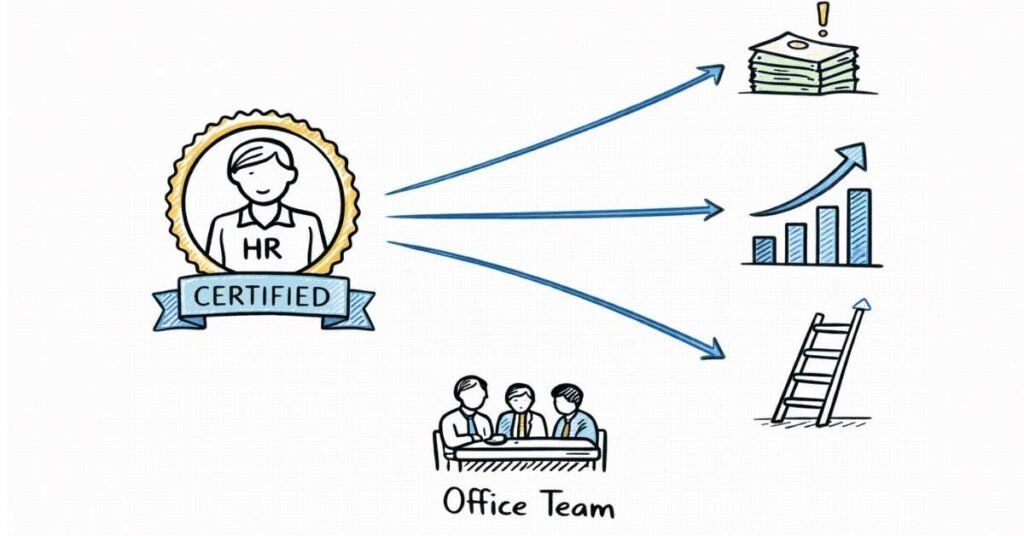
Why HR Certifications Matter
HR certifications validate your knowledge and competence through standardized, rigorous assessment:
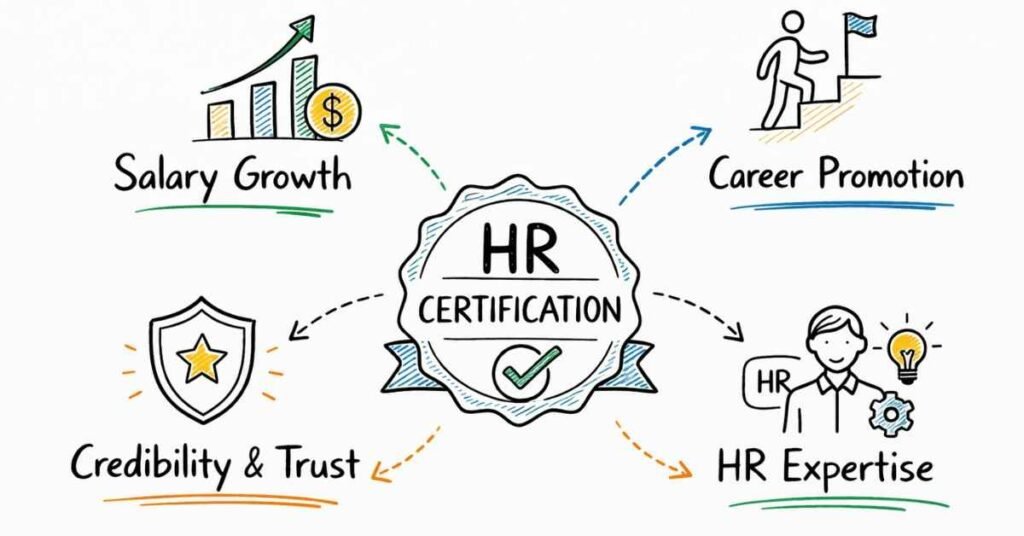
Career and Salary Impact
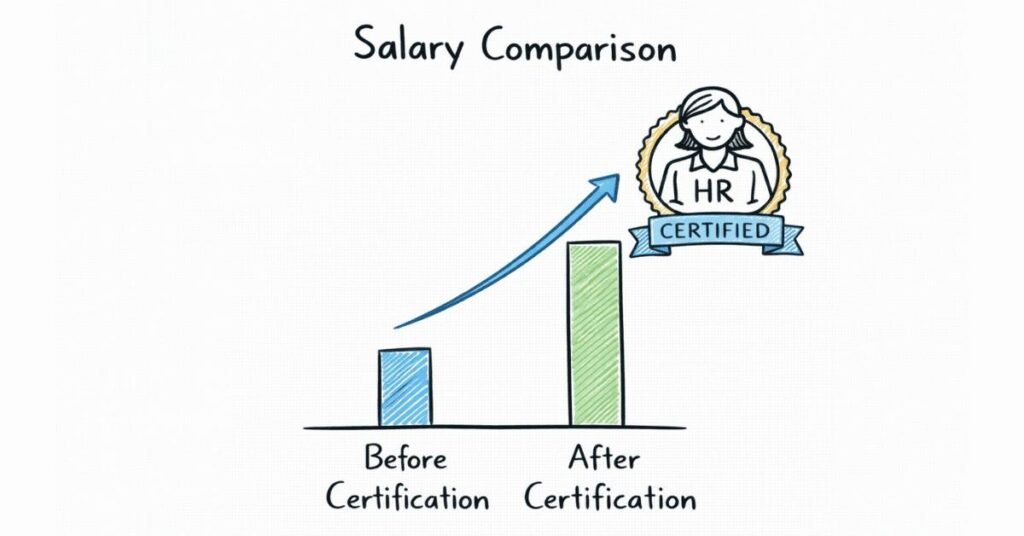
Higher Compensation: Almost all HR certifications lead to pay increases ranging from 2.9% to 28%, depending on the specific credential. For a mid-career HR professional earning ₹10 lakhs annually, even a conservative 10% increase means an additional ₹1 lakh yearly—compounding over a 20-year career to approximately ₹27 lakhs in additional lifetime earnings.
Increased Promotion Likelihood: Certified HR professionals are more likely to be promoted at almost every career level. The impact is particularly strong early in careers—82% of certified entry-level HR professionals report promotions in the past five years versus only 68% of non-certified peers.
Job Access: Many employers list certifications as “preferred” or “required” qualifications. Lacking certification may eliminate you from consideration even if you’re qualified otherwise.
Career Trajectory Shift: Certifications don’t just boost current salary—they unlock access to higher-tier positions with entirely different compensation structures. The jump from HR Generalist to HR Manager, or HR Manager to HR Director, involves salary increases far exceeding incremental raises within a single role. Certifications frequently serve as the qualifying credential making these jumps possible.
Professional Credibility
Standardized Validation: Unlike degrees or experience which vary widely in quality, certifications demonstrate you’ve met standardized competency thresholds.
Global Recognition: Major certifications like SHRM-CP/SCP and PHR/SPHR are recognized internationally, valuable if you pursue global opportunities.
Peer Recognition: The HR community respects certifications. Having credentials after your name signals professionalism and commitment.
Knowledge and Skill Development
Structured Learning: Certification preparation forces you to systematically learn or refresh HR fundamentals, filling knowledge gaps.
Current Best Practices: Certification bodies update exam content regularly, ensuring you learn current HR practices, not outdated approaches.
Confidence: Passing rigorous exams builds confidence in your HR knowledge and capabilities.
Major HR Certification Bodies and Credentials
Two primary organizations dominate HR certification in India and globally: SHRM (Society for Human Resource Management) and HRCI (HR Certification Institute).
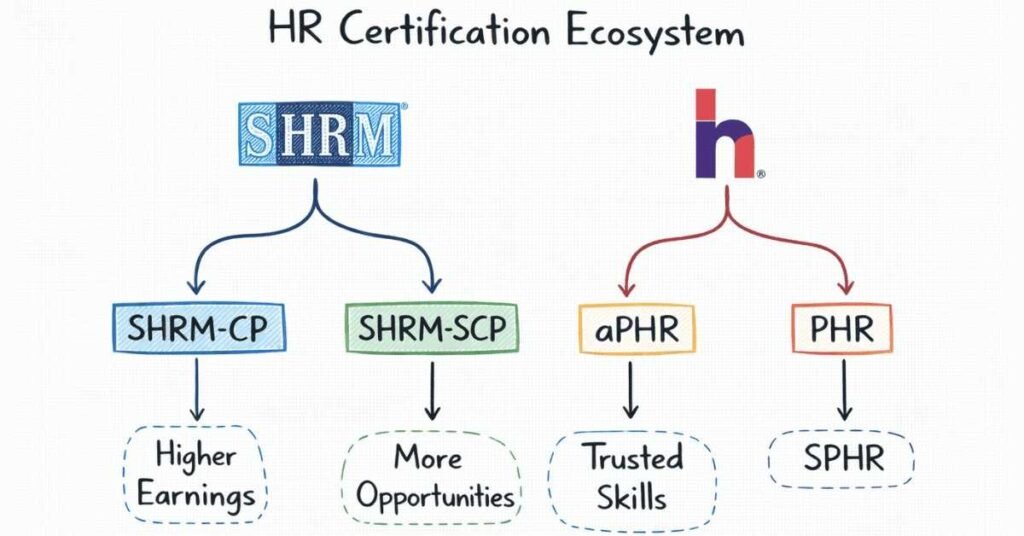
SHRM Certifications
SHRM offers competency-based certifications focusing on both knowledge and behavioral competencies:
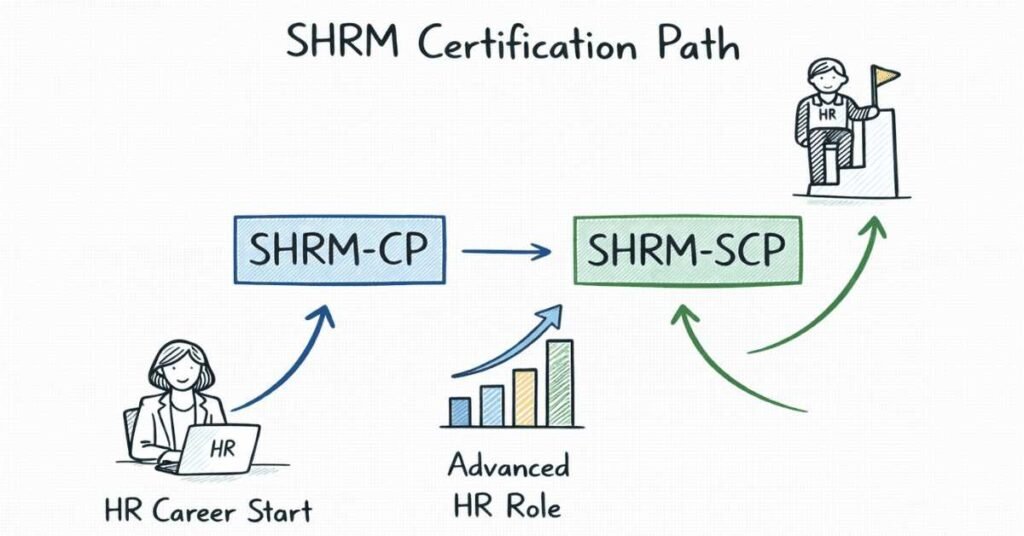
SHRM-CP (SHRM Certified Professional)
Target Audience: HR professionals at operational level performing day-to-day HR functions.
Typical Roles: HR Generalist, HR Specialist, Recruiter, HR Coordinator, HR Assistant.
Career Stage: Early to mid-career (0-7 years experience typically, though experience requirements vary).
Exam Focus: Operational HR execution, applying policies and procedures, tactical problem-solving, and supporting HR strategy.
Eligibility Requirements: Vary based on education and experience combination:
- Bachelor’s degree + 1 year HR experience
- Master’s degree or higher + no experience required
- Less than bachelor’s degree + 4 years HR experience
Exam Format: 134 knowledge-based items + 5 situational judgment items, 4 hours.
Cost: Approximately $300 exam fee for SHRM members, $400 for non-members (₹25,000-33,000) plus study materials.
Recertification: Every 3 years; earn 60 professional development credits (PDCs) through SHRM-certified conferences, events, and webinars.
Who Should Pursue: HR professionals seeking to validate foundational competence, establish credibility early in careers, and demonstrate commitment to HR profession. This is the certification 77% of SHRM applicants take first.
SHRM-SCP (SHRM Senior Certified Professional)
Target Audience: Senior HR professionals performing strategic-level work and leadership roles.
Typical Roles: HR Manager, HR Director, HRBP, Senior HR Specialist, VP of HR.
Career Stage: Mid to senior career (typically 7+ years experience).
Exam Focus: Strategic HR leadership, developing and implementing HR strategy, influencing organizational direction, policy development, and change management.
Eligibility Requirements: Higher requirements than SHRM-CP:
- Bachelor’s degree + 4 years HR experience
- Master’s degree + 3 years HR experience
- Less than bachelor’s degree + 7 years HR experience
Exam Format: Similar to SHRM-CP but with more complex scenarios requiring strategic thinking.
Cost: Same as SHRM-CP.
Recertification: Same as SHRM-CP.
Who Should Pursue: Experienced HR professionals in or aspiring to strategic HR leadership roles, those partnering with senior executives, and professionals making policy and strategic decisions.
HRCI Certifications
HRCI offers multiple certifications emphasizing technical HR knowledge:
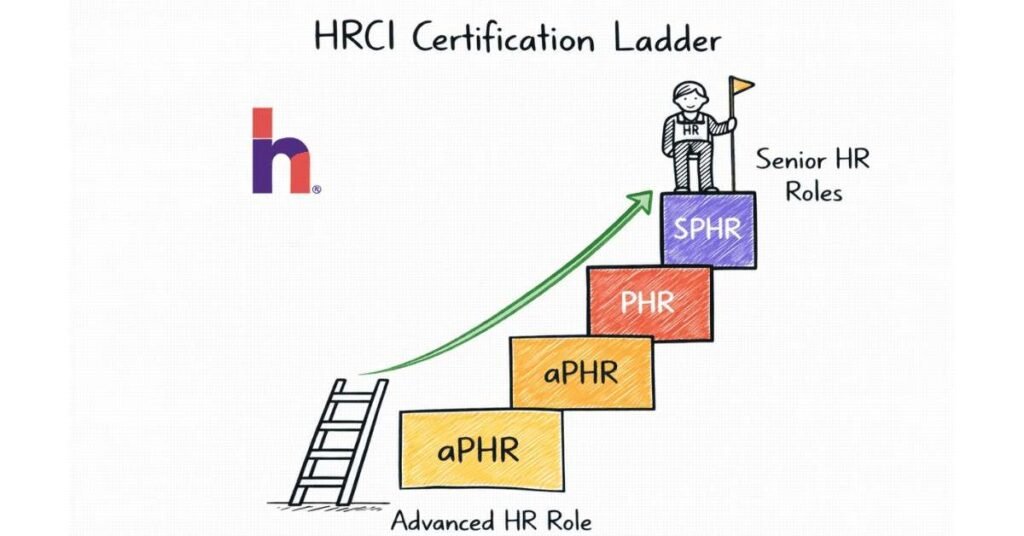
PHR (Professional in Human Resources)
Target Audience: HR professionals focused on technical and operational HR management.
Typical Roles: HR Generalist, HR Coordinator, Recruiter, HR Analyst.
Career Stage: Early to mid-career.
Exam Focus: Technical aspects of HR—employment law, talent acquisition, compensation and benefits, employee relations, HR operations.
Eligibility Requirements:
- Bachelor’s degree + 1 year HR experience
- Less than bachelor’s degree + 3 years HR experience
Exam Format: 150 multiple-choice questions, 3 hours.
Cost: Approximately $395 for PHR exam (₹33,000) plus study materials.
Recertification: Every 3 years; either retake exam or earn 60 recertification credits through HRCI-sanctioned programs.
Who Should Pursue: HR professionals wanting deep technical HR knowledge, those working in compliance-heavy environments, and professionals preferring exam-based validation over competency assessment.
SPHR (Senior Professional in Human Resources)
Target Audience: Senior HR professionals responsible for HR policy and strategy.
Typical Roles: HR Manager, HR Director, CHRO, senior HRBP.
Career Stage: Senior career (typically 7+ years at strategic level).
Exam Focus: Strategic HR management, policy formulation, workforce planning, organizational development, and business alignment.
Eligibility Requirements:
- Bachelor’s degree + 4 years strategic HR experience
- Master’s degree + 3 years strategic HR experience
Exam Format: 150 multiple-choice questions, 3 hours.
Cost: Approximately $495 for SPHR exam (₹41,000) plus study materials.
Recertification: Same as PHR.
Who Should Pursue: Experienced HR professionals in senior roles, those developing organizational HR strategy, and professionals seeking credential emphasizing strategic HR expertise.
Other HRCI Certifications
aPHR (Associate Professional in Human Resources): Entry-level certification for those new to HR or with less than 1 year experience.
GPHR (Global Professional in Human Resources): For HR professionals managing global workforces across multiple countries. This certification brings the highest pay boost among HRCI credentials.
SHRM vs. HRCI: Which Should You Choose?
Both organizations offer respected certifications. Understanding differences helps you decide:
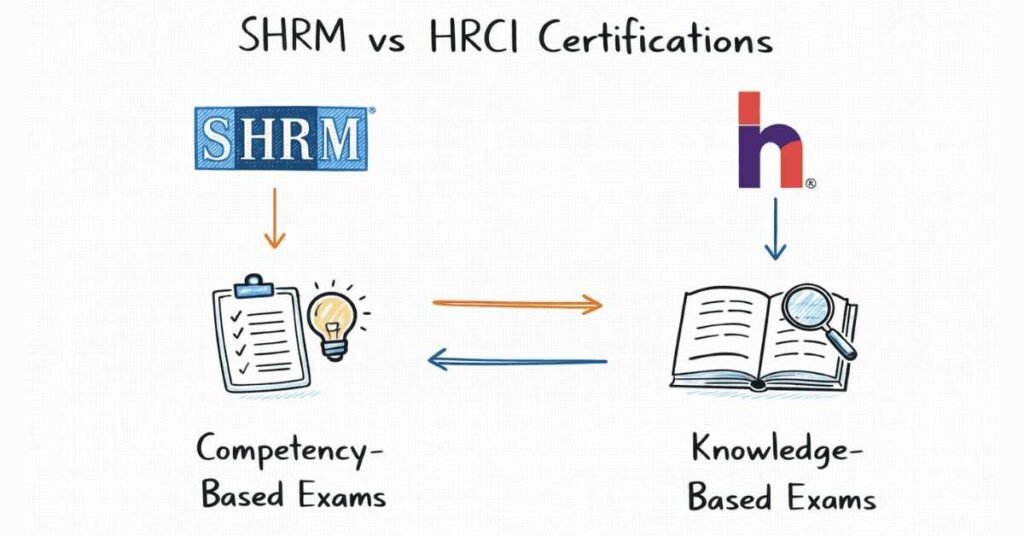
SHRM Certifications (SHRM-CP/SCP)
Focus: Competency-based—assesses both knowledge AND behavioral competencies (leadership, communication, relationship management).
Philosophy: HR professionals need both knowledge and soft skills to succeed.
Exam Style: Multiple choice plus situational judgment questions assessing how you’d handle realistic scenarios.
Recertification: Requires earning professional development credits through SHRM activities.
Recognition: Widely recognized globally; SHRM is world’s largest HR association.
Best For: Professionals who want well-rounded assessment of HR capabilities including soft skills, those planning international careers, and those who value SHRM’s large member network.
HRCI Certifications (PHR/SPHR)
Focus: Knowledge-based—emphasizes technical HR knowledge and competence.
Philosophy: Deep technical expertise is the foundation of HR effectiveness.
Exam Style: Multiple choice questions testing knowledge of HR practices, laws, and procedures.
Recertification: Can retake exam OR earn recertification credits.
Recognition: Long-established (since 1976); particularly valued in U.S. and by organizations emphasizing compliance.
Best For: Professionals who prefer technically-focused assessments, those in compliance-heavy roles, and those who like option to recertify via exam.
Making Your Choice
Consider Your Learning Style: If you learn better through practical scenarios, choose SHRM. If you prefer technical knowledge assessment, choose HRCI.
Check Your Target Employers: Research which certifications are more valued in your industry and geography. Tech companies may prefer SHRM; manufacturing or highly-regulated industries may prefer HRCI.
Assess Your Career Stage: Both offer early-career (SHRM-CP/PHR) and senior (SHRM-SCP/SPHR) options. Choose based on current role and near-term goals.
Review Sample Questions: Both organizations offer sample questions on their websites. Try them to see which exam style suits you.
Consider Your Network: If your organization or mentors strongly favor one certification, that may guide your choice.
Truth: Both Are Valuable: Many successful HR professionals hold multiple certifications. You can’t make a “wrong” choice—either certification significantly enhances your career.
Specialized HR Certifications
Beyond foundational credentials, specialized certifications deepen expertise in specific HR areas:
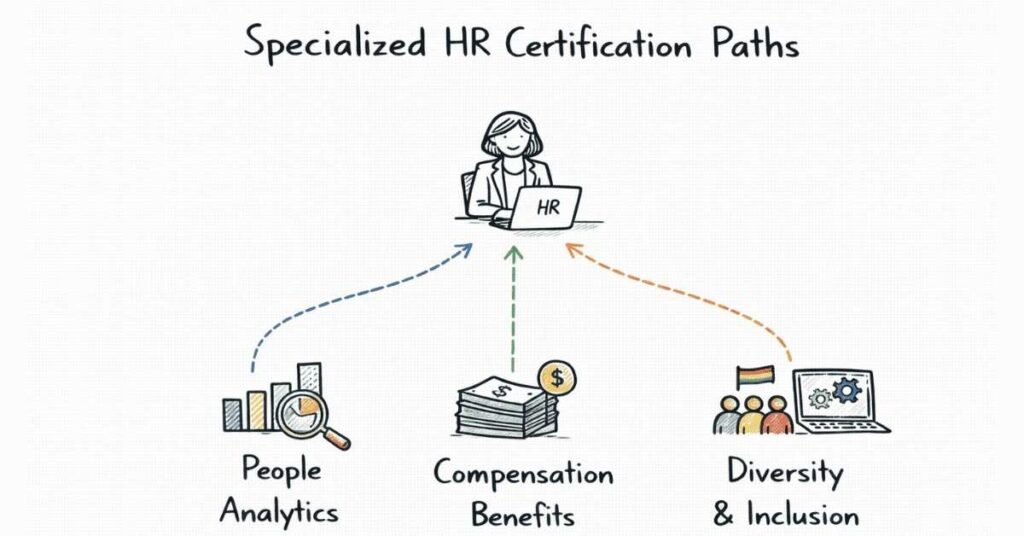
People Analytics and HR Data
Certificate Programs (AIHR): People Analytics, HR Metrics & Dashboarding, Digital HR certificates.
Why Pursue: Growing demand for data-savvy HR professionals. These credentials differentiate you in competitive markets.
Best For: HR professionals moving into analytics roles, those wanting to add quantitative skills to qualitative HR expertise.
Compensation and Benefits
Certified Compensation Professional (CCP): WorldatWork certification focusing on compensation design and administration.
Certified Benefits Professional (CBP): WorldatWork certification for benefits expertise.
Why Pursue: Compensation and benefits are technically complex. Specialization commands premium compensation.
Best For: HR professionals in or targeting compensation and benefits roles.
Diversity, Equity, and Inclusion
Various DEI Certificates: Cornell, Villanova, and other universities offer DEI-focused certificate programs.
Why Pursue: DEI is growing priority. Credentials demonstrate commitment and competence in this sensitive area.
Best For: HR professionals leading DEI initiatives or aspiring to DEI specialist roles.
Leadership and Coaching
Certified Professional Coach: Institute for Professional Excellence in Coaching (iPEC) certification. According to PayScale, this brings the highest pay boost of any HR-related certification (28% increase).
Strategic HR Leadership (SHRL): Human Capital Institute certification for senior HR leaders.
Why Pursue: HR increasingly involves coaching and developing leaders. These credentials enhance those capabilities.
Best For: Senior HR professionals, HRBPs, and those working extensively with leadership development.
Technology and Systems
Workday, SuccessFactors, Oracle Certifications: Platform-specific credentials for HRIS specialists.
Why Pursue: HRIS expertise is in high demand. Platform certifications demonstrate technical proficiency.
Best For: HR technology specialists, HRIS analysts and managers.
Calculating the True ROI of HR Certifications
Understanding the real return helps you make informed investment decisions:
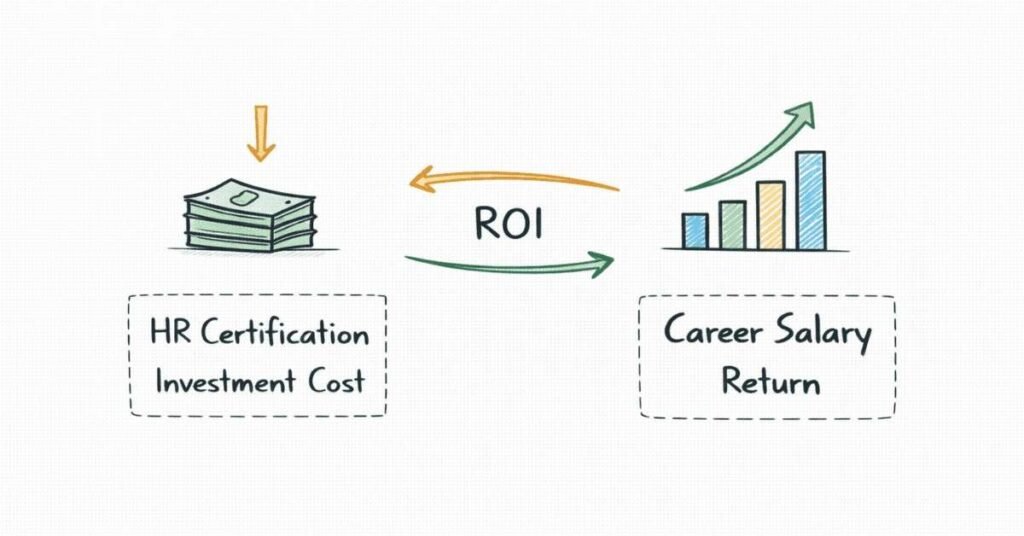
Direct Financial Returns
Immediate Salary Increase: 2.9-28% depending on certification. Conservative estimate: 10% for foundational certifications like SHRM-CP or PHR.
Example: If you earn ₹10 lakhs annually and receive 10% increase after certification:
- Annual increase: ₹1 lakh
- Over 20-year remaining career with 3% annual raises: approximately ₹27 lakhs additional lifetime earnings[
Higher-Tier Position Access: Certifications help you qualify for managerial and senior roles paying 30-50% more than specialist roles. A jump from ₹10 lakhs (Generalist) to ₹15 lakhs (Manager) adds ₹5 lakhs annually—far exceeding the certification’s direct impact.
Investment Costs
Exam Fees: ₹25,000-40,000 depending on certification.
Study Materials: ₹10,000-15,000 for prep courses, study guides, practice exams.
Study Time: 100-150 hours typically. Calculate opportunity cost if this time could be spent earning income.
Total Investment: ₹40,000-80,000 including time.
Break-Even Analysis
Scenario: ₹50,000 total investment (fees + materials), ₹1 lakh annual salary increase
Break-even: 6 months. After that, it’s pure gain.
5-Year Return: ₹5 lakhs additional earnings on ₹50,000 investment = 900% ROI
Intangible Benefits
Beyond salary, certifications provide:
Career Insurance: During layoffs, certified professionals are often retained over non-certified peers.
Negotiating Power: Certifications strengthen your position in salary negotiations and job offers.
Confidence: Passing rigorous exams boosts professional confidence, influencing performance and career decisions.
Network Access: Certification communities provide networking opportunities, job leads, and peer learning.
Knowledge Gaps Filled: Systematic study reveals and addresses knowledge gaps you didn’t know existed.
When ROI Is Highest
Early Career: Certification impact is strongest early when you’re establishing credibility. Entry-level certified professionals are 14 percentage points more likely to be promoted than non-certified peers.
Career Transitions: Changing specializations or industries is easier with recognized credentials.
Salary Negotiations: Certification strengthens your case during annual reviews or job changes.
Competitive Markets: In locations with many qualified HR professionals, certification differentiates you.
Preparing for HR Certification Exams
Effective preparation increases passing likelihood and learning:
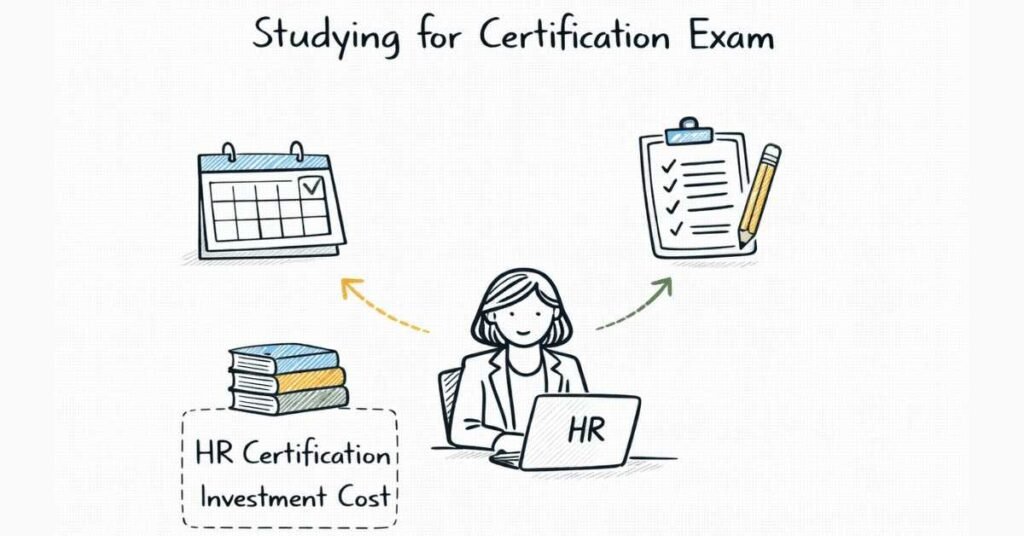
Create a Study Plan
Start Early: Begin 3-4 months before exam date for manageable pace.
Set Schedule: Block specific study times weekly (e.g., 10-12 hours weekly for 12-16 weeks).
Cover All Domains: Don’t neglect weaker areas. Exams test broadly across HR.
Build in Review Time: Reserve final 2-3 weeks for review and practice exams.
Use Quality Study Materials
Official Study Systems: SHRM Learning System and HRCI study materials align directly with exam content.
SHRM BASK (Body of Applied Skills & Knowledge): The blueprint for SHRM exams. Study this framework thoroughly.
Prep Courses: Consider instructor-led or online prep courses if you learn better with structure.
Study Groups: Join or form study groups with other candidates for mutual support and learning.
Practice Extensively
Practice Exams: Take multiple full-length practice exams under timed conditions.
Review Mistakes: Don’t just note correct answers—understand WHY you got questions wrong.
Situational Judgment: For SHRM exams, practice the situational judgment questions. These assess competencies differently than knowledge questions.
Focus on Weak Areas
Identify Gaps: Use practice exam results to identify knowledge gaps.
Deep Dive: Spend extra time on weak domains.
Real-World Application: Connect concepts to your work experience for better retention.
Test-Taking Strategies
Time Management: Pace yourself. Don’t spend too long on difficult questions.
Process of Elimination: On multiple choice, eliminate obviously wrong answers first.
Trust Your Preparation: Don’t second-guess too much. Your first instinct is often correct.
Stay Calm: Manage test anxiety through preparation, rest, and breathing techniques.
Maintaining Your Certification
Certifications require periodic renewal:
Recertification Requirements
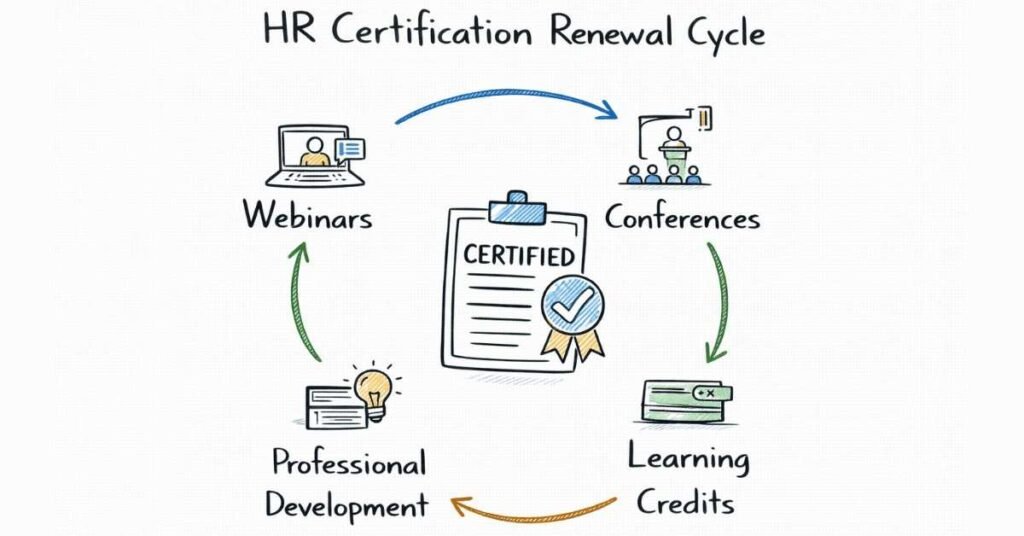
SHRM (SHRM-CP/SCP): 60 professional development credits every 3 years through SHRM-approved activities.
HRCI (PHR/SPHR): Either retake exam OR earn 60 recertification credits every 3 years.
Earning Recertification Credits
Conferences and Events: SHRM Annual Conference, regional conferences, and chapter events.
Webinars and Courses: Online learning opportunities.
Teaching and Speaking: Speaking at conferences or teaching HR courses.
Writing and Publishing: Publishing HR articles or research.
Professional Activities: Volunteering with HR associations, mentoring, or committee participation.
Why Recertification Matters
Stays Current: Forces you to keep learning as HR evolves.
Maintains Value: Certification value depends on ongoing standards. Recertification ensures credibility.
Career Insurance: Letting certification lapse signals reduced commitment.
Alternative HR Development Programs
Beyond certifications, other development options exist:
University Certificate Programs
Cornell University (eCornell): HR Essentials, HR Management, Diversity and Inclusion certificate programs developed by ILR School faculty.
Oxford Home Study Centre: Certificate in Human Resource Management.
Benefits: Academic rigor, prestigious institution names, comprehensive coverage.
Drawbacks: Often more expensive and time-intensive than professional certifications.
Online Learning Platforms
AIHR Academy: Comprehensive HR certificate programs in various specializations (People Analytics, Digital HR, Sourcing and Recruitment).
Coursera: Partners with universities and HRCI offering HR courses and certificates.
LinkedIn Learning: Broad library of HR courses on specific topics.
Benefits: Flexible, affordable, focused on specific skills.
Drawbacks: Less recognition than SHRM/HRCI certifications for career advancement.
Professional Associations
SHRM Membership: Access to resources, local chapters, conferences, and networking even without certification.
National HRD Network (India): Indian HR association offering learning and networking.
Benefits: Networking, current information, community support.
Certification Decision Framework
Use this framework to decide if and when to pursue certification:
Pursue Certification NOW If:
- You’re early-career (0-5 years) looking to establish credibility
- Job postings you target list certifications as preferred/required
- You’re seeking promotion to management within 1-2 years
- You’re changing industries or HR specializations[
- You have knowledge gaps in foundational HR area
- Your employer offers financial support
Wait on Certification If:
- You’re very early career (less than 1 year) still learning basic HR
- You’re planning significant career change outside HR
- Financial resources are severely constrained[
- You lack time for adequate preparation
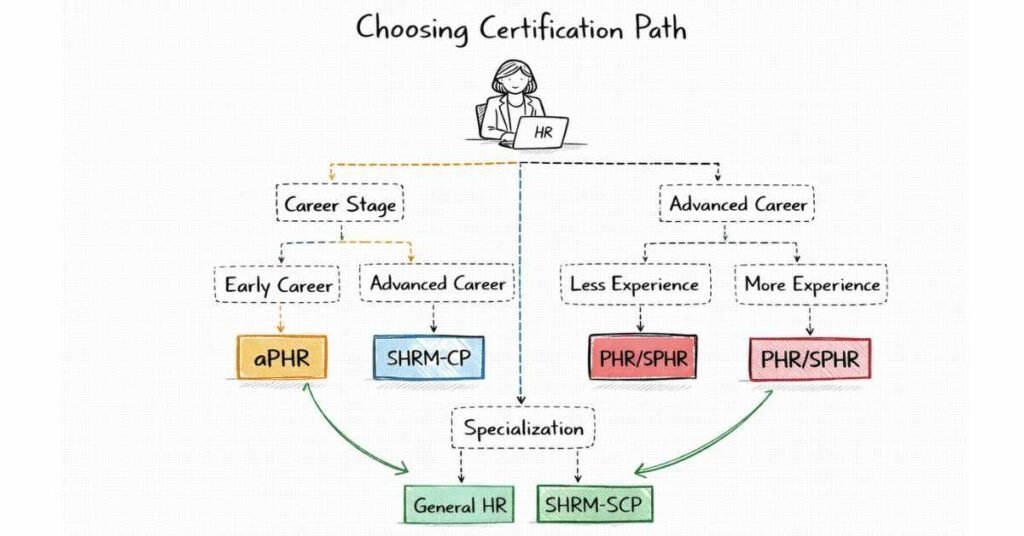
Choose Specialized Certification If:
- You’re established in specific HR specialization (analytics, compensation, HRIS)
- Foundational certifications are already established
- Your career path is clearly specialized
HR certifications represent high-ROI career investments offering salary increases, promotion opportunities, knowledge development, and professional credibility. Whether you choose SHRM-CP/SCP for competency-based assessment or PHR/SPHR for technical knowledge validation, certification accelerates your career trajectory significantly.
The key is choosing the right certification for your career stage, preparing thoroughly, and viewing certification as one component of continuous professional development. Combined with strong performance, ongoing learning, and strategic career moves, certification becomes a powerful catalyst propelling you toward your HR career goals.
The investment you make today in certification compounds throughout your career, ultimately generating returns many multiples of the initial cost while opening doors that might otherwise remain closed.