
Civil Engineering Industry Sectors: Construction, Transportation & Urban Development
Table of Contents
Introduction
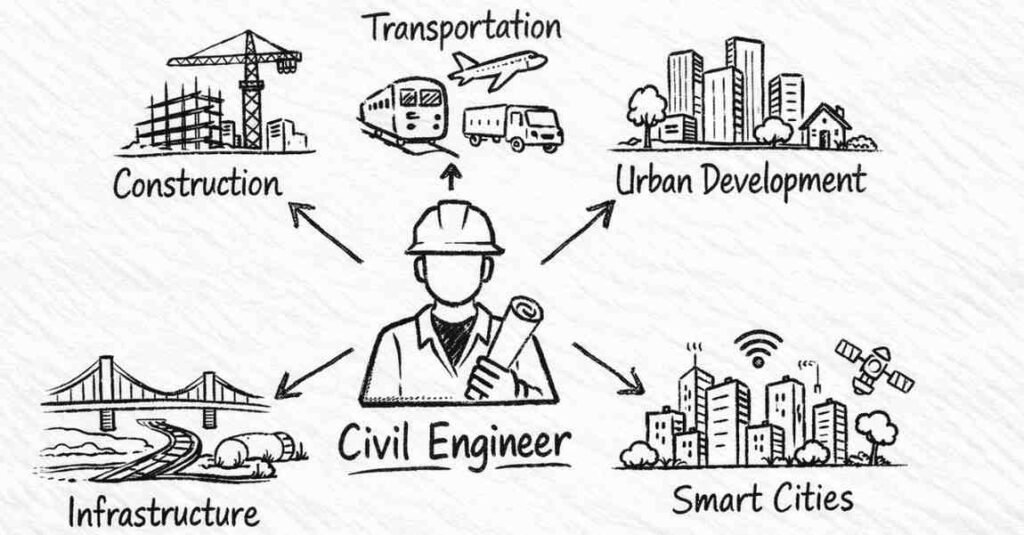
When people think “civil engineering jobs,” most imagine one big construction industry. The reality is much more diverse.
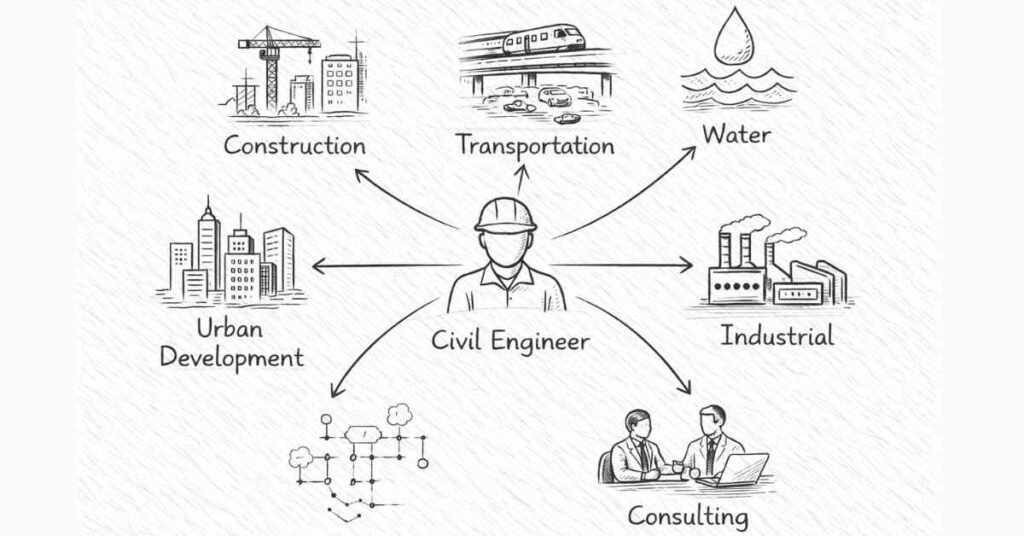
Civil engineers work across multiple industry sectors—each with different types of projects, work culture, growth opportunities, and challenges. Understanding these sectors helps you target your job search and career planning more effectively.
Let’s explore the major sectors where civil engineers build their careers in India.
1. Building Construction Sector
This is the largest employer of civil engineers—the sector that builds where we live, work, and shop.
What This Sector Builds:
- Residential buildings: Apartments, housing complexes, gated communities, affordable housing
- Commercial complexes: Office buildings, IT parks, malls, showrooms
- Institutional buildings: Schools, colleges, hospitals, government offices
- Mixed-use developments: Integrated townships combining residential, commercial, and recreational spaces
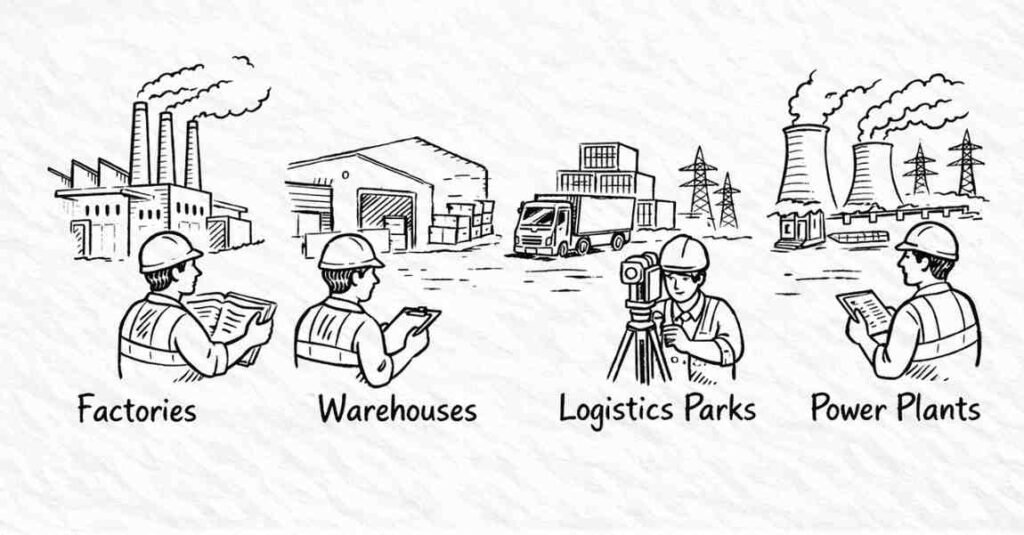
- Industrial buildings: Factories, warehouses, manufacturing units
Types of Companies:
- Large construction firms: L&T Construction, Tata Projects, Shapoorji Pallonji, Afcons, Punj Lloyd
- Real estate developers: DLF, Godrej Properties, Prestige Group, Sobha, Brigade
- Regional construction companies: Hundreds of mid-sized firms operating in specific states or cities
- Design consultancies: Firms providing architectural and structural design services
Job Opportunities:
- Site Engineers and Project Managers (execution)
- Structural Design Engineers
- Quantity Surveyors and Estimators
- Planning Engineers
- Quality Control Engineers
- BIM Specialists
Work Culture:
- Fast-paced with strict timelines
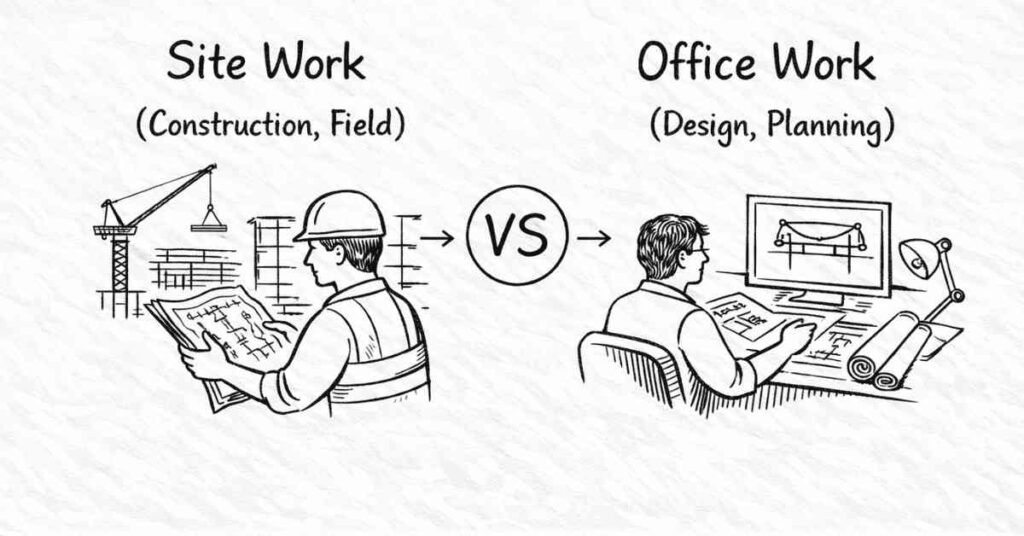
- Mix of site and office work depending on role
- Project-based employment (you move to new projects every 1-3 years)
- Performance pressure but good learning opportunities
Salary Range:
- Entry-level: ₹3.5-6 LPA
- Mid-level: ₹6-12 LPA
- Senior-level: ₹12-25 LPA
Growth Opportunities:
India’s construction sector is projected to grow 6-8% in 2026, driven by urbanization, housing demand, and commercial development. Real estate and construction remain major job creators.
Challenges:
- Work pressure and tight deadlines
- Market fluctuations affecting project launches
- Delayed payments from developers sometimes
- Physical demands of site work
Best For:
Engineers who want diverse project experience, enjoy building structures, and don’t mind the dynamic, sometimes unpredictable nature of construction.

2. Infrastructure & Transportation Sector
This sector builds the networks that connect India—roads, highways, railways, metros, airports.
What This Sector Builds:
- Highways and expressways: National Highways, state highways, expressways, rural roads
- Metro rail systems: Urban mass rapid transit in cities like Delhi, Mumbai, Bangalore, Pune, Ahmedabad, Nagpur
- Railways: Track modernization, station redevelopment, high-speed rail corridors
- Airports: New airports, terminal expansions, runway improvements
- Bridges and flyovers: Road overbridges, underpasses, elevated corridors
- Ports and harbors: Coastal infrastructure, container terminals
Types of Organizations:
Government/PSUs:
- NHAI (National Highways Authority of India)
- Indian Railways and Railway PSUs
- Metro corporations (DMRC, BMRCL, etc.)
- Airports Authority of India
- Public Works Departments (PWD, CPWD)
Private Contractors:
- L&T, GMR, GVK, IRB Infrastructure, Dilip Buildcon
- International firms: Larsen & Toubro, Fluor, Bechtel
Consulting Firms:
- AECOM, Jacobs, Arup, STUP Consultants
- Transportation planning and design firms
Job Opportunities:
- Highway Engineers
- Transportation Engineers and Planners
- Bridge Design Engineers
- Metro/Railway Engineers
- Project Managers for infrastructure projects
- Traffic Engineers
- Pavement Design Specialists
Work Culture:
- Project sites often in remote or highway corridors (away from cities)
- Long project durations (highways can take 2-4 years)
- Government projects offer stability but slower pace
- Private contractors offer faster growth but more pressure
Salary Range:
- Government/PSU entry: ₹3.5-5 LPA (with job security and benefits)
- Private sector entry: ₹4-6 LPA
- Mid-level: ₹7-14 LPA
- Senior-level: ₹15-25 LPA
Growth Opportunities:
Massive government investment in infrastructure:
- National Infrastructure Pipeline with multi-trillion rupee investments
- Metro expansion in 20+ cities
- Bharatmala and PMGSY highway programs
- High-speed rail corridors
- Airport modernization across tier-2 and tier-3 cities
This sector offers long-term job security and consistent opportunities.
Challenges:
- Remote project locations
- Living away from family during project execution
- Weather-dependent work (monsoons can delay highway work)
- Land acquisition and approval delays sometimes stall projects
Best For:
Engineers passionate about large-scale infrastructure, willing to work in varied locations, and interested in projects with long-term national impact.

3. Water Resources & Irrigation Sector
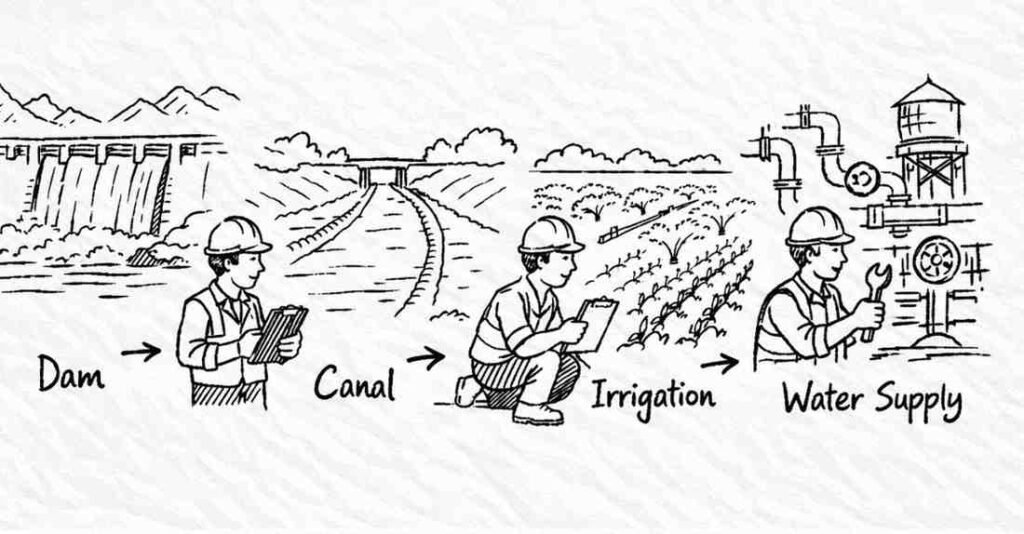
This sector manages India’s most critical resource—water.
What This Sector Builds:
- Dams and reservoirs: For irrigation, drinking water, hydropower
- Irrigation projects: Canals, distributaries, lift irrigation schemes
- Water supply schemes: City water supply networks, treatment plants
- Flood control works: Embankments, drainage channels, river training
- Coastal structures: Sea walls, breakwaters, jetties
Types of Organizations:
Government:
- State Irrigation and Water Resources Departments
- Central Water Commission
- National Water Development Agency
- State Water Boards
Private/Consulting:
- Water resources consultancies
- Dam design and engineering firms
- International organizations (World Bank funded projects)
Job Opportunities:
- Water Resources Engineers
- Dam Design Engineers
- Irrigation Engineers
- Hydrologists
- Project Engineers for water projects
Work Culture:
- Government-dominated sector with stable but moderate-paced work
- Projects often in rural or semi-urban areas
- Long gestation periods (dam projects can take 5-10 years)
- Socially impactful work (providing water for agriculture and communities)
Salary Range:
- Government: ₹3.5-5 LPA entry with pension and benefits
- Consulting firms: ₹4-7 LPA entry
- Senior roles: ₹10-18 LPA
Growth Opportunities:
- India faces water scarcity challenges, driving investment in water infrastructure
- Inter-basin water transfer projects
- Modern irrigation technologies and micro-irrigation
- Rainwater harvesting and water conservation projects
Best For:
Engineers interested in environmental sustainability, willing to work in rural areas, and passionate about solving water-related challenges.
4. Urban Development & Smart Cities Sector
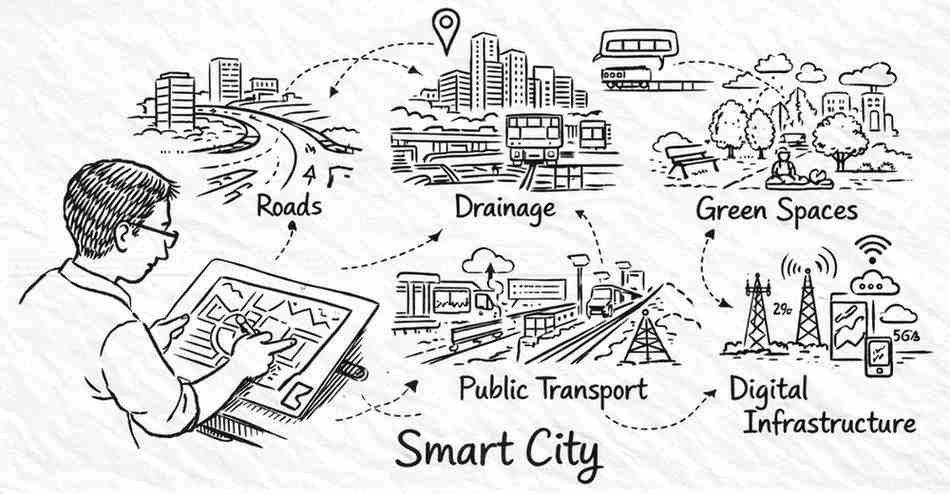
This rapidly growing sector focuses on building and managing modern, sustainable cities.
What This Sector Does:
- Smart city planning and implementation: 100 smart cities across India
- Municipal infrastructure: City roads, drainage, water supply, sewerage
- Urban planning: Master planning, zoning, land use planning
- Public spaces: Parks, plazas, pedestrian areas
- Smart transportation: Intelligent traffic systems, bus rapid transit
- Waste management: Solid waste collection, treatment, recycling facilities
- Green infrastructure: Sustainable buildings, green corridors, urban forestry
Types of Organizations:
Government:
- Municipal corporations and city development authorities]
- Smart City SPVs (Special Purpose Vehicles)
- Urban Development Departments
Consulting:
- Urban planning consultancies
- Smart city technology providers
- Infrastructure management companies
Job Opportunities:
- Urban Planners
- Municipal Engineers
- Smart City Project Engineers
- Traffic and Transportation Engineers
- Environmental Engineers for urban projects
- GIS Specialists for urban planning
Work Culture:
- Multidisciplinary (working with architects, planners, tech firms)
- Innovation-focused (new technologies, smart solutions)
- Stakeholder-intensive (coordination with citizens, government, multiple agencies)
- Growing importance of sustainability and livability
Salary Range:
- Entry: ₹3.5-6 LPA
- Mid-level: ₹6-12 LPA
- Senior planners and smart city specialists: ₹12-20 LPA
Growth Opportunities:
Massive growth driven by:
- 100 Smart Cities Mission with ₹2+ lakh crore investment
- Rapid urbanization (600+ million urban population expected by 2030)
- Focus on sustainable, livable cities
- Integration of IoT, AI, and data analytics in city management
Best For:
Engineers interested in holistic city development, technology integration, sustainability, and creating people-centric infrastructure.
5. Industrial Infrastructure Sector
Building infrastructure for manufacturing and industry.
What This Sector Builds:
- Industrial corridors: Delhi-Mumbai Industrial Corridor (DMIC), Chennai-Bangalore Industrial Corridor
- Special Economic Zones (SEZs)
- Industrial parks and clusters
- Logistics parks and warehouses
- Manufacturing facilities
- Power plants: Thermal, solar, wind, hydroelectric
- Cold storage and cold chain infrastructure
- Data centers
Types of Companies:
- Large infrastructure developers (L&T, Shapoorji, Tata Projects)
- Industrial real estate firms
- Prefabricated construction companies]
- Power generation companies
- Logistics and warehousing firms
Job Opportunities:
- Industrial Project Engineers
- Structural Engineers for industrial buildings
- Project Managers
- Planning Engineers
- Quality and Safety Engineers (strict standards for industrial facilities)
Work Culture:
- Technical rigor (industrial facilities have strict design requirements)
- Often in developing industrial zones (new areas being developed)
- Interaction with international standards and practices
- Growing adoption of prefab and modular construction
Salary Range:
- Entry: ₹4-7 LPA (often higher than building construction)
- Mid-level: ₹7-15 LPA
- Senior: ₹15-30 LPA[
Growth Opportunities:
Strong growth from:
- Make in India initiative driving manufacturing growth
- Industrial corridor development ($90 billion DMIC project)
- Logistics and warehousing boom from e-commerce
- Renewable energy projects
- Data center expansion
Best For:
Engineers who enjoy technically demanding projects, are willing to work in developing industrial zones, and want exposure to modern construction technologies like prefabrication.
6. Consulting & Design Services Sector
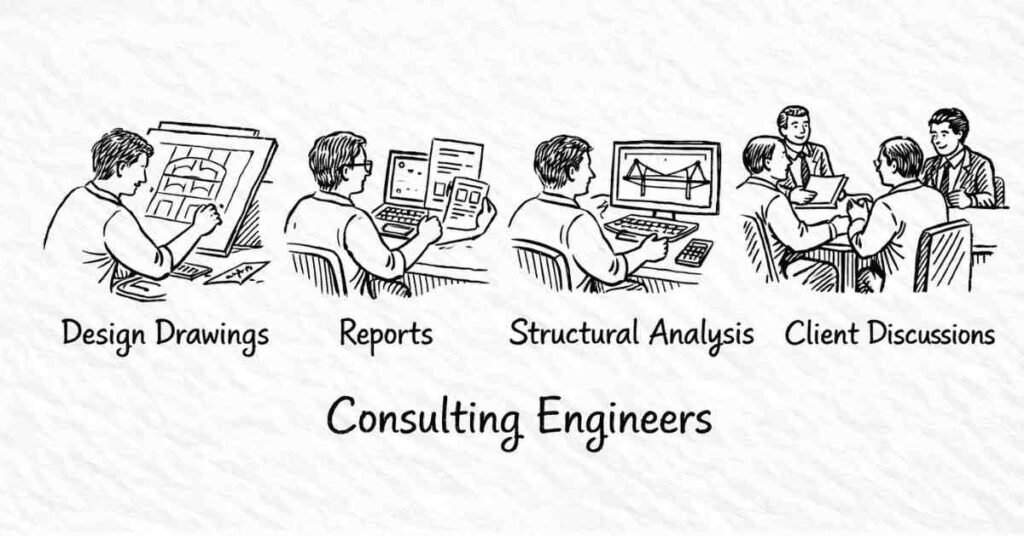
These firms provide specialized technical expertise without directly executing construction.
What Consulting Firms Do:
- Structural design and engineering
- Project feasibility studies
- Detailed project reports (DPRs)
- Construction supervision and quality monitoring
- Project management consultancy
- Specialized services (geotechnical, environmental, traffic, BIM)
Types of Firms:
International:
- AECOM, Jacobs, Arup, Bechtel, Fluor
Indian:
- STUP Consultants, Consulting Engineering Services, Intercontinental Consultants
Specialized:
- Geotechnical consultancies
- BIM service providers
- Traffic and transportation consultancies
Job Opportunities:
- Design Engineers
- Project Consultants
- Specialist Engineers (geotechnical, structural, traffic)
- BIM Specialists
- Project Management Consultants
Work Culture:
- Office-based with field visits for surveys and inspections
- Intellectually stimulating (variety of projects)
- Better work-life balance than execution roles generally
- Exposure to multiple project types and clients
- Learning opportunities from experienced consultants
Salary Range:
- Entry: ₹3-5.5 LPA
- Mid-level: ₹6-12 LPA
- Senior consultants: ₹12-25 LPA
Best For:
Engineers who prefer technical and analytical work over site execution, enjoy variety, and want to build deep expertise in specific domains.
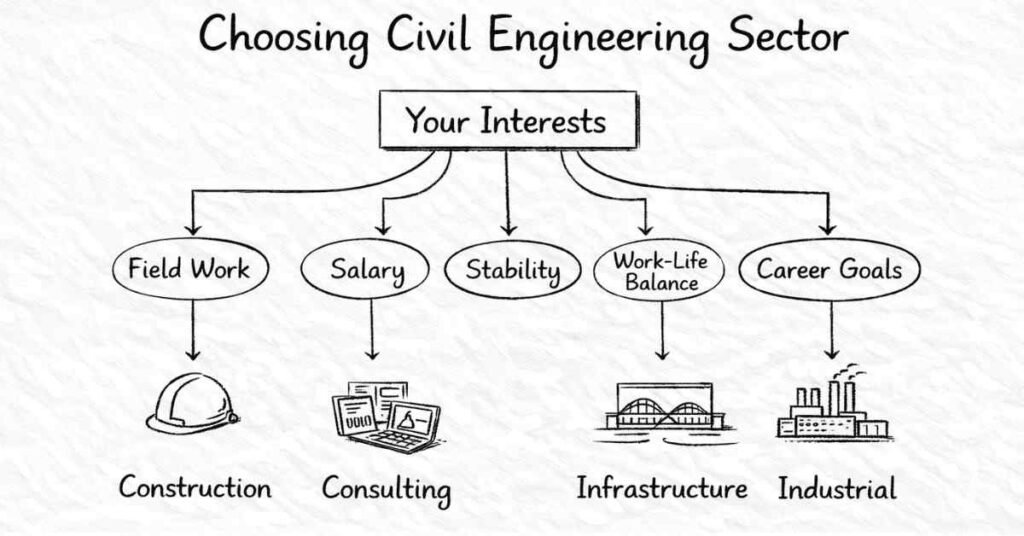
Choosing the Right Sector for You
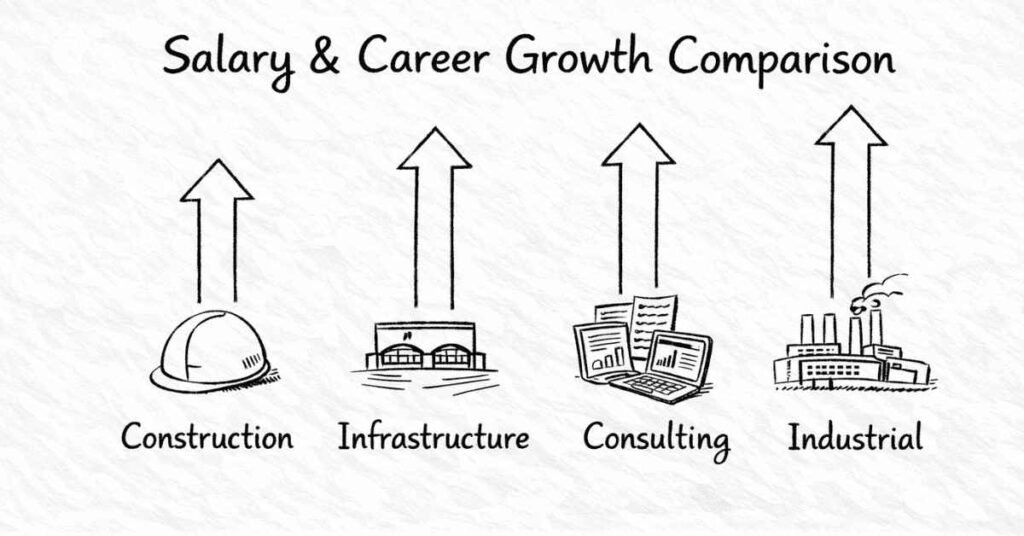
Different sectors suit different priorities:
Choose Building Construction If:
- You want maximum job opportunities
- You prefer staying in urban areas
- You like seeing projects completed relatively quickly (1-3 years)
- You want diverse project types
Choose Infrastructure/Transportation If:
- You’re passionate about nation-building
- You don’t mind remote locations
- You want long-term job security (government sector)
- You like large-scale, long-duration projects
Choose Water Resources If:
- You care about environmental sustainability
- You’re willing to work in rural/semi-urban areas
- You want socially impactful work
- You prefer stable government employment
Choose Urban Development/Smart Cities If:
- You’re interested in technology and innovation
- You want multidisciplinary work
- You care about sustainable development
- You enjoy complex stakeholder coordination
Choose Industrial If:
- You want technically challenging work
- You’re open to developing/remote industrial zones
- You want higher compensation
- You’re interested in modern construction methods
Choose Consulting If:
- You prefer analytical work over hands-on execution
- You want better work-life balance
- You enjoy variety and continuous learning
- You want to build specialized expertise
Cross-Sector Movement
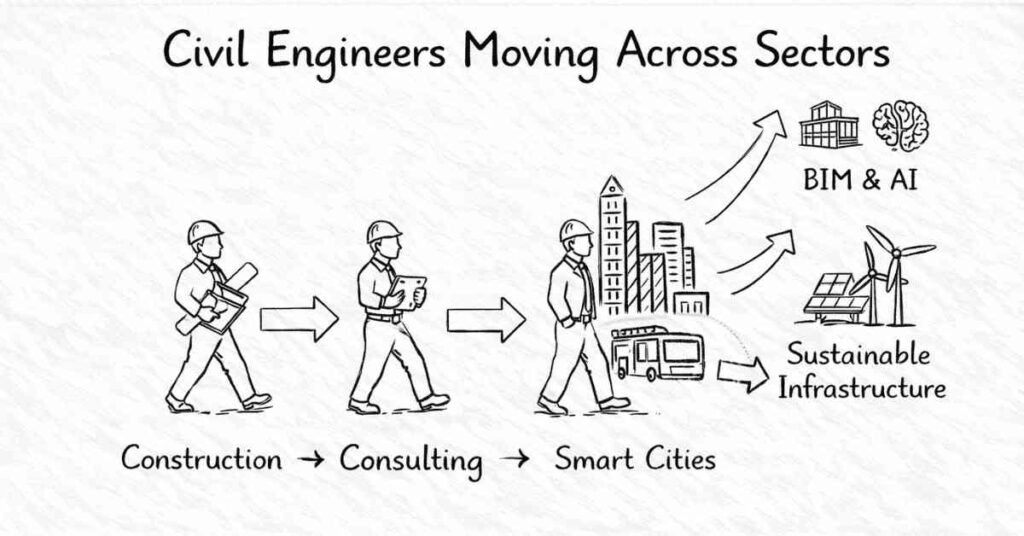
Your first job’s sector doesn’t lock you in. Many engineers:
- Start in construction, move to consulting
- Work in infrastructure, then join smart cities
- Gain site experience, then switch to design firms
- Each sector teaches valuable skills that transfer across the industry.
Final Thoughts
India needs civil engineers across all these sectors. From building homes to designing highways, from managing water resources to planning smart cities—every sector contributes to national development.
Choose based on your interests, lifestyle preferences, and career goals. The “best” sector is the one that aligns with what you value and enjoy. Your career is a long journey—pick a sector where you’ll be motivated to learn, grow, and contribute.