
EMAIL MARKETING SPECIALIST CAREER GUIDE
Table of Contents
Why Email Marketing is Still Thriving in 2026
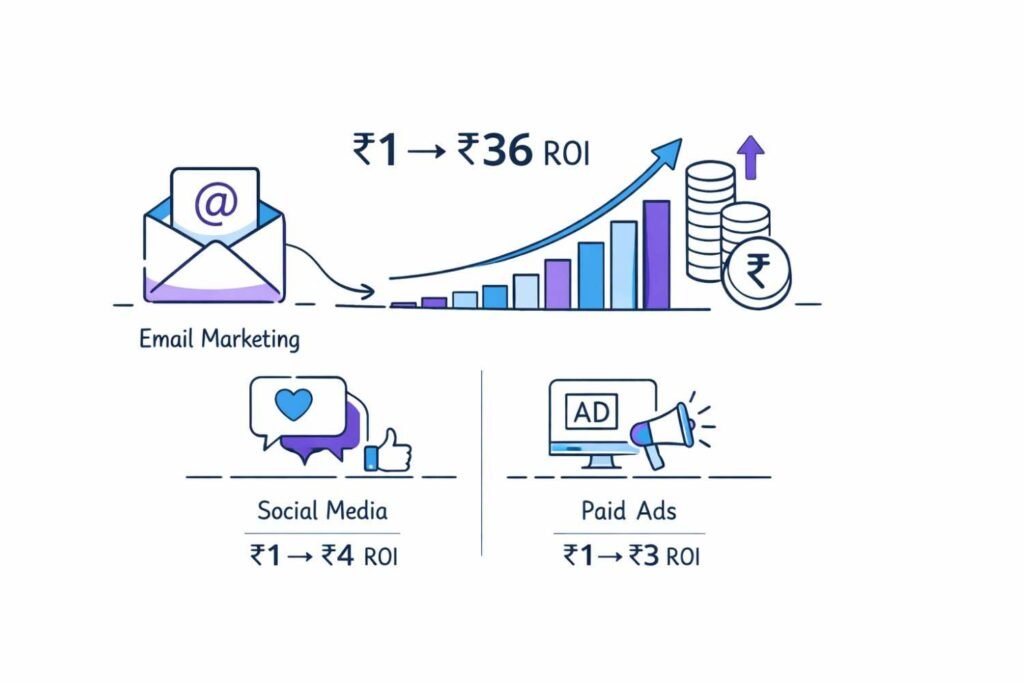
In a world obsessed with Instagram Reels and LinkedIn posts, you might think email is outdated. That couldn’t be further from the truth. Email marketing consistently delivers the highest ROI among all digital marketing channels—for every ₹1 spent, businesses earn an average ₹36-42 in return. No other marketing channel comes close to this profitability.
Email marketing specialists design, execute, and optimize email campaigns that nurture leads, re-engage customers, and drive sales through personalized messaging. They’re the strategic minds behind those welcome emails that make you feel valued, abandoned cart reminders that bring you back to complete purchases, and newsletters that keep you engaged with brands you love.
What makes email special in 2026? Unlike social media where algorithms control who sees your content, email gives you direct access to your audience’s inbox. When someone gives you their email address, you own that relationship—no platform can take it away. For Indian businesses ranging from e-commerce stores to edutech platforms to B2B SaaS companies, email remains the most reliable channel for predictable revenue generation.
What Email Marketing Specialists Actually Do
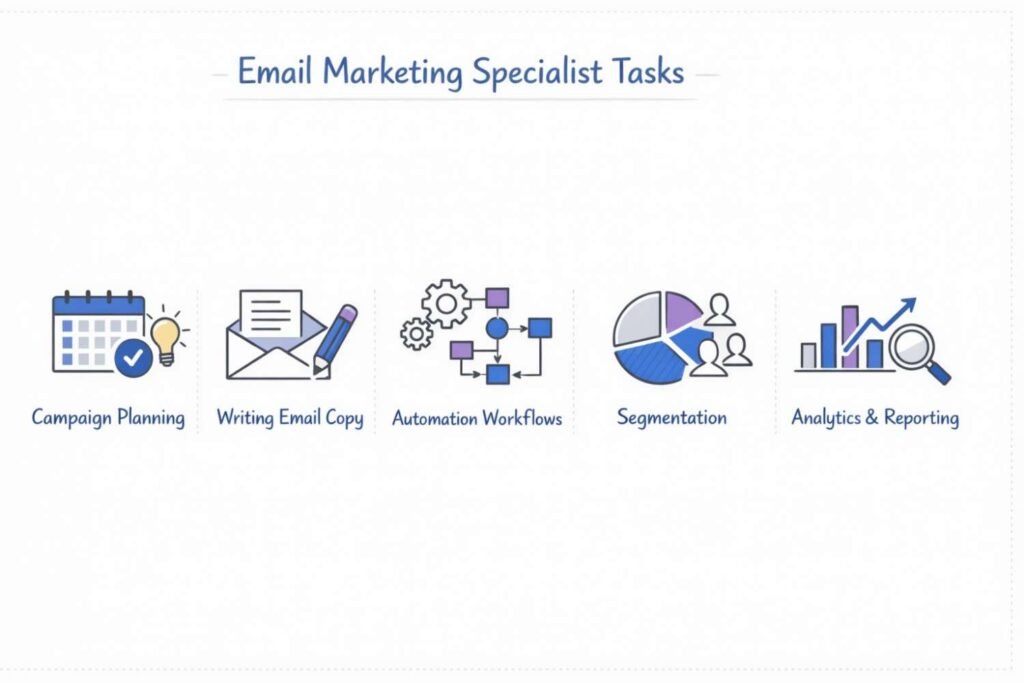
Email marketing specialists wear multiple hats throughout their workday
Strategic Planning
- Develop email marketing strategies aligned with business goals (lead generation, sales, retention)
- Create annual email calendars mapping promotional campaigns, seasonal offers, and nurture sequences
- Segment email lists based on demographics, behavior, and engagement patterns
- Define key performance indicators and success metrics for campaigns
Campaign Creation and Execution
- Write compelling email copy with strong subject lines, engaging body content, and clear calls-to-action
- Design email templates using drag-and-drop builders or HTML/CSS coding
- Set up automated email workflows triggered by user actions (sign-ups, purchases, abandoned carts)
- Conduct A/B testing on subject lines, send times, content, and CTAs
- Schedule campaigns for optimal open and click-through rates
List Management
- Build and grow email lists through lead magnets, website forms, and sign-up campaigns
- Clean email lists regularly by removing inactive subscribers and invalid addresses
- Ensure compliance with data protection regulations like GDPR and India’s Digital Personal Data Protection Act
- Implement double opt-in processes to maintain list quality
Analysis and Optimization
- Monitor campaign performance metrics—open rates, click-through rates, conversion rates, unsubscribe rates
- Analyze email deliverability and sender reputation scores
- Identify trends in subscriber behavior and preferences
- Report results to stakeholders with actionable recommendations
- Continuously optimize campaigns based on performance data
Essential Skills for Email Marketing Specialists
Technical Skills
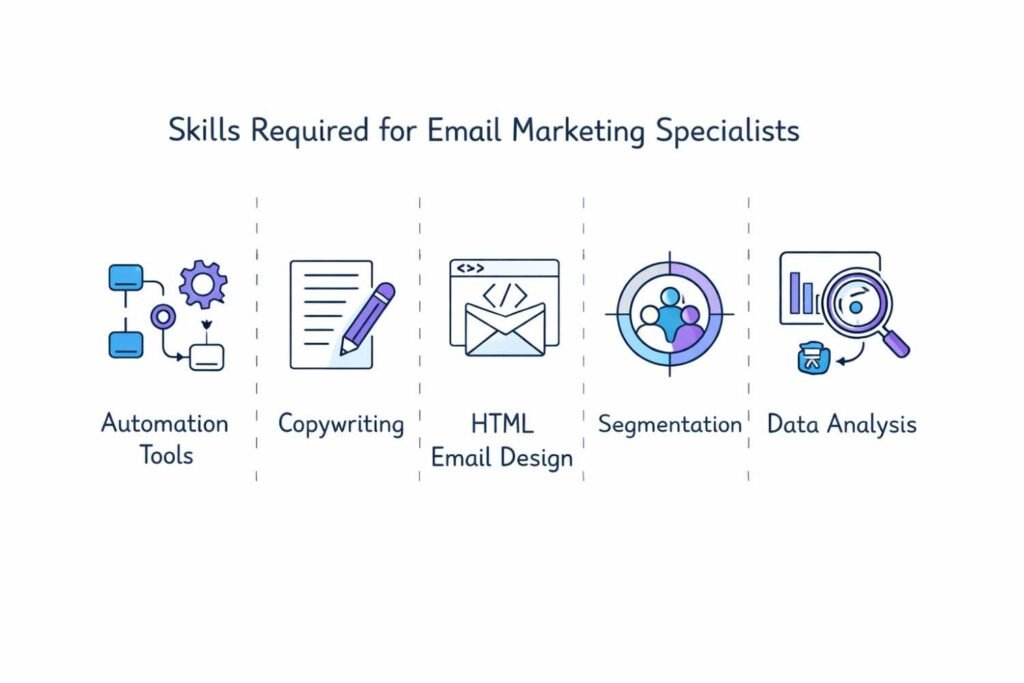
Email Service Providers (ESP) Mastery: Proficiency in platforms like Mailchimp, SendGrid, HubSpot, Klaviyo, Campaign Monitor, or Omnisend. Understanding how to build campaigns, create automation workflows, manage lists, and analyze performance within these tools.
Marketing Automation: Setting up sophisticated automated workflows that trigger emails based on user behavior—welcome series, onboarding sequences, re-engagement campaigns, birthday emails, and post-purchase follow-ups.
HTML/CSS Basics: While many tools offer drag-and-drop builders, understanding HTML and CSS allows you to customize templates, fix rendering issues, and create unique designs.
Data Analysis: Using analytics tools to interpret campaign performance, identify patterns, calculate ROI, and make data-driven optimization decisions.
List Segmentation: Creating targeted segments based on demographics (age, location, gender), behavior (purchase history, email engagement, website activity), and psychographics (interests, preferences).
Deliverability Management: Understanding sender reputation, authentication protocols (SPF, DKIM, DMARC), avoiding spam filters, and maintaining healthy list hygiene.
Creative Skills
Copywriting: Writing subject lines that drive opens, body content that engages, and CTAs that convert. Mastering the art of persuasive writing while maintaining brand voice.
Design Sensibility: Creating visually appealing emails that render correctly across devices and email clients. Understanding responsive design principles for mobile optimization.
Personalization Strategy: Going beyond “Hi [First Name]” to create truly personalized experiences using dynamic content, product recommendations, and behavioral triggers.
Strategic Skills
Customer Journey Mapping: Understanding where email fits in the overall customer journey and creating appropriate messaging for each stage—awareness, consideration, decision, retention, advocacy.
A/B Testing Methodology: Designing valid tests, determining sample sizes, interpreting results accurately, and implementing winners systematically.
Compliance Knowledge: Understanding email marketing laws, consent requirements, unsubscribe processes, and data protection regulations.
Email Marketing Best Practices for 2026
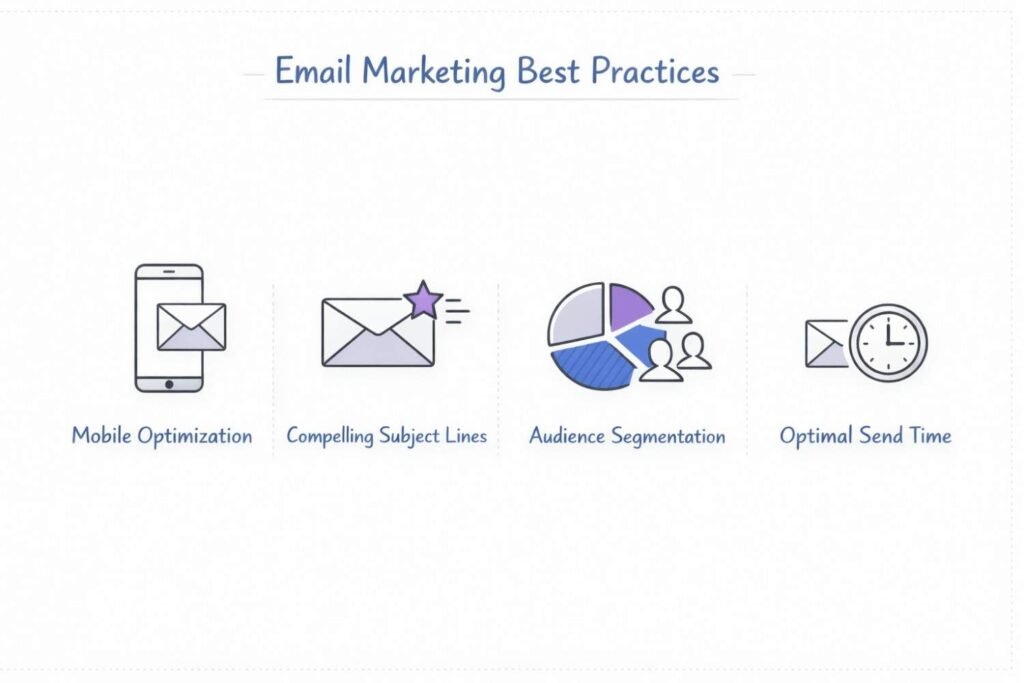
Mobile-First Optimization
Over 70% of emails in India are opened on mobile devices. Mobile optimization is no longer optional—it’s fundamental.
Best Practices:
- Keep subject lines under 40 characters so they display fully on mobile screens
- Use single-column layouts that adapt to narrow screens
- Make buttons large enough for easy tapping (minimum 44×44 pixels)
- Place important information and CTAs above the fold
- Optimize images to load quickly on slower connections common in India
- Test emails across popular email clients (Gmail app, Yahoo Mail, Outlook) and devices
Regional Personalization for Indian Audiences
India’s diversity demands localized email strategies
Language Customization: Segment lists by preferred language and send campaigns in Hindi, Tamil, Telugu, Bengali, or other regional languages alongside English.
Cultural Relevance: Design campaigns around Indian festivals (Diwali, Holi, Eid, Pongal, Durga Puja) with appropriate imagery, colors, and messaging that resonates culturally.
Geographic Targeting: Personalize content based on location—promote monsoon products in Mumbai during rainy season, winter wear in Delhi during cold months.
Compelling Subject Lines
Subject lines determine whether emails get opened or ignored
Proven Techniques:
- Use personalization beyond names—reference recent purchases, browsing behavior, or location
- Create urgency with genuine scarcity (“Last 3 hours for 40% off” works better than fake countdowns)
- Ask questions that spark curiosity (“Are you making this digital marketing mistake?”)
- Include numbers and specifics (“5 proven strategies” performs better than “Multiple strategies”)
- Keep it under 50 characters, ideally 30-40 for mobile
- A/B test consistently—what works for one audience may not work for another
Advanced Segmentation
Generic mass emails underperform dramatically compared to targeted segments
Segmentation Strategies:
- Behavioral: Engaged subscribers vs. inactive subscribers require different approaches
- Purchase History: Segment by first-time buyers, repeat customers, high-value customers, lapsed customers
- Engagement Level: Create tiers based on email opens and clicks over past 90 days
- Demographics: Age, gender, location, job title for B2B
- Lifecycle Stage: Prospects, new customers, loyal customers, at-risk customers each need tailored messaging
- Product Interest: Based on website browsing behavior or previous purchases
Dynamic segmentation automatically updates as subscriber behavior changes, ensuring targeting remains accurate.
Optimal Send Times
While global benchmarks suggest sending emails between 9-11 AM, Indian audiences have unique patterns
Testing Recommendations:
- B2B Emails: Tuesday-Thursday, 9-11 AM IST (when professionals check emails at work)
- B2C Emails: Evenings 7-9 PM IST (when people relax after work) and Sunday mornings
- E-commerce: Weekends often perform well for shopping-related emails
- Promotional Emails: Beginning and end of month align with salary cycles in India
Always test your specific audience’s preferences—behavior varies by industry, product type, and audience demographics.
A/B Testing Everything
Continuous testing drives performance improvements:
What to Test:
- Subject lines (personalized vs. generic, short vs. long, question vs. statement)
- From names (company name vs. person’s name vs. both)
- Send times (morning vs. afternoon vs. evening)
- Email content length (short and punchy vs. detailed and comprehensive)
- CTA button text, color, and placement
- Images vs. text-heavy designs
- Tone of voice (formal vs. casual, humorous vs. serious)
Test one element at a time with statistically significant sample sizes to draw valid conclusions.
Email Marketing Tools and Platforms
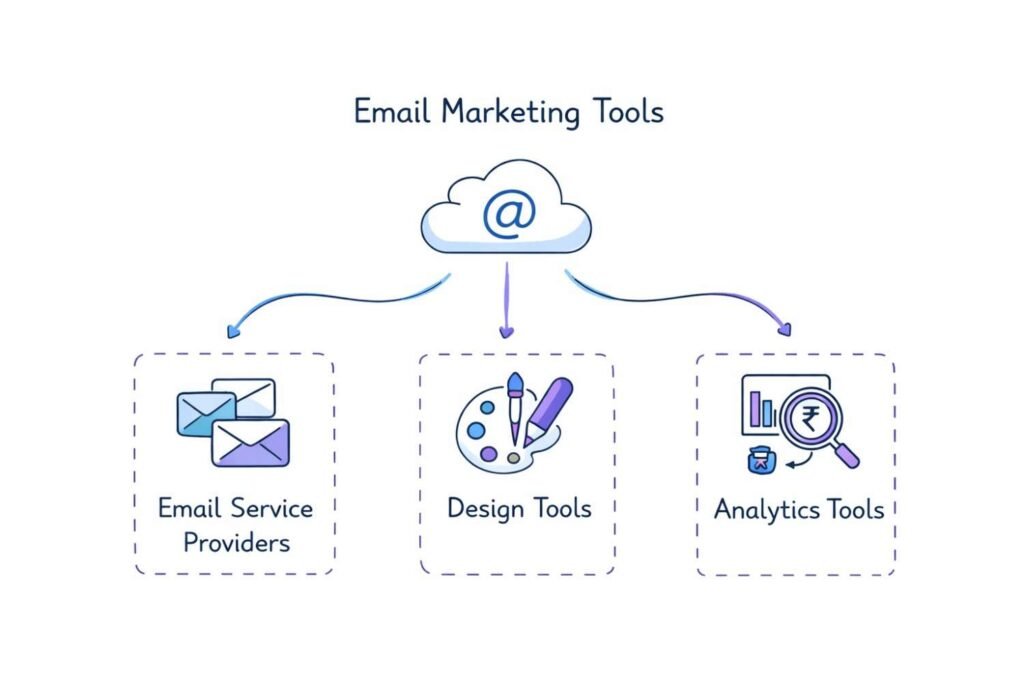
Popular ESPs for Indian Market
Mailchimp: User-friendly platform perfect for small businesses and beginners. Offers free plan for up to 500 subscribers with robust automation features. Cost: Free to ₹2,500/month.
SendGrid: Developer-friendly platform with strong deliverability and API access. Excellent for transactional emails (order confirmations, password resets). Cost: Free tier available; paid from ₹1,200/month.
HubSpot Marketing Hub: All-in-one marketing automation platform integrating email with CRM, landing pages, and analytics. Cost: Free tools available; premium from ₹8,000/month.
Klaviyo: E-commerce-focused ESP with powerful segmentation and product recommendation capabilities. Cost: Free up to 250 contacts; paid from ₹3,000/month.
Zoho Campaigns: Affordable option from Indian company Zoho with multilingual support and integration with Zoho ecosystem. Cost: Starting ₹250/month.
Campaign Monitor: Intuitive platform with beautiful templates and easy automation builder. Cost: From ₹800/month.
Design and Testing Tools
Litmus: Test email rendering across 100+ email clients and devices, preview subject lines, and analyze deliverability. Cost: From ₹8,000/month.
Canva: Create email graphics, headers, and visual elements with templates and drag-and-drop interface. Cost: Free version available; Pro from ₹1,000/month.
Email on Acid: Similar to Litmus for testing and previewing emails before sending. Cost: From ₹6,000/month.
Analytics and Optimization
Google Analytics: Track email-driven website traffic, conversions, and revenue by setting up UTM parameters in email links. Cost: Free.
Microsoft Clarity: Understand how email visitors behave on your website with heatmaps and session recordings. Cost: Free.
Most beginners start with free or low-cost tools like Mailchimp or Zoho Campaigns, then upgrade as list size and requirements grow.
Email Marketing Specialist Salary in India
Email marketing specialists earn competitive salaries, especially as they gain automation and analytics expertise:
Experience-Based Salary Ranges
- Entry-Level (0-2 years): ₹2-4 lakhs per year
- Mid-Level (2-5 years): ₹4-8 lakhs per year
- Senior-Level (5-8 years): ₹8-12 lakhs per year
- Email Marketing Manager (8+ years): ₹12-18 lakhs per year
Average salary for experienced email marketing specialists is ₹6-8 lakhs annually.
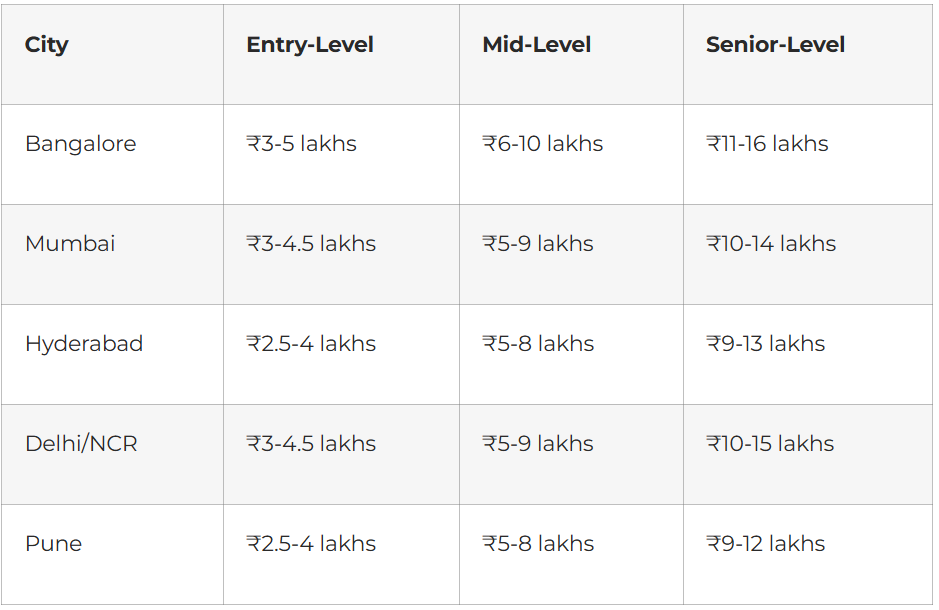
City-Wise Comparison
Industry Variations
- E-commerce: ₹4-14 lakhs (high volume campaigns, revenue attribution)
- SaaS/Technology: ₹5-15 lakhs (complex automation, lifecycle marketing)
- Edutech: ₹4-12 lakhs (student nurturing, course promotion)
- Agencies: ₹3-11 lakhs (managing multiple client accounts)
- Finance/Fintech: ₹5-13 lakhs (compliance requirements, high-value customers)
Freelance Email Marketing
Freelancers typically charge:
- ₹10,000-30,000 per campaign design and execution
- ₹20,000-60,000 monthly retainers for ongoing management
- ₹1,000-3,000 per hour for consulting
- ₹5,000-15,000 for automation workflow setup
Managing 4-6 clients generates ₹60,000-2,00,000 monthly income for established freelancers.
How to Become an Email Marketing Specialist
Month 1: Learn Email Marketing Fundamentals
Week 1-2: Understand Core Concepts
- Study email marketing strategy, segmentation, personalization, automation
- Learn about deliverability, sender reputation, spam laws
- Understand key metrics—open rate, click-through rate, conversion rate, bounce rate, unsubscribe rate
- Read HubSpot’s Email Marketing Guide and Mailchimp’s Resources
Week 3-4: Practice on Personal Projects
- Sign up for free Mailchimp or Mailerlite account
- Create a simple email list (friends, family, or blog subscribers)
- Design welcome email series using templates
- Send your first campaign and analyze results
Month 2: Master an ESP Platform
Choose one platform to master deeply—Mailchimp is ideal for beginners:
Mailchimp Mastery:
- Complete Mailchimp Academy courses (free)
- Build 5-6 different email templates for various purposes
- Set up automation workflows (welcome series, abandoned cart, re-engagement)
- Practice list segmentation with different criteria
- Understand tagging and audience management
- Learn reporting and analytics features
Document everything as portfolio pieces with screenshots.
Month 3: Study Copywriting and Design
Copywriting Skills:
- Take HubSpot Email Marketing Certification (free)
- Study successful email swipe files from brands like Swiggy, Zomato, Amazon
- Practice writing 50+ subject lines
- Write email copy for different scenarios (welcome, promotional, transactional, nurture)
Design Skills:
- Learn basic Canva for creating email graphics
- Study email design best practices
- Understand responsive design principles
- Test emails across devices and clients
Month 4-5: Build Portfolio Projects
Project 1: Email Campaign Case Study
- Design complete email campaign for fictional or real business
- Include: strategy, audience segmentation, 5-6 email sequence, automation setup
- Show metrics if you ran real campaign
- Present as professional PDF case study
Project 2: Automation Workflow
- Build complex automation workflow (e.g., 30-day onboarding for SaaS product)
- Diagram the workflow with trigger points and decision branches
- Write all email copy
- Explain strategy and expected outcomes
Project 3: Email Audit and Optimization
- Audit a real company’s email marketing
- Identify issues (deliverability, design, copy, frequency, segmentation)
- Provide detailed recommendations
- Rewrite sample emails showing improvements
Project 4: A/B Test Results Analysis
- Run real A/B tests on subject lines or content
- Document hypothesis, test design, results
- Explain learnings and recommendations
Create portfolio website showcasing these projects.
Month 6: Gain Practical Experience
Option A: Internships
- Apply for email marketing internships at e-commerce companies, agencies, or startups
- Even 3-month internships provide real-world experience
- Focus on learning over salary initially
Option B: Freelance Projects
- Offer email marketing services on Upwork, Fiverr, Freelancer
- Start with lower rates (₹5,000-10,000 per project) to build reviews
- Join Facebook groups for email marketers and network
Option C: Manage Email for Small Business
- Approach local businesses needing email marketing
- Offer to set up and manage their email marketing for 3 months
- Get testimonials and results for portfolio
Month 7+: Apply for Full-Time Roles
Job Titles to Search:
- Email Marketing Executive
- Marketing Automation Specialist
- CRM Executive
- Digital Marketing Executive (Email focus)
- Retention Marketing Executive
Resume Strategy:
- Highlight platform expertise (Mailchimp, HubSpot, etc.)
- Quantify results (“Achieved 35% open rate, 15% above industry average”)
- Include certifications prominently
- Link to portfolio
- Showcase both creative (copywriting, design) and analytical (A/B testing, metrics) skills
Where to Apply:
- E-commerce companies (high demand for email marketers)
- SaaS companies (complex automation needs)
- Digital marketing agencies
- Naukri, LinkedIn, Indeed, Internshala
Career Growth Path for Email Marketers
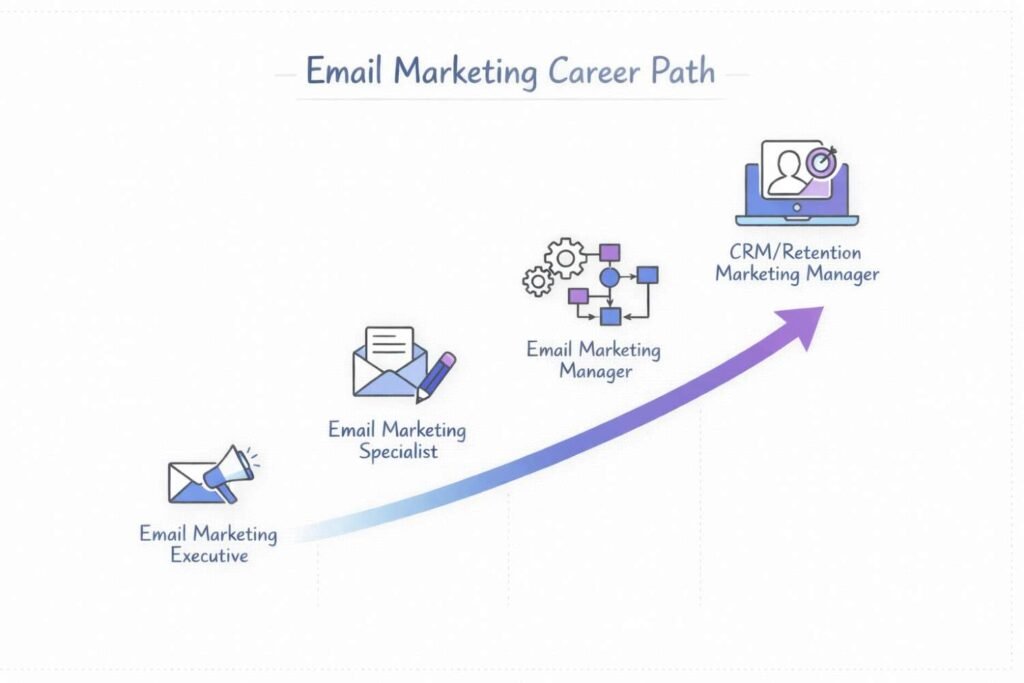
Year 0-2: Email Marketing Executive
Execute campaigns under supervision. Write emails, design templates, manage lists, schedule sends. Learn the fundamentals. Expected salary: ₹2-4 lakhs.
Year 2-4: Email Marketing Specialist
Own email channel independently. Develop strategies, create automation workflows, manage segmentation, analyze performance. Expected salary: ₹4-8 lakhs.
Year 4-6: Senior Email Marketing Specialist
Lead email marketing for organization or large clients. Optimize complex automation, manage junior team members, report to senior management. Expected salary: ₹8-12 lakhs.
Year 6-8: Email Marketing Manager
Oversee entire email marketing function. Manage team, set strategy, allocate budget, integrate email with broader marketing. Expected salary: ₹12-18 lakhs.
Year 8+: CRM/Retention Marketing Manager
Manage all customer retention channels (email, SMS, push notifications). Shape customer lifecycle strategy, collaborate with product and sales teams. Expected salary: ₹15-22 lakhs.
Many email specialists also transition into:
- Marketing Automation Manager: Focus on complex automation across channels
- Lifecycle Marketing Manager: Own entire customer journey
- CRM Manager: Manage customer data and multi-channel communication
- Freelance Consultant: Offer email strategy to multiple clients
Email Marketing Trends Shaping 2026
AI-Powered Personalization
AI tools analyze subscriber behavior to predict optimal send times, content preferences, and product recommendations for each individual. Dynamic content blocks change based on who’s opening the email.
Interactive Emails
Emails with embedded polls, quizzes, carousels, and accordions increase engagement without requiring clicks to external sites.
Privacy-First Marketing
With stricter data protection laws, email marketers must focus on zero-party data (information customers willingly share) and explicit consent.
Omnichannel Integration
Email coordinates with SMS, WhatsApp, push notifications, and in-app messages for seamless customer experiences.
Accessibility Focus
Designing emails accessible to people with disabilities—proper alt text, semantic HTML, screen reader compatibility.
Common Email Marketing Challenges and Solutions
Challenge 1: Low Open Rates
Solutions:
- Test different subject lines extensively
- Clean list regularly, removing inactive subscribers
- Improve sender reputation by maintaining engagement
- Personalize subject lines beyond just names
- Send at optimal times for your audience
Challenge 2: High Unsubscribe Rates
Solutions:
- Reduce email frequency if sending too often
- Improve content relevance through better segmentation
- Set expectations during signup about email frequency
- Make emails valuable, not just promotional
- Survey unsubscribers to understand why they’re leaving
Challenge 3: Deliverability Issues
Solutions:
- Authenticate domain with SPF, DKIM, and DMARC
- Maintain list hygiene by removing bounces
- Avoid spam trigger words in subject lines and content
- Warm up new sending domains gradually
- Monitor sender reputation scores
Challenge 4: Low Engagement
Solutions:
- Create compelling, valuable content
- Use storytelling instead of pure promotion
- Add interactive elements
- Optimize for mobile devices
- Test different content formats
FAQs: Email Marketing Specialist Career
Q: Is email marketing dying with social media dominating?
No. Email consistently delivers the highest ROI and gives you owned access to your audience. Social media complements email but doesn’t replace it.
Q: Do I need coding skills for email marketing?
Basic HTML/CSS helps but isn’t mandatory. Most platforms offer drag-and-drop builders. As you advance, technical skills become more valuable.
Q: Which certification is most valuable for email marketing?
HubSpot Email Marketing Certification is free and widely recognized. Platform-specific certifications (Mailchimp, Klaviyo) are also valuable.
Q: Can I specialize only in email marketing long-term?
Yes. Email specialists often expand into marketing automation, CRM, or lifecycle marketing—all related specializations with strong demand.
Q: How long before I see results from email campaigns?
Email delivers fast results—campaigns can generate sales within hours. Building a high-performing email program takes 3-6 months of consistent optimization.
Your Next Steps: Launch Your Email Marketing Career
Email marketing offers one of the most reliable, measurable, and profitable career paths in digital marketing. Unlike channels dependent on algorithms, email gives you direct control over your audience relationship. The businesses earning crores through email marketing need specialists who understand strategy, automation, personalization, and optimization.
Start today by signing up for a free email marketing platform and sending your first campaign. Even if it’s just to 10 friends asking for feedback on your blog, you’re learning the fundamentals. Document your process. Test different approaches. Build your portfolio one campaign at a time.
The email marketing specialists earning ₹10-15 lakhs today started with their first poorly-designed email that nobody opened. They kept learning, testing, and improving. Your email marketing career starts with clicking “send” on your first campaign. What are you waiting for?