
INTELLECTUAL PROPERTY LAW CAREER

Table of Contents
Introduction:
Every time you see the Nike swoosh, stream a Bollywood song on Spotify, or use a smartphone with patented technology, you’re experiencing protected intellectual property. Behind each of these protections stands an intellectual property lawyer who helped secure those rights. IP law sits at the fascinating intersection of creativity, technology, business, and legal strategy—making it one of the most intellectually stimulating and financially rewarding legal specializations available today.lawbhoomi+1
India’s IP law landscape is booming. With the startup ecosystem flourishing, technology companies expanding, pharmaceutical innovation accelerating, and entertainment industries thriving, demand for skilled IP lawyers continues growing rapidly. Companies recognize that their most valuable assets often aren’t physical—they’re patents protecting inventions, trademarks building brand value, and copyrights securing creative content. Protecting these intangible assets requires specialized legal expertise that commands premium compensation.lawbhoomi
IP lawyers in India earn significantly above general practice averages—₹10-15 lakhs annually on average, with experienced specialists making ₹20-35 lakhs or more depending on location and specialization. Entry-level positions start at ₹3-8 lakhs, offering strong foundations for lucrative career growth. If you’re fascinated by innovation, enjoy technical problem-solving, and want a legal career combining business strategy with creative protection, IP law deserves serious consideration.6figr+1

Understanding Intellectual Property: The Basics
The Four Pillars of IP Protection
Patents protect inventions—new products, processes, machines, or technological solutions that solve practical problems. When a pharmaceutical company develops a new drug or a tech startup creates innovative software architecture, patents prevent others from copying those inventions for typically 20 years. Patent law requires understanding both legal principles and technical details of inventions you’re protecting.registerkaro
Trademarks safeguard brand identity—logos, brand names, slogans, colors, and even sounds that distinguish one company’s products from competitors. Think of the McDonald’s golden arches or Apple’s bitten apple logo. Trademark lawyers help businesses register these identifying marks, enforce them against infringement, and build valuable brand portfolios.registerkaro
Copyrights protect original creative works—books, music, films, artwork, software code, and architectural designs. Copyright automatically exists when someone creates original work, though registration provides stronger legal protection. Copyright lawyers help creators protect their work, negotiate licensing deals, and pursue infringers.india-briefing+1
Trade Secrets cover confidential business information providing competitive advantages—manufacturing processes, customer lists, or proprietary formulas like Coca-Cola’s secret recipe. Unlike other IP forms requiring registration, trade secrets derive value from remaining confidential. IP lawyers help companies establish protection systems and pursue legal remedies when secrets are stolen.
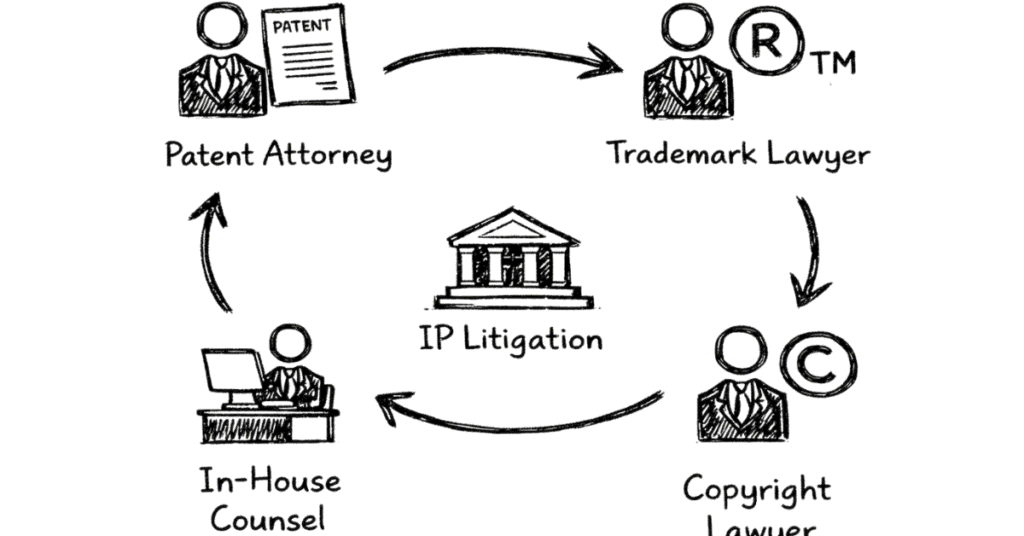
Career Paths in IP Law
Patent Attorney
Patent attorneys represent the most specialized IP lawyers, requiring both legal and technical expertise. You’ll help inventors secure patents by drafting detailed patent applications describing inventions precisely, prosecuting applications before patent offices to address examiner objections, and conducting prior art searches to ensure inventions are truly novel.razorpay
Educational requirements: Most patent attorneys hold technical undergraduate degrees—engineering, science, pharmacy, or computer science—plus law degrees. This dual expertise allows you to understand complex technical inventions well enough to describe them legally. In India, becoming a patent attorney requires registering with a State Bar Council as an advocate and being at least 21 years old.razorpay+1
Where you’ll work: Patent-intensive industries—pharmaceuticals, biotechnology, software, electronics, automotive, and chemicals—actively hire patent attorneys. Bangalore, with its concentration of technology companies, offers particularly strong opportunities, with senior IP counsel earning ₹25-35 lakhs.lawbhoomi
Daily work: Your mornings might involve drafting a patent application for a new medical device, afternoon reviewing prior art to assess whether a client’s invention is patentable, and evenings responding to patent office objections requiring technical and legal arguments.
Trademark Specialist
Trademark lawyers help businesses build and protect brand identity. You’ll conduct trademark searches to ensure proposed brand names don’t infringe existing marks, file trademark applications with the Indian Trademark Registry, oppose problematic trademark applications from competitors, and enforce client trademarks against counterfeiters and infringers.registerkaro
Who needs you: Every business building brand value needs trademark protection—from small startups choosing company names to multinational corporations managing portfolios of hundreds of trademarks. E-commerce sellers on platforms like Amazon and Flipkart particularly need trademark protection to prevent counterfeiters from selling fake products under their brand names.registerkaro
Career advantage: Trademark work doesn’t require technical educational backgrounds, making it accessible to lawyers from any undergraduate discipline. Your understanding of branding, marketing, and consumer behavior becomes as valuable as pure legal knowledge.
Copyright Lawyer
Copyright lawyers serve creative industries—entertainment, publishing, software development, advertising, and content creation. You’ll help clients register copyrights, draft licensing agreements allowing others to use protected works, negotiate royalty arrangements, and pursue copyright infringement claims against unauthorized users.india-briefing
Growing opportunities: India’s exploding digital content creation—YouTube creators, streaming platforms, music producers, software developers—creates massive copyright protection needs. Content creators and YouTubers should register copyrights for their content and trademarks for their brand names.india-briefing+1
The work: You might negotiate a licensing deal for a Bollywood film’s music rights in the morning, draft a copyright infringement notice for a client whose photographs were used without permission in the afternoon, and advise a software company on protecting their code in the evening.
IP Litigation Specialist
When IP disputes can’t be resolved through negotiation, litigation specialists take cases to court. You’ll represent clients in patent infringement lawsuits, trademark opposition proceedings, copyright infringement cases, and trade secret misappropriation claims. This path combines IP expertise with courtroom advocacy skills.lawbhoomi
Compensation: Litigation can be particularly lucrative when cases involve high-value IP—pharmaceutical patent disputes or trademark battles between major brands. Delhi NCR, a hub for litigation and government matters, offers senior IP litigators ₹20-28 lakhs.lawbhoomi
In-House IP Counsel
Many companies, especially in technology and pharmaceuticals, employ in-house IP lawyers managing their entire IP portfolios. You’ll develop IP strategy aligned with business goals, manage external IP law firms handling specific matters, coordinate patent filing strategies globally, and advise business teams on IP implications of new products or partnerships.lawbhoomi
Advantages: In-house roles typically offer better work-life balance than law firms, regular hours, and deep engagement with one company’s business. You become a strategic business partner, not just a legal service provider.

Salary Expectations: What IP Lawyers Earn
Entry-Level Compensation (0-3 Years)
Fresh IP lawyers start with salaries ranging from ₹3-8 lakhs annually depending on location and employer. Mumbai entry-level positions offer ₹6-8 lakhs, while Delhi NCR starts at ₹5-7 lakhs. These starting salaries exceed general legal practice averages, reflecting IP law’s specialized nature.lawbhoomi
Some salary data suggests entry-level IP lawyers earn approximately ₹3 lakhs annually, though this likely reflects the absolute minimum for smallest firms or tier-3 cities.payscale
Mid-Career Earnings (4-10 Years)
With several years’ experience, IP lawyers earn ₹8-15 lakhs annually. Specialization significantly impacts this range—patent attorneys with technical expertise often command higher salaries than general IP practitioners. According to comprehensive surveys, 70% of IP law salaries fall between ₹18-36 lakhs, indicating strong mid to senior career compensation.6figr+1
Location premium: Mumbai IP lawyers average ₹22-24 lakhs annually. Bangalore, home to technology companies and startups, offers particularly strong compensation for patent-focused lawyers.lawbhoomi
Senior-Level Compensation (10+ Years)
Experienced IP specialists at top law firms or corporations earn ₹20-35 lakhs or more. Mumbai senior IP lawyers make ₹28-30 lakhs, while Bangalore senior IP counsel reaches ₹25-35 lakhs. The average IP lawyer salary in India is around ₹10-15 lakhs, but specialists in metropolitan areas and premium practice settings substantially exceed these averages.6figr+1
Factors driving premium salaries:
- Technical expertise: Patent attorneys with engineering or science backgrounds command premiums
- Specialization: Deep expertise in high-value areas like pharmaceutical patents or software copyright
- Industry: Technology, pharmaceuticals, and entertainment industries pay higher than traditional manufacturing
- Employer type: Top-tier IP boutiques and multinational corporations offer highest compensation
Practice area: Patent prosecution and high-stakes litigation typically pay more than routine trademark work
Building Your IP Law Career: Practical Steps
Educational Foundation
Step 1: Choose Your Undergraduate Degree Strategically
For patent law careers, technical undergraduate degrees provide tremendous advantages. Engineering, computer science, pharmacy, biotechnology, chemistry, or physics degrees allow you to understand technical inventions you’ll later protect as a patent attorney. Many successful patent attorneys hold B.Tech or B.Sc degrees before pursuing law.razorpay
For trademark or copyright work, any undergraduate degree works—commerce, arts, management, or humanities all provide adequate foundations. Business or marketing backgrounds help you understand branding strategy relevant to trademark work.shiksha
Step 2: Pursue a Law Degree
After your undergraduate degree, complete either a 3-year LLB or enroll in a 5-year integrated law program (BA LLB, B.Tech LLB). Top National Law Universities and respected private law schools provide the strongest credentials for competitive IP positions.shiksha
Step 3: Specialize During Law School
Take every IP-related elective your law school offers—intellectual property law, patent law, copyright law, trademark law, and entertainment law courses. These courses provide foundational knowledge and demonstrate genuine interest to future employers. Participate in IP law moot court competitions to develop specialized research and advocacy skills.shiksha
Step 4: Consider Advanced Degrees
An LLM (Master of Laws) with IP specialization significantly enhances your credentials and earning potential. Some lawyers pursue LLMs from foreign universities—particularly the US or Europe—to gain international IP law expertise valuable for working with multinational clients or global law firms.shiksha
Gaining Practical Experience
Internships: Seek internships with IP law firms, IP divisions of full-service law firms, or in-house legal departments of technology or pharmaceutical companies. IP boutiques like Singh & Associates or Remfry & Sagar offer excellent learning environments. Even 2-3 month internships provide exposure to real IP work and often lead to job offers.shiksha
Patent Agent Certification: Consider pursuing patent agent certification from the Indian Patent Office while still in law school. This certification allows you to represent clients before patent offices even before completing your law degree, providing valuable practical experience and competitive advantages.razorpay
Research Positions: Academic research in IP law—assisting professors with papers or conducting independent research—builds deep subject knowledge while developing writing skills valuable throughout your career.
Essential Skills to Develop
Technical Aptitude: For patent work, continuously develop technical understanding. Read scientific journals in your field, stay current with technological developments, and maintain curiosity about how things work technically.razorpay
Attention to Detail: IP law demands meticulous precision. Patent applications require exact technical descriptions. Trademark searches must be thorough. Copyright registrations need complete documentation. Developing obsessive attention to detail distinguishes excellent IP lawyers from average ones.
Research Skills: IP work involves extensive research—searching patent databases, reviewing trademark registries, analyzing prior art, and tracking legal precedents. Master research methodologies and relevant databases early.
Business Acumen: Understanding business strategy helps you provide valuable IP counsel. Companies don’t just want legal compliance—they want IP strategies supporting business objectives. Develop commercial awareness by reading business news, understanding industry dynamics, and thinking strategically about IP as business assets.
Communication Excellence: You’ll constantly translate between technical and legal languages. Engineers need to understand legal implications of patent strategies. Lawyers need to grasp technical details of inventions. Business executives want strategic IP advice without legal jargon. Developing clear communication across these audiences becomes essential.
Why IP Law Is Growing
Innovation Economy
India’s economy increasingly values innovation over mere manufacturing. Startups developing new technologies need patent protection. Technology companies building software products require copyright and patent strategies. This shift toward knowledge-based economies creates sustained demand for IP legal services.shiksha+1
Global Competition
Indian companies competing globally must protect their innovations internationally. This requires IP lawyers who understand both Indian and foreign IP systems—creating opportunities for lawyers with international expertise.shiksha
Digital Transformation
Everything moving online creates new IP challenges. Software copyright, domain name disputes, content protection on streaming platforms, and technology patent issues generate continuous IP legal work.india-briefing+1
Brand Value Recognition
Companies increasingly recognize that brand value—protected through trademarks—constitutes their most valuable assets. Startups raising venture capital need clean IP portfolios. E-commerce brands require trademark protection against counterfeiters. This awareness drives demand for trademark specialists.registerkaro
Enforcement Emphasis
Government initiatives strengthening IP enforcement—better court systems, faster dispute resolution, and stricter penalties for infringement—encourage businesses to invest in IP protection, knowing their rights can be effectively enforced.i
Is IP Law Right for You?
You’ll Thrive in IP Law If You:
- Enjoy understanding how things work technically or creatively
- Like solving puzzles and analyzing complex information
- Appreciate the intersection of law, business, and innovation
- Want legal work with clear business impact
- Find technology, entertainment, or pharmaceutical industries fascinating
- Enjoy continuous learning about new innovations and creative works
- Value specialization over general practice
- Want premium compensation reflecting specialized expertise
Consider Alternatives If You:
- Dislike technical or scientific concepts
- Prefer broad generalist practice over specialization
- Find detailed research and analysis tedious
- Want immediate courtroom advocacy over transactional work
- Strongly prefer traditional litigation to advisory roles
- Don’t enjoy learning about business strategy
IP law offers intellectually stimulating careers combining legal expertise with technical or creative understanding. The work directly impacts innovation, business success, and creative industries. Compensation reflects specialized knowledge, with strong earning potential throughout your career. For lawyers drawn to innovation, technology, creativity, and business strategy, IP law provides one of the most rewarding legal specializations available today.shiksha+1