
PARALEGAL CAREER OPPORTUNITIES
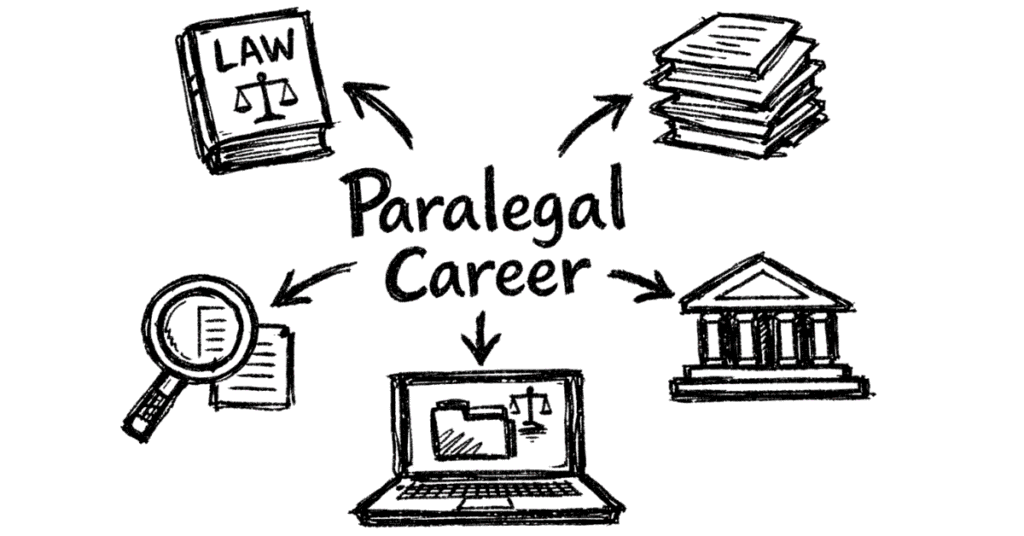
Table of Contents
Introduction:
Think lawyers do everything in a law firm? Think again. Behind every successful lawyer is often a skilled paralegal doing the heavy lifting—researching case law, drafting contracts, organizing evidence, and keeping cases moving forward. If you’re drawn to the legal field but aren’t sure about becoming a full-fledged lawyer, or if you want to enter the legal profession quickly without spending five years in law school, paralegal work offers an excellent entry point.thelegalschool
The paralegal profession in India has grown tremendously over the past decade. Law firms, corporate legal departments, and even government agencies now recognize that employing skilled paralegals improves efficiency and reduces costs. Lawyers can focus on strategy, client relationships, and courtroom advocacy while paralegals handle essential support work that keeps legal matters organized and progressing smoothly.careers360+1
What makes this career particularly attractive is accessibility. You don’t need a law degree to start—many paralegals begin with bachelor’s degrees in any field plus specialized paralegal training. Entry-level paralegals earn between ₹2-4 lakhs annually, with experienced professionals making ₹4.5-7 lakhs or more. In major metros like Mumbai, average paralegal compensation reaches ₹10.7 lakhs for experienced professionals. This guide explores everything you need to know about building a successful paralegal career in India.erieri+2
What Does a Paralegal Actually Do?
The Backbone of Legal Operations
Paralegals serve as the operational engine of legal work. While lawyers provide legal advice, represent clients, and appear in court, paralegals ensure all the supporting work happens efficiently. Your role sits somewhere between administrative assistant and junior lawyer—you need legal knowledge but don’t provide legal advice or represent clients directly.thelegalschool
Imagine a corporate merger where Company A is acquiring Company B. The lawyer leads negotiations and advises on legal strategy. But who reviews hundreds of contracts to identify potential problems? Who organizes financial documents for due diligence? Who drafts the initial versions of transaction agreements? That’s you—the paralegal making sure nothing falls through the cracks.
Core Daily Responsibilities
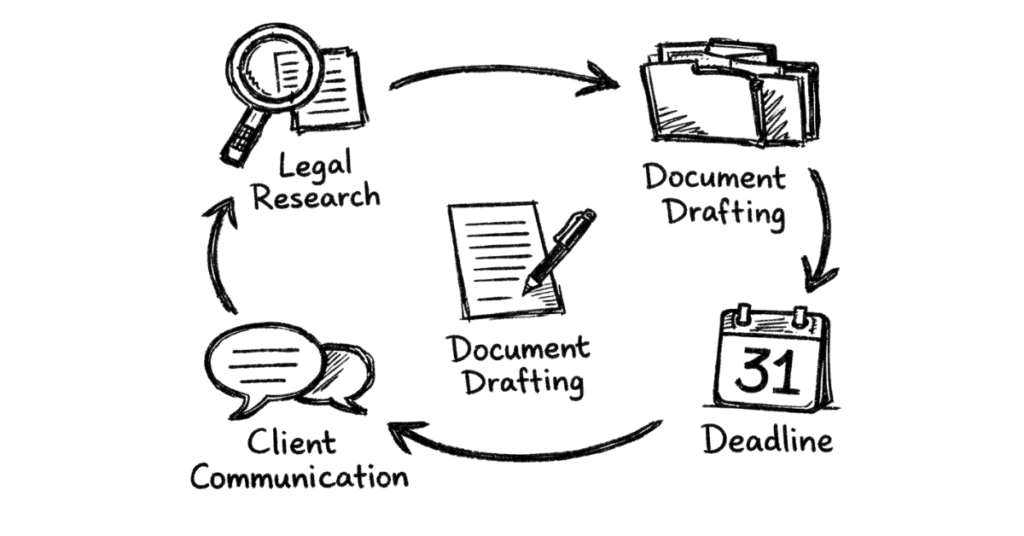
Legal Research: This consumes a significant portion of your time. When lawyers need to understand how courts have ruled on specific issues, you dive into legal databases like Manupatra, SCC Online, or Indian Kanoon to find relevant case law. You don’t just find cases—you read them, understand their application, and summarize key findings for the lawyer to review.thelegalschool
Research extends beyond case law. You might investigate statutes, legal commentaries, or procedural rules. For example, if your firm is handling a property dispute in Karnataka, you’d research specific provisions of Karnataka’s land laws, find precedents from Karnataka High Court, and identify any recent amendments that might affect the case.thelegalschool
Document Drafting: Paralegals draft numerous legal documents under lawyer supervision. You’ll create first drafts of contracts, affidavits, legal notices, petitions, and agreements. The lawyer reviews and refines your drafts, but you handle the initial heavy lifting of putting thoughts into proper legal language and format.thelegalschool
Good drafting requires attention to detail and clarity. A missing clause in a non-disclosure agreement could fail to protect your client’s confidential information. An unclear provision in a vendor contract might create disputes later. You learn to draft documents that are both legally sound and easily understandable.thelegalschool
Case File Management: Every legal matter generates mountains of paperwork—client communications, evidence documents, court filings, correspondence with opposing parties, and internal notes. Your job involves organizing all this material systematically so lawyers can instantly access whatever they need.thelegalschool
Modern case management often uses software systems, but the principle remains the same: creating order from potential chaos. You maintain filing systems (physical and digital), track document versions, ensure nothing gets lost, and can quickly locate specific documents when lawyers ask for them.thelegalschool
Client Communication: While lawyers handle strategic client discussions, paralegals often manage day-to-day client interactions. You might contact clients to gather additional information, update them on case progress, schedule meetings, or explain procedural steps. This requires professional communication skills and the ability to explain legal processes in plain language without providing legal advice.scribd+1
Scheduling and Deadline Management: Legal work operates on strict deadlines—court filing dates, contract execution timelines, response deadlines for legal notices. Missing deadlines can have serious consequences, from losing cases to exposing clients to liability. You maintain detailed calendars, send reminders to lawyers about upcoming deadlines, and ensure all time-sensitive tasks get completed on schedule.thelegalschool
Evidence Organization: In litigation matters, you help organize evidence systematically. This might involve creating chronologies of events, organizing witness statements, indexing documentary evidence, and preparing exhibit lists. When lawyers head to court, they need evidence organized so clearly that they can access any document within seconds.thelegalschool
Court Filing and Liaison: You handle administrative aspects of court appearances—filing petitions and documents with court registries (increasingly through e-filing systems), obtaining certified copies of orders, tracking hearing dates, and sometimes attending court to monitor case listings.
Skills That Make You Successful
Technical Legal Skills
Legal Research Proficiency: Mastering legal research databases is fundamental. You need to know how to construct effective search queries, filter results by jurisdiction or date, and quickly identify the most relevant cases among hundreds of results. Different databases have different interfaces—SCC Online works differently from Manupatra—so familiarity with multiple platforms increases your value.thelegalschool
Beyond database mechanics, good research requires understanding legal reasoning. When a lawyer asks you to research “cases on breach of confidentiality clauses in employment contracts,” you need to understand what makes a case relevant—similar facts, applicable legal principles, or jurisdictional authority.
Document Drafting Skills: Clear, precise writing distinguishes excellent paralegals from average ones. Legal drafting follows specific conventions—defined terms in contracts, proper petition formats for different courts, and standard clauses for various agreement types. You learn these conventions through practice and by studying well-drafted examples.thelegalschool
Your drafting should eliminate ambiguity while remaining readable. Unnecessarily complex language impresses no one and often creates confusion. The best legal documents communicate clearly while protecting clients legally.scribd
Understanding Legal Procedures: You need working knowledge of how legal processes actually function. What’s the procedure for filing a civil suit? What documents are needed for company incorporation? What’s the timeline for trademark registration? This procedural knowledge helps you anticipate what needs to happen next in any matter.thelegalschool
Attention to Detail: Legal work demands meticulous accuracy. A single wrong date in a contract could create problems. A missed citation in a court filing might weaken an argument. Successful paralegals develop almost obsessive attention to detail—you check and double-check everything before it goes out
Soft Skills That Matter
Communication Excellence: You’ll communicate with diverse people—lawyers, clients, court staff, opposing parties, witnesses, and vendors. Each requires different communication styles. Lawyers want concise, accurate information. Clients need reassurance and clear explanations. Court staff require formal, respectful interaction.scribd+1
Written communication skills are equally important. Your emails, letters, and document drafts should be professional, grammatically correct, and appropriately formal.scribd
Organizational Abilities: Managing multiple cases simultaneously requires strong organizational skills. You might be researching for one case, drafting documents for another, and managing deadlines for three more—all at the same time. Systems and checklists become your best friends. Digital tools like task management apps help, but the discipline of staying organized must come from you.thelegalschool
Time Management: Legal work involves competing priorities and urgent requests. A lawyer might need research completed by end of day while you’re already working on document drafting with tomorrow’s deadline. Learning to prioritize tasks, work efficiently, and communicate realistic timelines prevents you from becoming overwhelmed.thelegalschool
Discretion and Confidentiality: Legal matters involve sensitive information—financial details, personal problems, business secrets. As a paralegal, you’ll have access to information that must never be shared outside appropriate professional contexts. Professional discretion isn’t just ethical—it’s legally required and violations can end your career.scribd
Adaptability: Legal work rarely follows predictable patterns. An urgent motion might disrupt your planned day. New evidence might require reorganizing your entire filing system. Court dates change unexpectedly. Successful paralegals stay flexible and adapt quickly to changing priorities.scribd
Cultural Sensitivity: India’s diverse population means you’ll interact with people from various backgrounds, religions, and socioeconomic situations. Treating everyone with respect and cultural awareness is essential, particularly when working with marginalized communities through legal aid organizations.
Technical Proficiency
Computer Skills: Modern paralegal work is heavily digital. You need strong proficiency with:thelegalschool
- Microsoft Office: Word for document drafting, Excel for organizing data and tracking deadlines, PowerPoint for creating presentations
- Legal Databases: Comfort navigating Manupatra, SCC Online, Indian Kanoon, and AIR
- E-filing Systems: Many courts now require electronic filing; you’ll need to navigate these platforms
- Document Management Software: Many firms use specialized case management systems
- Basic Research Tools: Internet research skills to gather background information, locate contact details, or research companies
Email Management: Legal professionals receive massive email volumes. Developing systems for organizing, prioritizing, and responding to emails efficiently prevents important messages from getting lost.
Educational Paths to Becoming a Paralegal
No Single Required Path
Unlike lawyers who must complete LLB degrees, paralegal qualifications vary considerably. This flexibility makes the profession accessible to people from diverse educational backgrounds. However, certain pathways are more common and valued by employers.thelegalschool
Any Bachelor’s Degree Plus Paralegal Training: Many paralegals hold bachelor’s degrees in any discipline—arts, commerce, science, or management—and then complete specialized paralegal certification programs. This combination demonstrates general education plus specific legal training.thelegalschool
Law Graduates: Some people complete law degrees (LLB) but choose not to practice as advocates, instead working as paralegals. This provides excellent legal knowledge, though it’s not necessary for paralegal work. Law graduates typically command higher starting salaries in paralegal roles.thelegalschool
Diploma or Certificate Programs: Several institutions offer paralegal-specific diplomas or certificates. These programs teach practical legal skills—research methods, drafting techniques, case management, and procedural knowledge—specifically designed for paralegal work.ialm+1
Popular Paralegal Certification Programs
Professional Paralegal Certification Course (IALM Academy): This 90-day program covers fundamental paralegal skills including legal research, document drafting, case management, and professional communication. The course provides practical training applicable immediately in paralegal roles.ialm
Paralegal Associate Diploma Course (LawSikho): This comprehensive 12-month program offers in-depth training covering Indian legal systems, document management, contract drafting, and even international legal work. The curriculum includes theory-based studies and practical modules, preparing students for diverse paralegal roles in law firms, corporate legal departments, and government agencies.careers360
The program teaches formal and informal legal communications, clause drafting in contracts, and provides knowledge of cybersecurity law, data protection, and privacy regulations. Students receive personalized feedback and career guidance, making it valuable for career starters.careers360
University Diploma Programs: Several universities now offer paralegal studies as diploma programs, typically lasting 6-12 months. These programs provide academic credentials along with practical training.
Online Certification Courses: Numerous online platforms offer shorter paralegal courses focusing on specific skills like legal research, contract drafting, or litigation support. While less comprehensive than diploma programs, these can supplement your existing education and demonstrate commitment to the field.
Building Skills During Education
Whichever educational path you choose, supplement formal learning with practical experience:
Internships: Work with law firms, corporate legal departments, or NGOs providing legal aid. Even unpaid internships provide invaluable exposure to real legal work and often lead to job offers.thelegalschool
Volunteer Work: Legal aid organizations always need help. Volunteering allows you to develop skills while contributing to social justice.scribd
Practice Exercises: Many online resources offer sample legal documents and research problems. Practice drafting contracts, researching legal questions, and organizing case materials even before getting a job.
Read Legal Documents: Find publicly available legal documents—Supreme Court judgments, sample contracts, petition formats—and study how they’re structured. This builds familiarity with legal language and formatting.
Salary Expectations: What Paralegals Earn
Entry-Level Compensation (0-2 Years)
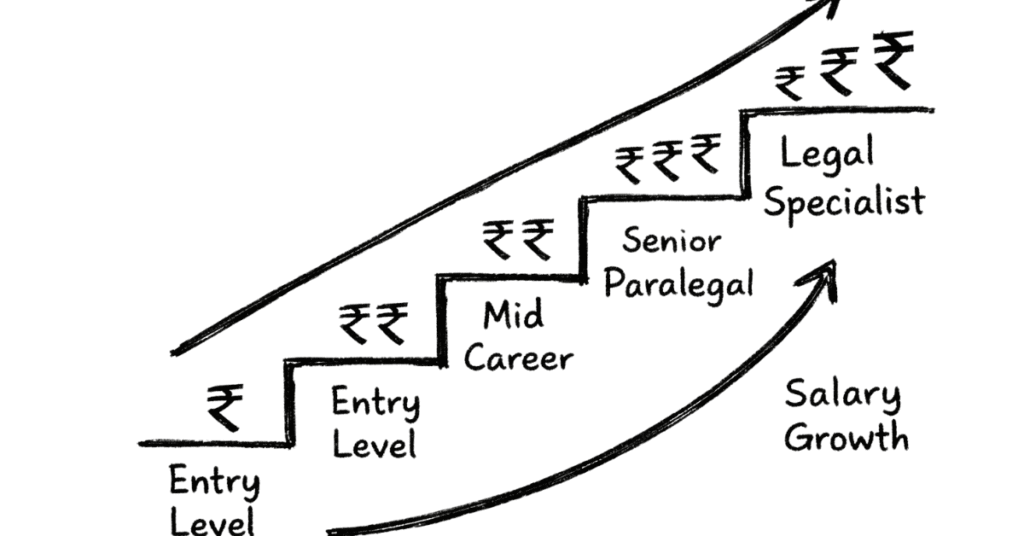
Starting salaries for paralegals in India typically range from ₹2-4 lakhs annually. This translates to roughly ₹16,000-33,000 per month. While modest compared to some professions, these salaries provide decent starting points, especially considering you can enter paralegal work without a law degree.thelegalschool
Several factors influence entry-level pay:
Location significantly impacts earnings: Paralegals in Mumbai, Delhi, Bangalore, and other metros earn 30-50% more than those in smaller cities. Mumbai paralegals average ₹10.7 lakhs annually across all experience levels, indicating higher starting salaries than national averages.erieri
Employer type matters: Large law firms and corporate legal departments typically pay better than small practices or NGOs. However, smaller organizations often provide broader learning opportunities since you’ll handle more diverse tasks.
Educational credentials influence starting pay: Paralegals with law degrees or recognized certification programs often negotiate higher starting salaries than those with only general bachelor’s degrees.thelegalschool
Specialization commands premiums: Entry-level paralegals with specialized skills—intellectual property research, corporate compliance knowledge, or real estate documentation experience—can earn above-average starting salaries.
Mid-Career Earnings (3-7 Years)
With 3-5 years of experience, paralegal salaries increase substantially to ₹4.5-7 lakhs annually. At this stage, you’ve developed expertise in specific practice areas, work with minimal supervision, and might train junior paralegals.thelegalschool
Average paralegal compensation across experience levels reaches ₹16.7 lakhs according to some sources, though this likely reflects senior and specialized roles. More typically, mid-career paralegals in general practice earn ₹5-8 lakhs annually.6figr+1
Factors boosting mid-career salaries:
Specialization: Paralegals who specialize in high-demand areas like intellectual property, corporate transactions, or international legal work earn premium salaries. Specialized knowledge makes you harder to replace.
Additional responsibilities: Mid-career paralegals often take on supervisory duties—training new staff, managing case workflows, or coordinating with external parties. These expanded responsibilities justify higher compensation.
Certifications: Pursuing additional certifications during your career demonstrates commitment to professional development and often leads to raises or promotions.ialm+1
Switching employers: Moving to larger firms or corporate legal departments typically provides significant salary bumps. Your experience makes you attractive to better-paying employers.
Senior-Level Compensation (8+ Years)
Experienced paralegals with 8+ years can earn ₹8-12 lakhs or more annually. Some senior paralegals in premium positions earn even higher amounts—particularly those working for top law firms, multinational corporations, or in specialized practice areas.salary+1
In Mumbai, for instance, experienced paralegals earn between ₹6.7-11.6 lakhs, with some reaching ₹10.7 lakhs average. Senior paralegals in Indore earn around ₹9 lakhs according to some surveys.salary+1
Premium-paying roles:
Legal Research Specialists: Senior paralegals who become research experts command higher salaries because of their specialized knowledge and efficiency in handling complex research projects.
Litigation Support Managers: Managing all paralegal and support functions for large litigation matters—coordinating document review, evidence organization, and court filings—pays well due to high responsibility levels.
Compliance Paralegals: Paralegals working in corporate compliance departments, especially in regulated industries like banking or pharmaceuticals, often earn more than general practice paralegals.
International Legal Support: Paralegals who work on international matters or support foreign lawyers practicing in India earn premiums because of their specialized knowledge and often unconventional working hours.
Additional Compensation
Beyond base salary, many paralegal positions include:
- Performance bonuses: 10-20% of annual salary based on work quality and firm profitability
- Health insurance: Medical coverage for you and sometimes family members
- Professional development: Employers funding certification courses, workshops, or conference attendance
Flexible work options: Some firms now offer remote or hybrid work, particularly valuable in major cities with long commutes
Where Paralegals Work
Law Firms
Large Full-Service Firms: Major law firms employ teams of paralegals supporting various practice groups. These firms offer structured training, exposure to sophisticated legal work, and career progression paths from junior paralegal to senior research specialist. The work environment is professional but demanding, with tight deadlines and high expectations.careers360
Boutique and Specialized Firms: Smaller firms focusing on specific practice areas—intellectual property, tax, or corporate law—offer opportunities to develop deep expertise quickly. You’ll work closely with lawyers and gain broader exposure than you might in a large firm’s highly specialized role.
Litigation Practices: Firms handling court cases need paralegals skilled in case law research, evidence organization, and court procedures. Litigation work can be unpredictable—court date changes and urgent motions frequently disrupt planned schedules—but offers the satisfaction of supporting important legal battles.
Corporate Legal Departments
Companies across industries maintain in-house legal teams that employ paralegals. Corporate paralegal roles typically offer better work-life balance than law firms, with regular hours and more predictable workloads. You’ll handle contract management, regulatory compliance documentation, corporate governance paperwork, and vendor legal coordination.careers360
Technology Companies: Tech firms need paralegals familiar with intellectual property, data privacy, and technology contracts. These roles might involve managing patent portfolios, tracking trademark registrations, or supporting compliance with data protection regulations.
Banks and Financial Institutions: Financial services companies employ paralegals for loan documentation, regulatory compliance, and internal investigations. These roles require understanding financial regulations and banking operations.careers360
Manufacturing and Industrial Companies: Paralegals in manufacturing handle diverse matters—supplier contracts, employment issues, environmental compliance, and intellectual property protection.
Government and Public Sector
Government legal departments, public sector undertakings, and regulatory bodies hire paralegals for legal research, documentation, and administrative support. These positions offer job security and regular working hours, though salaries may be lower than private sector roles. Benefits like pension plans often compensate for lower base pay.careers360
Non-Profit Organizations and Legal Aid
NGOs providing legal services to marginalized communities employ paralegals who conduct community outreach, provide legal literacy education, assist in dispute resolution, and support lawyers serving underprivileged clients. These roles offer profound satisfaction from helping people who lack access to justice, though salaries are typically lower than commercial practice.careers360+1
Required skills for legal aid work: Cultural sensitivity, empathy, community engagement abilities, and commitment to social justice. You’ll work with diverse populations facing various legal challenges—land disputes, domestic violence, consumer fraud, or government benefit issues.scribd
Legal Process Outsourcing (LPO) Companies
LPO firms provide legal services to foreign clients, primarily from the US and UK. These companies need paralegals for document review, legal research using international law, and contract analysis. LPO work offers exposure to international legal practices and often pays competitively. However, the work can be repetitive and may require night shifts to match client time zones.careers360
Real Estate and Banking Firms
Property transactions and financial services generate substantial legal work. Real estate firms need paralegals for title searches, document preparation, and registration support. Banks require documentation specialists for loan processing and security creation.careers360
Courts and Judicial Offices
Court registries and judicial offices sometimes employ paralegals for case management, legal research supporting judges, and administrative functions. These positions provide unique insights into judicial functioning and offer stable employment.
Career Progression and Growth
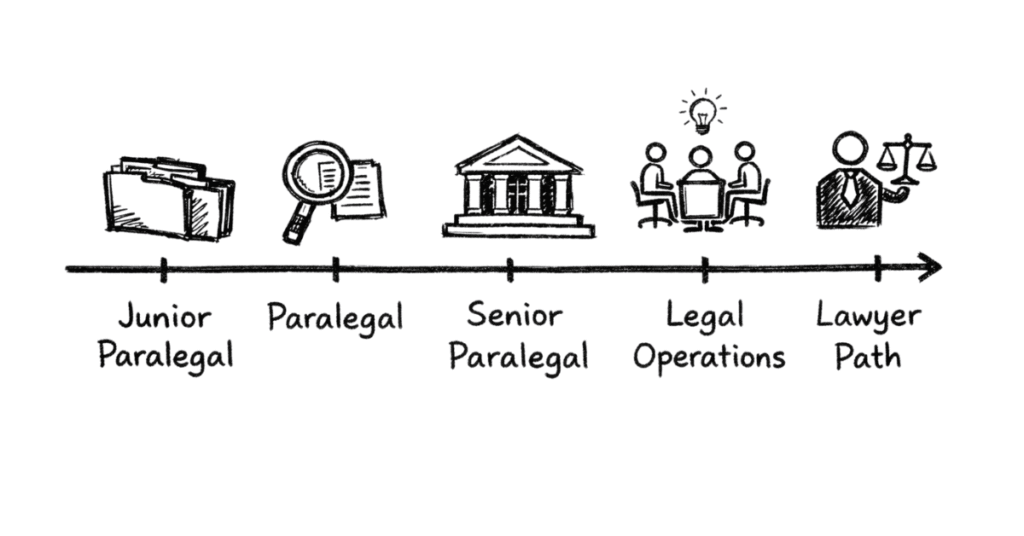
Entry Level: Junior Paralegal (0-2 Years)
You start by learning the basics—familiarizing yourself with your employer’s work, mastering their systems, and handling straightforward tasks under close supervision. Initial responsibilities include basic research, simple document drafting, file organization, and administrative support. This foundational phase is about building competence and reliability.thelegalschool
Focus during this stage:
- Learn internal systems and procedures thoroughly
- Develop strong relationships with lawyers you support
- Ask questions and seek feedback on your work
- Build fundamental skills through repetition
- Demonstrate reliability and attention to detail
Mid-Career: Paralegal / Legal Assistant (3-6 Years)
With several years’ experience, you work more independently and handle complex matters. You might specialize in particular practice areas—becoming the go-to person for intellectual property research or corporate documentation. Lawyers trust you to complete work with minimal supervision.thelegalschool
Focus during this stage:
- Develop specialization in high-value practice areas
- Take initiative on process improvements
- Begin mentoring junior paralegals
- Pursue relevant certifications to deepen expertiseialm+1
- Build professional network beyond your current employer
Senior Level: Senior Paralegal / Legal Specialist (7+ Years)
Senior paralegals often manage other paralegals, coordinate complex projects, and serve as subject matter experts. You might lead litigation support for major cases, manage document review teams, or oversee all paralegal functions for a legal department.thelegalschool
Focus during this stage:
- Develop management and leadership skills
- Build strategic thinking abilities
- Consider specialization shifts or additional qualifications
- Network with senior legal professionals
- Explore whether transitioning to other legal roles interests you
Alternative Career Paths
Transition to Lawyer: Many paralegals pursue LLB degrees while working, eventually becoming practicing lawyers. Your paralegal experience provides tremendous advantages in legal practice since you already understand practical legal work.thelegalschool
Legal Operations Management: Some senior paralegals move into legal operations roles, managing legal department efficiency, technology implementation, and vendor relationships rather than substantive legal work.
Compliance Roles: Paralegal experience translates well to compliance positions, especially in industries where you’ve developed expertise.
Legal Training and Education: Experienced paralegals sometimes transition into teaching paralegal courses or providing training for law firms and companies.
Legal Technology: Paralegals who develop strong technology skills might move into legal tech companies, working on products like case management software, legal research platforms, or document automation tools.
Challenges in Paralegal Careers
For Recent Graduates
Step 1: Choose Your Industry Focus Early
During your education, start narrowing down which industries interest you. Banking compliance differs dramatically from pharmaceutical compliance. Your choice affects which regulations you’ll learn, which certifications matter, and what daily work looks like. Consider:
- What subjects interest you? (Finance students naturally fit banking compliance)
- Which industries are growing? (Fintech, healthcare, and tech have strong demand)
- Where do your values align? (Some people love financial regulations; others prefer environmental compliance)
Step 2: Gain Relevant Internships
Practical experience separates competitive candidates from others. Seek internships with:
- Compliance departments in companies within your target industry
- Risk consulting firms that offer compliance services
- Regulatory bodies to understand the regulator’s perspective
- Legal firms with strong regulatory practices
Even a 2-3 month internship teaches you more about daily compliance work than any textbook.
Step 3: Build Foundational Knowledge
Start learning relevant regulations while still in college:
- Read regulatory circulars and guidelines (RBI circulars are publicly available)
- Follow compliance thought leaders on LinkedIn
- Join professional associations offering student memberships
- Take online courses covering your industry’s key regulations
Step 4: Develop Technical Skills
Learn tools commonly used in compliance:
- Advanced Excel for data analysis and reporting
- Compliance management software (research what your target industry uses)
- Basic data analysis tools
- Legal research databases
Step 5: Network Strategically
Compliance is a relationship-driven field. Start building connections:
- Attend compliance conferences and seminars
- Join LinkedIn groups focused on compliance in your target industry
- Connect with compliance professionals and request informational interviews
- Participate in compliance-related webinars and ask thoughtful questions
For Career Changers
Leverage Transferable Skills:
Many professionals successfully transition into compliance from other fields:
- Auditors already understand risk assessment and documentation
- Legal professionals bring regulatory interpretation skills
- Finance professionals understand financial regulations and risk
- Operations managers know how to implement processes across organizations
- IT professionals transition into technology compliance or data privacy roles
Start with Related Roles:
You might not jump directly into a senior compliance position. Consider entry points like:
- Compliance analyst roles in your current industry
- Internal audit positions with compliance components
- Risk management roles that include compliance aspects
- Legal assistant positions in compliance-heavy practices
Pursue Relevant Certifications:
Certifications help bridge experience gaps. A career changer with a strong CCEP certification demonstrates commitment and knowledge that compensates for limited direct experience.corporatecompliance+1
Highlight Relevant Experience:
In your resume and interviews, emphasize experiences that translate to compliance:
- Process improvement projects (show systematic thinking)
- Training you’ve delivered (compliance requires constant training)
- Policy development work (directly relevant)
- Audit or quality control experience (similar skill sets)
- Cross-functional project management (compliance requires working across silos)
Building Your Paralegal Career: Practical Steps
Step 1: Assess Your Fit for Paralegal Work
Be honest about whether this career matches your personality and preferences:
You’ll likely enjoy paralegal work if you:
- Like supporting others’ success rather than needing personal spotlight
- Enjoy research and discovering information
- Appreciate detailed, organized work
- Find legal topics intellectually interesting
- Want to work in law without committing to law school
- Value steady employment over entrepreneurial ventures
You might struggle if you:
- Need constant recognition and credit
- Dislike detailed documentation and filing
- Prefer creative work with few constraints
- Want to make final decisions rather than support decision-makers
- Expect immediate high earnings
- Strongly desire courtroom advocacy or client advisory roles
Step 2: Get Relevant Education
If you’re still in college, any bachelor’s degree works, though law, commerce, or liberal arts provide good foundations. After graduation, pursue paralegal certification from reputable programs.ialm+2
If you’ve already graduated without legal training, enroll in paralegal certification courses that provide practical skills. These programs typically last 3-12 months and significantly improve your job prospects.ialm+1
Step 3: Gain Practical Experience
Theoretical knowledge isn’t enough. Seek internships or volunteer positions that provide hands-on experience:thelegalschool
- Contact law firms asking about paralegal internships
- Volunteer with legal aid NGOs serving underprivileged communitiesscribd
- Offer to assist practicing lawyers with research or documentation
- Take on pro bono projects through legal clinics
Even unpaid initial experience builds your resume and teaches practical skills that employers value.
Step 4: Develop Technical Skills
Master tools commonly used in legal practice:
- Practice using legal databases—many offer free limited access for learning
- Develop advanced Microsoft Office skills, especially Word and Excel
- Learn about e-filing systems used in Indian courts
- Build research skills using free resources like Indian Kanoon
Step 5: Create a Strong Resume
Your paralegal resume should emphasize:
- Relevant education and certificationsialm+1
- Practical experience, including internships and volunteer work
- Specific skills—legal research, document drafting, case management
- Technical proficiencies—databases and software you’ve used
- Concrete examples of work you’ve completed
Step 6: Network and Apply Strategically
Many paralegal positions aren’t advertised widely. Build connections through:
- LinkedIn networking with legal professionals
- Attending legal conferences and seminars
- Joining paralegal professional associations
- Reaching out to law school alumni working in firms
- Directly contacting law firms and legal departments expressing interest
Apply to positions matching your skills, even if they seem competitive. Emphasize your practical abilities and willingness to learn.
Step 7: Prepare for Interviews
Paralegal interviews typically assess:
- Technical knowledge: Basic legal concepts and procedural understanding
- Practical skills: You might receive sample research problems or drafting tests
- Software proficiency: Demonstrating comfort with Microsoft Office and legal databases
- Organizational abilities: How you’d manage multiple competing deadlines
- Communication skills: Explaining complex information clearly
- Cultural fit: Whether your work style matches the firm’s environment
Prepare examples demonstrating these competencies from your education, internships, or volunteer work.
Is Paralegal Work Right for You?
The Honest Reality
Paralegal careers offer genuine advantages: accessible entry without law degrees, steady employment, intellectual engagement, and opportunities to contribute meaningfully to legal outcomes. You’ll constantly learn because every case or matter presents new challenges. The work provides structure and clear career progression, with salaries improving substantially as you gain experience.erieri+3
However, paralegal work isn’t glamorous. You won’t argue in courtrooms or advise clients on legal strategy. Much of your work happens behind the scenes—in legal databases, document files, and case management systems. Recognition comes less frequently than it might in more visible roles. Career advancement eventually plateaus without additional qualifications like law degrees.thelegalschool
The work demands meticulous attention to detail, strong organizational discipline, and comfort with routine alongside variety. You’ll support others’ success rather than claiming spotlight yourself. For some people, this feels limiting. For others—those who enjoy creating order from complexity, who find satisfaction in excellent support work, and who appreciate legal work without wanting full lawyer responsibilities—paralegal careers provide fulfilling, stable paths.
Making the Decision
Consider paralegal work if you:
- Find legal topics genuinely interesting
- Excel at detailed, organized work
- Enjoy research and information discovery
- Want legal career exposure quickly without long law school commitment
- Appreciate supporting professionals in high-stakes work
- Value work-life balance over maximum earning potential
- Like learning continuously about diverse topics
Paralegal work offers a solid foundation in legal practice. Many paralegals eventually pursue law degrees with tremendous advantages—they already understand practical legal work, making law school concepts more meaningful. Others build long, satisfying careers as specialized paralegal professionals, becoming indispensable experts in their practice areas.thelegalschool
The profession is growing as legal practices recognize the efficiency and cost savings skilled paralegals provide. If helping lawyers achieve better outcomes for clients, working with interesting legal problems, and building a stable career in law appeals to you, paralegal work deserves serious consideration.