
Climate Specialist Career: How to Become a Climate Change Analyst
Table of Contents
Introduction
Climate change is no longer just a topic in news debates or school textbooks. Companies, governments, and even investors now ask a serious question: “How will climate change affect our plans, profits, and people?” That is where climate specialists and climate change analysts come in. They help organizations understand climate risks, cut emissions, and move towards net-zero targets.
This guide explains, in simple language, what a climate specialist does, how to become one, what to study, what skills you need, and what kind of salary you can expect.
Who Is a Climate Specialist?
A climate specialist (or climate change analyst) is a professional who focuses on:
- Measuring and understanding greenhouse gas (GHG) emissions.
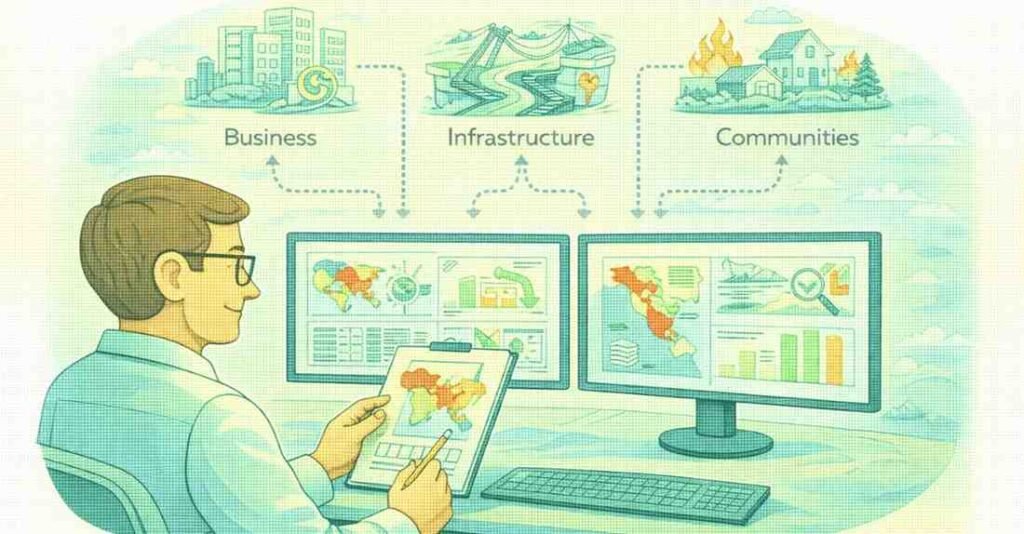
- Studying how climate change affects businesses, infrastructure, and communities.
- Helping organizations plan for mitigation (reducing emissions) and adaptation (preparing for climate impacts).
In simple words, a climate specialist answers questions like:
- “How much are we contributing to climate change?”
- “What will happen to our operations if rainfall patterns change or heatwaves increase?”
- “What should we do now to avoid bigger problems later?”
Climate roles sit at the crossroads of environment, data, policy, and business.
What Does a Climate Change Analyst Do?
Exact responsibilities vary by organization, but common tasks include:
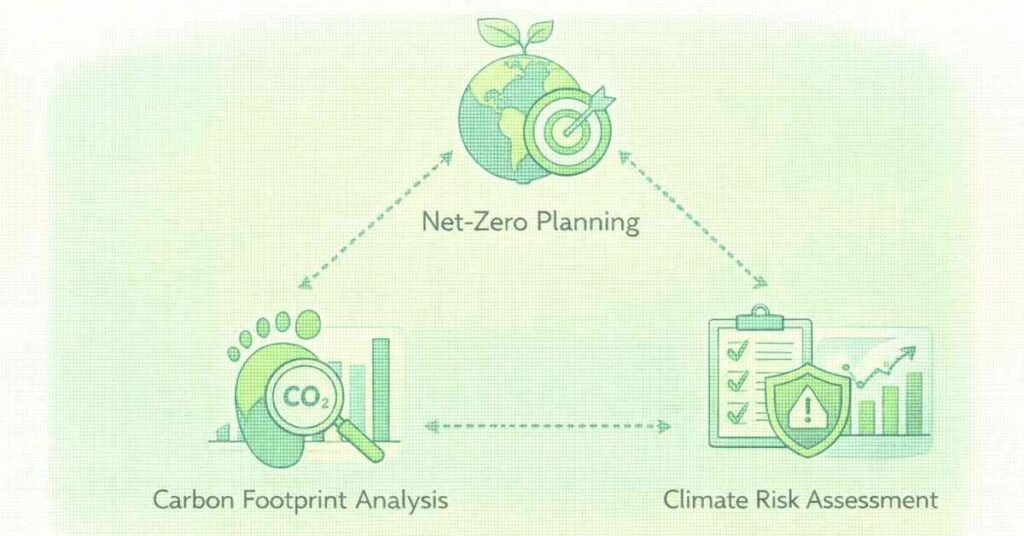
1. Carbon Footprint and Emissions Analysis
- Calculate an organization’s greenhouse gas emissions from fuel use, electricity, travel, supply chains, and more.
- Classify emissions into Scope 1, Scope 2, and Scope 3 based on widely used GHG accounting standards.
- Prepare carbon footprint reports and dashboards for internal and external stakeholders.
2. Net-Zero and Decarbonization Planning
- Help set emission reduction targets (for example, 50% reduction by 2030).
- Identify practical actions: switching to renewable energy, improving energy efficiency, changing fuels, optimizing logistics, etc.
Estimate how much each measure can cut emissions and what it might cost.
3. Climate Risk and Vulnerability Assessment
- Study how climate hazards like floods, heatwaves, droughts, or storms could affect operations, assets, or supply chains.
- Work with risk, finance, and operations teams to understand vulnerabilities.
Support adaptation plans—such as designing climate-resilient infrastructure or diversifying suppliers.
4. Climate Reporting and Disclosures
- Support climate-related disclosures for frameworks like TCFD or similar reporting requirements.
- Prepare information for investors, regulators, and sustainability reports.
Ensure climate data is consistent, transparent, and aligned with regulations and best practices.
5. Policy and Market Tracking
- Keep track of national and global climate policies, carbon pricing mechanisms, and industry trends.
- Translate these developments into business implications for the organization.
Much of the work involves analysis, coordination, and communication rather than heavy fieldwork.
Where Do Climate Specialists Work?
Climate-related roles exist across multiple sectors, not just in NGOs:
- Consulting firms – climate and sustainability advisory; helping clients with carbon accounting, climate risk, and net-zero strategies.
- Large corporates – climate or sustainability teams inside companies in sectors like energy, manufacturing, IT, finance, and FMCG.
- Financial institutions – banks, investors, and insurance companies assessing climate risks in their portfolios.
- International organizations and NGOs – working on climate policy, adaptation projects, or community-based climate resilience.
- Government agencies – departments focused on environment, energy, urban development, and climate missions.
This diversity means you can eventually choose between more technical, business-oriented, or policy-oriented roles based on your interest.

Key Skills Required for Climate Specialist Roles
You don’t need to be a climate scientist with a PhD, but you do need solid foundational skills in environment, data, and communication.
Technical Skills
- Climate and GHG Basics
- Understanding greenhouse gases, global warming, and basic climate science.
- Familiarity with concepts like carbon budget, net-zero, and climate scenarios.
- Understanding greenhouse gases, global warming, and basic climate science.
- Carbon Accounting & GHG Protocol
- Learning how to calculate emissions from fuel, electricity, travel, etc.
- Knowing the difference between Scope 1, 2, and 3 emissions.
- Using emission factors and standard calculation methods.
- Learning how to calculate emissions from fuel, electricity, travel, etc.
- Data Analysis and Excel
- Working comfortably with spreadsheets and large datasets.
- Using formulas, pivot tables, and charts to make sense of climate and energy data.
- Working comfortably with spreadsheets and large datasets.
- Energy and Process Understanding
- Basic awareness of how energy is used in buildings, factories, and transport.
- Ability to identify where energy savings and emission reductions are possible.
- Basic awareness of how energy is used in buildings, factories, and transport.
- Reporting and Documentation
- Writing clear, structured climate sections for sustainability reports or internal documents.
- Presenting technical findings in a way that managers and non-technical people can understand.
- Writing clear, structured climate sections for sustainability reports or internal documents.
- Optional but Valuable: Tools & Modeling
- Familiarity with simple scenario analysis and climate tools.
- Basic use of visualization tools or BI dashboards for presenting climate data.
- Familiarity with simple scenario analysis and climate tools.
Soft Skills
- Analytical Thinking
- Breaking down complex problems into smaller parts.
- Linking data, risks, and solutions in a logical way.
- Breaking down complex problems into smaller parts.
- Communication Skills
- Explaining technical concepts like “Scope 3 emissions” in simple terms.
- Presenting climate risks and solutions clearly to management, clients, or partners.
- Explaining technical concepts like “Scope 3 emissions” in simple terms.
- Collaboration
- Working with finance, operations, engineering, and sustainability teams.
- Coordinating information from multiple departments.
- Working with finance, operations, engineering, and sustainability teams.
- Curiosity and Continuous Learning
- Climate science and policies are evolving; you must stay updated.
- Willingness to learn new tools, frameworks, and best practices over time.
- Climate science and policies are evolving; you must stay updated.
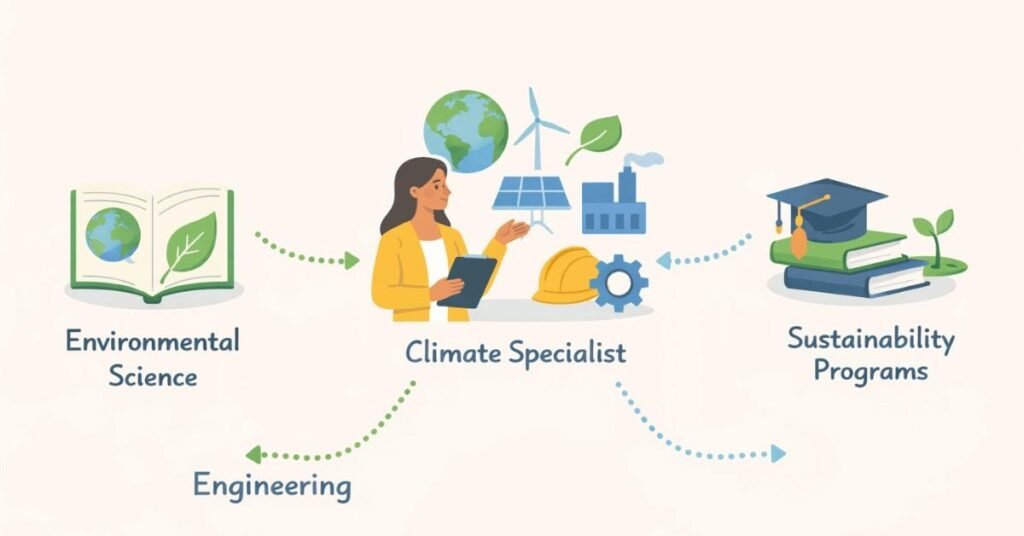
Educational Path to Become a Climate Specialist
There is more than one path. The best combination is usually environment/engineering basics + climate/sustainability specialization + data comfort.
After Class 12
Good undergraduate options include:
- BSc Environmental Science
- BSc in Climate Science / Earth Science / Geography (where available)
- BTech/BE in Environmental Engineering, Energy Engineering, Civil, Chemical, or Mechanical with interest in sustainability
- BSc Physics or related with a plan to shift into energy/climate later
If these are not available, any science or engineering degree can still work if you actively build climate knowledge alongside.
After Graduation
You can go two ways:
Option 1: Master’s Focused on Climate/Energy
- MSc in Climate Change, Environmental Science with climate focus, Environmental Management, or Energy & Environment.
- MTech in Environmental Engineering, Energy Engineering, or related.
Option 2: Sustainability / Business Route
- MBA or PG programs in Sustainability, ESG, or Energy Management where climate is a major component.
Short specialized climate courses and diplomas are also useful for working professionals who want to shift from a general environmental or energy role into climate-specific work.
Useful Certifications and Courses
“Hi, I’m [Name], a [specific role] with [X] years of experience in [technology stack/domain]. I specialize in [2-3 core technical competencies]. At [current/previous company], I [specific achievement with metrics rel
While not mandatory, certain types of programs can give you structure and credibility:
- Certifications in carbon accounting or GHG inventory management.
- Short courses on climate change and health, climate policy, or climate finance from reputed institutions.
- Online courses on climate science, net-zero, and decarbonization strategies from recognized platforms.
Choose 1–2 strong programs rather than collecting many basic certificates.
ated to performance, scalability, or user impact]. I’m particularly skilled in [relevant technologies for this role] and excited about [specific aspect of the company’s technical challenges or products].”
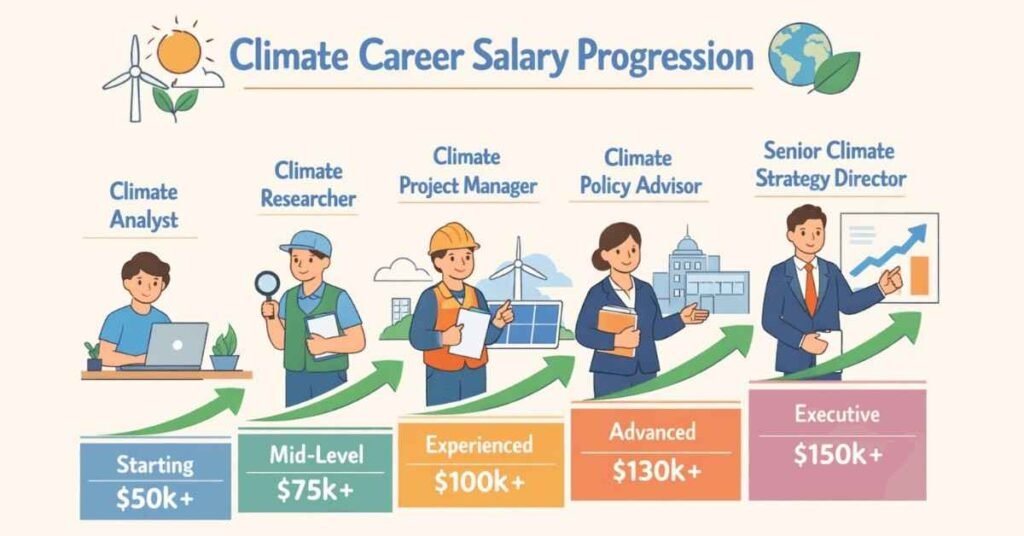
Climate Specialist Salary Expectations (India – Approximate)
Climate roles often pay better than many traditional environment-only roles, especially when linked with consulting or corporate strategy.
- Entry-Level Climate/Carbon Analyst (0–2 years):
Typically comparable to or slightly higher than general environmental analyst roles in large cities, with better upside in consulting and big corporates. - Mid-Level Climate Consultant / Specialist (3–6 years):
Salaries can move into higher double-digit ranges as you handle projects, clients, or internal climate strategies. - Senior Climate Strategy Roles (7+ years):
Compensation can rise significantly, especially in multinational firms, specialized climate consultancies, and finance-related climate risk teams.
Pay is influenced by:
- Type of employer (consulting and finance usually pay more than NGOs).
- Your degree and specialization.
Your combination of environmental, analytical, and business skills.
Step-by-Step Roadmap to Become a Climate Specialist
Step 1: Build Your Basics (School & Early College)
- Choose Science in 11th–12th if possible.
- Learn the fundamentals of climate change from reliable books, online courses, or lectures.
- Follow climate news—heatwaves, floods, IPCC reports, national climate policies—to understand real-world context.
Step 2: Pick a Climate-Friendly Degree
- At undergraduate level, choose a degree that gives you either:
- Strong environmental/climate foundation, or
- Strong technical/energy foundation.
- Strong environmental/climate foundation, or
- During your degree, take every chance to choose projects, seminars, or electives related to climate, energy, or emissions.
Step 3: Learn Carbon & Data Skills Early
- Practice basic carbon footprint calculations using simple case examples (like household or small office energy use).
- Strengthen your Excel and data handling skills.
- Learn how to read sustainability sections of annual reports.
Step 4: Do a Climate-Focused Internship
- Target internships with:
- Sustainability or climate teams in companies.
- Consulting firms with climate or energy efficiency projects.
- NGOs or think tanks working on climate policy, adaptation, or renewable energy.
- Sustainability or climate teams in companies.
- Even if your work is support-level, focus on learning real methodologies and tools.
Step 5: Specialize via Higher Studies or Professional Courses
- Decide if you want to:
- Go for a Master’s (MSc/MTech) directly in climate/energy/sustainability, or
- Work for a few years and then pursue a PG/Executive program in climate or sustainability.
- Go for a Master’s (MSc/MTech) directly in climate/energy/sustainability, or
- Add at least one credible certification in climate or carbon accounting to formalize your skillset.
Step 6: Build a Climate Portfolio
- Create 2–3 mini case studies or projects such as:
- A basic carbon footprint estimate for a small business or campus (even as a hypothetical exercise).
- A short analysis of climate risks for a sector like agriculture, power, or real estate.
- A summary of a major climate policy and what it means for businesses.
- A basic carbon footprint estimate for a small business or campus (even as a hypothetical exercise).
- Document these in a clean PDF or slides; this becomes talking material in interviews.
Step 7: Apply to Climate Roles Strategically
Look for role titles such as:
- Climate Change Analyst
- Climate Specialist
- Carbon Analyst / GHG Analyst
- Net-Zero Consultant
- Decarbonization Analyst
- Energy & Climate Consultant
Customize your resume to highlight:
- Climate-relevant subjects and projects.
- Any carbon or energy analysis you have done.
- Tools: Excel, basic data analysis, reporting frameworks.
- Certifications or courses in climate or carbon accounting.
Common Interview Topics for Climate Specialist Roles
The Story Arc Method
Expect questions around:
- Climate Basics:
- What is climate change and how is it different from weather?
- What are greenhouse gases and which ones are most important?
- What is climate change and how is it different from weather?
- Emissions and Net-Zero:
- Explain Scope 1, 2, and 3 emissions in simple terms.
- What does “net-zero” mean for a company?
- Explain Scope 1, 2, and 3 emissions in simple terms.
- Practical Scenarios:
- How would you approach calculating emissions for a factory or office?
- What are 3 practical steps a company can take to reduce emissions?
- How would you approach calculating emissions for a factory or office?
- Risk & Adaptation:
- Give an example of a climate risk for a specific sector.
- How should companies prepare for increasing climate risks?
- Give an example of a climate risk for a specific sector.
- Your Motivation & Approach:
- Why are you interested in climate work?
- How do you stay updated on climate news and policies?
- Why are you interested in climate work?

Is a Climate Career Right for You?
Consider climate specialist roles if:
- You care deeply about climate change but also enjoy structured analysis and data.
- You want to work on real-world solutions—beyond just awareness or activism.
- You are comfortable with a role that mixes technical understanding, business impact, and communication.
- You want a future-proof career area that will only grow in importance over the next decades.
For environmental students, climate roles are a natural progression into higher-impact, higher-visibility work. For engineers and data-oriented students, climate roles allow you to use your technical brain for a meaningful cause.