
Environmental Services Career Guide: Your Complete Roadmap to a Green Future
Table of Contents
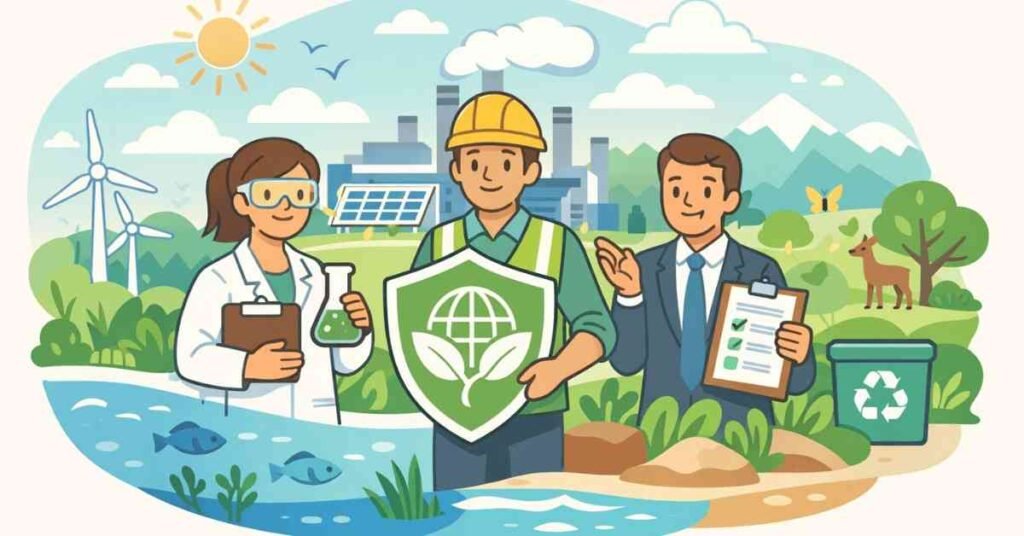
Think about the air you breathe, the water you drink, and the planet you live on. Someone has to protect all of that—and that someone could be you. Environmental services isn’t just a career; it’s about making a real difference while building a stable, rewarding profession.
India is experiencing a green revolution in the job market. Over the past three years, environmental job listings on platforms like LinkedIn and Indeed have doubled, creating thousands of opportunities for freshers and experienced professionals alike. Whether you’re a student figuring out your path or a professional looking to switch careers, this guide will walk you through everything you need to know about breaking into environmental services.
What Exactly Are Environmental Services?
Environmental services is a broad field focused on protecting our environment and human health. Professionals in this sector work on solving real-world problems like air pollution, water contamination, waste management, and climate change.
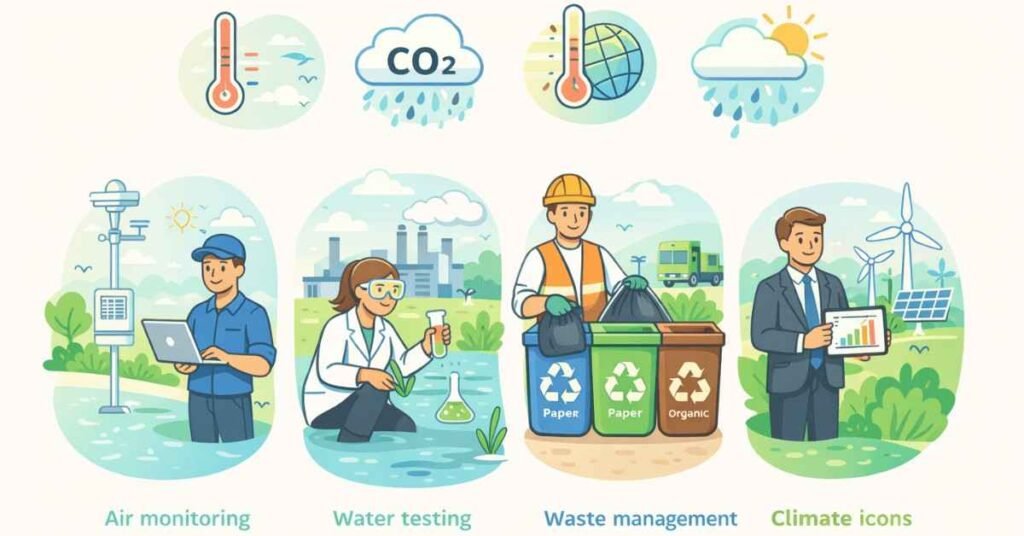
Unlike traditional careers that focus solely on profits, environmental services careers let you contribute to sustainability while earning a good living. You could be testing air quality at industrial sites, designing waste management systems for cities, advising companies on reducing their carbon footprint, or developing policies that shape India’s environmental future.
The field has grown rapidly because India’s strengthening environmental laws (like the Environment Protection Act 1986, Air and Water Acts, and CPCB guidelines) now require industries to stay compliant, reduce pollution, and meet sustainability targets. This creates consistent demand for trained professionals who understand both the science and the regulations.
Why Choose Environmental Services as Your Career?
Growing Job Market
The numbers tell a compelling story. Environmental job opportunities in India have surged dramatically, with employers actively seeking fresh talent. The U.S. Bureau of Labor Statistics projects 4% growth for environmental scientists and specialists through 2034, with approximately 8,500 new openings annually.
In India specifically, sectors like renewable energy, sustainability consulting, waste management, and environmental compliance are experiencing explosive growth. Companies like EY, Deloitte, and major corporations are expanding their Climate Change and Sustainability Services divisions, creating premium positions for qualified candidates.
Competitive Salaries
Let’s talk money—because passion alone doesn’t pay the bills. Entry-level positions in environmental services typically start between ₹3-8 lakhs annually in India. As you gain experience and specialize, sustainability professionals earn an average of ₹23.6 lakhs per year, with the top 10% earning over ₹40 lakhs annually.
The median salary for environmental scientists globally is approximately $80,060 (around ₹66 lakhs) annually, showing the international potential of these skills. Your earnings grow significantly as you move into senior roles like Environmental Manager, Sustainability Consultant, or Policy Analyst.
Diverse Career Paths
Environmental services isn’t a one-size-fits-all career. You can specialize based on your interests and strengths. Love working outdoors? Become a field technician or environmental scientist. Prefer data and analysis? Environmental data analysts are in high demand. Good with people and policy? Sustainability consultants and policy analysts are needed everywhere.
Job Security and Purpose
Here’s the reality: environmental problems aren’t going away anytime soon. Climate change, pollution, and resource depletion mean environmental professionals will always be needed. Plus, India’s commitment to achieving 50% renewable energy by 2030 and reducing carbon emissions creates long-term job security.
Beyond security, there’s deep satisfaction in knowing your work protects communities, preserves natural resources, and leaves the planet better for future generations.
Top Environmental Services Career Roles
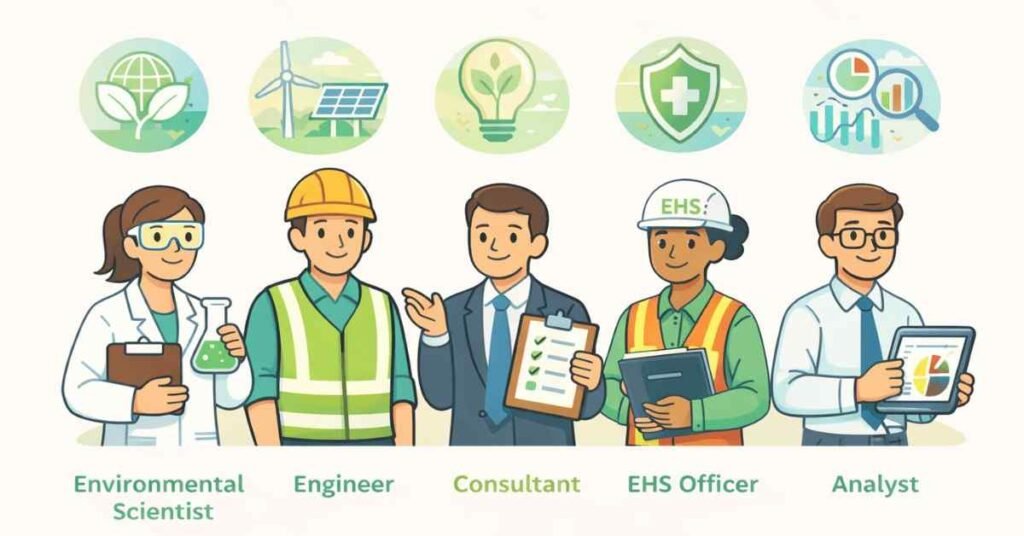
Below are some of the most common and in-demand roles in environmental services, explained in simple language so students and freshers can understand easily, along with typical work settings and focus areas.
1. Environmental Scientist
- Studies air, water, soil, and ecosystems to understand pollution and its impact.
- Collects samples in the field, runs tests in laboratories, and prepares reports for government, NGOs, or companies.
- Often works on issues like groundwater contamination, air quality around factories, or the impact of construction on local wildlife.
2. Environmental Engineer
- Designs solutions to environmental problems such as wastewater treatment systems, solid waste management, or air pollution control equipment.
- Works closely with industries, government bodies, and consultants to ensure facilities meet environmental standards and regulations.
- Involved in planning and implementing projects like sewage treatment plants, landfill sites, and pollution control systems.
3. Environmental Consultant / Sustainability Consultant
- Advises companies, real estate projects, and industries on how to reduce pollution, save energy, and comply with environmental laws.
- Prepares Environmental Impact Assessment (EIA) reports, sustainability strategies, and ESG (Environmental, Social, Governance) reports.
- Works either in consulting firms (like Big 4 and specialized sustainability firms) or as an independent expert.
4. Environmental Monitoring & Compliance Officer
- Monitors whether factories, construction sites, and other establishments follow environmental rules.
- Checks emissions, waste disposal, noise levels, and water discharge against legal limits set by pollution control boards.
- Prepares inspection reports and may coordinate with regulators for corrective actions.
5. Waste Management Specialist
- Focuses on how to collect, segregate, recycle, and dispose of solid, liquid, biomedical, or hazardous waste safely.
- Works with municipal bodies, hospitals, manufacturing units, and waste management companies.
- Designs systems to reduce waste generation and increase recycling and recovery.
6. Climate Change Analyst / Sustainability Analyst
- Studies climate data, greenhouse gas emissions, and the carbon footprint of organizations or projects.
- Helps companies plan climate strategies like net-zero targets, renewable energy transitions, and emission reduction plans.
- Works with large corporations, consulting firms, international organizations, and NGOs focused on climate action.
7. Environmental Health & Safety (EHS) Officer
- Ensures workplace safety along with environmental protection in industries like manufacturing, chemicals, oil and gas, and construction.
- Conducts safety training, hazard assessments, and emergency preparedness drills, and monitors waste and emissions.
- Bridges occupational safety and environmental compliance within the organization.
8. Wildlife & Conservation Officer
- Works on protecting forests, wildlife, and biodiversity through research, conservation projects, and community programs.
- Employed in forest departments, wildlife NGOs, conservation organizations, and research institutions.
- Involves fieldwork like tracking species, habitat restoration, and awareness campaigns in local communities.
9. Environmental Educator / Trainer
- Teaches students, employees, and communities about environmental issues and sustainable practices.
- Works in schools, colleges, training institutes, NGOs, or corporate CSR programs.
- Designs workshops, training modules, and awareness campaigns on topics like waste segregation, water conservation, and climate change.
10. Environmental Policy Analyst / Researcher
- Studies environmental laws, policies, and international agreements and analyzes their impact.
- Works with think tanks, government ministries, NGOs, or international bodies to design better policies and frameworks.
- Drafts policy briefs, research papers, and recommendations for lawmakers and decision-makers.
Education Pathways and Courses
Different roles need different levels of education. Below is a simplified roadmap for students in India and similar education systems.
After 10th Standard
- Choose Science stream (PCM or PCB) in 11th and 12th if you are serious about environmental science, engineering, or research-based roles.
- Focus on subjects like Biology, Chemistry, and Geography to build basic environmental understanding
After 12th Standard
You have several options:
- BSc Environmental Science
- Duration: 3 years.
- Ideal for careers in environmental science, monitoring, conservation, NGOs, and entry-level roles in environmental labs and consulting.
- Duration: 3 years.
- B.Tech / BE in Environmental Engineering, Civil Engineering, or Chemical Engineering (with environmental focus)
- Duration: 4 years.
- Suitable for engineering-heavy roles like environmental engineer, EHS roles, and infrastructure or industrial projects.
- Duration: 4 years.
- Related degrees
- BSc in Geology, Microbiology, Life Sciences, or Geography with later specialization in environment.
- Good for moving into environmental analysis, GIS, and research after postgraduation.
- BSc in Geology, Microbiology, Life Sciences, or Geography with later specialization in environment.
After Graduation (PG Options)
Technology and Software Development
If you want to move into higher-level roles, research, or consulting:
- MSc Environmental Science / Environmental Management / Environmental Studies
- Builds deeper knowledge of pollution control, environmental law, ecology, and climate change.
- Helpful for roles in policy, research, and senior technical positions.
- Builds deeper knowledge of pollution control, environmental law, ecology, and climate change.
- M.Tech Environmental Engineering / Environmental Management
- Best suited for those with a B.Tech/BE background.
- Leads to specialized engineering roles, high-level consulting, and infrastructure projects.
- Best suited for those with a B.Tech/BE background.
- MBA in Sustainability Management / Environmental Management
- Ideal for those interested in leadership, consulting, ESG, or corporate sustainability roles.
- Combines business with environmental strategy for roles in large corporations and consulting firms.
- Ideal for those interested in leadership, consulting, ESG, or corporate sustainability roles.
Essential Skills for Environmental Services
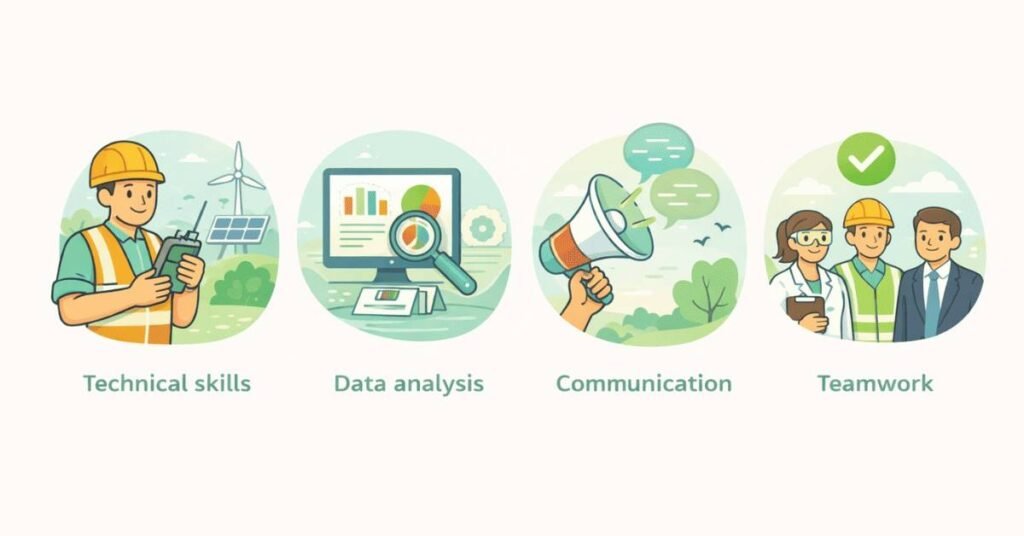
Employers look for a mix of technical and soft skills. Many of these can be built through coursework, internships, and self-learning.
Technical Skills
- Environmental laws and regulations
- Understanding national acts, pollution control norms, and compliance standards is critical for almost every role.
- Understanding national acts, pollution control norms, and compliance standards is critical for almost every role.
- Data collection and analysis
- Ability to collect samples, use field instruments, and analyze data using tools like Excel, GIS, or basic statistical software.
- Ability to collect samples, use field instruments, and analyze data using tools like Excel, GIS, or basic statistical software.
- Laboratory skills
- Testing water quality, air samples, and soil for contaminants using standard methods.
- Testing water quality, air samples, and soil for contaminants using standard methods.
- GIS and remote sensing (optional but powerful)
- Useful for mapping land use, forests, water bodies, and environmental changes over time.
- Useful for mapping land use, forests, water bodies, and environmental changes over time.
- Report writing and documentation
- Preparing clear, structured environmental reports, EIAs, and monitoring summaries.
Soft Skills
- Problem-solving mindset
- Environmental work often involves real-world problems that don’t have textbook answers, so creative thinking is valuable.
- Environmental work often involves real-world problems that don’t have textbook answers, so creative thinking is valuable.
- Communication skills
- You must explain technical findings to non-technical people like managers, government officials, or community members.
- You must explain technical findings to non-technical people like managers, government officials, or community members.
- Teamwork and collaboration
- Most projects involve teams of engineers, scientists, policy experts, and local stakeholders.
- Most projects involve teams of engineers, scientists, policy experts, and local stakeholders.
- Ethical and responsible attitude
- Environmental data and compliance reports affect public health and legal decisions, so integrity is non-negotiable.
Certifications That Boost Your Profile
While not always mandatory, certifications can help you stand out, especially for consulting and international roles.
- International certifications for environmental professionals (like those from NREP) are recognized in many countries and show your commitment to the field.
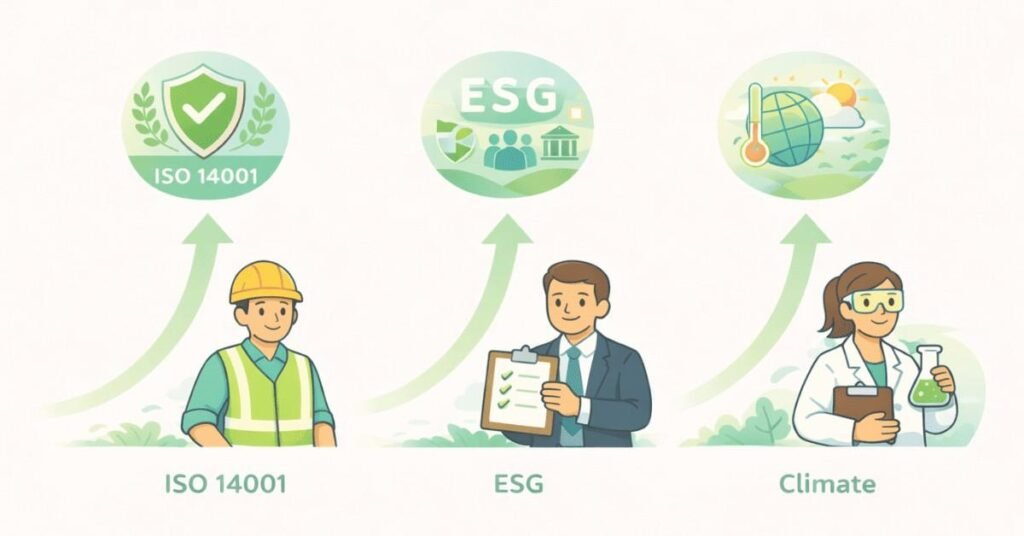
- Short courses and certifications in climate change, ESG, environmental management systems (ISO 14001), and sustainability reporting strengthen your CV for roles in corporate sustainability and consulting.
Step-by-Step Career Roadmap (Student to Professional)
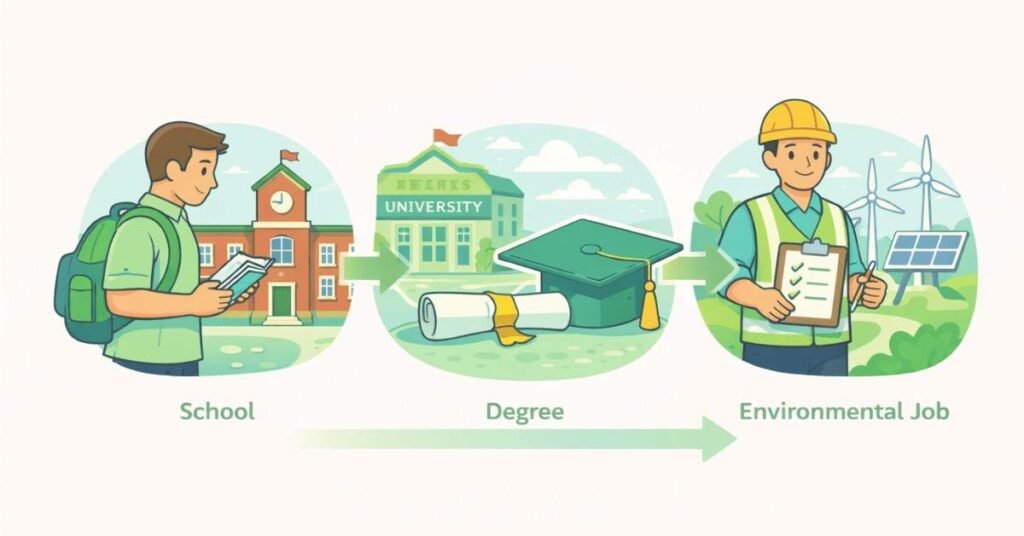
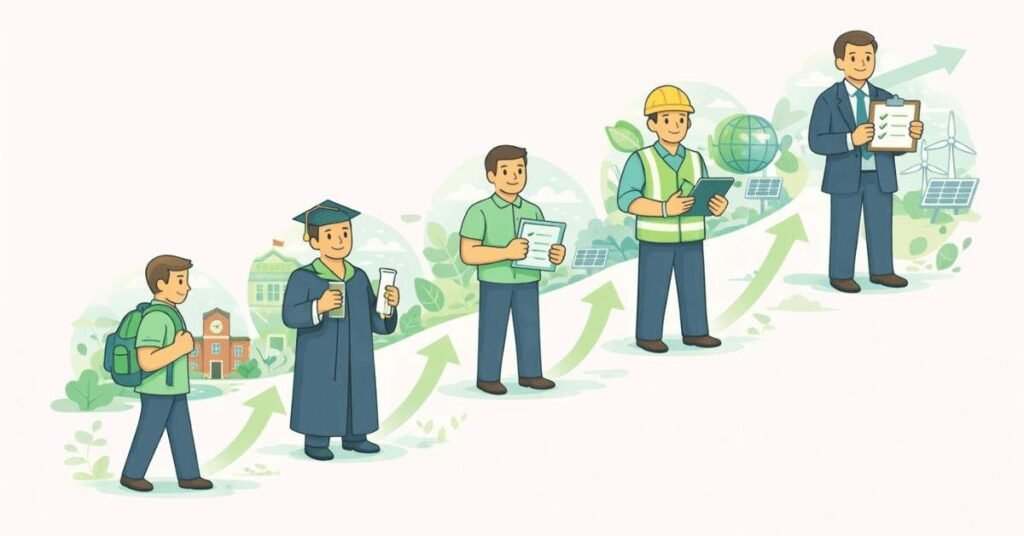
This section shows how a student can move from school to a stable career in environmental services, using simple, practical steps that work well for Indian and global contexts.
Stage 1: School Level (Classes 8–12)
- Build awareness: Start following environmental topics in the news—air pollution, climate change, water crises, waste problems, and government schemes.
- Subject choices: In 11th–12th, choose the Science stream (PCB/PCM) if you want to enter environmental science, engineering, or research roles.
- Competitions and clubs: Participate in eco-clubs, science fairs, and environment-themed competitions to gain early exposure and confidence.
Stage 2: Choosing the Right Degree (After 12th)
Pick a path based on your interest and strengths.
- If you like biology and fieldwork:
- Go for BSc Environmental Science, Life Sciences, Geology, or related courses.
- Go for BSc Environmental Science, Life Sciences, Geology, or related courses.
- If you like maths + engineering:
- Choose B.Tech/BE in Environmental Engineering, Civil Engineering, or Chemical Engineering with environmental electives.
- Choose B.Tech/BE in Environmental Engineering, Civil Engineering, or Chemical Engineering with environmental electives.
- If you like policy, management, and communication:
- Start with any related bachelor’s (science/engineering) and plan a master’s in Environmental Management, Sustainability, or an MBA in Sustainability later.
- Start with any related bachelor’s (science/engineering) and plan a master’s in Environmental Management, Sustainability, or an MBA in Sustainability later.
During your degree:
- Focus on scoring well in core subjects like ecology, pollution control, environmental chemistry, hydrology, and environmental law.
- Develop basic computer and data skills (Excel, PowerPoint, basic statistics), since almost all roles require reporting and analysis.
Stage 3: Internships and Practical Exposure
Hands-on experience is what separates a “graduate” from an “employable professional.”
- Where to look for internships:
- Environmental labs, environmental consultancy firms, NGOs, pollution control-related projects, corporate sustainability teams, and research institutes.
- Environmental labs, environmental consultancy firms, NGOs, pollution control-related projects, corporate sustainability teams, and research institutes.
- What you may do as an intern:
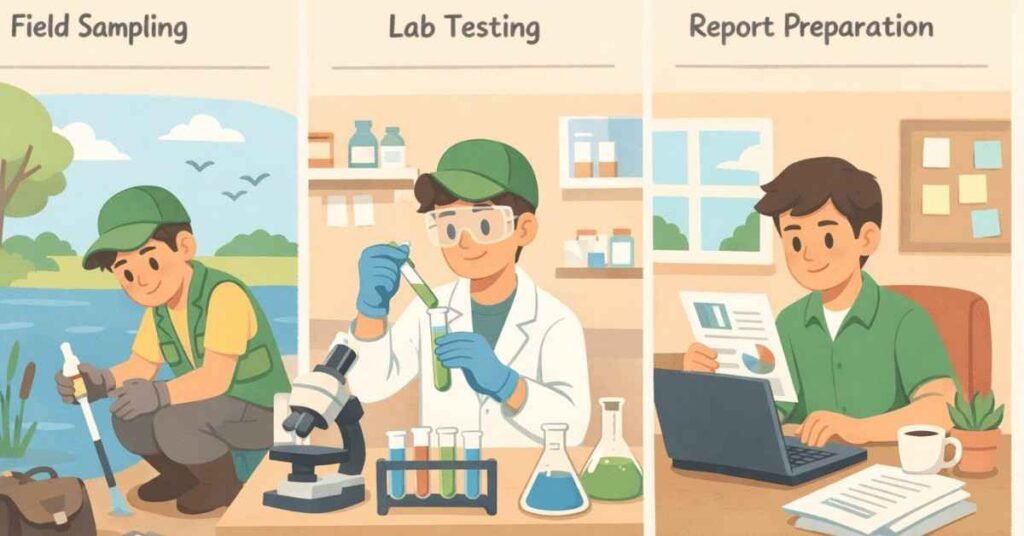
- Assist in data collection and sampling (air, water, soil).
- Do basic lab testing under supervision.
- Help in report preparation, documentation, or awareness campaigns.
- Assist in data collection and sampling (air, water, soil).
Aim for at least 1–2 internships during your graduation so your CV has real work exposure, not just academics.
Stage 4: Skill Building During College
Along with your degree, add skills that employers actively look for.
- Learn tools and techniques:
- Basic environmental monitoring methods (for water, air, soil).
- Basics of GIS and remote sensing if your college offers it.
- Exposure to ISO 14001 (Environmental Management Systems) and EHS practices is a plus.
- Basic environmental monitoring methods (for water, air, soil).
- Improve soft skills:
- Practice writing clear reports and presentation.
- Join group projects to improve teamwork and communication.
- Practice writing clear reports and presentation.
Stage 5: Higher Studies (Optional but Powerful)
For faster growth and specialized roles, a master’s degree can be very helpful.
- MSc Environmental Science / Environmental Management:
- Suited for research, consulting, policy, and advanced technical roles.
- Suited for research, consulting, policy, and advanced technical roles.
- M.Tech in Environmental Engineering:
- Ideal for design-heavy roles (treatment plants, pollution control systems, infrastructure projects).
- Ideal for design-heavy roles (treatment plants, pollution control systems, infrastructure projects).
- MBA in Sustainability / Environmental Management:
- Good for those targeting corporate sustainability, ESG consulting, or strategy roles in big firms.
ESG Analyst Salary in India (Realistic View)
Sample 4-Year Learning Plan (For a BSc Environmental Science Student)
This example gives a rough idea of how you can structure your growth from Year 1 to Year 4, including internships and skill-building.
Year 1
- Focus areas:
- Basics of ecology, environmental science, chemistry, and biology.
- Basics of ecology, environmental science, chemistry, and biology.
- Actions:
- Join college eco-club or environmental cell.
- Attend local seminars, webinars, and workshops on climate change and sustainability.
- Join college eco-club or environmental cell.
- Output:
- Build awareness, get comfortable with the subject, and start networking with faculty.
- Build awareness, get comfortable with the subject, and start networking with faculty.
Year 2
- Focus areas:
- Pollution, environmental laws, environmental impact, environmental management.
- Pollution, environmental laws, environmental impact, environmental management.
- Actions:
- Do your first internship (NGO, lab, college project, or local environmental initiative).
- Start learning basic data analysis and Excel.
- Do your first internship (NGO, lab, college project, or local environmental initiative).
- Output:
- One internship + a basic understanding of how environmental work happens in the real world.
- One internship + a basic understanding of how environmental work happens in the real world.
Year 3
- Focus areas:
- Special papers like climate change, waste management, water resource management, or conservation.
- Special papers like climate change, waste management, water resource management, or conservation.
- Actions:
- Do a more serious internship with a consultancy, industrial unit, or research organization.
- Work on a final-year project that can be showcased in your CV and interviews.
- Do a more serious internship with a consultancy, industrial unit, or research organization.
- Output:
- Real-world project experience and a clearer idea of your specialization.
- Real-world project experience and a clearer idea of your specialization.
Year 4 (If You Plan PG or Job Prep)
Some BSc programs may be 3 years; consider this as your “Year after Graduation” planning phase.
- If going for jobs:
- Apply to environmental labs, consultancies, NGOs, EHS roles in industry, or entry-level monitoring jobs.
- Prepare a CV that highlights projects, internships, and skills, not just marks.
- Apply to environmental labs, consultancies, NGOs, EHS roles in industry, or entry-level monitoring jobs.
- If going for higher studies:
- Prepare for entrance exams and shortlists for MSc/M.Tech/MBA programs in environment-related fields.
How to Get Internships and Build a Portfolio
A strong portfolio shows employers proof of your skills and interest.
Finding Internships
- Use online platforms:
- Job and internship portals often list openings for environmental interns, research assistants, and field assistants.
- Job and internship portals often list openings for environmental interns, research assistants, and field assistants.
- Direct outreach:
- Email local environmental NGOs, labs, consultancies, and college professors with a short and clear message explaining your interest and attaching your CV.
- Email local environmental NGOs, labs, consultancies, and college professors with a short and clear message explaining your interest and attaching your CV.
- College connections:
- Many colleges have MoUs or relationships with industries and NGOs; ask your department for leads.
What to Include in Your Portfolio
- Academic projects related to pollution studies, waste management, climate analysis, or biodiversity.
- Internship certificates, recommendation letters, and any small reports you were part of (without sharing confidential data).
- Participation in environment-related events, paper presentations, competitions, or awareness campaigns.
Cracking Interviews in Environmental Services
Freshers often worry about experience, but interviewers primarily look for clarity, basics, and attitude.
Day Before the Interview
- Understand the organization:
- Check if they focus on consulting, monitoring, waste management, conservation, research, or corporate sustainability.
- Check if they focus on consulting, monitoring, waste management, conservation, research, or corporate sustainability.
- Revise your basics:
- Be clear on topics like types of pollution, basic environmental laws, EIA concept, climate change, and common treatment methods.
- Be clear on topics like types of pollution, basic environmental laws, EIA concept, climate change, and common treatment methods.
- Prepare examples:
- Be ready to talk about a project or internship where you collected data, solved a problem, or worked with a team.
During the Interview
- Use simple, clear language to explain concepts instead of memorized jargon.
- Show that you are willing to learn and can adapt to fieldwork, lab work, or documentation as required.
- Ask thoughtful questions about the kind of projects, training, and growth opportunities offered by the organization.
Long-Term Growth and Future Scope
Environmental services as a field is expected to grow steadily because governments, companies, and international bodies are increasing their focus on climate action, pollution control, and sustainability.
- Career growth:
- With 3–5 years of experience and possibly a master’s, you can move into senior roles like Environmental Manager, Lead Consultant, Sustainability Manager, or Policy Specialist.
- With 3–5 years of experience and possibly a master’s, you can move into senior roles like Environmental Manager, Lead Consultant, Sustainability Manager, or Policy Specialist.
- Earning potential:
- Sustainability and environment-related roles at mid and senior levels in India can reach average packages of around ₹20–25 lakhs annually, with top roles going higher depending on skills and sector.
FAQs: Environmental Services Career (Student-Friendly)
1. Is environmental services a good career for the future?
Yes, environmental services is a strong long-term career because pollution, climate change, and resource scarcity are increasing, and governments and companies are under pressure to act more responsibly. Governments worldwide are tightening environmental regulations, and companies are investing in sustainability, which steadily increases demand for skilled professionals in this field. Many roles also allow you to work across sectors—industry, consulting, NGOs, research, and international organizations—giving flexibility and stability over time.
2. Can a non-engineering student build a career in environmental services?
Yes, you do not need to be an engineer to enter this field. Students with BSc degrees in Environmental Science, Life Sciences, Geology, Microbiology, or related subjects can work in environmental monitoring, conservation, consulting support, policy, and education roles. With a relevant master’s degree (like MSc Environmental Science or Environmental Management), non-engineers can move into higher-level positions in research, consulting, and policy-making as well.
3. Do I need a master’s degree to get a job?
A master’s is not compulsory for entry-level jobs, but it is very helpful for faster growth and specialized roles. Many entry-level positions in labs, monitoring, NGOs, and junior consultant roles accept candidates with a bachelor’s degree and some internship experience. However, roles in advanced consulting, policy, senior technical positions, and corporate sustainability often prefer or require a master’s like MSc, M.Tech, or MBA in Sustainability.
4. Will I earn well in environmental services?
At the beginning, salaries are modest to moderate, but they grow significantly with experience and specialization. Freshers in India often start around ₹3–8 lakhs per year depending on role, location, and employer type. As you gain 5–10 years of experience, move into sustainability, ESG, or senior environmental roles, average pay can rise to around ₹20–25 lakhs annually, with top professionals earning more in large corporates and consulting firms.
5. Is there a lot of fieldwork?
It depends on the role. Environmental scientists, monitoring officers, and conservation workers usually spend more time in the field collecting samples, doing surveys, or visiting sites. Consultants, analysts, and policy professionals often divide their time between office-based analysis, client meetings, and occasional site visits, so you can choose a path that suits your comfort level with fieldwork.
6. Can I work abroad with an environmental background from India?
Yes, environmental science and sustainability skills are globally relevant, especially if you have strong fundamentals and recognized certifications. Degrees in environmental science and engineering, when combined with international standards knowledge (like ISO 14001) and environmental professional certifications, can improve your chances of working with global organizations, NGOs, and multinational firms. English communication, report writing, and familiarity with global climate and ESG concepts also help if you plan to work overseas.
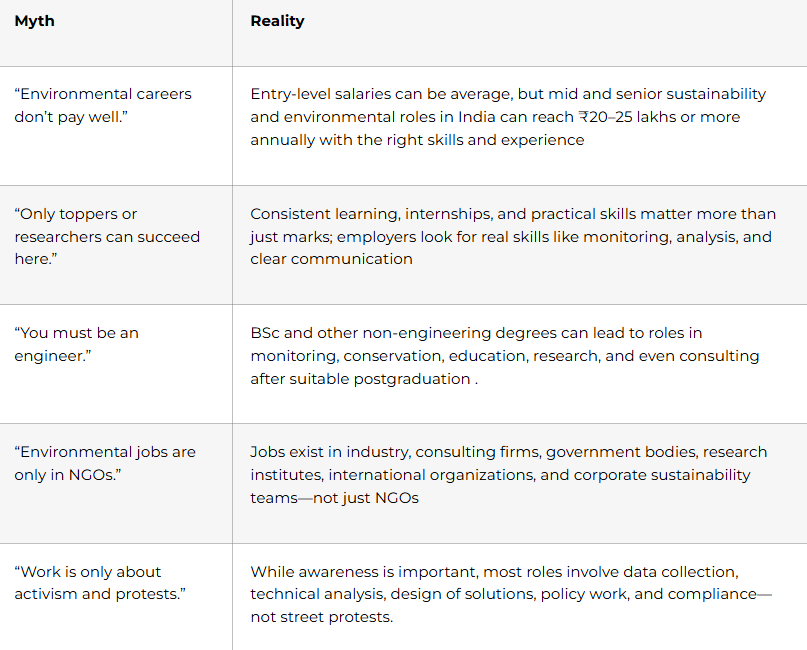
Common Myths vs Reality in Environmental Services
Getting Started Checklist (For Students and Freshers)
Use this as a simple, action-focused list you can follow step by step.
Step 1: Clarify Your Interest
- Decide whether you like science and fieldwork, engineering and design, or policy and management more. This will guide your choice of degree and specialization.
- Explore a few online videos or short courses on climate change, pollution, and sustainability to confirm your interest. Many platforms offer beginner-friendly introductions to environmental topics.
Step 2: Choose the Right Course
- If you are in school:
- Take Science in 11th–12th (PCM/PCB) if possible to keep maximum options open for environmental science and engineering later.
- If you are after 12th:
- Pick BSc Environmental Science or related subjects if you like scientific and field-based roles.
- Choose B.Tech/BE (Environmental/Civil/Chemical with environment focus) if you prefer technical design and engineering roles.
Step 3: Build Skills Early
- Learn basic data analysis tools like Excel, simple graphs, and charts to understand environmental data better.
- Improve English writing and presentation skills so you can prepare clear project reports and communicate findings effectively.
Step 4: Get at Least One Internship
- Look for internships with environmental labs, consultancies, NGOs, or college projects related to pollution, climate, or conservation.
- Treat the internship seriously: arrive on time, ask questions, and request feedback so you can understand what real work in this field looks like
Step 5: Create a Simple Portfolio
- Collect your project reports, small research tasks, presentations, and certificates in one digital folder that you can share when needed.
- Add a one-page CV summarizing your education, skills, internships, projects, and any environmental events you have participated in.
Step 6: Consider Certifications and Higher Studies
- After or during graduation, consider short certifications in environmental management systems, climate change, or sustainability to stand out in job applications.
- If you want leadership, consulting, or research roles, plan for an MSc, M.Tech, or MBA in a relevant environment-related specialization.
Detailed Career Path Based on Education Level
- This section covers actionable roadmaps for students at every education stage—from Class 10 to working professionals looking to switch careers into environmental services. Each path is designed to be practical and realistic for Indian and global contexts.
Path 1: After Class 10th
- If you are currently in Class 10 or have just completed it, this is the right time to think ahead and choose the correct stream.
Step 1: Choose the Right Stream in 11th-12th
- Science Stream (PCB – Physics, Chemistry, Biology):
- Best choice if you want to become an Environmental Scientist, Ecologist, Conservation Biologist, or work in environmental monitoring and research.
- Opens doors to BSc Environmental Science, Life Sciences, Microbiology, Botany, Zoology, and related degrees after 12th.
- Best choice if you want to become an Environmental Scientist, Ecologist, Conservation Biologist, or work in environmental monitoring and research.
- Science Stream (PCM – Physics, Chemistry, Mathematics):
- Ideal if you are interested in Environmental Engineering, designing pollution control systems, or technical roles in industries.
- Prepares you for B.Tech/BE in Environmental Engineering, Civil Engineering, or Chemical Engineering after 12th.
- Ideal if you are interested in Environmental Engineering, designing pollution control systems, or technical roles in industries.
- Science Stream (PCMB – Physics, Chemistry, Maths, Biology):
- If your school offers all four subjects, this gives you maximum flexibility to choose between environmental science and environmental engineering paths later.
- If your school offers all four subjects, this gives you maximum flexibility to choose between environmental science and environmental engineering paths later.
- Commerce or Arts Stream:
- Not common for environmental careers, but if you choose Arts and take Geography or Environmental Studies as electives, you can later pursue BA/BSc in Environmental Studies, Sustainable Development, or Urban Planning at the undergraduate level.
- After graduation, you can pursue master’s programs in Environmental Management or MBA in Sustainability to enter consulting, policy, or corporate sustainability roles
- Not common for environmental careers, but if you choose Arts and take Geography or Environmental Studies as electives, you can later pursue BA/BSc in Environmental Studies, Sustainable Development, or Urban Planning at the undergraduate level.
Step 2: Build Awareness Early
- Follow environmental topics in news and social media—climate change, air quality, plastic waste, water scarcity, wildlife conservation.
- Join your school’s eco-club or science club to participate in activities like tree planting, waste segregation drives, or awareness campaigns.
- Watch beginner-friendly YouTube videos or take short free courses on climate change and sustainability to confirm your interest.
Step 3: Explore Vocational Options (Alternative Path)
- If you prefer hands-on, skill-based training instead of traditional academic paths, consider diploma or vocational courses after 10th in environmental fields.
- Some ITI and polytechnic institutes offer diplomas in Environmental Science, Pollution Control, Water Treatment, or Waste Management, which can lead to technical assistant or monitoring roles.
- After completing a diploma (usually 2-3 years), you can join the workforce or pursue lateral entry into degree programs if you want further education
Path 2: After Class 12th
You have completed 12th, and now it’s time to choose your undergraduate course based on your stream and career interest.
If You Took Science (PCB or PCMB)
- BSc Environmental Science (3 years):
- Core degree for environmental careers focused on research, monitoring, conservation, and NGO work.
- Eligibility: 50-60% in 12th Science (varies by college).
- Career options after BSc: Environmental Technician, Field Assistant, Lab Analyst, Junior Consultant, Conservation Assistant.
- Core degree for environmental careers focused on research, monitoring, conservation, and NGO work.
- BSc in related fields (Botany, Zoology, Life Sciences, Geology, Microbiology):
- You can specialize in environment later through a master’s in Environmental Science or Environmental Management.
If You Took Science (PCM or PCMB)
- B.Tech/BE Environmental Engineering (4 years):
- Best for technical roles in designing pollution control systems, water treatment plants, waste management facilities, and EHS (Environment, Health, Safety) roles in industries.
- Eligibility: Minimum 50-60% in Physics, Chemistry, Maths in 12th; some colleges require JEE or state-level engineering entrance exams.
- Best for technical roles in designing pollution control systems, water treatment plants, waste management facilities, and EHS (Environment, Health, Safety) roles in industries.
- B.Tech/BE Civil Engineering or Chemical Engineering (4 years):
- You can specialize in environmental subjects through electives or move into environmental roles after gaining work experience.
If You Took Commerce or Arts
- BA/BSc Environmental Studies or Sustainable Development:
- Available in some universities; focuses on environmental policy, sustainability, and management rather than hard science.
- Good for roles in NGOs, policy research, education, and awareness campaigns.
- Available in some universities; focuses on environmental policy, sustainability, and management rather than hard science.
- Later Specialization:
- After completing any bachelor’s degree, you can pursue a master’s in Environmental Management, Sustainability, or an MBA in Sustainability to enter consulting and corporate roles.
Diploma Option After 12th
- If you prefer shorter courses, many institutes offer Diploma in Environmental Science or Environmental Management (2-3 years) after 12th.
- These prepare you for technical assistant roles, monitoring jobs, and junior positions in labs and industries.
- After diploma, you can work or pursue lateral entry into degree programs.
- These prepare you for technical assistant roles, monitoring jobs, and junior positions in labs and industries.
Path 3: During Undergraduate Studies (BSc/B.Tech)
You are currently pursuing your degree and want to prepare well for environmental careers.
Year 1-2: Build Basics
- Focus on understanding core subjects like ecology, environmental chemistry, pollution control, environmental laws, and resource management.
- Develop basic computer skills: Excel, PowerPoint, data analysis, and report writing.
- Join college eco-clubs, attend seminars, webinars, and workshops related to climate change, sustainability, and environmental issues.
Year 2-3: Get Your First Internship
- Apply for internships with environmental labs, NGOs, research institutes, or consultancies during summer vacations.
- Internships give hands-on exposure to fieldwork, data collection, lab testing, and report preparation.
- Treat internships seriously and ask for recommendation letters or certificates that you can add to your CV.
Year 3-4: Specialize and Prepare for Jobs or Higher Studies
- Work on a meaningful final-year project that can be showcased during job interviews or higher study applications.
- Decide whether you want to enter the job market after graduation or pursue a master’s degree for better growth opportunities.
- If planning for jobs, start building your CV with internships, projects, skills, and certifications.
- If planning for higher studies, research MSc/M.Tech/MBA programs and prepare for entrance exams if required.
Path 4: After Graduation (BSc/B.Tech Completed)
You have completed your bachelor’s degree and are deciding the next step.
Option A: Enter the Job Market Directly
- Apply for entry-level roles like Environmental Technician, Monitoring Officer, Junior Consultant, Lab Analyst, Field Assistant, or EHS Officer.
- Use job portals, LinkedIn, company websites, and direct outreach to environmental consultancies, NGOs, industries, and government environmental departments.
- Prepare a strong CV highlighting your education, internships, projects, skills (data analysis, report writing, monitoring), and any certifications.
Option B: Pursue Higher Studies
Higher education significantly improves career growth, salary, and access to advanced roles.
- MSc Environmental Science / Environmental Management (2 years):
- Deepens knowledge in specialized areas like climate change, waste management, environmental policy, water resources, or pollution control.
- Opens doors to research, consulting, senior technical roles, and policy positions.
- Deepens knowledge in specialized areas like climate change, waste management, environmental policy, water resources, or pollution control.
- M.Tech Environmental Engineering (2 years):
- Suitable for B.Tech graduates who want to specialize in advanced engineering solutions for pollution control, water treatment, and waste management.
- Leads to roles in design, infrastructure projects, and senior engineering positions.
- Suitable for B.Tech graduates who want to specialize in advanced engineering solutions for pollution control, water treatment, and waste management.
- MBA in Sustainability / Environmental Management (2 years):
- Combines business strategy with environmental knowledge, ideal for corporate sustainability, ESG consulting, and leadership roles.
- Suitable for graduates from any background (science, engineering, commerce) who want to move into management and strategy.
- Combines business strategy with environmental knowledge, ideal for corporate sustainability, ESG consulting, and leadership roles.
- MSc Environmental Science / Environmental Management (2 years):
Path 5: For Working Professionals (Career Change or Upskilling)
You are already working in a different field but want to transition into environmental services, or you are in an environmental role and want to upskill.
Step 1: Assess Your Current Background
- If you have a science, engineering, or technical background, transitioning is easier because your analytical and technical skills are transferable.
- If you come from commerce, arts, management, or non-technical fields, focus on building environmental knowledge through structured courses and certifications.
Step 2: Take Professional Courses and Certifications
- PG Diploma in Environmental Management / Sustainability (6-24 months, part-time or online):
- Designed for working professionals who want to learn environmental science, resource management, climate protection, and sustainability without quitting their jobs.
- Many institutes offer flexible online or weekend programs.
- Designed for working professionals who want to learn environmental science, resource management, climate protection, and sustainability without quitting their jobs.
- Certificate Courses in Sustainability and Environmental Management:
- Short-term courses (3-6 months) that cover environmental principles, management tools, ESG frameworks, and sustainability skills.
- Platforms like Coursera, Udemy, and professional institutes offer globally recognized certifications.
- Short-term courses (3-6 months) that cover environmental principles, management tools, ESG frameworks, and sustainability skills.
- Executive MBA in Sustainability:
- If you are in mid-career and want leadership roles in corporate sustainability or consulting, an executive MBA tailored for working professionals is a strong option.
Step 3: Gain Practical Exposure
- Volunteer with environmental NGOs, join sustainability projects at your current workplace, or take on part-time consulting assignments to build experience.
- Network with environmental professionals through LinkedIn, attend industry conferences, webinars, and sustainability meetups to learn and find opportunities.
Step 4: Transition Gradually
- Start applying for environmental roles that value your existing skills (project management, data analysis, communication, compliance) combined with your new environmental knowledge.
- Target roles like Sustainability Analyst, ESG Consultant, Environmental Compliance Officer, or Corporate Sustainability Manager depending on your experience level.
Path 6: For Diploma Holders or Those Without a Degree
If you have completed only a diploma or did not pursue a traditional degree, you still have pathways into environmental services.
Diploma in Environmental Science or Management
- Many polytechnic institutes and vocational training centers offer diplomas in environmental fields (2-3 years).
- These prepare you for technical assistant roles, lab work, field monitoring, and operational positions in industries and environmental agencies.
Gain Work Experience and Upskill
- Start with entry-level positions like Environmental Technician, Field Assistant, or Lab Assistant.
- Start with entry-level positions like Environmental Technician, Field Assistant, or Lab Assistant.
Lateral Entry into Degree Programs
- Some universities allow diploma holders to enter degree programs (like BSc Environmental Science) directly into the second year through lateral entry schemes.
- This lets you earn a full degree while having practical work experience, which strengthens your career prospects.