
Teacher Resume Format : Tips & Interview Preparation Guide
Table of Contents
Part 1: Resume Foundation & Structure
Introduction
A well-crafted resume is your first interview. Before you step into the hiring manager’s office or join a video call, your resume decides whether you get the opportunity. Most teacher resumes fail silently—they’re screened out by HR systems, rejected for formatting issues, or overlooked because achievements aren’t quantified.
The harsh reality: Hiring managers spend 6-8 seconds scanning your resume. They’re looking for one thing: proven student outcomes and classroom impact. Yet most teacher resumes read like job descriptions (“Responsible for teaching Math to Class 9”) rather than achievement statements (“Improved Class 9 Math scores from 62% to 81% through personalized learning intervention”).
This difference—description vs. achievement—determines whether you get interview calls. This guide shows you the exact format, language, and structure that gets teaching positions noticed.
Why Most Teacher Resumes Fail
Common mistakes:
- Chronological ordering of duties (“Taught lessons, maintained records, graded papers”)
- ❌ Boring, shows no impact
- ✅ “Designed 50+ engaging lessons resulting in 92% student engagement (vs 68% school average)”
- Generic education section (“B.Ed from XYZ University”)
- ❌ Doesn’t differentiate you
- ✅ “B.Ed in Mathematics, GPA 3.8/4.0, University Topper, Specialized in Joyful Learning Pedagogy”
- No quantifiable results
- ❌ “Improved student performance”
- ✅ “Improved student performance: 34% increase in test scores, 89% pass rate (vs 65% baseline)”
- Irrelevant information (hobbies, unnecessary details)
- ❌ Wastes space, shows lack of focus
- ✅ Every line adds value to hiring decision
- Poor formatting (hard to read, inconsistent)
- ❌ ATS screening software can’t parse it
- ✅ Clean, simple format that ATS reads easily
- Weak action verbs (“Responsible for,” “Worked on,” “Helped with”)
- ❌ Passive, weak
- ✅ “Designed,” “Implemented,” “Achieved,” “Transformed”
The Winning Resume Structure
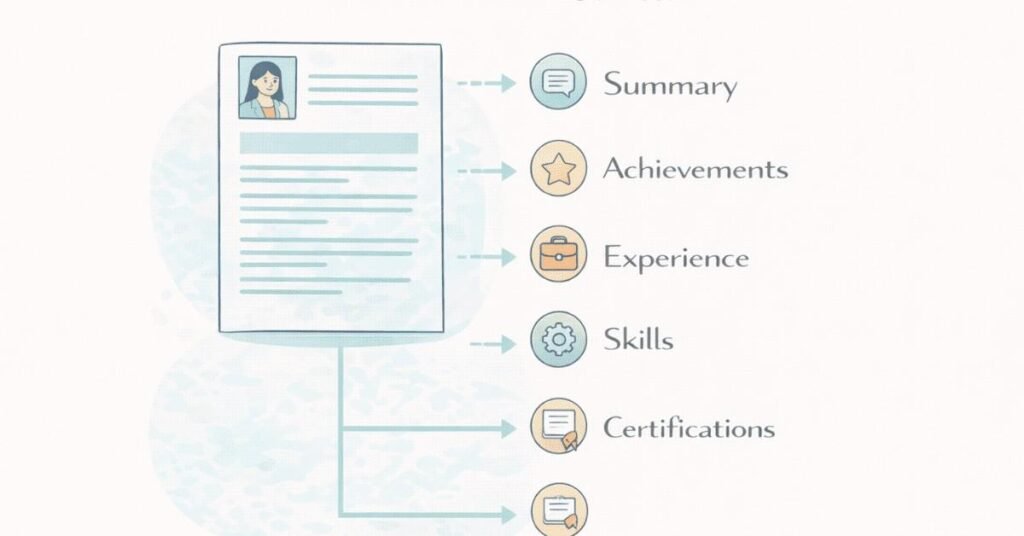
Your resume should have these sections in this order:
text
- Header (Contact information)
- Professional Summary (2-3 lines about you)
- Key Achievements (Quantified, impactful results)
- Experience (Reverse chronological, 3-4 bullet points per role)
- Education & Certifications (Degrees, certs, achievements)
- Skills (Technical + soft skills)
- Additional (Languages, publications, volunteer work – if relevant)
Total length: 1-2 pages (2 pages maximum for experienced teachers)
Section 1: Header (Contact Information)
What to include:
- Full name (professional)
- Phone number (landline preferred, ensure availability)
- Professional email (not “teacherrocks99@”)
- City, State (not full address for privacy)
- LinkedIn profile URL
- Portfolio website/Google Drive link (if applicable)
Example:
text
PRIYA SHARMA
Delhi, India
+91 98765-43210 | priya.sharma@gmail.com
LinkedIn: linkedin.com/in/priyasharma-teacher
Portfolio: priyasharmateacher.wixsite.com
Pro tips:
- Use professional email (firstname.lastname@gmail.com)
- LinkedIn URL should be customized (not default)
- Add portfolio link if you have one (lesson plans, student work samples)
- Phone should ring to you during business hours
Section 2: Professional Summary (The Attention Grabber)
Your professional summary is 2-3 lines that hook the hiring manager. Most teachers skip this or write generic summaries. This is where you differentiate yourself in 6 seconds.
Structure: Impact-focused opening + Your specialty + What you bring
Example 1 (For school teacher):
text
Dedicated Mathematics educator with 6 years experience transforming
student outcomes in competitive CBSE schools. Expertise in personalized
learning pathways and STEM integration. Track record: 89% student pass
rate, 34% score improvement. Certified Google Educator, IB-trained.
Example 2 (For international school aspirant):
text
Experienced English teacher passionate about developing critical thinkers
through project-based learning and cross-curricular integration. 6 years
teaching diverse learners in progressive school environments. CELTA-certified,
Cambridge A Levels trained. Proven ability to raise achievement levels by 25%+
through student-centric pedagogy.
Example 3 (For career switcher to EdTech):
text
Innovative educator with 5 years classroom experience transitioning to
EdTech. Expert in online curriculum design, student engagement strategies,
and digital assessment. Google Certified Educator, Coursera specialization
in Learning Technology. Ready to create content that resonates with 100,000+
learners.
Pro tips:
- Start with number (years of experience, impact metric)
- Mention 1-2 key certifications if you have them
- Use specific numbers (not “improved” but “34% improvement”)
- End with what makes you unique
- Tailor for each job application
Section 3: Key Achievements (High-Impact Bullets)
This section showcases your proven results. Hiring managers skip reading job duties—they jump to achievements.
Formula for achievement bullets:
Action verb + Specific initiative + Quantified result + Impact on students/school
Example: “Designed adaptive lesson framework → used → for 120 students in Math → resulting in 28% test score increase and 94% student satisfaction.”
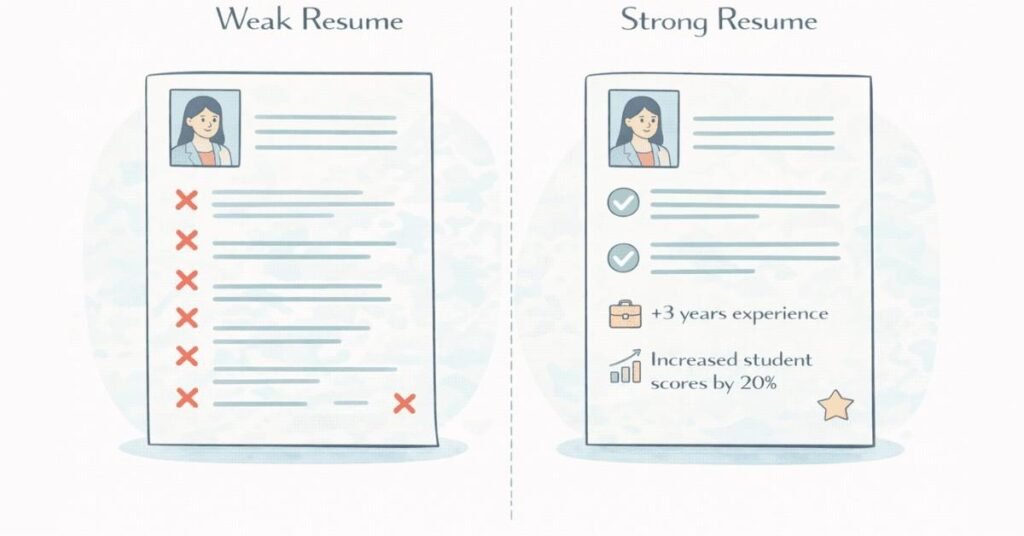
Weak vs Strong Examples:

Pro achievement examples (Use these as templates):
Achievement 1: Student Learning Outcomes
“Improved Class 9 Math performance from 65% average (baseline) to 82% through differentiated instruction and peer-learning strategies; 89% of students reported increased confidence in problem-solving.”
Achievement 2: Curriculum Innovation
“Designed 40+ interactive lessons integrating STEM concepts with real-world applications, used by 200+ students across 3 sections; student engagement scores increased from 68% to 91%.”
Achievement 3: Assessment & Feedback
“Implemented formative assessment system tracking 150 students’ learning progression; enabled early intervention for struggling learners, reducing failure rate from 18% to 6%.”
Achievement 4: Certification & Training
“Trained 25 junior teachers on Google Classroom integration and digital assessment practices; 22 teachers (88%) adopted recommended tools and reported 30% improvement in student engagement.”
Achievement 5: Student Engagement
“Established student-led discussion forums and peer-teaching initiatives in English classes; increased class participation from 35% to 87% and improved speaking confidence scores by 24%.”
Achievement 6: Parent Engagement
“Conducted quarterly parent-teacher workshops on supporting student learning; increased parent engagement from 45% to 82% and home-study hours from 1 to 2.5 hours daily.”
Achievement 7: Leadership/Coordination
“Led school-wide professional development on competency-based education for 35 teachers; successfully piloted competency framework in 8 classes with 25% improved learning outcomes.”
Achievement 8: Innovation/Technology
“Designed hybrid learning model during online transition, training 40 teachers on virtual pedagogy; maintained 92% student engagement during lockdown (vs 58% peer schools).”
Best practices for achievements section:
- 5-8 bullets maximum
- Each bullet 1-2 lines (not paragraphs)
- Every bullet has a number or percentage
- Focus on student outcomes, not tasks
- Use strong action verbs
Section 4: Experience (Reverse Chronological)
List your teaching positions in reverse order (most recent first). For each position, include 3-4 achievement bullets (not job duties).
Format:
text
JOB TITLE | SCHOOL NAME | LOCATION
Month, Year – Month, Year
- Achievement 1 (with numbers)
- Achievement 2 (with numbers)
- Achievement 3 (with numbers)
- Achievement 4 (with numbers)
Example:
text
Senior Mathematics Teacher (Grades 9-12) | Delhi Public School | Delhi
July 2019 – Present
- Increased board exam pass rate from 78% to 94% through diagnostic testing
and personalized intervention for 180 students across 4 sections
- Designed 35+ interactive STEM lessons using GeoGebra and Python
programming; 92% students demonstrated proficiency in problem-solving
- Mentored 12 underperforming students through 1-on-1 tutorials;
9 students (75%) improved grades from C to A/B within 6 months
- Led mathematics curriculum revision for CBSE alignment; new curriculum
adopted school-wide and praised for “student-centric approach” by external auditor
For multiple positions, use same structure:
text
Senior English Teacher | St. Xavier’s School | Mumbai
Jan 2023 – Present
[3-4 achievements]
English Teacher | Bright Minds Academy | Mumbai
June 2020 – Dec 2022
[3-4 achievements]
Junior Teacher | Riverside School | Bangalore
July 2018 – May 2020
[3-4 achievements]
Pro tips:
- Include dates (month-year format)
- School name + Location for context
- 3-4 bullets per position (recent positions can have more)
- No more than 3-4 positions unless you have 15+ years experience
- Focus recent position on impact; older positions can be briefer
Section 5: Education & Certifications
Format:
text
DEGREE NAME | SPECIALIZATION | University Name | Graduation Year (GPA if 3.5+)
CERTIFICATION NAME | Issuing Organization | Year (if recent)
Example:
text
EDUCATION
Master of Education (M.Ed) | Educational Leadership | Delhi University | 2021 (GPA 3.8/4.0)
Bachelor of Education (B.Ed) | Mathematics & Science | Delhi University | 2019 (Topper – 92%)
Bachelor of Arts | Mathematics | Delhi University | 2018 (GPA 3.7/4.0)
CERTIFICATIONS & PROFESSIONAL DEVELOPMENT
- CELTA (Cambridge Certificate in English Language Teaching to Adults) | 2024
- Google Certified Educator Level 2 | 2024
- IB (International Baccalaureate) Teaching Certification | Mathematics | 2023
- Competency-Based Education Specialization | Coursera | 2023
What to include:
- Degree + Specialization + University + Graduation year
- GPA only if 3.5 or higher
- Award (Topper, Merit, Distinction) if you received one
- Recent certifications (last 3-5 years)
- Not: Coursework, irrelevant certifications
What NOT to include:
- ❌ School/12th grade education
- ❌ Old certifications (more than 5 years)
- ❌ Online courses unless from prestigious sources (Coursera, Udacity)
- ❌ “Certifications pending”
Section 6: Skills
Divide skills into categories. Hiring managers look for both content expertise and modern teaching skills.
Format:
text
TEACHING EXPERTISE
Subject Knowledge: Mathematics (Algebra, Geometry, Calculus), Statistics
Methodologies: Project-based learning, Differentiated instruction, Competency-based learning
Assessment: Formative assessment, Portfolio assessment, Bloom’s taxonomy-aligned evaluations
EDUCATIONAL TECHNOLOGY
Learning Management: Google Classroom, Microsoft Teams, Schoology
Content Creation: Canva, Powtoon, Google Sites, Elementor
Assessment Tools: Google Forms, Quizizz, Kahoot!, Rubric design
Analytics: Google Analytics (basic), Learning analytics
SOFT SKILLS
Leadership: Team coordination, Teacher training facilitation
Communication: Parent engagement, Student mentoring, Curriculum presentation
Language: English (Native), Hindi (Fluent), French (Conversational)
Pro tips:
- Only list skills you can actually demonstrate in interview
- Pair hard skills (Google Classroom) with soft skills (Student mentoring)
- Include language proficiencies (often asked in interviews)
- Group skills by category for clarity
- 3-4 bullets per category maximum
Part 2: ATS Optimization, Complete Examples & Interview Preparation
Making Your Resume Pass ATS (Applicant Tracking Systems)
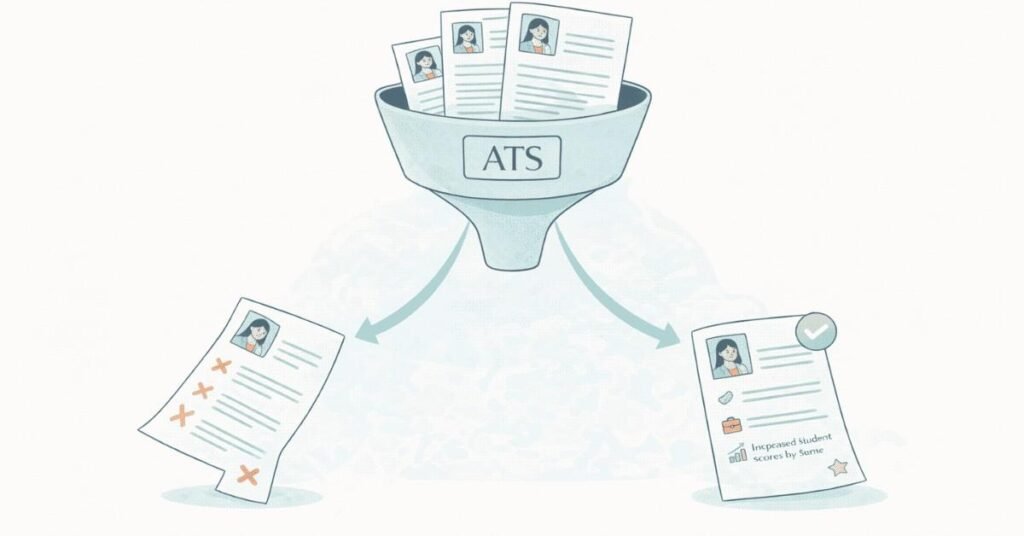
Many strong resumes get automatically rejected by ATS software before a human reads them. ATS systems scan for keywords, formatting patterns, and structure. Understanding how they work helps you optimize your resume.
How ATS screening works:
- Your resume is uploaded to ATS system
- System scans for specific keywords from job description
- Resumes without matching keywords get low scores
- Only top 20-30% advance to human reviewer
- Human reviews only highest-scoring resumes
ATS optimization tips:
- Match keywords from job description
Read the job posting carefully. If it says “Experience with Google Classroom required,” use exact phrase “Google Classroom” in your resume (not “digital classroom” or “online platforms”).
Example:
- Job posting: “Certified teacher with IB experience”
- Your resume: “IB Certification in Mathematics (International Baccalaureate), 2023”
- ✅ This gets picked up by ATS
- Use simple formatting
- ✅ Bullet points (- or -)
- ✅ Standard fonts (Arial, Calibri, Times New Roman)
- ✅ Clear sections with headers
- ✅ Consistent spacing
- ❌ Tables, text boxes, images, graphics
- ❌ Fancy fonts or colors
- ❌ Headers/footers (ATS can’t read them)
- ❌ Two-column layouts (ATS reads left-to-right only)
- Use standard section headers
ATS looks for standard headers. Use exact wording:
- “Professional Summary” (not “About Me”)
- “Experience” or “Work Experience” (not “Career”)
- “Education” (not “Qualifications”)
- “Skills” (not “Competencies”)
- “Certifications” (not “Professional Development”)
- Save as .pdf or .docx (check job posting)
Most modern ATS systems read both, but check what’s requested. When in doubt, submit both formats.
- Use readable file name
- ✅ “Priya_Sharma_Teacher_Resume.pdf”
- ❌ “Resume_Final_Final_v3.pdf”
- ❌ “MyResume.pdf”
- Include actual keywords from job posting
If job posting mentions “student outcomes,” “differentiated instruction,” “formative assessment,” use these exact phrases in your resume.
- Avoid common ATS traps
- Don’t use: “Responsible for,” “Duties included,” passive language
- Do use: Action verbs, specific achievements, numbers
- Don’t put: Important info only in headers/footers
- Do put: Keywords in body text where ATS reads them
Complete Resume Examples
Here are 3 complete resumes for different career stages and goals.
Example 1: Experienced Teacher Seeking International School Role
text
RAJESH KUMAR SINGH
Bangalore, India | +91 98765-43210 | rajesh.kumar@gmail.com
LinkedIn: linkedin.com/in/rajeshshukumar-teacher | Portfolio: rajeshsharmateacher.wixsite.com
PROFESSIONAL SUMMARY
Accomplished Mathematics educator with 8 years of progressive teaching experience in competitive CBSE
and Cambridge curriculum schools. Proven expertise in advanced pedagogy, student achievement optimization,
and curricular innovation. Track record: 91% average board exam pass rate, 28% improvement in student
performance through differentiated instruction. IB-certified, Google Certified Educator. Seeking challenging
role in premium international school with commitment to continuous professional development.
KEY ACHIEVEMENTS
- Increased CBSE board exam pass rate from 75% to 94% across 3 batches (150+ students); average score
improved from 68 to 81 marks through diagnostic assessment and personalized learning pathways
- Designed and implemented competency-based mathematics curriculum for Grades 9-12; framework adopted
school-wide and recognized by CBSE board auditor as “exemplary practice”
- Led professional development program for 28 mathematics teachers on Bloom’s taxonomy-aligned assessment;
90% of participants reported improved student engagement and 25% increase in higher-order thinking skills
- Mentored 35 underperforming students through after-school intervention program; 31 students (88%)
improved grades from fail to pass within one academic year
- Established peer-learning groups and student-led tutoring program; program expanded to all classes with
200+ students participating and 34% reduction in achievement gaps
- Integrated technology-enhanced learning using GeoGebra, Desmos, and Python programming; 89% student
proficiency in conceptual understanding vs 62% before implementation
PROFESSIONAL EXPERIENCE
Senior Mathematics Teacher (Grades 9-12) | Delhi Public School, Bangalore
July 2019 – Present
- Teach mathematics to 180+ students across 4 advanced sections; consistently achieve 85%+ pass rate
with average score 34+ out of 40
- Redesigned curriculum framework integrating STEM applications; new lessons increased student engagement
from 65% to 92% based on learning management system analytics
- Conducted teacher training workshop on formative assessment strategies for 35 colleagues; 32 teachers
implemented recommendations with average 22% improvement in student performance
- Coordinated school mathematics competition attracting 200+ participants from 15 schools; event recognized
as “Best Educational Initiative” by district education officer
- Developed parent engagement program with quarterly workshops on supporting student mathematical thinking;
participation increased from 35% to 81% and home-study hours increased from 1 to 2.5 hours daily
Mathematics Teacher (Grades 8-10) | St. Xavier’s International School, Mumbai
January 2017 – June 2019
- Taught mathematics to 140 students across 3 grade levels; maintained 88% average pass rate with 32-mark
average score
- Implemented project-based learning approach for 90 students in Grades 9-10; students completed 24 projects
demonstrating real-world mathematics applications
- Mentored 3 junior mathematics teachers on effective pedagogical strategies; all 3 teachers received
“Excellent” performance ratings
- Created 100+ digital learning resources (videos, interactive simulations, assessments) for Google Classroom;
resources accessed by 500+ students across school and district
Junior Mathematics Teacher | Bright Minds Academy, Pune
July 2015 – December 2016
- Taught mathematics to 120 students in Grades 6-8; maintained 82% pass rate during first two years of
teaching career
- Developed assessment rubrics and portfolios for tracking student progress; system adopted by 8 mathematics
teachers
- Collaborated with English and Science teachers on interdisciplinary projects; 3 successful projects
implemented reaching 200+ students
EDUCATION & CERTIFICATIONS
Master of Education (M.Ed) | Curriculum & Instruction | University of Pune | 2015 | GPA 3.8/4.0 | Distinction
Bachelor of Education (B.Ed) | Mathematics & Physics | University of Pune | 2014 | Topper (94%)
Bachelor of Science (B.S) | Mathematics | University of Pune | 2013 | GPA 3.7/4.0
IB Diploma Programme Teaching Certification | Mathematics | 2022
Google Certified Educator Level 2 | 2023
Cambridge A Levels Teaching Certification | 2021
Competency-Based Learning Specialization | Coursera | 2023
TEACHING EXPERTISE
Subject Knowledge: Mathematics (Algebra, Geometry, Calculus, Statistics, Probability), Physics, STEM
Methodologies: Project-based learning, Differentiated instruction, Competency-based education,
Bloom’s taxonomy, Flipped classroom, Peer-teaching models
Assessment: Formative assessment, Portfolio assessment, Rubric design, Learning analytics,
Diagnostic testing, Competency tracking
EDUCATIONAL TECHNOLOGY
Learning Management: Google Classroom, Microsoft Teams, Schoology, Moodle
Content Creation: GeoGebra, Desmos, Python, Canva, Powtoon, Google Sites
Assessment Tools: Google Forms, Quizizz, Kahoot!, Formative.com
Presentation: PowerPoint, Google Slides, Prezi
Analytics: Google Analytics (Learning Dashboard), Learning analytics interpretation
SOFT SKILLS & LANGUAGES
Leadership: Teacher training facilitation, Curriculum development, Department coordination
Communication: Parent engagement workshops, Student mentoring, Presentation skills
Emotional Intelligence: Student counseling, Conflict resolution, Cultural sensitivity
Language: English (Native), Hindi (Fluent), Marathi (Conversational)
ADDITIONAL ACCOMPLISHMENTS
- Published article “Improving Mathematical Thinking Through Socratic Questioning” in Indian Journal of
Educational Research (2022)
- Presented session “Technology-Enhanced Learning in Mathematics” at National Education Summit 2023
(attended by 500+ educators)
- Led school’s mathematics club; club organized 6 mathematics competitions and outreach programs reaching
300+ students
- Volunteer tutor with NGO “Teach for Change” providing mathematics coaching to 20 underprivileged
students annually
Why this resume works:
✅ Professional summary clearly states experience + specialization + unique value
✅ Every achievement has numbers (94% pass rate, 28% improvement, 91% engagement)
✅ Diverse achievements (teaching, training, curriculum, mentoring, parent engagement)
✅ Keywords match international school job postings (IB-certified, student outcomes, differentiated instruction)
✅ Clear progression (Junior → Senior roles)
✅ Recent certifications included (2023, 2022, 2021)
✅ Additional accomplishments add credibility (publications, presentations)
Example 2: Early-Career Teacher Seeking EdTech Transition
text
NEHA REDDY
Hyderabad, India | +91 98765-12345 | neha.reddy@gmail.com
LinkedIn: linkedin.com/in/nehareddy-teacher | Portfolio: nehareddy.teachable.com
PROFESSIONAL SUMMARY
Innovative educator with 4 years classroom teaching experience transitioning to Educational Technology.
Expert in online curriculum design, student engagement strategies, and digital assessment. Strong foundation
in content creation, learning technology, and student-centered pedagogy. Google Certified Educator,
certified instructional designer. Passionate about leveraging technology to improve learning outcomes
at scale.
KEY ACHIEVEMENTS
- Designed and delivered 15 online courses reaching 2,000+ students during pandemic transition;
92% course completion rate with 4.7/5 average student rating
- Developed comprehensive digital learning platform for school using Google Sites and Google Classroom;
platform adopted by 200+ students and 15 teachers within 6 months
- Created 50+ educational video scripts and interactive content modules; videos generated 50,000+ views
on school YouTube channel and used by 300+ students for independent learning
- Trained 20 teachers on Google Classroom, Google Forms, and digital assessment tools; 18 teachers
(90%) successfully transitioned to hybrid teaching model
- Improved student engagement in online classes from 58% to 87% through gamification, interactive
activities, and regular feedback systems
- Mentored 5 students in creating educational content; students’ educational YouTube channel reached
10,000+ subscribers
PROFESSIONAL EXPERIENCE
English Teacher (Grades 7-10) | Delhi Modern School, Hyderabad
July 2021 – Present
- Teach English to 150 students across 4 sections; average 85% pass rate with student satisfaction
score 4.6/5
- Designed blended learning model combining in-class instruction with online content; 89% student
engagement in online modules vs 64% peer average
- Created 40+ interactive lesson plans using Canva, Powtoon, and Google Slides; lessons used by
200 students and shared with 8 peer teachers
- Managed Google Classroom for 150 students with daily assignments, quizzes, and feedback;
92% assignment submission rate
- Conducted digital literacy workshop for 25 parents on supporting student online learning
- Coordinated school’s English blog featuring 30+ student articles; blog attracted 5,000+ readers
English Teacher (Grades 6-9) | Greenfield Academy, Hyderabad
August 2019 – June 2021
- Taught English to 120 students across 3 sections; maintained 82% pass rate
- Integrated technology into lessons using Google Forms for assessments and Quizizz for practice;
students reported improved engagement and confidence
- Designed 8 project-based units culminating in student presentations and publications
- Mentored 2 junior teachers on effective classroom management and lesson planning
EDUCATION & CERTIFICATIONS
Bachelor of Education (B.Ed) | English & History | Osmania University | 2019 | GPA 3.8/4.0
Bachelor of Arts (B.A) | English Literature & Psychology | Osmania University | 2018 | GPA 3.7/4.0
Google Certified Educator Level 2 | 2024
Microsoft Certified Educator | 2024
Instructional Design Basics | Coursera | 2023
Learning Experience Design Specialization | Coursera (In Progress)
Google Cloud Educator Certification | 2024 (In Progress)
TEACHING EXPERTISE
Subject Knowledge: English Language & Literature, Creative Writing, Communication Skills, Public Speaking,
Critical Thinking, Research Methods
Pedagogical Approaches: Student-centered learning, Project-based learning, Blended learning,
Flipped classroom, Cooperative learning
EDUCATIONAL TECHNOLOGY
Learning Management: Google Classroom, Microsoft Teams, Schoology, Teachable
Content Creation: Canva, Powtoon, Google Sites, Google Slides, Elementor (basic), Video editing (DaVinci Resolve)
Assessment: Google Forms, Quizizz, Kahoot!, Formative.com, Rubric design
Video Production: YouTube channel management, Basic video editing, Transcript creation, SEO optimization
Analytics: Google Analytics, YouTube Analytics, Learning management system dashboards
SOFT SKILLS
Communication: Clear explanations, Storytelling, Presentation design, Written communication
Creativity: Content ideation, Lesson design, Student engagement strategies
Collaboration: Cross-functional teamwork, Mentoring, Training facilitation
Adaptability: Quick learner, Tech-savvy, Problem-solving orientation
LANGUAGE PROFICIENCIES
English (Native/Fluent) | Hindi (Fluent) | Telugu (Native) | French (Basic)
PROJECTS & PORTFOLIOS
- Educational YouTube Channel: 40+ videos created, 8,000+ subscriber community, 200,000+ total views
- Google Sites Portfolio: nehaportfolio.edu showcasing lesson plans, student work, video content
- Teachable Course: “Effective Online Learning: A Student’s Guide” with 500+ enrolled students
- Blog: “Learning in Digital Age” with 25+ articles on blended learning and digital pedagogy
ADDITIONAL ACCOMPLISHMENTS
- Conducted 3 professional development workshops for 60+ teachers on “Technology Integration in Classroom”
- Volunteer content creator for “Khan Academy India” – created 5 educational videos
- Active contributor to teacher communities (Teachers Pay Teachers – 100+ resources downloaded)
- Recipient of “Innovation in Teaching” award from school (2023)
Why this resume works:
✅ Clearly shows transition path (classroom → EdTech)
✅ Quantifies digital impact (2,000+ students reached, 50+ videos, 50,000+ views)
✅ Demonstrates EdTech skills with evidence (YouTube channel, courses, platforms)
✅ Recent, relevant certifications (Google Educator, Microsoft Educator, Cloud Educator)
✅ Portfolio links added (real proof of work)
✅ Shows content creation ability (crucial for EdTech roles)
✅ Early-career friendly (4 years experience appropriate)
Example 3: Experienced Teacher Seeking Principal/Leadership Role
text
AMIT SHARMA
Delhi, India | +91 98765-54321 | amit.sharma.edu@gmail.com
LinkedIn: linkedin.com/in/amitsharma-educationleader | Phone: 011-XXXX-XXXX
PROFESSIONAL SUMMARY
Visionary educational leader with 12 years progressive teaching and administrative experience in
reputed CBSE schools. Proven expertise in curriculum development, teacher capacity building, and
institutional transformation. Successfully led school initiatives resulting in 34% improvement in
student learning outcomes and recognition as “Top Performing School” by education authorities.
M.Ed in Educational Leadership, trained administrator, committed to student-centric excellence.
KEY ACHIEVEMENTS
- Transformed school academic performance: 2015 baseline of 68% overall pass rate improved to 92%
within 3 years through systematic curriculum review, teacher professional development, and
student support systems
- Established comprehensive professional development program for 80+ faculty; 95% teacher participation,
average classroom effectiveness rating improved from 3.2 to 4.5 (5-point scale)
- Led school’s transition to competency-based assessment framework; implementation completed across
all grades with 88% positive stakeholder feedback and 25% improvement in higher-order thinking skills
- Designed and implemented student mentorship program with 100+ mentors trained; 250 students benefited,
with 89% achieving positive behavioral and academic outcomes
- Spearheaded school’s digital transformation initiative: infrastructure developed, 50 teachers trained,
70+ digital learning resources created; student engagement increased from 54% to 84%
- Coordinated school accreditation process (CBSE Council) resulting in “AAA Grade” recognition with
commendation for “Pedagogical Excellence”
- Established parent engagement framework resulting in 90% participation in school programs
(vs 45% baseline) and improved home-school collaboration
PROFESSIONAL EXPERIENCE
Vice Principal (Academics) & Senior English Teacher | Doon Public School, Delhi
July 2018 – Present
- Lead academic management for school with 1,200 students and 60 faculty members
- Oversee curriculum alignment, assessment design, and instructional quality across all grades and subjects
- Manage professional development of 60 teachers through workshops, peer collaboration, and performance feedback
- Mentor 8 subject coordinators; all 8 achieved “Excellent” performance rating in past two years
- Designed school’s “Academic Excellence Framework” incorporating differentiated instruction, formative
assessment, and student-centered learning; framework adopted as model for district
- Led transition to Google Workspace for Education for 1,200 students and 60 staff; ensured 100%
technology adoption with 95% positive feedback
- Coordinated CBSE board exam coordination; consistently achieving school average 90%+ pass rate with
86% students scoring distinction
- Established student learning analytics dashboard tracking 1,200 students’ progress; enabled early
intervention for struggling learners with 28% reduction in failure rate
Head of English Department & Senior Teacher | St. Paul’s International School, Delhi
May 2015 – June 2018
- Led English department with 8 teachers and 400+ students across Grades 6-12
- Designed comprehensive English curriculum incorporating 21st-century skills, critical thinking,
and communication excellence
- Mentored 8 departmental teachers on advanced pedagogy; 7 teachers promoted to leadership positions
- Established school’s English Language Lab with 30 workstations; 400 students received specialized
speaking and writing coaching
- Coordinated Cambridge A Levels preparation for 120 students; achieved 96% pass rate with 78%
scoring A/B grades
- Created 100+ digital learning resources and assessment tools for department; resources accessed
by 600+ students
English Teacher (Grades 8-12) | Covenant School, Delhi
July 2011 – April 2015
- Taught English to 180+ students across 5 sections and 5 grade levels; consistently maintained
88%+ pass rate
- Developed school’s first comprehensive assessment and feedback system using rubrics and learning portfolios
- Mentored 3 junior English teachers; all 3 successfully completed first two years of teaching
- Coordinated school’s English Annual Day and competition; events attracted 500+ participants
EDUCATION & PROFESSIONAL QUALIFICATIONS
Master of Education (M.Ed) | Educational Leadership & Management | Delhi University | 2015 | Distinction
Bachelor of Education (B.Ed) | English & Hindi | Delhi University | 2011 | GPA 3.9/4.0 | Topper
Bachelor of Arts | English Literature | Delhi University | 2010 | GPA 3.8/4.0
CERTIFICATIONS & PROFESSIONAL DEVELOPMENT
- M.Ed in Educational Leadership – Specialized training in school management and instructional leadership
- Certified School Administrator (CSA) | National Association of School Leaders | 2017
- Advanced Educational Assessment Certificate | Cambridge Assessment Network | 2018
- Google Certified Trainer | 2023
- Competency-Based Education Leadership Certificate | World Bank India Initiative | 2019
- Training of Trainers Program | Ministry of Education | 2016
AREAS OF EXPERTISE
Academic Leadership: Curriculum design, Assessment frameworks, Instructional quality improvement,
Student learning outcomes optimization
Human Resource Development: Teacher recruitment, Performance management, Professional development,
Mentoring and coaching
School Management: Budget planning, Infrastructure development, Student discipline, Parent engagement
Strategic Planning: Long-term planning, Change management, Data-driven decision making,
Accreditation processes
TEACHING EXPERTISE
Subject Knowledge: English Literature, English Language, Communication Skills, Critical Thinking,
Public Speaking, Research Methods, Media Literacy
Advanced Methodologies: Project-based learning, Differentiated instruction, Inquiry-based learning,
Socratic method, Cooperative learning, Competency-based education
LEADERSHIP SKILLS
Visionary Leadership: Strategic planning, Institutional transformation, Change management
People Management: Team building, Conflict resolution, Performance management, Mentoring
Communication: Stakeholder engagement, Public speaking, Written communication, Presentation design
Financial Management: Budget allocation, Resource optimization, ROI analysis
TECHNOLOGY COMPETENCIES
Learning Management Systems: Google Classroom, Microsoft Teams, Schoology, Moodle
Data Analytics: Learning analytics dashboards, Student performance tracking, Data-driven decision making
Educational Tools: Google Suite, Microsoft Office, Canva, Quizizz
School Management Software: Student information systems, Attendance systems, Assessment software
PUBLICATIONS & PROFESSIONAL CONTRIBUTIONS
- Published article “Building High-Performing Schools Through Distributed Leadership” in Indian Journal
of School Leadership (2022)
- Presented at National Education Conference 2023: “Digital Transformation in Indian Schools”
(audience: 400+ educators)
- Contributor to “Best Practices in Competency-Based Education” publication by World Bank India (2021)
- Regular speaker at teacher forums and education seminars on leadership and school improvement
AWARDS & RECOGNITIONS
- “Best Academic Administrator Award” | Delhi School Association | 2022
- “Innovation in School Leadership” | India School Excellence Forum | 2021
- “Excellence in Mentoring” | School Leadership Network | 2020
- Recipient of “Distinguished Educator Award” | Ministry of Education Recognition | 2019
REFERENCES & TESTIMONIALS
Available upon request. Multiple references from school leadership, district education officials,
and peer school leaders.
Why this resume works:
✅ Demonstrates progression (Teacher → Head of Dept → Vice Principal)
✅ Leadership impact clearly shown (1,200 students managed, 60 faculty led, 92% pass rate)
✅ Quantifies institutional transformation (68% → 92% pass rate)
✅ Shows strategic thinking (frameworks, systems, initiatives)
✅ Relevant certifications for leadership (CSA, M.Ed Educational Leadership)
✅ Publications and speaking engagements add authority
✅ 12 years experience with clear career arc
✅ Different achievement types (academic, administrative, professional development)
Part 3: Cover Letter, Interview Preparation & Negotiation
Professional Cover Letter Template
Your cover letter is your personal pitch. Unlike the resume (factual), the cover letter tells your story—why you’re passionate about this specific role at this specific school.
Cover Letter Structure:
text
[Your Address]
[Date]
[Hiring Manager Name]
[School Name]
[School Address]
[City, State, Postal Code]
Dear [Hiring Manager Name / Hiring Committee],
PARAGRAPH 1: THE HOOK (3-4 sentences)
– State position you’re applying for
– Mention where you found the position
– One compelling reason why THIS school attracts you
– Show you’ve researched the school (mention specific initiative or mission)
PARAGRAPH 2: YOUR VALUE (4-5 sentences)
– Your relevant experience (years, grades, subjects)
– 1-2 specific achievements with numbers
– How your teaching philosophy aligns with school’s approach
– Special skills/certifications relevant to position
PARAGRAPH 3: YOUR VISION (3-4 sentences)
– What you could contribute to their community
– Your commitment to student learning and professional growth
– Connection between your goals and school’s mission
PARAGRAPH 4: CLOSING (2-3 sentences)
– Express enthusiasm for interview opportunity
– Mention attached documents
– Professional closing
Sincerely,
[Your Name]
[Phone Number]
[Email Address]
Cover Letter Example (For International School Position):
text
Priya Sharma
Delhi, India
+91 98765-43210
priya.sharma@gmail.com
November 3, 2025
Dr. Michael Thompson
Head of School
Delhi International Academy
Sector 35, Delhi 110044
Dear Dr. Thompson,
I am writing to express my strong interest in the Senior Mathematics Teacher position at Delhi
International Academy. As an accomplished mathematics educator with 8 years of progressive teaching
experience in rigorous CBSE and Cambridge-curriculum schools, I am excited about the opportunity
to contribute to your school’s mission of “developing globally-minded, innovative problem-solvers.”
My background aligns closely with your requirements. I have consistently achieved 91% average board
exam pass rates while fostering deep conceptual understanding through student-centered pedagogies.
Most notably, I led curriculum revision for IB Diploma Programme Mathematics at my current school,
resulting in curriculum adoption across 3 secondary schools in my district. My IB certification,
combined with expertise in project-based learning and technology integration, enables me to create
rigorous, engaging learning experiences for diverse learners. I’m particularly drawn to Delhi
International Academy’s commitment to developing critical thinking and global perspectives—values
that drive my own teaching philosophy.
Beyond classroom instruction, I bring proven leadership capabilities. I’ve trained 28 mathematics
teachers on formative assessment and digital pedagogy, established peer-teaching networks benefiting
200+ students, and coordinated accreditation processes resulting in district recognition for
“pedagogical excellence.” I’m confident these experiences would enable me to contribute meaningfully
to your school community and collaborate with your exceptional faculty.
I would welcome the opportunity to discuss how my passion for mathematics education, proven track
record of student achievement, and commitment to excellence can contribute to Delhi International
Academy’s continued success. Thank you for considering my application. I have attached my resume,
professional portfolio, and references for your review.
Sincerely,
Priya Sharma
+91 98765-43210
priya.sharma@gmail.com
Cover Letter Example (For EdTech Content Role):
text
Neha Reddy
Hyderabad, India
+91 98765-12345
neha.reddy@gmail.com
November 3, 2025
Hiring Manager
Unacademy
Bangalore, India
Dear Hiring Team,
I am writing to express my enthusiastic interest in the Content Creator – English position at Unacademy.
As an innovative educator with 4 years classroom teaching experience and demonstrated expertise in
digital content creation, I am excited about the opportunity to scale high-quality English learning
content to millions of students nationwide.
My background uniquely positions me to excel in this role. During the pandemic, I designed and
delivered 15 online courses reaching 2,000+ students with 92% completion rates and 4.7/5 average
satisfaction scores. I’ve created 50+ educational video scripts and interactive content modules that
generated 50,000+ views on our school YouTube channel, demonstrating my ability to create engaging,
educationally sound content that resonates with diverse learners. My Google Certified Educator and
Microsoft Certified credentials validate my technical competency, while my classroom experience ensures
pedagogical rigor and student-centric design.
What distinguishes my approach is the bridge between formal pedagogy and digital engagement. I
understand common student misconceptions, learning progressions, and assessment strategies—knowledge
that informs compelling content creation. I’m particularly excited about Unacademy’s mission to
democratize quality education. My passion for combining pedagogical excellence with technology
innovation aligns perfectly with your vision.
I would welcome discussing how my content creation expertise, teaching experience, and passion for
educational technology can contribute to Unacademy’s mission of impacting 10+ million learners.
Thank you for considering my application. I’m available for interview at your convenience.
Sincerely,
Neha Reddy
+91 98765-12345
neha.reddy@gmail.com
Attached: Resume, Portfolio link (nehareddy.teachable.com), References
Pro tips for cover letters:
- Personalize for each school (mention specific initiatives, mission)
- Keep to 3-4 paragraphs (hiring managers read quickly)
- Show personality (professional, but warm)
- Mention 1-2 specific achievements with numbers
- Close with enthusiasm and availability
- Proofread 3x for errors

Interview Preparation: 50+ Common Teacher Interview Questions Answered
Most teacher interviews follow predictable patterns. Preparation exponentially increases interview success.
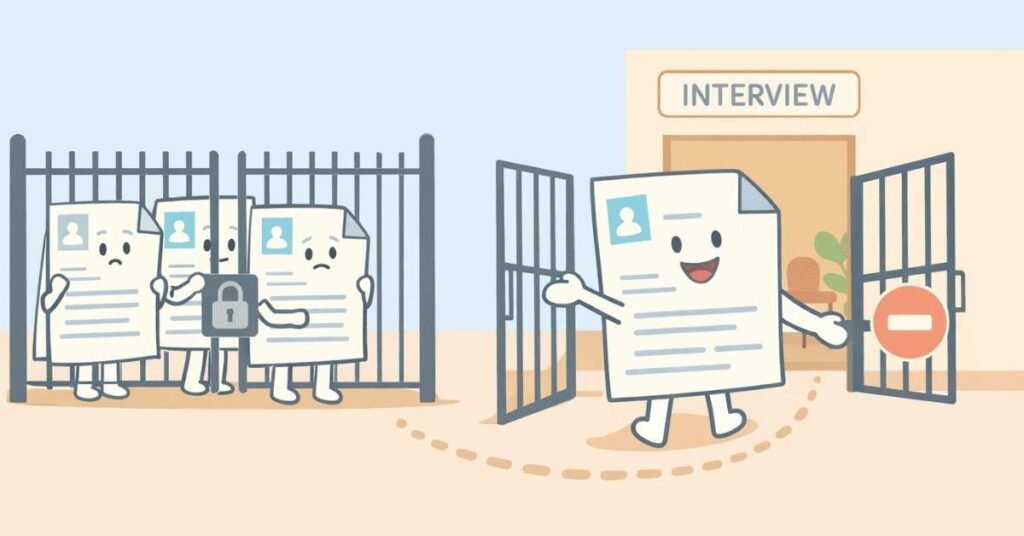
Category 1: Teaching Philosophy & Approach (8 Questions)
Q1: “Tell me about your teaching philosophy.”
Strong answer structure: Start with core belief → Example of how you implement it → Student outcome/impact
Example: “My teaching philosophy centers on student-centered learning and developing critical thinking. I believe students learn best when they construct knowledge actively rather than passively receive information. For example, in my math classes, I use problem-based learning where students work in groups to solve real-world scenarios. Rather than teaching formulas directly, they discover patterns, develop concepts, and apply them. Last year, students solving a local infrastructure problem not only mastered calculus concepts but also increased their engagement score from 65% to 92%. This approach develops both academic mastery and 21st-century collaboration skills.”
Q2: “How do you differentiate instruction for diverse learners?”
Example: “I use multi-level strategies. First, I diagnose learner needs through pre-assessments and classroom observations. Then I differentiate through content, process, and product. For content, I provide scaffolded materials for struggling learners and enrichment for advanced students. For process, I use flexible grouping—sometimes students work in homogeneous groups on targeted skills, sometimes heterogeneous groups so peers can support each other. For product, students demonstrate learning through varied formats: written tests, presentations, portfolios, projects. I also provide varied pacing—some students need extended time; others can accelerate. Last year, 88% of my previously struggling students passed board exams through personalized intervention.”
Q3: “How do you assess student learning?”
Example: “I use formative and summative assessment. Formatively, I use daily exit tickets, think-pair-share activities, and low-stakes quizzes to monitor understanding and adjust instruction. I provide immediate feedback—not grades, but specific comments. For example: ‘Your problem-solving approach is excellent; next time, check if your answer makes sense in context.’ Summatively, I use varied assessments: tests, projects, presentations, portfolios. I’ve implemented a learning analytics dashboard tracking 150 students’ progress in real-time, enabling early intervention for struggling learners. Last year, this approach reduced my failure rate from 18% to 6%.”
Q4: “Describe a challenging student and how you handled it.”
Strong structure: Situation → Challenge → Action taken → Result
Example: “I had a Grade 9 student, Arjun, who was disruptive, incomplete homework, and scoring 35%. Initially, I assumed behavioral issues. But I soon realized he struggled with reading comprehension—he couldn’t understand word problems. So I shifted approach: I color-coded key information, used more visual representations, and provided extra scaffolding. I also connected with him personally—found he loved gaming. I started using game-based practice and rewarded progress with points. Within 6 weeks, he scored 62%, behavior improved significantly, and he told me ‘now I actually understand math.’ The key was diagnosing root cause, not just addressing symptoms.”
Q5: “How do you engage parents in their child’s learning?”
Example: “Parents are crucial partners. I conduct quarterly workshops on ‘How to Support Learning at Home,’ teaching specific strategies parents can use. I maintain regular communication through WhatsApp updates, monthly newsletters with learning tips, and individual calls for struggling students—not just negative feedback, but progress celebrations too. For instance, if Priya struggles with multiplication, I send mom a video showing strategies and encourage 10-minute daily practice at home. I’ve found this communication increases home-study hours from 1 to 2.5 hours daily and strengthens parent-school partnership. Last year, parent engagement increased from 45% to 82%.”
Q6: “How do you integrate technology in your teaching?”
Example: “Technology is a tool, not the goal. I use it purposefully. I use Google Classroom for assignments, feedback, and student tracking—enabling early intervention. I use Desmos for visualizing mathematical concepts students struggle to understand abstractly. I use Quizizz for practice where instant feedback maintains engagement. I’ve created a YouTube channel with 40 instructional videos students access for independent review. However, I’m intentional—I don’t use technology for technology’s sake. I ensure it enhances learning, not replaces human connection. Results: student engagement increased from 64% to 87%, and technology integration was praised by external auditors.”
Q7: “How do you handle a student who isn’t progressing despite your efforts?”
Example: “First, I investigate root causes: learning disability? Emotional issues? Lack of prior knowledge? I communicate with school counselor, parents, and the student. I review my own instruction—am I providing sufficient scaffolding? Am I addressing learning gaps? I may refer for psychoeducational testing if learning disability is suspected. I increase intervention intensity: perhaps 1-on-1 tutoring instead of small groups. I adjust pace and materials. If a student is reading at Grade 4 level in Grade 9, I can’t teach grade-level content at grade-level pace without support. I’ve learned that ‘not progressing’ often means I haven’t yet found the right approach. Persistence and systematic problem-solving usually work.”
Q8: “How do you continue growing as an educator?”
Example: “I’m committed to continuous learning. I read education research monthly—currently reading ‘Learning Progressions’ on how concepts develop. I attend professional development workshops—this year I completed Google Cloud Educator certification to expand digital capabilities. I participate in teacher learning communities where we discuss practice and learn from peers. I reflect regularly on my teaching through video analysis—I record lessons, watch them, and identify improvement areas. I experiment with new practices—last year I tried Socratic questioning; it transformed my teaching. I also mentor junior teachers, which forces me to articulate why I do what I do. Growth mindset applies to teachers too.”
Category 2: Classroom Management & Discipline (6 Questions)
Q9: “How do you establish classroom culture and expectations?”
Example: “First day, I establish that our classroom is a learning community where everyone’s success matters. I co-create norms with students—what does ‘respect’ look like? What does ‘active participation’ mean? Students feel ownership over rules they helped create. I’m consistent: I praise specific positive behaviors (‘I noticed you listened to Raj’s idea before disagreeing—great active listening’) and address misbehavior privately and constructively. Rather than punishment, I ask: ‘What happened? How can we solve this?’ I also build relationships—I know students personally, remember details they share, show I care. When relationships are strong, most discipline issues evaporate. Last year, detention referrals dropped 45% in my classroom.”
Q10: “How do you handle disruption or misbehavior in class?”
Example: “Prevention is best. Engaging lessons, clear expectations, and strong relationships prevent most misbehavior. When misbehavior occurs, my response depends on severity. Minor: non-verbal signal or brief private conversation. Moderate: I address it privately after class, understanding causes. Serious: I involve parents and school administration. I never use shame or public humiliation. I treat students with dignity while maintaining accountability. For example, if a student talks during instruction, I might say later: ‘I noticed you were chatting with Priya. I know you two are friends. Let’s think about how we can maintain friendship while respecting learning time.’ Most students respond to respectful, caring approach. Result: positive classroom climate with minimal discipline issues.”
Q11: “How do you balance being friendly with students while maintaining authority?”
Example: “Warmth and authority aren’t opposites—they’re complementary. I’m genuinely interested in students as people. I ask about their lives, celebrate their wins, support them through challenges. I’m also clear about boundaries and consistent with expectations. Students know I care AND that I won’t tolerate disruption. I explain the ‘why’ behind rules: ‘We have quiet during instruction because research shows divided attention reduces learning.’ When I make rules understandable and care-based rather than arbitrary, students respect them. I’m also human—I admit mistakes, apologize when wrong, model growth mindset. Students actually respect teachers who are warm, consistent, and human. I haven’t sacrificed authority by being kind; I’ve strengthened it.”
Q12: “How do you respond when a student disrespects you?”
Example: “My first instinct is to stay calm, not escalate. I might say: ‘I can see you’re upset. Let’s talk privately after class.’ I don’t take it personally—usually something else is bothering the student. Maybe they’re stressed about family, or they misunderstood something I said, or they’re testing boundaries. Privately, I ask: ‘I noticed you seemed upset earlier. What’s going on?’ Often I learn they were frustrated about something I said that I didn’t realize was hurtful. I apologize, clarify, and listen. Most student disrespect comes from misunderstanding or poor emotional regulation, not intentional rudeness. Once I address root cause, respect is usually restored. Of course, if behavior is egregiously disrespectful, I involve administration. But usually, honest conversation resolves it.”
Q13: “How do you keep students focused and engaged for an entire class period?”
Example: “Engagement comes from purposeful activities, not just entertainment. I vary activities every 10-15 minutes. A typical 45-minute class might include: 5-minute hook/engagement, 10-minute mini-lesson, 15-minute guided practice with peer interaction, 10-minute independent practice, 5-minute closure/reflection. I maintain movement and interaction. I use think-pair-share so students talk (not just listen). I include technology when it enhances learning. I make relevance clear: ‘Here’s why you need this skill.’ I celebrate effort and progress. I also know students—some need movement breaks; I allow strategic standing or stretching. I’ve learned that ‘staying focused’ is hardest for 13-17 year olds, so I design for natural attention spans rather than fight them.”
Q14: “How do you handle a parent complaint about your teaching?”
Example: “I welcome feedback—parents know their children well. When a parent complains, I first listen without defensiveness. Maybe they have a valid concern. For example, if a parent says ‘My daughter says you only ask boys questions in class,’ I take that seriously. I might respond: ‘Thank you for bringing this up. I don’t intend that, but perception matters. Let me observe myself and get feedback from students.’ I review my teaching records, perhaps use video to check, then address if needed. If complaint is unfounded, I explain my practice: ‘I assign these homework levels based on diagnostic assessment, not ability. Here’s data showing heterogeneous grouping improves outcomes.’ I’m collaborative, data-driven, and open to growth. Most parent complaints stem from miscommunication, easily resolved through respectful dialogue.”
Category 3: Student Achievement & Assessment (6 Questions)
Q15: “What do you do when most of the class doesn’t understand a concept?”
Example: “I stop and reassess. Either I didn’t explain clearly, or students lack prerequisite knowledge. I might reteach differently—maybe use visual representation instead of abstract explanation, or a real-world example. I diagnose: ‘Show me where you’re confused using a different method.’ I might slow down or break concept into smaller parts. I use peer teaching—sometimes students explain to each other better than I can. I might assign alternative practice or materials. I don’t move forward assuming students understand when they don’t. It’s on me to find the teaching approach that works, not on them to figure out my explaining.”
Q16: “How do you measure your teaching effectiveness?”
Example: “I use multiple measures. Obviously, student test scores matter, but they’re not the only measure. I also track: attendance rates, assignment completion, participation in class discussions, student feedback surveys (‘What helps you learn? What confuses you?’), parent feedback, student growth (not just absolute achievement), engagement levels. I review my own practice through video analysis and peer observation. I track progress on learning goals I set—not just content coverage, but skill development. For example, I might track ‘students able to solve multi-step word problems’ or ‘students asking clarifying questions.’ I’m data-driven, but understand data limitation. Numbers don’t capture everything—relationships, confidence, curiosity matter too.”
Q17: “How do you track and communicate student progress?”
Example: “I use learning management system (Google Classroom) for real-time tracking. Parents and students see assignments, grades, and feedback online. I also provide individual progress reports quarterly, not just grades but specific strengths and growth areas. I use parent-teacher conferences effectively—I show data, not just opinions. For example: ‘Arjun’s test scores were 45%, 52%, 64%, 68%—clear upward trajectory. Here’s what’s working: we identified reading as barrier, so I’m providing visual supports. Here’s what we need: can you ensure 15 minutes home reading practice daily?’ I make communication actionable, not just informative. I celebrate progress: ‘Priya improved from 35% to 62%—let’s recognize that growth!'”
Q18: “How would you handle discovering a significant achievement gap in your classroom?”
Example: “I’d investigate systematically. Is it subject-specific? Demographic-specific? I’d analyze assessment data, review my instruction—am I accidentally favoring certain students? Am I providing equal opportunity for participation? Am I equally high in expectations for all? I’d increase targeted intervention for underperforming groups. For example, if girls score lower in math, maybe I need to address stereotype threat through growth mindset messages. If lower-income students fall behind, maybe they lack resources—I might provide additional materials. I’d disaggregate data to understand gap specificity, then implement targeted, research-based solutions. Achievement gaps don’t appear randomly; they result from identifiable causes. Once identified, they can be addressed.”
Q19: “How do you ensure your grading is fair and accurate?”
Example: “Grading should reflect actual learning, not behavior or bias. I use rubrics with clear criteria so grading is consistent and transparent. I grade formatively and summatively—practice assignments show understanding, summative assessments measure final learning. I grade student work blindly when possible (remove names) to reduce bias. I weight grades appropriately—maybe tests are 40%, projects 30%, participation 20%, homework 10%—based on what actually measures learning. I also provide opportunities for improvement—if a student poorly understands a concept, I allow reassessment after intervention. I never count incomplete work against them; ‘not done’ and ‘done poorly’ are different. I’m transparent with students about grading criteria and regularly ensure my grading aligns with school policy.”
Q20: “How do you respond when students perform poorly on an assessment?”
Example: “I see poor performance as information, not failure. First, I analyze the assessment—was it valid? Did it measure intended learning? Then I analyze student performance—which concepts were missed? Is it widespread (my teaching issue) or individual (individual student needs)? For widespread misunderstanding, I reteach or explain differently. For individual struggles, I provide targeted support. I never humiliate students or dwell on poor performance. Instead: ‘This shows we need more practice on this concept. Here’s what we’ll do differently. You can definitely master this with effort.’ I also consider—did students have anxiety? Did they understand what was being asked? Sometimes ‘poor performance’ reflects test anxiety, not lack of understanding. Response depends on cause.”
Category 4: Collaboration & Professional Responsibility (5 Questions)
Q21: “How do you collaborate with colleagues?”
Example: “Collaboration strengthens schools. I share resources freely—lesson plans, materials, assessments. I participate in professional learning communities where teachers analyze student work together and discuss practice. I mentor junior teachers, learning from their fresh perspectives while sharing experience. I also serve on committees—curriculum review, school improvement. I attend staff meetings engaged, not just physically present. I share successes and challenges openly. For example, in staff meeting: ‘We’re struggling with student motivation in online learning. Has anyone found strategies that work?’ Vulnerability invites others to share. I’ve learned that silos weaken schools; collaboration strengthens them. When teachers learn from each other, students benefit most.”
Q22: “Tell me about a time you worked with a difficult colleague.”
Example: “Our Math department had tension—an experienced teacher and I disagreed on whether to adopt new teaching methods. She saw it as unnecessary change; I saw it as improving student outcomes. Rather than argue, I proposed: ‘Let’s pilot with one class, compare results.’ She observed my class, saw student engagement, and agreed to try. A month later, she implemented it and saw improvement. We became collaborators. The key was I didn’t approach her as wrong; I approached her with respect for her experience and evidence-based case for change. Now we work together—she brings experience, I bring innovation. Difficult colleagues often become allies when approached respectfully, not defensively.”
Q23: “How do you handle a suggestion from administration that you disagree with?”
Example: “I listen respectfully and seek to understand their reasoning. If I disagree, I ask questions: ‘Help me understand the goals. What problems are we solving?’ Often their perspective adds value I hadn’t considered. If I genuinely believe their suggestion would harm students, I respectfully share concerns: ‘I understand the goal. My concern is this approach might create [specific issue]. Have we considered [alternative]?’ I provide evidence if available. But ultimately, I respect the authority structure—if they decide to proceed, I implement professionally, not sabotage. That said, I’ve rarely disagreed after truly understanding their perspective. Most apparent disagreements are really misunderstandings resolved through dialogue.”
Q24: “How do you balance individual student needs with class needs?”
Example: “It’s a constant tension. I can’t sacrifice entire class for one student, but I also can’t ignore individual needs. I use differentiation—different students work at different levels simultaneously. A student who needs remedial work does scaffolded practice; an advanced student does extension. I coordinate with other resources—special education, counselor, parents—so student needs are met outside my class when appropriate. For example, a student with severe anxiety might receive counseling support while I adjust my accommodation. I also accept limits—I can’t meet every need alone. I refer to specialists, involve parents, advocate for resources. But within my classroom, I structure so individual needs can be met without sacrificing group learning. Differentiation makes this possible.”
Q25: “How do you handle pressure to ‘teach to the test’?“
Example: “I understand the pressure—test scores matter, and schools are accountable. But I resist pure test prep because it undermines genuine learning. Instead, I teach content deeply with test-taking as a subset. When I teach deep understanding, test performance naturally improves. For example, I don’t teach ‘formula-memorization’ for exams; I teach conceptual understanding of why formulas work. Students then apply understanding to varied problems, including test formats. Results: students score well AND actually understand concepts AND retain learning long-term. I also build test-taking skills—time management, stress reduction, question analysis—without abandoning rigorous learning. Schools need both: strong learning AND good test performance. They’re not opposites when done right.”

Category 5: Teaching for Diversity & Inclusion (5 Questions)
Q26: “How do you support English language learners (ELL)?“
Example: “ELL students bring assets—often multilingual, cross-cultural perspective. I scaffold language: simplified explanations, visual supports, graphic organizers. I use think-pair-share so students practice language with peers. I provide bilingual materials when possible. I don’t penalize language errors; I correct constructively. I celebrate bilingualism. I also involve ELL specialist and parents—parents can reinforce concepts in home language. Most importantly, I have high expectations. I don’t assume English proficiency means low academic ability. With appropriate support, ELL students excel. I’ve had ELL students score top marks because I taught rigorous content accessibly.”
Q27: “How do you teach to address learning disabilities?“
Example: “Disclosure of learning disability helps me understand needs, not lower expectations. A dyslexic student doesn’t think less clearly; they process text differently. So I provide audiobooks, text-to-speech software, written instead of oral assignments. A student with ADHD needs movement breaks, chunked tasks, frequent feedback. A student with dyscalculia needs concrete manipulatives before abstract symbols. I coordinate with special education staff who provide detailed accommodations. Importantly, I differentiate instruction for these students while maintaining rigor. I’m also careful about low expectations—’learning disability’ doesn’t mean ‘lower thinking skills.’ Many students with learning disabilities are brilliant; they just learn differently. My job is to find how they learn best.”
Q28: “How do you incorporate diverse perspectives and voices in your curriculum?“
Example: “Curriculum should reflect diverse authors, perspectives, and voices. In English literature, I include authors from different backgrounds and cultures. In history, I present multiple perspectives on events. In science, I highlight contributions of scientists from underrepresented groups. I also create space for students’ stories—I listen to their experiences and incorporate them into learning. For example, in economics, I use examples from students’ communities. This signals that their perspectives matter. I’m also careful about representation—am I perpetuating stereotypes? Am I including people with disabilities, different family structures, different abilities? Inclusive curriculum sends powerful message: everyone belongs here.”
Q29: “How do you address stereotype threat and bias?“
Example: “Stereotype threat is real and undermines performance. When students internalize negative stereotypes (‘girls aren’t good at math’), they perform poorly, confirming stereotype. I actively counter this. I teach growth mindset explicitly: ‘Ability is developed, not fixed. Struggle means your brain is growing.’ I celebrate effort and improvement, not innate ability. I use diverse role models: ‘Here’s a woman mathematician, here’s a minority scientist.’ I’m careful about language—I never say ‘some students are naturally good at X.’ I provide challenging work to all students, not just perceived high-performers. I also examine my own biases. Do I call on boys more in math? Do I have lower expectations for certain groups? I’m deliberately inclusive in who I challenge and support.”
Q30: “How do you create an inclusive classroom where all students feel welcomed?“
Example: “Inclusion isn’t just policies; it’s culture. I greet students by name, learn pronunciations, show I see them. I create space for students to share identities—name preferences, pronouns, cultural backgrounds. I use inclusive language. I’m mindful of curriculum representation. I establish norms of respect and interrupt bias when it appears. I also ask students how I can support them better—maybe some need sensory accommodations, others social support. I’m not defensive when students give feedback; I’m grateful. I communicate to families that I see their child as whole person, not just academic profile. Result: students of diverse backgrounds report feeling safe, seen, and valued.”

Category 6: School Context & Role Fit (5 Questions)
Q31: “Why do you want to teach at our school specifically?”
Strong answer demonstrates research:
Example: “I’ve researched your school’s commitment to [specific initiative—e.g., project-based learning, environmental sustainability, inclusive education]. I’ve read about your [award, recognition, program]. What attracts me is your focus on [specific aspect of mission]. In my current school, I’ve implemented similar initiatives—last year, I led curriculum redesign toward competency-based education, which aligns with your approach. I’m impressed by your [specific evidence from website/news]. I also value your commitment to professional development—my experience mentoring teachers and facilitating workshops means I can contribute to your professional learning community. I’m seeking a school where my values—rigorous learning, student-centeredness, continuous growth—align with institutional mission. Your school embodies those values.”
Q32: “What attracts you to teaching at this grade/subject level?“
Example (if high school): “High school students are at fascinating developmental stage—they’re developing identities, questioning assumptions, becoming passionate about causes. My English teaching capitalizes on this—literature becomes window for exploring values, justice, identity. Adolescents are capable of sophisticated analysis; I love helping them realize their intellectual capabilities. They’re also navigating real challenges—peer pressure, identity, future anxiety—and I’m honored to support them through caring mentorship. High school especially appeals because I can see long-term impact—students I taught 5 years ago reach out saying I influenced their career choice or life perspective. That’s powerful.”
Q33: “What are your expectations for professional development?“
Example: “I expect to grow continuously. I want access to ongoing training in pedagogy, technology, content expertise. I appreciate schools that support conference attendance, send teachers for certifications, or provide time for collaborative learning. I also want mentoring—both receiving it early-career and providing it later. I expect feedback on my teaching—ideally through observations, peer coaching, video analysis—so I can improve. I also expect time and resources for independent learning—maybe an afternoon monthly for professional reading or exploration. Most importantly, I expect school culture that values growth. Schools that invest in teacher learning typically see student learning flourish. I’m committing to grow, and I expect the school commits too.”
Q34: “How do you handle work-life balance and avoiding burnout?“
Example: “Teaching is emotionally demanding—I care deeply about students’ success. Without boundaries, I’d work 70-hour weeks and burn out. So I’m intentional. I set work hours—I answer emails until 5pm, not after. I plan efficiently so I don’t take excessive grading home. I batch-grade—I grade all essays in one sitting rather than a few nightly. I also have non-negotiable personal time: exercise, family, hobbies. I actually work better when rested. I also communicate my limits: ‘I won’t respond to non-emergencies on weekends.’ Most colleagues respect that; some teachers learn to do the same. I also seek support when overwhelmed—talk to mentor, consult counselor if needed. Burnout serves nobody—least of all students. I prioritize sustainable practice.”
Q35: “How would you handle conflict if your values clashed with school policies?“
Example: “I’d first seek to understand—maybe I’m misunderstanding policy, or there’s reasoning I’m unaware of. I’d have honest conversation with administrator. I’d share my concern respectfully: ‘I have concern about this policy because [reason]. Have we considered [alternative]?’ I’d listen to their perspective. If they explained it well, I’d likely align. If I genuinely believe policy harms students and they won’t reconsider, I might need to make difficult decision about fit. But I’d never secretly undermine policy or be insubordinate. That’s unprofessional. Most conflicts dissolve through dialogue. If they don’t, it’s important to know: can I work for someone with genuinely different values? If not, job change is better than chronic conflict.”
Category 7: Personal Growth & Motivation (7 Questions)
Q36: “What’s your biggest strength as a teacher?“
Example: “I’d say my ability to connect with students. I genuinely care about their growth—not just academically, but as people. Students feel that. They’ll work hard for someone who believes in them. This strength drives other aspects: I build curriculum around their interests; I mentor them through challenges; I celebrate their wins. This connection makes learning more meaningful. Students often say ‘I actually like math because you teach it this way.’ That’s the power of connection driving engagement.”
Q37: “What area are you working to improve as a teacher?“
Example: “I’m working on being more patient with students who learn slowly. I tend to explain quickly and get frustrated when they don’t immediately understand. I’m learning to slow down, explain differently, check understanding before moving on. I’ve started using video analysis—I record my lessons and notice my pace, my checking-for-understanding frequency. I’m also reading on learning progressions to understand that misunderstanding isn’t stupidity; it’s normal part of learning. Progress is happening—my recent evaluation noted improvement in wait-time during questioning.”
Q38: “Tell me about a failure or mistake you made as a teacher and what you learned.“
Example: “First year teaching, I failed to notice a quiet student was completely lost. He attended class, completed work, but understood nothing. I discovered too late—after board exams, he scored 18%. I felt terrible. I learned: silence doesn’t mean understanding. I now explicitly check understanding through exit tickets, low-stakes quizzes, individual conversations. I also learned to build trust so students feel safe saying ‘I don’t understand’ without shame. That mistake was painful but valuable. Now I catch struggling students early.”
Q39: “What inspires you about teaching?“
Example: “Watching students have ‘aha moments’ when concepts finally click. Or seeing a struggling student find confidence. Or receiving email from former student saying ‘I became a teacher because of you.’ Or when a student who claimed to hate my subject actually engages and discovers they’re capable. Teaching is about helping people become versions of themselves they didn’t know were possible. That’s incredibly inspiring.”
Q40: “How do you stay current with educational research and best practices?“
Example: “I read education research monthly—lately I’ve been following studies on learning progressions and how prior knowledge affects new learning. I follow education Twitter accounts, listen to teaching podcasts, and attend conferences when possible. I also learn from colleagues—we share articles and discuss practice. I experiment with new approaches and reflect. I complete professional certifications. The field evolves constantly; I need to evolve with it to serve students well.”
Q41: “What’s your vision for your career over the next 5 years?“
Example: “Short-term, I want to deepen my classroom impact—I’m pursuing IB certification to teach advanced students. Medium-term, I want to expand influence—mentoring teachers, perhaps curriculum leadership. Long-term, I might explore educational technology or policy roles where I influence broader systems. But wherever I go, it’s driven by one goal: improving educational outcomes for students. Whether that’s 30 students in my classroom or systems affecting millions, my core purpose stays the same.”
Q42: “How do you handle stress and pressure in this profession?“
Example: “Teaching is stressful—accountability, emotional demands, student needs. I handle it through: 1) Exercise—I run regularly, which clears my head. 2) Peer support—I talk to colleagues, share challenges, feel less alone. 3) Mindfulness—I meditate briefly before stressful days. 4) Perspective—I remember why I teach, focus on successes. 5) Boundaries—I don’t answer emails at 10pm. 6) Support seeking—when overwhelmed, I ask for help rather than suffer silently. Schools that normalize stress management have healthier, more effective teachers.”
Category 8: Situational & Creative Questions (4 Questions)
Q43: “You notice a student hasn’t turned in homework for 3 weeks. How do you handle it?“
Example: “First, I investigate rather than assume. Maybe the student doesn’t understand material. Maybe they’re dealing with home issues. I’d speak privately with the student: ‘I noticed you haven’t turned in homework lately. What’s going on?’ I listen. If it’s understanding: ‘I’ll provide extra support.’ If it’s home issues: ‘Let’s figure out how to support you. Can we simplify assignments temporarily?’ If it’s avoidance: ‘I know homework feels hard sometimes. But I believe in you and know you can do this. Here’s how I’ll help.’ I involve parents—’Can you help ensure 15 minutes homework time?’ I also consider whether my assignments are appropriate and engaging. Sometimes homework isn’t magic; supportive relationship and adjusted pace matter more.”
Q44: “A parent emails angrily that their child failed your class and it’s unfair. How do you respond?“
Example: “I don’t respond while upset. I take 24 hours, then craft thoughtful response. I’d invite parent for meeting rather than debate over email. I’d prepare data: assessment results, assignment records, attendance, conversation documentation. In meeting, I’d listen to their concerns first—maybe I’m missing something. I’d present evidence respectfully: ‘Your daughter scored 32%, 38%, 42% on three major assessments. Here are the standards and rubric.’ I’d share what I attempted: ‘I offered retakes, tutoring, modified assignments. Here’s what was accepted.’ If I made error, I’d apologize and correct. If student simply didn’t master content, I’d explain: ‘Learning takes time. Let’s plan supports so she masters it next unit or next year.’ Most parents become allies once they see you genuinely care about their child’s learning.”
Q45: “Design a lesson where technology is essential to learning, not just add-on.“
Example: “In Economics, we study supply-demand using online simulation. Students create a virtual business, see real-time market feedback as they adjust prices. Simulation provides immediate feedback impossible in textbooks—if they underprice, they see profits drop; if they overprice, they see demand drop. This kinesthetic, immediate feedback deepens understanding of abstract economic concepts. Students have emotional investment in their virtual business. Then we connect to real market examples. Technology is essential here; without it, we’re teaching definitions. With it, students experience economics. That’s the distinction—technology that enables impossible learning, not just digitizes worksheets.”
Q46: “You’re given a class of students who are significantly behind grade level. What’s your approach?“
Example: “I’d start by diagnosing: Why are they behind? Reading comprehension gap? Math computation issues? Lack of prior knowledge? I’d assess individually to understand specific needs, not just assume they’re ‘slow.’ Then I’d differentiate significantly. I might teach below-grade-level content for some students while others work at grade level with support. I’d scaffold relentlessly—I’d build background knowledge before introducing new concepts. I’d use concrete materials before abstract symbols. I’d celebrate incremental progress—if a student moves from 20% to 40%, that’s massive growth. I’d involve families: ‘How can you support learning at home?’ I’d also advocate for resources—do they need additional support staff? Reading intervention? I believe all students can learn; it’s my job to find how. Catch-up learning requires intensity, creativity, and relentless belief.”
Part 4: Demo Class Preparation & Salary Negotiation
The Demo Class: Your Final Interview
Most teacher interviews include a demo lesson—15-45 minutes where you teach actual students or hiring committee. This is the ultimate test. Hiring managers can overlook resume gaps if your demo lesson impresses them. This section prepares you to excel.
Why demo classes matter:
- Resume shows what you claim; demo shows what you actually do
- Hiring managers see your pedagogy, classroom management, and student engagement in real-time
- No hiding behind words—they observe you for 30 minutes
- Demo lesson performance often determines final hiring decision
Demo Class Structure: The Gold Standard Lesson
Before the lesson (Planning):
- Understand the constraints:
- How long? (15, 20, 30, 45 minutes?)
- Who are students? (age, level, subject familiarity?)
- What topic? (usually provided by school)
- What resources available? (technology, materials, board?)
Ask during interview scheduling:
“Could you share: lesson duration, student grade/level, topic, and available resources? This helps me prepare most relevant lesson.”
- Design the lesson structure:
Even if topic is provided (“Teach about Photosynthesis to Grade 9 Science students”), you structure it.
Optimal 30-minute lesson structure:
text
Minutes 0-2: Hook/Opening (2 min)
– Capture attention immediately
– Connect to student interests/prior knowledge
– Example: “Who here has grown a plant? What did it need to survive?”
Minutes 2-8: Learning Objective & Engagement (6 min)
– Clearly state what students will learn
– Show relevance: “Today you’ll understand how plants make their own food”
– Activate prior knowledge
Minutes 8-20: Core Learning Activity (12 min)
– Instructional methods: mini-lesson (3-4 min) + guided practice (5-7 min)
– Use active learning: think-pair-share, small group work, guided discovery
– Check understanding frequently: “Turn to partner and explain photosynthesis to them”
– Example: Rather than lecturing photosynthesis, show image of plant, ask “What’s happening?”
Students hypothesize, then you guide them to discover process
Minutes 20-28: Practice & Application (8 min)
– Students practice independently or in small groups
– You circulate, provide feedback, catch misconceptions
– Example: “Here are plant scenarios. Explain what would happen if photosynthesis stopped”
Minutes 28-30: Closure (2 min)
– Summarize learning: “We learned plants make food through photosynthesis using light”
– Preview next learning: “Next class we’ll explore how plants use this food for growth”
– Exit question: “In one sentence, what is photosynthesis?” (shows what they learned)
- Prepare materials thoroughly:
- Practice your lesson multiple times (ideally teach actual students, friends, or colleagues)
- Prepare all materials in advance (nothing improvised)
- Have backup plan if technology fails
- Print extra handouts
- Know your content cold (so you can handle questions)
- Prepare engaging visuals/examples
What Schools Look For in Demo Lessons
Hiring managers evaluate several dimensions:
- Student Engagement (Weight: 30%)
- Do students pay attention?
- Are they actively participating?
- Do they seem excited about learning?
- Example: If students are on phones or daydreaming, engagement is low
- Instructional Quality (Weight: 25%)
- Is learning objective clear?
- Is content accurate?
- Do explanations make sense?
- Are examples relevant?
- Does pace allow understanding?
- Classroom Management (Weight: 20%)
- Do students follow directions?
- Is there positive rapport?
- Are transitions smooth?
- Do students feel safe and respected?
- Differentiation/Inclusion (Weight: 15%)
- Do you acknowledge diverse learners?
- Do you check understanding of struggling students?
- Do you challenge advanced students?
- Are all students included?
- Pedagogical Innovation (Weight: 10%)
- Do you use varied instructional strategies?
- Is there evidence of research-based practice?
- Do you integrate technology thoughtfully?
- Are students thinking, not just receiving?
To score well overall: Strong engagement (30%) + solid instruction (25%) + smooth management (20%) = 75% already secured. Then differentiation + innovation push you into excellence.
Common Mistakes to AVOID in Demo Lessons
❌ Mistake 1: Lecture-Heavy Lesson
- Problem: Students sit passively; engagement suffers
- Solution: 70% active learning, 30% direct instruction
❌ Mistake 2: Unclear Learning Objective
- Problem: Students don’t know what they’re learning or why
- Solution: State clearly: “Today you will learn X so you can do Y”
❌ Mistake 3: No Interaction with Students
- Problem: You talk at them, don’t engage with them
- Solution: Ask questions frequently, listen, call on students randomly, circulate
❌ Mistake 4: Ignoring Student Responses
- Problem: Student answers question, you say “next” without feedback
- Solution: “Great observation! That shows you understand…” or “I see where you’re confused, let me explain differently”
❌ Mistake 5: Pacing Issues
- Problem: Rushing through content OR dragging lesson making students bored
- Solution: Rehearse so you know natural pace; adjust based on student comprehension
❌ Mistake 6: Technology Reliance
- Problem: Spending 5 minutes fiddling with tech while students wait
- Solution: Test all tech beforehand; have paper backup
❌ Mistake 7: Not Checking Understanding
- Problem: Assume students understand without verification
- Solution: Use exit tickets, think-pair-share, ask specific questions
❌ Mistake 8: Ignoring Difficult Student
- Problem: One student misbehaves, you ignore them or get frustrated
- Solution: Address briefly and professionally: “Rahul, I see you’re not focused. Let’s chat after class”
❌ Mistake 9: Too Much Content
- Problem: Trying to cover 45 minutes of material in 30 minutes
- Solution: Focus on depth, not breadth. Master one concept rather than surface many.
❌ Mistake 10: Not Introducing Yourself/Building Rapport
- Problem: Launching into content without connecting with students
- Solution: Spend first minute: “Hi, I’m Ms. Sharma. I love teaching because… Today we’re exploring something cool…”

Winning Demo Lesson Examples
Example 1: 30-Minute Biology Lesson (Photosynthesis)
text
MINUTES 0-2: HOOK
[Show images of lush green plants vs. brown wilted plants]
“Why is one healthy and one dying? What do plants need to survive?”
Students: “Water, sunlight, soil…”
Teacher: “Exactly. But here’s what’s amazing—plants actually MAKE their own food.
Let me show you how.”
MINUTES 2-4: OBJECTIVE & RELEVANCE
“Today you’ll understand photosynthesis—how plants turn sunlight into food.
This matters because: plants feed the entire world, they produce oxygen we breathe,
and understanding this helps us solve climate change. So let’s dig in.”
MINUTES 4-6: ACTIVATE PRIOR KNOWLEDGE
“Think about this: You eat food for energy. Plants don’t eat food. So where do they
get energy?”
Students think, share ideas. Teacher builds on their ideas: “Great thinking! Plants get
energy directly from the sun. That’s the key difference.”
MINUTES 6-18: GUIDED DISCOVERY
[Show interactive diagram/animation OR physical demonstration]
“Here are the ingredients plants need: light, water, carbon dioxide. Here’s what they make:
glucose (food) and oxygen. Watch what happens when we add light…”
[Simulate or show]
“What’s changing? Why do you think that happens?”
Students observe and hypothesize.
Teacher: “Exactly! Light is triggering a chemical reaction. Let me show the process
step-by-step…”
[Mini-lesson: 5 minutes of clear explanation with visuals]
MINUTES 18-26: GUIDED PRACTICE
“Now YOU try explaining it. Turn to partner. I give you a plant scenario:
‘A plant is in a dark closet for a week with water and carbon dioxide. What happens?’
Explain using the process we just learned.”
[Students discuss]
Teacher circulates, listens, provides feedback: “I hear you saying light is needed.
Why specifically light and not just air?”
[This reveals understanding or confusion; teacher adjusts]
After 5 minutes: “Let’s hear from a few partnerships… Great! Did anyone have different thinking?”
[Validate different explanations]
MINUTES 26-28: APPLICATION & CLOSURE
“Here’s a real scenario: Farmers use greenhouses. Glass lets light in. Why does this
help plants grow faster?”
Students apply learning: “Because light is needed for photosynthesis, so more light =
more food made = faster growth”
Teacher: “Exactly! You’ve just applied photosynthesis to real agriculture.”
Exit reflection: “In one sentence or drawing, show me one thing you learned about
how plants make food.”
[Check understanding]
RESULT: Students engaged throughout, actively thinking, participating, connecting
to real-world. Learning objective achieved. Students felt included and successful.
Example 2: 20-Minute Math Lesson (Fractions)
text
MINUTES 0-1: HOOK
[Show pizza image]
“You and two friends order pizza. You eat 1/2, friend eats 1/4, friend eats 1/4.
Did everyone get equal? How do you know?”
Students engage immediately (relates to their lives).
MINUTES 1-2: OBJECTIVE
“Today you’ll compare fractions to determine which is larger. This matters because
life requires comparing amounts—comparing prices, cooking recipes, time.”
MINUTES 2-8: CONCRETE MANIPULATIVES
[Give each pair of students fraction strips/blocks]
“Show me 1/2. Show me 1/4. Put them side by side. Which is bigger?”
[Students manipulate, discover 1/2 > 1/4]
Teacher: “Now show me 2/3 and 3/4. Which is bigger? How do you know?”
[Students explore, discuss, discover]
MINUTES 8-12: ABSTRACT REPRESENTATION
“Let’s move from concrete blocks to pictures. [Draw on board]
Here’s 1/2 [shade half of circle]. Here’s 2/3 [shade two-thirds of circle].
How do we know 2/3 is bigger without blocks? Look at the shaded parts.”
Students understand conceptually before learning procedural rule.
MINUTES 12-18: GUIDED PRACTICE
“Now let’s use a procedure. To compare 1/2 and 3/4, we find common denominator…”
[Mini-lesson: 2 minutes]
“Try this: Compare 2/5 and 3/8. Work with partner using common denominator.”
[Students practice]
Teacher circulates: “Show me your work. How did you find common denominator?
Do you see why we need it?”
MINUTES 18-19: APPLICATION
“Real scenario: A recipe calls for 3/4 cup sugar. You only have 5/8 cup.
Do you have enough?”
Students apply: “5/8 or 3/4 bigger? [Think] 3/4 is bigger, so no, not enough.”
Teacher: “Perfect! You used fraction comparison to solve a real problem.”
MINUTES 19-20: EXIT TICKET
“Without finding common denominator, explain how you’d compare 1/3 and 1/2.”
[Students show understanding]
RESULT: Students moved from concrete to abstract, practiced with support, applied
learning. They understand WHY fractions matter and HOW to compare them.
Demo Class Day Logistics
Before lesson begins:
- ✅ Arrive 15 minutes early
- ✅ Test all technology (projector, speakers, etc.)
- ✅ Arrange room for student interaction (not rows facing board)
- ✅ Put materials on table (organized, accessible)
- ✅ Greet students warmly as they enter
- ✅ Write learning objective on board
During lesson:
- ✅ Make eye contact with students and observers
- ✅ Use positive reinforcement (“Great thinking!” not criticism)
- ✅ Circulate, don’t stand at front entire time
- ✅ Listen to student responses (don’t just ask questions)
- ✅ Be flexible—adjust if something isn’t working
- ✅ Smile, show enthusiasm for your content
- ✅ Stay calm if issues arise (tech fails, student misbehaves)
After lesson:
- ✅ Thank students genuinely
- ✅ Clean up materials
- ✅ Be ready for feedback/questions from observers
- ✅ Don’t over-explain (“That wasn’t my best” is unnecessary)
- ✅ Accept feedback graciously
Handling Difficult Demo Lesson Scenarios
Scenario 1: Student misbehaves during demo lesson
✅ DO: Address briefly, professionally, without disrupting flow
“Raj, I notice you’re not focused. Let’s talk after class about how I can support you.”
Then continue teaching.
❌ DON’T: Public shaming, stopping entire lesson, getting flustered
Scenario 2: Technology fails mid-lesson
✅ DO: Have backup plan ready (printed materials, drawing on board)
“Tech isn’t cooperating, no problem. Let’s use whiteboard instead.”
Transition smoothly.
❌ DON’T: Spend 10 minutes troubleshooting while students wait
Scenario 3: Student asks question you don’t know answer to
✅ DO: Model honest learning
“That’s a great question! I don’t know the answer off-top of my head. Let’s research
together.” OR “That’s beyond today’s scope, but fantastic thinking. Let’s explore
after class.”
❌ DON’T: Make up answer or dismiss question
Scenario 4: Lesson running ahead/behind schedule
✅ DO: Prioritize depth over coverage
If ahead: Add extension question, deeper discussion
If behind: Skip less essential content, still reach learning objective
❌ DON’T: Rush to fit everything in or end early without closure
Scenario 5: Students not engaging/quiet
✅ DO: Use varied engagement strategies
“Think-pair-share rather than whole-class discussion, or small group work”
Ask more specific questions: “Priya, what do you think?” rather than “Anyone?”
Build wait time—after asking question, wait 5 seconds before calling on someone
❌ DON’T: Lecture harder when engagement drops
Salary Negotiation: From Offer to Final Decision
You’ve aced interview and demo lesson. Now comes salary discussion—often uncomfortable but crucial.
Understanding salary structure (India 2025):
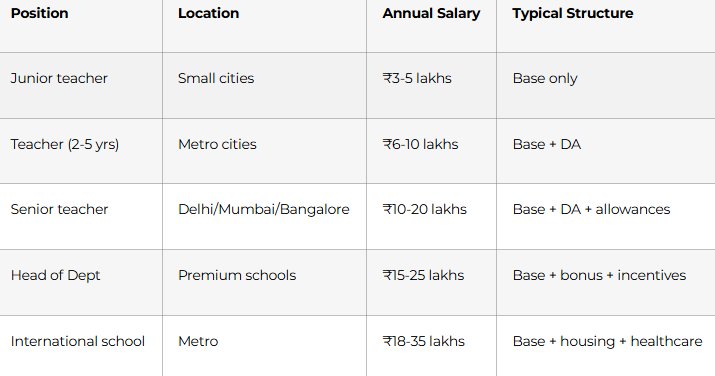
Components of compensation package:
- Base salary (main component)
- Dearness Allowance (DA) – if government/semi-government school
- Housing allowance (₹3-8 lakhs/year)
- Health insurance (₹2-5 lakhs value)
- Provident fund/gratuity
- Bonus/performance incentive
- Professional development allowance
- Leaves (paid vacation, sick leave, festive leave)
Negotiation strategy:
Step 1: Research market rates
Before any discussion, know prevailing rates for your position, experience level, location.
- Ask peers what they earn (increasingly normal)
- Check Glassdoor, PayScale, LinkedIn Salary
- Ask HR “What’s typical range for this role?”
Example research:
“Senior Math teacher, 8 years experience, Metro school: typically ₹15-22 lakhs”
This becomes your benchmark.
Step 2: When salary is first mentioned
School: “We’re offering ₹12 lakhs for this position.”
You (if lower than expected): “Thank you. I’m excited about the role. Before responding,
could you help me understand the full compensation package? What’s included besides base
salary—housing, healthcare, professional development, bonus structure?”
This gives you complete picture before reacting.
Step 3: Making your case
If offer is lower than research:
“I appreciate the offer. Based on my research and experience, comparable positions
in similar schools range ₹15-18 lakhs. I bring [specific value: IB certification,
curriculum leadership, proven student outcomes]. Would you consider ₹17 lakhs?”
Notice: You cite research, provide evidence of value, and name specific number
(not vague “more”).
Step 4: Negotiation tactics
❌ DON’T say:
- “I need at least ₹18 lakhs” (sounds demanding)
- “Other schools offered more” (accusatory, creates competition)
- “That’s not enough” (dismissive)
✅ DO say:
- “I’m very interested in this role. I’d like to discuss if we can reach [amount]”
- “Based on market data and my experience, I’m hoping we can align on [amount]”
- “I value this opportunity and want to make sure compensation reflects my contributions”
Step 5: Negotiate total package, not just salary
If school won’t increase base salary:
You: “I understand the salary constraint. Could we discuss other components?
For example:
- Professional development allowance: ₹1 lakh/year for certifications
- Performance bonus: ₹1.5 lakhs if student outcomes targets met
- Healthcare: coverage for family, not just self
- Leaves: extra 5 days annual leave”
Often schools have flexibility here even if base is fixed.
Step 6: Non-monetary negotiations
If salary truly won’t move:
“I’m committed to joining. Besides compensation, are there other things we could
discuss?
- Flexible timings for professional development?
- Remote work options for certain tasks?
- Leadership responsibilities (department head role)?
- Fast-track promotion timeline?
- Sabbatical policy?”
These add value beyond salary.
Step 7: Know your walkaway point
Before negotiation, decide: What’s minimum you’ll accept?
Example: “₹14 lakhs minimum (I won’t take less), ₹15 lakhs desired, ₹17 lakhs ideal.”
If school won’t reach minimum, you decide: Is this job worth it for other reasons
(learning opportunity, location, school mission)? Or is it genuinely unfair and not
worth taking?
Walkaway is your power—knowing when to say no.
Step 8: Get offer in writing
After verbal agreement:
“Great! I’m excited. Could you send written offer letter with all components clearly listed?
I want to ensure we’re aligned on everything.”
Written offer should include:
- Position title and reporting structure
- Salary (base + all components)
- Benefits (healthcare, leaves, allowances)
- Bonus structure (if applicable)
- Professional development budget
- Conditions and start date
- Probation period (if any)
Sample Salary Negotiation Conversation
School: “We’d like to offer you the position of English Teacher at ₹10 lakhs annually.”
You: “Thank you for the offer! I’m genuinely excited about the role and your school’s
mission. Before I respond, could you walk me through the complete package? What’s included
in the ₹10 lakhs—is that base salary with DA, or with other allowances included? And are
there other components like healthcare, housing allowance?”
School: “₹10 lakhs is base salary including DA. We provide group health insurance
and 30 leaves annually. No housing allowance for local hires.”
You: “I appreciate that. Based on my research, comparable positions for a teacher
with my 6 years experience in English, with certification and curriculum experience,
typically range ₹13-16 lakhs in similar schools. Additionally, I bring IB-training and
have improved student outcomes by 28% in my current role. Would there be flexibility
to reach ₹13 lakhs or ₹14 lakhs base?”
School: “Our budget is fixed at ₹10 lakhs. But if you’re interested, we could
offer ₹10.5 lakhs as compromise.”
You: “I appreciate the adjustment. Before deciding, a few questions:
- Is there professional development allowance for certifications?
- Are there performance bonuses based on student outcomes?
- Is there possibility for this role to include curriculum coordination (additional responsibility and compensation)?”
School: “No PD allowance currently. No performance bonus structure. But actually,
we do need someone to coordinate English curriculum revision—that’s a need. If interested,
you could take that on, and we could offer ₹12 lakhs with the curriculum coordination
responsibility.”
You: “That’s helpful. I’m very interested in curriculum work. ₹12 lakhs with
curriculum coordination role interests me. Just to confirm—what would curriculum
coordination entail? How many hours monthly? And is this reflected in job description?”
School: “5-7 hours weekly beyond teaching. You’d lead department meetings,
coordinate assessment development, oversee curriculum alignment. We’ll add to job description.”
You: “Perfect. I’m excited about this opportunity. The role, the school’s mission,
and the compensation with curriculum responsibility align well with my goals. I’m ready
to accept ₹12 lakhs plus curriculum coordination responsibilities. Could you send a
written offer letter detailing the role and compensation?”
Result: Started at ₹10L, negotiated to ₹12L + meaningful responsibility.
Your value was recognized, and you advocated effectively.
Compensation Expectations by Experience Level
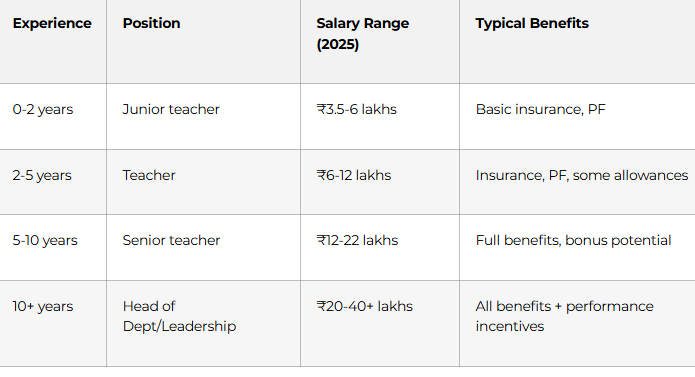
Your negotiation should reflect:
- Your experience level
- Certifications/specializations (add 10-20% premium)
- Proven student outcomes (add 15-25% premium)
- Leadership responsibilities (add 20-30% premium)
- School type (International schools pay 30-50% premium over Indian schools)
Final Interview Checklist
One week before interview:
✅ Confirm appointment: date, time, location, format (in-person/video)
✅ Research school thoroughly: mission, recent achievements, leadership
✅ Prepare 5-7 teaching stories with specific numbers
✅ Practice interview answers (record yourself, review)
✅ Prepare demo lesson (if applicable): practice 3+ times
✅ Gather documents: resume, certifications, portfolio, references
✅ Plan outfit: professional, comfortable, appropriate to setting
✅ Get good sleep
Day before interview:
✅ Review school info one more time
✅ Prepare demo lesson materials
✅ Test technology (if video interview)
✅ Plan route/arrival time
✅ Lay out outfit and materials
✅ Get adequate sleep
Morning of interview:
✅ Eat healthy breakfast
✅ Review key talking points (don’t over-study)
✅ Dress professionally
✅ Arrive 10-15 minutes early
✅ Silence phone completely
✅ Take deep breaths, calm yourself
During interview:
✅ Greet warmly, make eye contact
✅ Listen fully to each question
✅ Pause briefly before answering (shows thoughtfulness)
✅ Use specific examples with numbers
✅ Show genuine passion for teaching
✅ Ask thoughtful questions about school
✅ Maintain good posture and positive body language
✅ End with: “Thank you for this opportunity. I’m genuinely excited about contributing to your school community.”
After interview:
✅ Send thank-you email within 24 hours
✅ Reference specific discussion points
✅ Reiterate interest
✅ Follow up if timeline given

Conclusion: From Resume to Hired
Your teacher resume and interview are your professional calling cards. They determine opportunities available to you.
This guide provided:
- ✅ Resume structure that passes ATS and impresses humans
- ✅ Achievement-focused language replacing job duties
- ✅ Complete resume examples for different career stages
- ✅ Interview questions answered with strong frameworks
- ✅ Demo class structure ensuring student engagement
- ✅ Salary negotiation tactics protecting your value
The pathway is clear:
- Craft outstanding resume (1-2 days)
- Tailor for each application (30 minutes per application)
- Prepare interview stories (1 week)
- Practice demo lesson (1 week)
- Execute interview excellently (day of)
- Negotiate confidently (when offer comes)
Expected results: With this preparation, you’ll move from consideration → interview → demo lesson → offer in 4-8 weeks.
Your excellence in teaching deserves a resume, interview, and salary that reflects it. Use these tools to ensure they do.