
Career Growth & Development
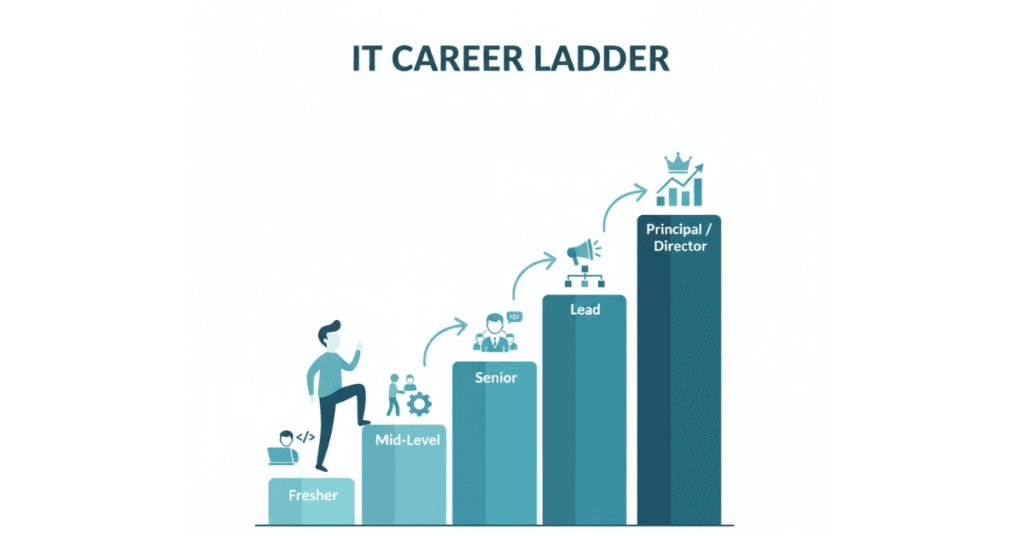
Table of Contents
Priya started as a junior developer earning ₹5.5 LPA in 2021. Fast-forward to 2025: she’s a tech lead managing a team of 8, earning ₹18 LPA with stock options. What changed? It wasn’t luck. It was strategic career decisions, continuous learning, and moving at the right times.
Most IT professionals don’t have a career map. They follow the flow, take promotions that come, and wonder why they’re not progressing faster. Understanding IT career progression changes everything.
The Career Progression Timeline: From Fresher to Senior
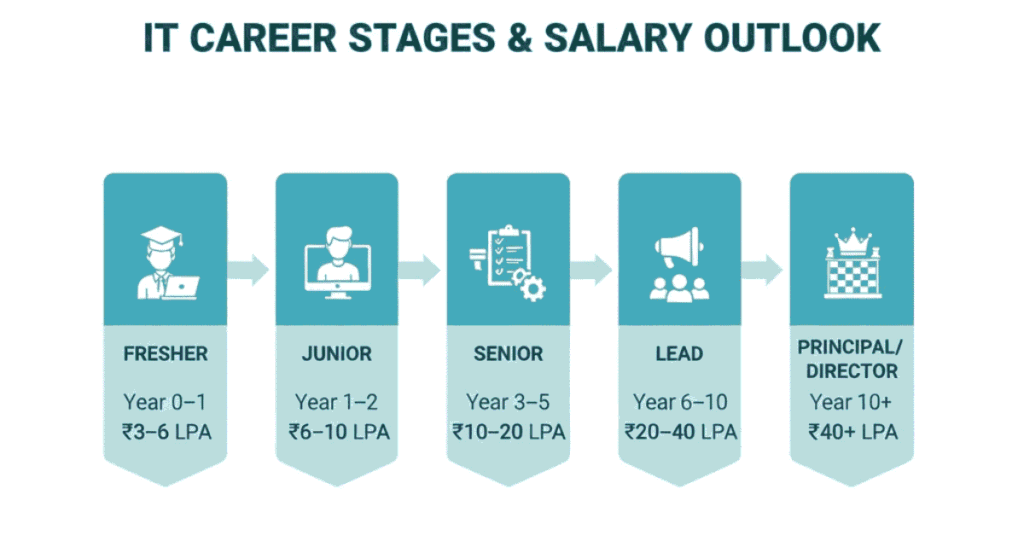
Year 0-1: Fresher/Junior (₹4-7 LPA)
What You’re Doing:
Learning the ropes, getting assigned simple tasks, building fundamentals, understanding company culture.
Expectations:
- Complete assigned tasks on time
- Learn from mentors
- Ask questions when stuck
- Show initiative for learning
- Deliver quality code/work
What Matters Most:
Reliability and learning attitude. Companies expect freshers to make mistakes; they don’t expect you to hide them or repeat them.
Mistakes to Avoid:
- Pretending to understand when you don’t
- Working in isolation without feedback
- Not asking questions
- Resisting feedback
Career Move:
Stay 1-1.5 years minimum. Build competence, contribute meaningfully, and establish credibility.
Years 1-2: Junior to Mid-Level (₹7-10 LPA)
What You’re Doing:
Taking ownership of features, mentoring juniors, participating in architecture discussions, specializing in a particular area.
Expectations:
- Deliver features independently
- Mentor junior developers
- Contribute to design decisions
- Write quality code
- Take on slightly more complex problems
What Matters Most:
Ownership and communication. Companies value people who don’t just execute but think about impact.
Skill Focus:
Deepen your specialization. If you love databases, become the database person. If you love frontend, master frontend frameworks.
Career Move:
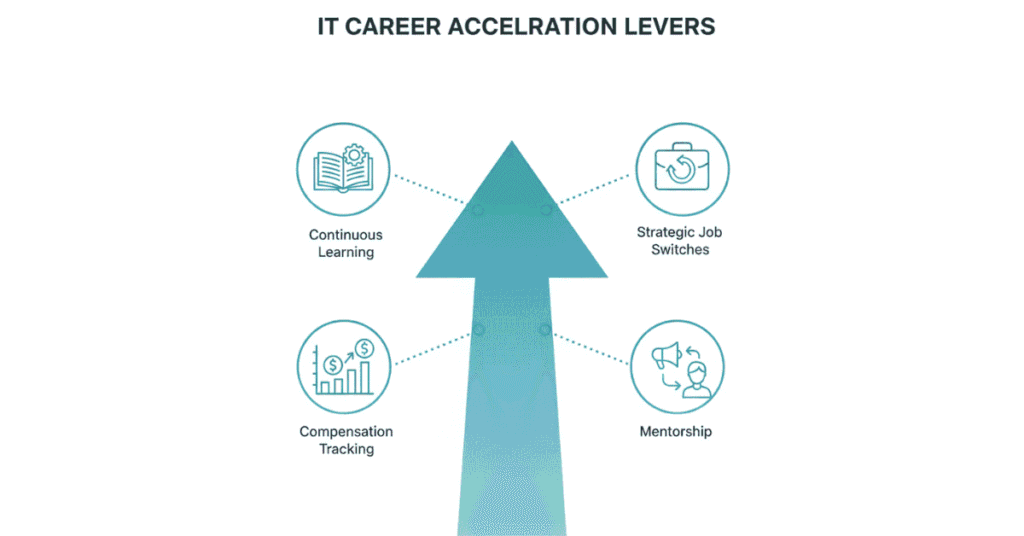
This is where you make strategic choices. If your company isn’t appreciating your growth, consider switching companies. A job switch here can increase salary by 25-35%. If internal promotion isn’t happening, external moves accelerate careers.
Years 3-5: Mid-Level to Senior (₹10-18 LPA)
What You’re Doing:
Leading projects, making architectural decisions, mentoring multiple people, contributing to hiring, representing your team in cross-functional discussions.
Expectations:
- Own entire products or large components
- Lead projects without constant supervision
- Mentor and develop junior team members
- Contribute to system architecture
- Drive improvements and innovations
- Represent your team in meetings
What Matters Most:
Leadership and business acumen. Technical skill matters, but your ability to lead, communicate, and deliver business value matters more.
Skill Focus:
Develop soft skills: communication, leadership, negotiation. These differentiate good senior engineers from great ones.
Specialization Options:
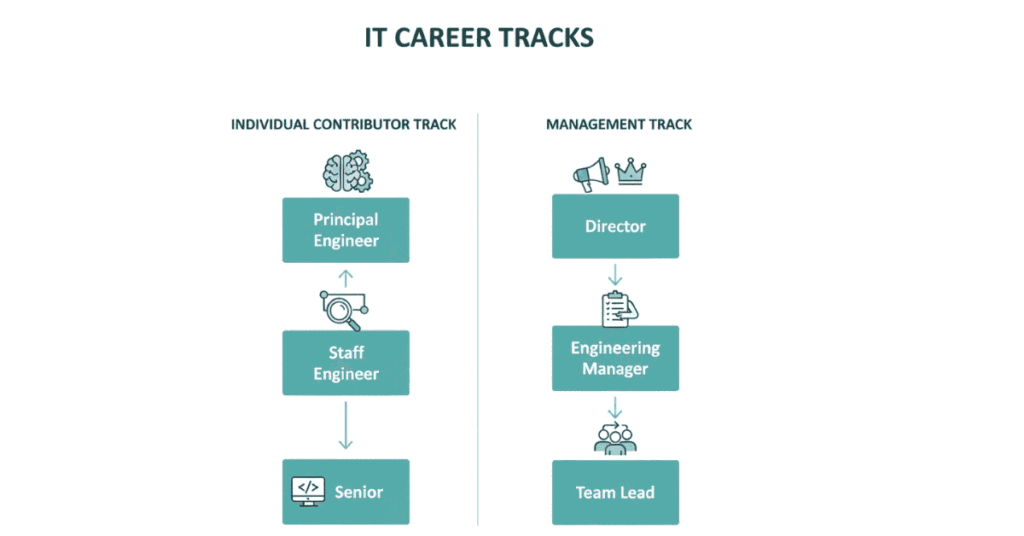
- Individual Contributor (IC) Track: Go deeper technically (Staff Engineer, Principal Engineer roles)
- Management Track: Lead people (Engineering Manager, Director)
- Hybrid: Both technical depth and some team responsibility
Career Move:
If you want to grow further, clarify your path. Do you want to go deep (IC track) or broad (management)? Your next company choice should align with this.
Years 6-10: Senior to Lead (₹18-30 LPA)
What You’re Doing:
Setting technical direction, leading multiple teams, influencing organizational strategy, interviewing and hiring, mentoring senior people.
Expectations:
- Own strategic technical decisions
- Lead multiple teams or large projects
- Contribute to organizational strategy
- Mentor senior engineers
- Represent company externally (conferences, speaking)
What Matters Most:
Impact and vision. You’re valued for what you enable others to do, not just what you do personally.
Years 10+: Principal/Director Level (₹30-50+ LPA)
You’re setting direction, influencing across the company, making strategic hires, representing the company externally.
The Specialization Decision: IC vs. Manager Track
One of IT’s biggest decisions happens around year 3-5: Do you want to go deep (Individual Contributor) or broad (Management)?
Individual Contributor (IC) Track:
Progression: Senior Engineer → Staff Engineer → Principal Engineer → Distinguished Engineer
Compensation: Senior: ₹18-25 LPA; Staff: ₹25-40 LPA; Principal: ₹40-60+ LPA
Responsibilities:
- Deep technical expertise
- Solving hard technical problems
- Setting technical standards
- Mentoring (informal)
- Architecture and design
Best For:
- People who love technology deeply
- Problem-solvers who get energized by complex technical challenges
- Those who dislike administrative overhead
- People preferring stability over rapid growth
Challenges:
- Can plateau in smaller companies (limited IC roles)
- Need to constantly learn to stay relevant
- Less direct authority than managers
Management Track:
Progression: Team Lead → Engineering Manager → Senior Manager → Director → VP
Compensation: Team Lead: ₹15-20 LPA; Manager: ₹18-28 LPA; Senior Manager: ₹28-45 LPA; Director: ₹45-70+ LPA
Responsibilities:
- Leading people
- Hiring and team building
- Performance management
- Budget and planning
- Cross-functional collaboration
Best For:
- People who enjoy developing others
- Those who like organizational impact
- People comfortable with conflict resolution
- Those seeking faster salary growth
Challenges:
- Less hands-on coding
- More administrative work
- Challenging people management situations
- Different skill set required
Honest Assessment:
Some people discover they prefer IC after trying management. Others discover management is their calling. Neither is wrong. The best companies allow transitions between tracks.
Continuous Learning: Non-Negotiable for Growth
Technology changes rapidly. Professionals who stop learning plateau quickly.
Learning Strategies:
Official Training (20% of learning):
- Online certifications
- Company-sponsored courses
- Conferences and workshops
Learning by Doing (50% of learning):
- Taking on challenging projects
- Side projects
- Open-source contributions
- Mentoring others (teaching forces deep learning)
Informal Learning (30% of learning):
- Reading articles and blogs
- Podcasts and videos
- Discussions with peers
- Online communities
Allocation:
Spend 20% of work time on learning. Most companies support this through “20% projects” or dedicated training time.
Strategic Learning:
Don’t learn randomly. Ask: “What skills will make me more valuable in 3-5 years?” Learn strategically toward that goal.
Internal vs. External Growth: Making the Move
Should You Seek Internal Promotion or Switch Companies?
Stay Internally If:
- You’re genuinely learning and contributing meaningfully
- The company is growing (expanding your opportunities)
- Your manager supports your growth
- Internal promotions are happening regularly
- You value stability and relationships
- Compensation is competitive
Switch Companies If:
- You’re not growing; just executing
- Internal promotions are stalled (you’ve been promised growth that isn’t happening)
- Your manager isn’t invested in your development
- You’ve maxed out roles in your company
- Compensation is below market rate
- You’re bored and need new challenges
Data Point:
Professionals who switch companies every 2-3 years in early-to-mid career (years 1-7) typically earn 30-50% more by year 7 than those who stay in one company. However, switching too frequently (every 6-12 months) makes you look unstable.
Optimal Strategy:
- Years 0-2: Stay, build credibility
- Years 2-5: Be open to switching; switch if growth stalls
- Years 5+: Strategic switches for big roles/compensations
Building Your Personal Brand
Career growth accelerates with visibility.
How to Build Personal Brand:
Write: Blog about technical topics, share insights on LinkedIn, contribute to publications. This positions you as an expert.
Speak: Give talks at meetups, conferences, or company events. Speaking builds credibility and networks.
Contribute: Open-source contributions get noticed. Build projects that solve real problems.
Network: Build genuine relationships with peers, mentors, and senior people in your field. Networks create opportunities.
Real Impact:
A developer with a strong personal brand gets recruited by better companies, commands higher salaries, and has more opportunities. Personal brand compounds over years.
Mentorship: Both Getting and Giving
Finding Mentors:
Early in your career, having 1-2 mentors accelerates growth significantly. Mentors provide guidance, introductions, and perspective you can’t get alone.
How to Find:
- Ask senior people you respect
- Participate in company mentorship programs
- Seek mentors at conferences or online communities
- Sometimes mentorship happens organically through projects
Becoming a Mentor:
Around year 3-4, start mentoring juniors. Teaching forces you to clarify your own knowledge and develops leadership skills.
Compensation Growth Tracking
To ensure you’re progressing fairly:
Track Your Market Value:
- Use Levels.fyi to see what others at your level/company earn
- Check Glassdoor for company salary data
- Participate in salary discussions (normalize transparency)
Negotiate Regularly:
- Many professionals forget to negotiate raises
- Promotions are opportunities to negotiate significantly (20-30% jumps possible)
- External offers are leverage for internal raises
Evaluate Total Compensation:
- Base salary is just part. Consider bonuses, stock options, benefits, flexibility.