
Interview Preparation for IT Roles
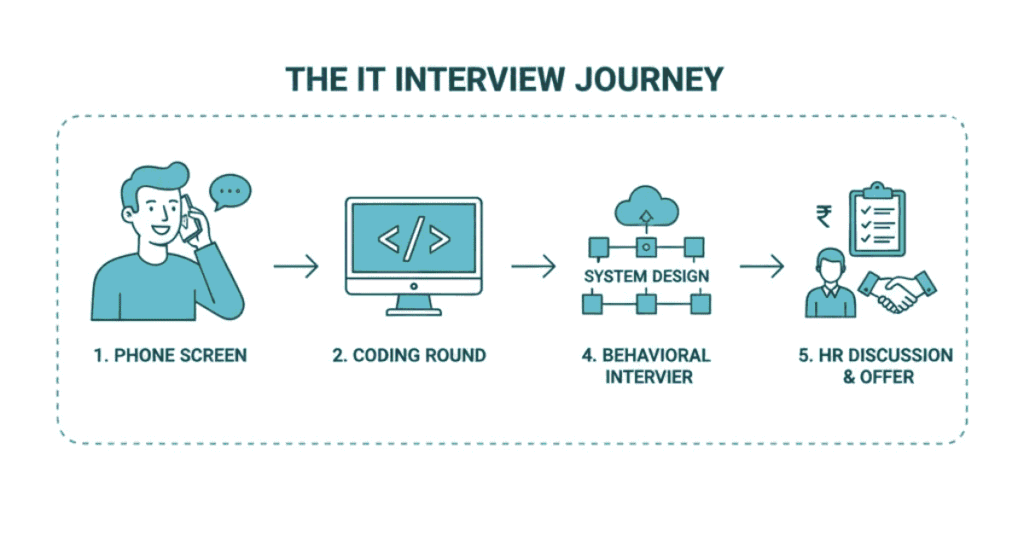
Table of Contents
Vikram sat nervously outside the interview room, palms sweating. He’d been a solid coder during practice, but something about technical interviews terrified him. When the interviewer asked “Design a system to handle 1 million users,” his mind froze. He stumbled through an answer, got rejected, and spent the next two weeks wondering what went wrong.
The truth? Technical interviews aren’t about knowing everything. They’re about thinking systematically, communicating clearly, and demonstrating problem-solving skills. Let’s break down exactly what to expect and how to ace it.
Understanding IT Interview Structure
Most IT interviews follow a predictable pattern:
Phone Screen (30 minutes): Initial conversation about background, motivation, and basic technical questions. This filters for cultural fit and baseline competency.
Technical Round 1 (60 minutes): Coding problems or technical questions specific to the role. For developers, this means writing code. For data scientists, this means explaining algorithms.
Technical Round 2 (60 minutes): Deeper problem-solving, system design, or architecture questions. Tests advanced thinking.
Behavioral Round (45 minutes): Questions about your experience, teamwork, conflict resolution. Assesses cultural fit and soft skills.
HR/Final Round (30 minutes): Compensation discussion, company culture fit, final questions.
Understanding this structure lets you prepare strategically for each stage.
Coding Interviews: The Technical Gauntlet
What to Expect:
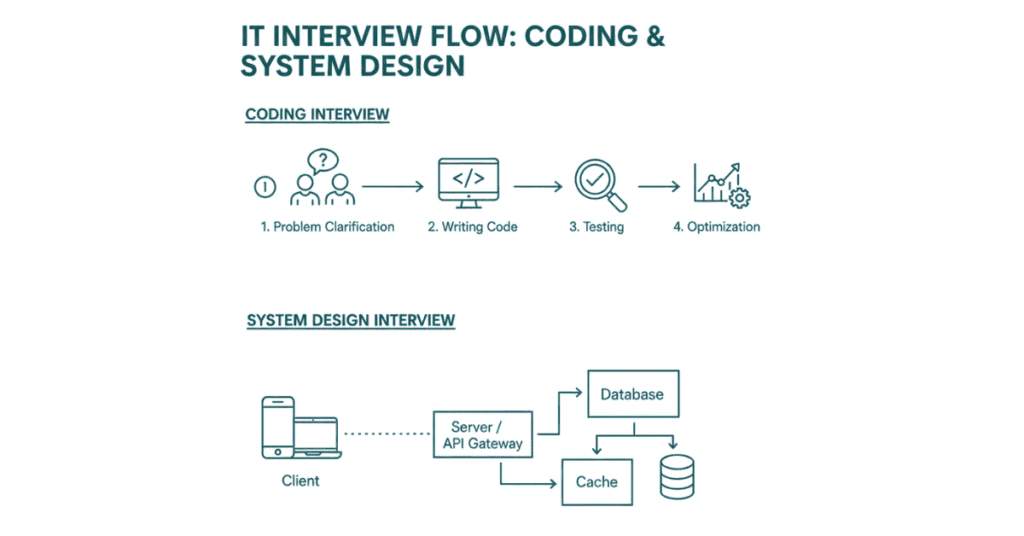
Interviewers present coding problems. You have 30-45 minutes to solve them while explaining your approach. You write code, test it, optimize it.
Common Problem Types:
Array & String Manipulation: Finding patterns, sorting, searching
Linked Lists: Reversing, detecting cycles, merging
Trees & Graphs: Traversals, shortest paths, connected components
Dynamic Programming: Optimization problems with overlapping subproblems
Hash Tables & Sets: Efficient searching and deduplication
Stacks & Queues: LIFO/FIFO problems
Preparation Strategy:
Solve 50-100 problems on platforms like LeetCode or HackerRank, focusing on medium difficulty. Don’t memorize solutions. Understand the logic, then solve variants.
During the Interview:
- Clarify the problem before coding (ask edge cases, constraints)
- Think aloud (interviewers want to see your thought process)
- Write pseudocode first before actual code
- Handle edge cases (empty arrays, null values, large inputs)
- Test your code with sample inputs
- Optimize iteratively (get a working solution first, then optimize)
Example Approach:
Problem: Find two numbers that add to a target sum
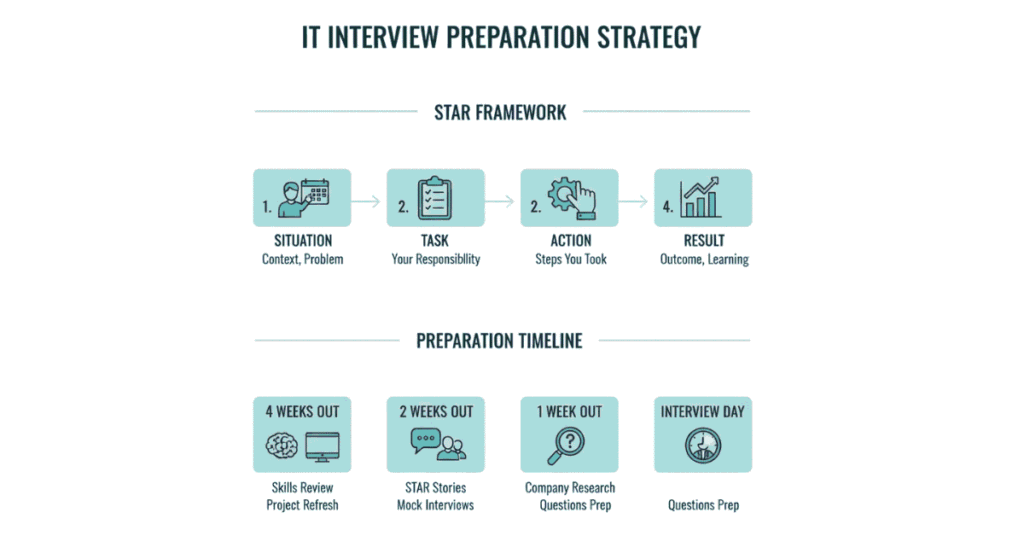
- Clarify: “Can the array have duplicates? What if no solution exists?”
- State approach: “I’ll use a hash set to track numbers I’ve seen”
- Write pseudocode
- Code it
- Test with examples
- Discuss time/space complexity
Common Mistakes to Avoid:
- Jumping to code without thinking
- Ignoring edge cases
- Not testing your code
- Over-complicating solutions
- Not communicating your approach
System Design Interviews: Thinking at Scale
Senior positions often include system design rounds.
Typical Question:
“Design Instagram” or “Design an e-commerce platform” or “Design a URL shortener”
What They’re Testing:
- Can you think about scalability?
- Do you understand databases, caching, load balancing?
- Can you make trade-offs (consistency vs. availability)?
- Do you communicate clearly?
Structured Approach:
- Requirements Clarification (5 minutes)
- Functional: What features must the system have?
- Non-functional: Scale (users, queries/sec), latency, availability requirements?
- High-Level Design (10 minutes)
- Draw architecture boxes: Client → Load Balancer → Servers → Database → Cache
- Identify major components
- Database Design (10 minutes)
- Schema design (tables, relationships)
- SQL vs. NoSQL decision
- Scalability Concerns (10 minutes)
- Caching strategy (Redis, Memcached)
- Database sharding/replication
- CDN for static content
- Message queues for async work
- Trade-offs & Justification (5 minutes)
- Why these choices?
- What would you change with different requirements?
Learning Resources:
Study “System Design Interview” by Alex Xu. Practice designing 5-10 systems before interviews.