
Education & Certifications

Table of Contents
Meera faced a choice that many aspiring IT professionals encounter. After 12th grade, she wondered: “Do I need a 4-year engineering degree? Or can bootcamps work? What about online certifications?” Her mother wanted a “safe” degree. Her friend was already learning coding through a bootcamp. The truth? Both paths work, but understanding them is crucial
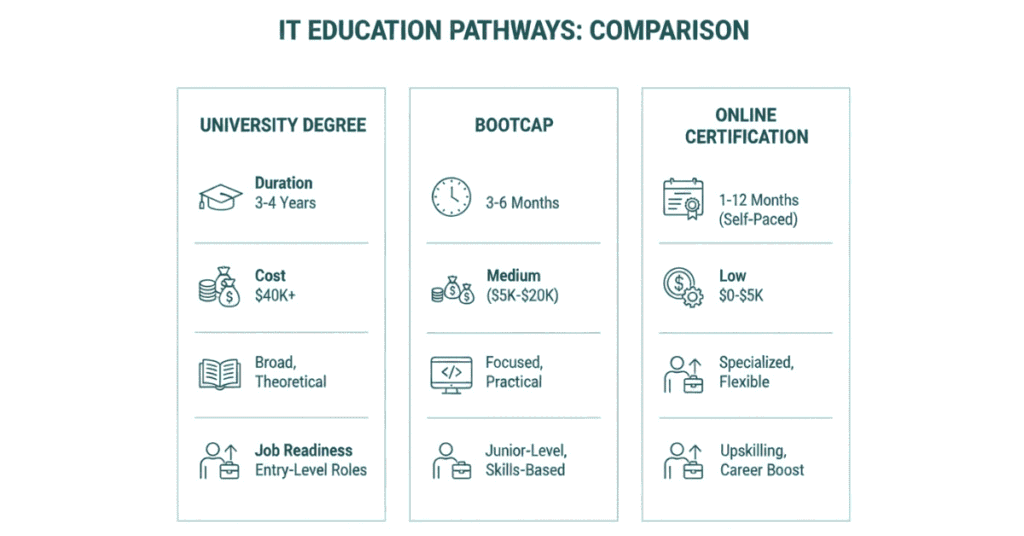
The Education Crossroads: Traditional Degree vs. Alternatives
Traditional University Degree (B.Tech / B.Sc Computer Science)
Duration: 4 years
Cost: ₹3-10 LPA (government colleges) to ₹15-30 LPA (private universities)
What You Get:
Structured curriculum covering fundamentals, internships, campus placement support, and a recognized credential.
Advantages:
- Comprehensive computer science foundation
- Campus placements with major companies
- Internship opportunities built into curriculum
- Graduate degree opens advanced opportunities
- Time to explore specializations
- Networking with batch mates
Disadvantages:
- 4-year time investment
- High cost for private institutions
- Outdated curriculum in some colleges (technology moves faster than academic updates)
- Classroom learning might feel slow for self-motivated learners
- Not all colleges offer industry-relevant training
2025 Reality Check:
A degree is still valuable, especially from recognized institutions. However, the degree alone isn’t enough. Students graduating from even good colleges struggle if they haven’t built projects or learned practically.
Who Should Choose This:
- Those who want a comprehensive foundation
- People aiming for government sector IT jobs (often requires degree)
- Those preferring structured learning environments
- Students seeking campus placements
Bootcamps & Intensive Programs (3-12 Months)
Duration: 3-12 months (varies by program)
Cost: ₹1-5 LPA depending on bootcamp quality
What You Get:
Intensive, practical training focused on immediate job readiness. Programs like coding bootcamps teach full-stack development, data science, or cybersecurity intensively.
Advantages:
- Fast, job-focused training
- Significantly cheaper than 4-year degree
- Hands-on project-based learning
- Direct industry mentorship
- Placement assistance upon completion
- Skip irrelevant theory; focus on practical skills
Disadvantages:
- No degree credential (though certificates help)
- Intense pressure and fast pace
- Limited depth in computer science fundamentals
- Quality varies dramatically by bootcamp
- Some employers still prefer degrees
- Less time for exploration
2025 Reality Check:
Bootcamps work excellently for motivated individuals. However, bootcamp graduates often face a barrier with traditional companies preferring degree holders. Startups and smaller companies increasingly hire bootcamp graduates based on skills.
Who Should Choose This:
- Career changers with limited time
- Highly self-motivated individuals
- Those targeting startup roles
- People wanting quick market entry
- Those with budget constraints
Online Certifications (Self-Paced)
Duration: 1-12 months (depends on commitment)
Cost: ₹500-50,000 depending on certification
What You Get:
Specialized training in specific skills (AWS, Kubernetes, Python, etc.). Platforms like Coursera, Udemy, LinkedIn Learning, and official certifications (AWS Certified Solutions Architect, etc.).
Advantages:
- Extremely affordable
- Learn at your own pace
- Flexible around work/studies
- Get recognized credentials
- Focus on specific, high-demand skills
- No prerequisites (generally)
Disadvantages:
- Requires self-discipline (high dropout rates)
- No structured career guidance
- Limited networking opportunities
- Employers value certifications less than degrees
- No dedicated placement support
- Risk of getting lost with so many options
2025 Reality Check:
Certifications are complementary, not replacements for education. A graduate with a degree + AWS certification beats both a degree holder without certifications and a bootcamp graduate without formal credentials.
Who Should Choose This:
- Current students supplementing their degree
- Professionals upskilling in new areas
- Self-disciplined learners
- Those seeking specific technical credentials
- Budget-conscious learners
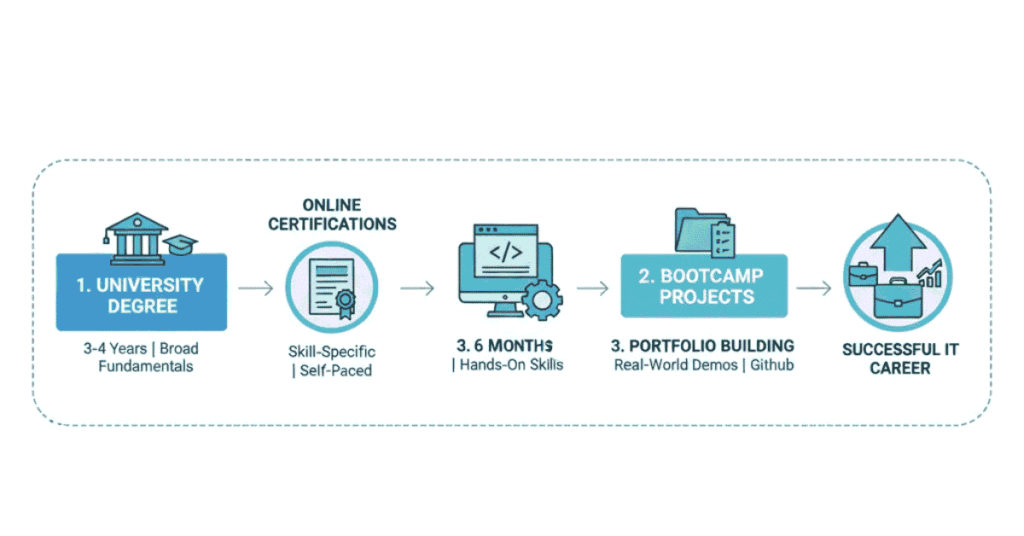
The Hybrid Approach: The Smart Path
Most successful IT professionals don’t choose one path—they blend them.
Example Path 1 (The Student):
- Year 1: Start B.Tech, complete first-year fundamentals
- Year 2-3: During college, take online specialization courses (Python, Cloud, etc.)
- Year 4: Complete bootcamp-style intensive project work, build portfolio
- Result: Graduate with degree + specialized skills + portfolio
Example Path 2 (The Career Changer):
- Enroll in 3-month bootcamp for full-stack development
- Simultaneously pursue AWS certification online (part-time)
- Build portfolio projects using bootcamp learning
- Result: Ready for job market within 6 months with bootcamp training + certification
Example Path 3 (The Self-Taught Professional):
- Self-learn through free resources and paid courses
- Complete 2-3 high-demand certifications (AWS, Azure, Kubernetes)
- Build 5-10 portfolio projects
Result: Strong portfolio compensates for lack of formal degree when applying to startups

Essential IT Certifications by Specialization
For Software Developers:
- AWS Certified Developer Associate (for cloud-aware developers)
- Kubernetes Application Developer (for container specialists)
- Java/Python professional certifications (if specializing in specific languages)
For Data Scientists:
- AWS Certified Machine Learning Specialty
- Google Cloud Professional Data Engineer
- Tableau or Power BI certifications
For Cybersecurity Professionals:
- CompTIA Security+
- Certified Ethical Hacker (CEH)
- AWS Certified Security Specialty
For Cloud Professionals:
- AWS Certified Solutions Architect (Associate, then Professional)
- Microsoft Azure Administrator
- Google Cloud Associate Cloud Engineer
For DevOps Engineers:
- AWS Certified DevOps Engineer
- Kubernetes Application Developer
- Docker Certified Associate
For Project Managers (IT):
- PMP (Project Management Professional)
- Scrum Master (CSM)
- ITIL Foundation
Certification ROI in 2025:
A relevant certification can justify ₹1-3 LPA salary increase. They demonstrate current knowledge and commitment to the field.
Which Certifications Matter Most:
Focus on certifications with high market demand. AWS certifications are currently the most valued, followed by Azure and Kubernetes. Generic certifications that everyone has (like basic CompTIA A+) are less differentiating.
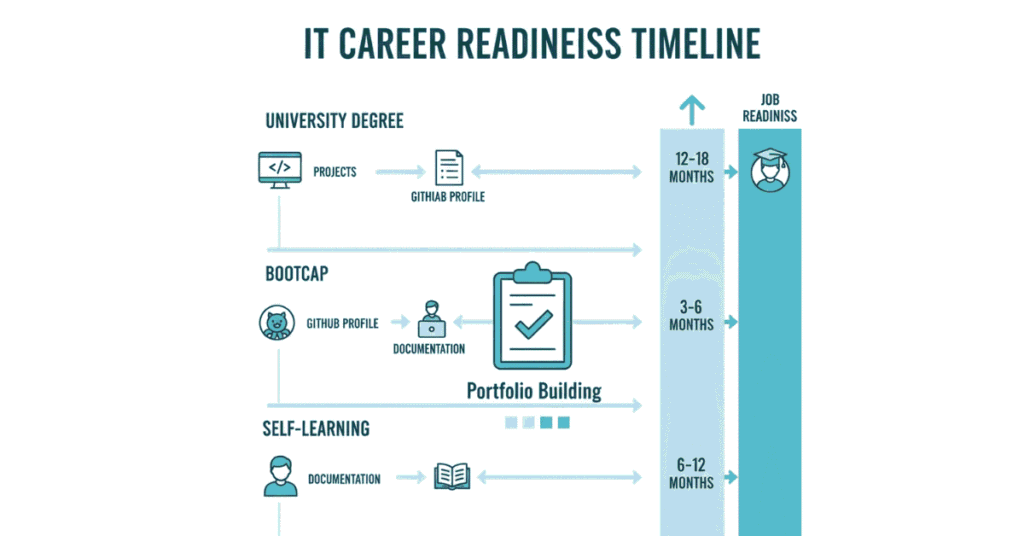
Building a Portfolio: Your Best Credential
In 2025, portfolio projects are increasingly important. Here’s why: portfolio demonstrates actual capability.
What to Build:
- Project Complexity: Simple to intermediate projects that showcase your learning
Examples:
- For Web Developers: Build a full-stack application (frontend + backend + database)
- For Data Scientists: Complete a data analysis project with predictions
- For Mobile Developers: Build a useful mobile app
- For DevOps: Deploy an application infrastructure using Kubernetes
- Relevance: Build projects using in-demand technologies
If you’re learning Python, build with Django or FastAPI, not outdated frameworks. If learning DevOps, use Docker and Kubernetes, not traditional VM setups.
- Documentation: Document your projects well
Include README files, explain your approach, discuss challenges and solutions. Companies value clear communication.
- Open Source Contributions: Contribute to popular open-source projects
This demonstrates ability to work with production code, follow conventions, and collaborate.
GitHub Profile:
Push projects to GitHub with clear documentation. Your GitHub profile becomes your resume for many employers, especially startups.
Realistic Timeline:
Building 3-5 solid portfolio projects takes 3-6 months if you’re dedicated. That’s your insurance policy for landing jobs.
Online Learning Platforms: Where to Learn
Free Resources:
- YouTube (FreeCodeCamp, Traversy Media, Academind)
- GitHub learning resources
- Codecademy free tier
- Udemy free courses
Paid Quality Platforms:
- Coursera: University-backed courses, good for structured learning (₹1,000-5,000 per course)
- Udemy: Affordable courses, huge variety, quality varies (₹300-1,500 per course during sales)
- LinkedIn Learning: Professional development, integrated with LinkedIn
- Pluralsight: Technology-focused, high quality (subscription model)
- DataCamp: Specializes in data science and analytics
- Official Certification Programs: AWS, Azure, Google Cloud official training
For Indian Learners:
- Unacademy (Indian platform with quality educators)
- Scaler Academy (formerly Coding Ninjas) – focused on career transitions
- NASSCOM courses – Indian IT association offerings
The Degree Requirement: Still Relevant?
Here’s the honest answer: It depends on your target.
Degree Required:
- Government IT sector jobs (mandate)
- Large IT services companies like TCS, Infosys (often prefer graduates initially)
- International opportunities requiring formal credential
Degree Not Critical:
- Startups (skill-focused hiring)
- Product companies (GitHub portfolio often more important)
- Freelancing and gig work
- Remote work for international companies
2025 Trend:
Skill-based hiring is increasing. More companies care about what you can do, not just credentials. However, a degree is still a safety net. It opens more doors even if not strictly necessary.
Strategic Recommendation:
If possible, pursue a degree while simultaneously building skills and portfolio. Best of both worlds. If forced to choose due to constraints, prioritize skills and portfolio, especially if targeting startups.
Time to Job: Realistic Timelines
With B.Tech + Campus Placement:
Degree (4 years) → Campus recruitment → Job secured before graduation (4 years total)
With Bootcamp:
Bootcamp (3-6 months) → Build portfolio (1-2 months) → Job search (1-3 months) → Employment (5-11 months total)
With Self-Learning:
Self-learn (3-6 months) → Build portfolio (2-3 months) → Job search (2-4 months) → Employment (7-13 months total)
With Bootcamp + Degree (Hybrid):
Start degree → Year 2-3 add bootcamp training → Year 4 graduation with specialization → Job immediately