
UGC NET Complete Guide: Your Pathway to College Teaching & Research
Table of Contents

Have you ever wondered what separates a brilliant subject expert who teaches in college from one who only knows their subject deeply but never gets the opportunity to teach? The answer, for most aspiring college professors in India, is a single exam: the UGC NET (National Eligibility Test). If your dream involves standing in front of university students, conducting groundbreaking research, or leading academic institutions, understanding UGC NET isn’t optional—it’s foundational.
Unlike school teaching where B.Ed and state-level TET suffice, higher education in India has a national gateway: UGC NET. This comprehensive guide walks you through everything—from basic eligibility through becoming a tenured Associate Professor. Whether you’re a fresh post-graduate uncertain about taking this path, or a Master’s degree holder ready to commit to academia, this guide answers every question about launching a college teaching career through UGC NET.
Part 1: Understanding UGC NET—What Is It, Really?
The Fundamentals
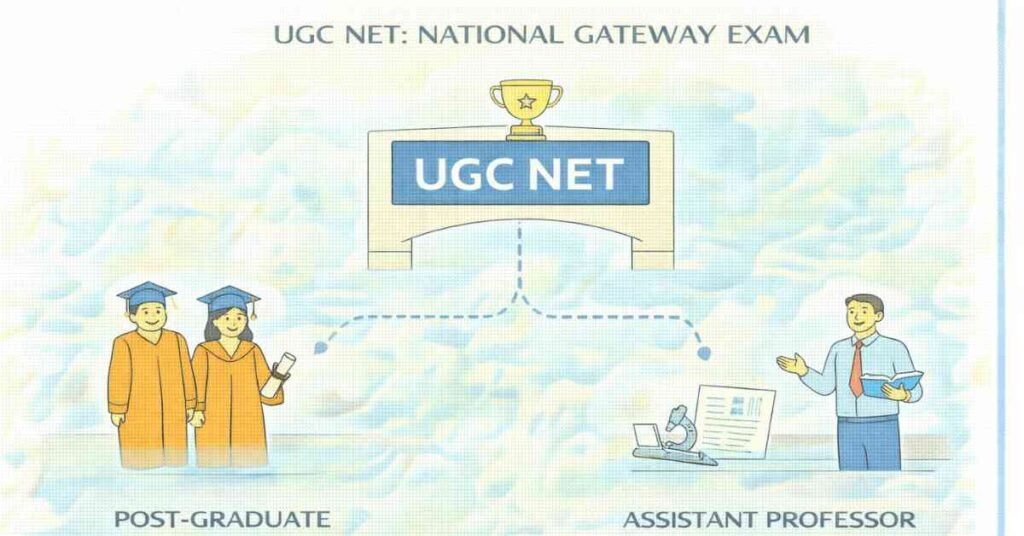
UGC NET isn’t just another exam—it’s the national standard determining who gets to teach in India’s universities and colleges. The National Testing Agency (NTA), on behalf of the University Grants Commission (UGC), conducts this exam to identify candidates eligible for two distinct career paths: becoming a Junior Research Fellow (JRF) for PhD studies, or becoming an Assistant Professor in colleges and universities.
Think of UGC NET as the national quality control mechanism for higher education. Before someone can teach undergraduate and postgraduate students at government or recognized private universities, they must demonstrate through this exam that they possess necessary subject knowledge, research aptitude, teaching ability, and academic integrity.
Two opportunities annually: UGC NET is conducted twice yearly—typically in June and December—giving multiple attempts without waiting years between attempts. This frequency actually benefits candidates because you can take the exam multiple times until qualifying, unlike some competitive exams with limited attempts.
85 subjects to choose from: Whether your passion is Hindi Literature, Computer Science, Psychology, Chemistry, Management, Law, or any of 85+ disciplines, there’s a UGC NET subject for you. You choose your subject based on your Master’s degree specialization.
Why UGC NET Matters for Your Career
Clearing UGC NET fundamentally changes your career trajectory:
For JRF candidates: You receive a prestigious Junior Research Fellowship stipend of ₹37,000 monthly for pursuing PhD, which increases to ₹42,000 as Senior Research Fellow in the third year. This stipend makes PhD pursuit financially viable for scholars who can’t afford self-funded research.
For Assistant Professor candidates: You become eligible to apply for college teaching positions across India in government and private universities, with starting salary of ₹57,700 basic pay (grossing around ₹75,000-₹80,000 monthly with allowances). This represents a significant income upgrade compared to school teaching.
Beyond immediate benefits, UGC NET qualification opens scholarly networks, research opportunities, conference participation funding, and pathways to leadership positions like department head, dean, and eventually vice-chancellor. The qualification itself carries prestige in academia—it’s India’s benchmark for academic excellence.
Part 2: Eligibility Criteria—Can You Actually Qualify?
Before investing months in preparation, verify you meet eligibility requirements.

Educational Qualification Requirements
Master’s degree is mandatory from a UGC-recognized university in a relevant discipline. You cannot appear for UGC NET with only a Bachelor’s degree—graduate education is a non-negotiable prerequisite.
Marks requirement: You need at least 55% marks (or equivalent grade) in your Master’s degree final examination. For candidates belonging to Scheduled Caste (SC), Scheduled Tribe (ST), Other Backward Class (OBC-NCL), Persons with Disability (PwD), or Transgender categories, the requirement is relaxed to 50% marks.
Special category relaxation: PhD degree holders whose Master’s exams were completed on or before September 19, 1991 (regardless of when results were declared) get a 5% marks relaxation—meaning they need only 50% marks instead of 55%, even if they belong to general category.
Appearing final year candidates: If you’re currently pursuing your Master’s degree and are in the final year examination, you can apply for UGC NET provisionally. However, you must complete your Master’s degree with the required percentage marks within two years of the NET result. Failure to do this renders you disqualified retroactively.
Age Limits
Here’s something many candidates misunderstand—age restrictions differ by position:
For JRF (Junior Research Fellowship): You must be under 30 years old as of the first day of the month in which the exam concludes. For a December 2025 exam, age is calculated as of December 1, 2025. This age limit applies regardless of caste or category.
For Assistant Professor position: There is absolutely no upper age limit. You can qualify for Assistant Professor positions at age 35, 45, or 55—age doesn’t matter. This opens opportunities for career switchers who want to enter academia after other professions.
For PhD admission: Age limit is relaxed to 35 years for SC/ST/OBC-NCL/PwD categories, with no limit for general candidates.
Nationality and Residency
UGC NET is available only to Indian nationals. Foreign nationals cannot appear for this exam to become Assistant Professors in Indian universities.
Part 3: Exam Pattern Demystified—What You'll Actually Face
Understanding the exam structure helps you plan preparation strategically.
Overall Structure
UGC NET consists of two papers conducted in a single 3-hour session with no break between them. You cannot leave after Paper 1 and return for Paper 2—the entire exam happens continuously in three hours.
Paper 1: General Teaching & Research Aptitude (50 questions, 100 marks, 1 hour)
This paper tests whether you possess basic teaching and research competencies beyond subject knowledge.
Topics covered include:
- Teaching Aptitude (10-15 questions) covers teaching methods, communication skills, learner psychology, and classroom management principles
- Research Aptitude (10-15 questions) focuses on research methodology, research ethics, hypothesis formulation, and data analysis principles
- Reading Comprehension (5-10 questions) tests your ability to understand written passages and answer questions based on them
- Logical Reasoning (10-15 questions) includes verbal reasoning (analogies, classifications) and non-verbal reasoning (pattern recognition)
- Communication Skills (5-10 questions) assess written and oral communication effectiveness
- ICT (Information and Communication Technology) (5-10 questions) test basic computer literacy, internet knowledge, and educational technology awareness
- People and Environment (5 questions) covers environmental issues, sustainability, and human ecology
- Higher Education System (5-10 questions) focuses on understanding Indian education structure, policies, and governance
Key insight: Paper 1 is often overlooked by candidates who focus entirely on their subject. Yet 25% of your total score comes from Paper 1. Even subject experts often score poorly on Paper 1 if they don’t specifically prepare for teaching and research concepts.
Paper 2: Subject-Specific Knowledge (100 questions, 200 marks, 2 hours)
Paper 2 is where your Master’s degree subject knowledge matters. You answer 100 multiple-choice questions from your chosen subject, carrying 200 marks.
The questions test:
- Deep subject conceptual understanding, not surface memory
- Application of concepts to real-world scenario
- Critical analysis and problem-solving in your discipline.
- Recent developments and contemporary issues in your field
- Connections between topics (integrative questions testing how concepts relate)
Key insight: Paper 2 requires advanced Master’s-level knowledge. If you studied for your Master’s exam by memorizing textbooks, you’ll struggle with Paper 2, which expects deeper conceptual understanding.
Marking and Qualifying Criteria
No negative marking: This is crucial—incorrect answers don’t reduce your score. This means you should attempt every question; leaving blanks costs you marks while wrong answers cost you nothing.
Total 300 marks: 100 from Paper 1 + 200 from Paper 2.
Qualifying marks: Approximately 40% overall (120 marks out of 300) is typically required to qualify for JRF or PhD admission. For Assistant Professor eligibility, slightly higher marks (around 45-50% depending on subject difficulty and competition) are usually needed.
Percentile-based selection: While minimum marks are fixed, your actual ranking depends on your percentile within your subject category. Scoring 130 marks in a difficult subject might rank higher than 150 marks in an easier subject.
Part 4: UGC NET Preparation—Strategic Approach
Study Timeline and Schedule
Realistic preparation duration: Most successful candidates prepare for 4-6 months dedicatedly before appearing. Some people prepare in 3 months with intense focus, while others take 8-9 months with casual study.
Ideal study hours: Target 4-5 hours daily of focused study. This breaks down as:
- 1-1.5 hours for Paper 1 topics (teaching aptitude, research methods, ICT, reasoning)
- 2.5-3.5 hours for Paper 2 subject-specific content
- 0.5-1 hour for mock tests and previous year questions
Study schedule structure: Create weekly plans dividing Paper 1 topics across the week, dedicate weekends to full-length mock tests, revise completed topics every week, and gradually increase practice test frequency as exam approaches.
Essential Study Strategy
Understand the syllabus completely before opening any study material. Download the official syllabus from ugcnet.nta.ac.in, read every topic listed, and note topics you find unfamiliar.
Divide topics by difficulty: Mark topics as easy, moderate, or difficult based on your current understanding. Allocate study time proportional to difficulty—spend more time on difficult topics.
Use official resources first:
For Paper 1, NCERT textbooks (especially Class 11-12 for reasoning, class 12 Biology for environment) provide foundational knowledge. For research methods, books like “Research Methodology” by C.R. Kothari are standard references.
For Paper 2, consult your Master’s degree textbooks—they’re your primary resource. Don’t search for external books unless your own textbooks feel inadequate.
Previous year question papers are gold: Solve at least 5-10 years of previous UGC NET question papers for your subject. This reveals question patterns, frequently asked topics, and question difficulty. You’ll notice many questions ask about similar concepts from different angles.
Mock tests simulate real conditions: Take full-length mock tests (150 questions in 3 hours) bi-weekly initially, then weekly as exam nears. This develops speed, accuracy, and stamina. Analyze mock test performance meticulously—identify weak topic areas and revisit them.
Paper-Specific Preparation Tips
For Paper 1:
- Don’t memorize teaching methods—understand their application in real classrooms
- Practice reasoning puzzles regularly (daily if possible) to build pattern recognition
- Read current affairs related to education policy—3-4 hours monthly keeps you updated
- For ICT section, understand concepts rather than memorizing technical terms
For Paper 2:
- Create concept maps showing how different topics connect
- Answer questions by explaining not just correct options but why others are wrong
- Read recent research papers in your field (2-3 papers monthly) to stay current
- Discuss complex concepts with peers or mentors—explaining aloud reveals understanding gaps
Part 5: JRF vs Assistant Professor—Two Distinct Pathways
Qualifying UGC NET opens two different career paths, and understanding these helps you aim for the right target.

Junior Research Fellowship (JRF)
JRF is designed for candidates wanting to pursue PhD with financial support.
What you get:
- ₹37,000 monthly stipend for first two years of PhD
- Upgrade to ₹42,000 monthly as Senior Research Fellow (SRF) from third year onward.
- House Rent Allowance if staying away from university
- Contingency grants for research expenses.
- Registration as regular PhD scholar at your chosen university
Duration: JRF is typically valid for 5 years—you must complete your PhD within this period. After 5 years, even if PhD is incomplete, JRF benefits cease.
Path after JRF: After completing PhD as JRF, you’re eligible to apply for Assistant Professor positions with an advantage—universities prefer PhD holders who’ve conducted supervised research. Many universities fast-track PhD holders into senior-level academic positions.
Who should target JRF: Candidates under 30 passionate about research, wanting to explore academic frontiers, and willing to invest 5+ years in PhD. If you love asking “why,” designing experiments, publishing research papers, and contributing to your discipline’s knowledge, JRF is your path.
Assistant Professor Eligibility
Assistant Professor eligibility through UGC NET is for candidates (regardless of age) wanting to teach immediately without waiting for PhD completion.
What you get:
- Immediate appointment as Assistant Professor (Entry Level) in colleges/universities
- Basic pay of ₹57,700 monthly, growing to approximately ₹75,000-₹80,000 with allowances
- Permanent or tenure-track positions in government colleges/universities
- Research opportunities—most Assistant Professors conduct research alongside teaching
- Clear promotion pathway: Senior Scale after 4-6 years, Selection Grade after 6-8 years, Associate Professor after 8-10 years
What Assistant Professors do: Teach undergraduate and postgraduate courses, guide student projects, conduct research, publish papers in journals, serve on department committees, mentor junior faculty, and participate in institutional governance.
Who should target this: Candidates wanting immediate employment, financial stability, and career progression. If you’re 35, have 10 years of work experience, want to shift to academia with financial security, Assistant Professor path suits you.
The Strategic Choice
Choose JRF if: You’re under 30, passionate about research, willing to support yourself on ₹37,000-₹42,000 monthly for 5 years. Consider that ₹37,000 is modest—you’ll live on a tight budget. JRF is an investment in your academic future.
Choose Assistant Professor if: You want immediate stable employment, need higher income, have family responsibilities, or are older than 30. As Assistant Professor, you can still conduct research while earning good salary.
Many successful academics do both: start as Assistant Professor, pursue PhD part-time or after a few years, then transition to senior positions with both teaching and research credentials.
Part 6: Career Progression—From Assistant Professor to Professor
UGC NET appointment as Assistant Professor is just the beginning.

The Promotion Ladder
Assistant Professor (Entry Level):
- Basic pay: ₹57,700; Gross with allowances: ₹75,000-₹80,000 monthly
- Responsibilities: Full-time teaching (12-18 hours weekly), curriculum design, student mentoring, departmental duties
- Duration: 4-6 years before first promotion
Assistant Professor (Senior Scale):
- Basic pay increases to approximately ₹62,000 (exact amount per 7th Pay Commission)
- Gross salary around ₹80,000-₹90,000 monthly
- Added responsibility: Lead research initiatives, guide department curricula
Assistant Professor (Selection Grade):
- Basic pay rises further to around ₹67,000
- Gross salary approximately ₹90,000-₹1,00,000 monthly
- New roles: Chair important committees, lead research centers
Associate Professor:
- Reached after approximately 8-10 years of service
- Basic pay increases significantly to around ₹77,000-₹85,000
- Gross salary ₹1,00,000-₹1,15,000 monthly
- Responsibilities expand to mentoring other faculty, senior administrative roles
Full Professor:
- Achieved after 15-20+ years of service with demonstrated excellence
- Basic pay ₹90,000-₹1,10,000
- Gross salary ₹1,20,000-₹1,50,000+ monthly
- Role: Academic leader, research mentor for entire department, university policy maker
Leadership Positions:
- Head of Department, Dean, Pro-Vice-Chancellor, Vice-Chancellor
- Salaries vary but reach ₹1,50,000-₹3,00,000+ for senior leadership
What Determines Promotion Speed?
Seniority isn’t automatic—you need:
- Strong teaching evaluations from students
- Published research—minimum 10 papers for Associate Professor promotion
- Successful PhD student supervision—at least 1-2 completed PhDs
- Sponsored research projects bringing funding to the institution
- Administrative or committee contributions
- Recognition in your field through awards, conferences, or consultancy
Exceptional performers can progress faster; those coasting through reach senior levels slowly.
Part 7: PhD Exemption—Alternative Routes
Here’s what many candidates don’t know: UGC NET isn’t the only path to college teaching.
PhD Holders and UGC NET Exemption
If you hold a PhD degree earned through formal research evaluation (with external examiners and viva voce defense), you’re exempt from UGC NET. You can directly apply for Assistant Professor positions.
However, the exemption has conditions:
- Your PhD must be from a UGC-recognized university
- The degree must be awarded through proper research methodology with external examiners
- Coursework-based doctorates (without thesis and viva) may not qualify—check your university’s rules
Practical consideration: While exemption exists theoretically, many universities prefer UGC NET qualification even from PhDs—it’s considered a national quality benchmark. So even if exempted, some PhDs take UGC NET for better opportunities.
Part 8: Common Misconceptions About UGC NET
"I need to be brilliant in my subject to pass UGC NET"
False. UGC NET tests application of concepts, not rote memorization. Many top-ranking NET qualifiers aren’t the “topper” types—they’re strategic thinkers who understand how concepts work. Someone with average grades in their Master’s can qualify if they prepare strategically.
"I can prepare in 2 months"
Unlikely for most candidates. While some exceptional students manage it, 4-6 months is realistic for thorough preparation. Rushing preparation leads to gaps in understanding that surface when facing tricky questions.
"I must join coaching to pass UGC NET"
Coaching helps but isn’t mandatory. Self-study using textbooks, previous papers, and online resources works equally well if you’re disciplined. Coaching’s real advantage is structured guidance and doubt-clearing.
"It's impossible to qualify on first attempt"
Not true. Around 4-5% of candidates qualify in their first attempt. While this percentage sounds low, remember lakh of candidates appear. Among those who prepare seriously for 5-6 months, first-attempt success rates rise to 15-20%.
Part 9: Your Action Plan—Starting Your UGC NET Journey
If you're in final year of Master's degree:
- Decide which path interests you: JRF or Assistant Professor
- Download the official UGC NET syllabus for your subject from ugcnet.nta.ac.in
- While completing your Master’s, note difficult concepts to revisit during dedicated NET preparation
- Score well in your Master’s—better grades make final year subjects clearer
- Begin reading previous year NET questions in your subject
If you've recently completed your Master's:
- Register on ugcnet.nta.ac.in and stay updated on exam notifications
- Decide your target exam month (next June or December)
- Plan 4-6 month preparation timeline backward from your target exam
- Gather study materials: textbooks, previous papers, online courses
- Join an online community of NET aspirants for motivation and doubt-clearing
If you're considering career switch to academia:
- Verify you have Master’s degree with 55% marks from recognized university
- Check age limits—if under 30, you can target JRF; no limit for Assistant Professor
- Plan 5-6 month preparation timeline accounting for refreshing Master’s concepts
- Focus on Paper 1 preparation since subject concepts might have faded
- Look for assistant roles in universities while preparing—network with faculty