
Government Teacher vs Private School Teacher: Which Career Path is Right for You?
Table of Contents
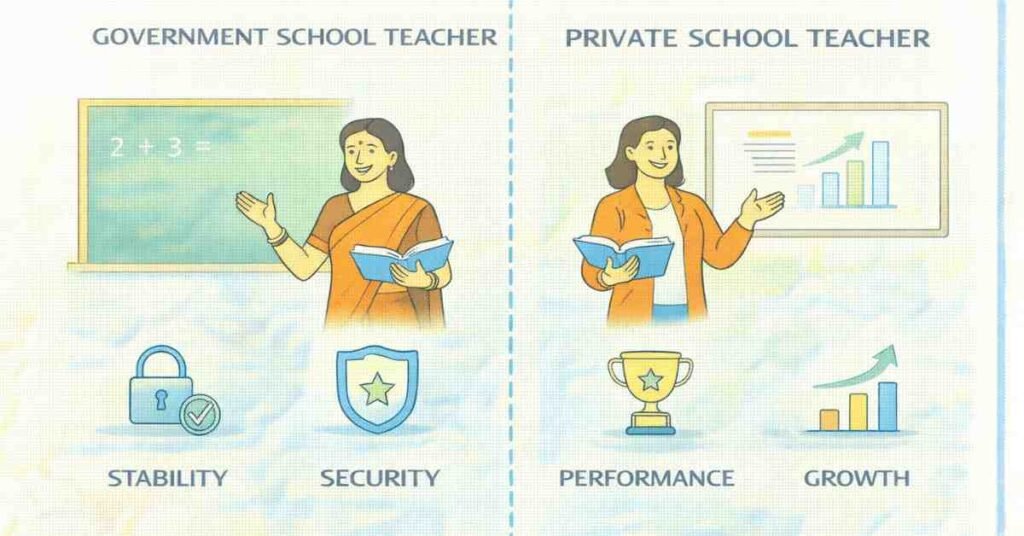
You’ve cleared your B.Ed and passed CTET or state TET—congratulations! But now comes the real crossroads: do you chase the security of government teaching jobs, or embrace the dynamic energy of private schools? Both paths lead to fulfilling teaching careers, but they’re fundamentally different journeys with distinct tradeoffs. Understanding these differences helps you make a decision aligned with your values, financial needs, and lifestyle preferences.
Think of it this way: choosing between government and private teaching is like choosing between a sturdy house with a fixed mortgage versus a modern apartment with variable rent. Both provide shelter, but the experience, commitment, and lifestyle are quite different. Let’s break down what you actually need to know to make this crucial career decision.
Part 1: The Salary Story—What You'll Actually Take Home
Let’s address the elephant in the room: money matters. How much you earn shouldn’t be the only factor, but it’s definitely a legitimate one.
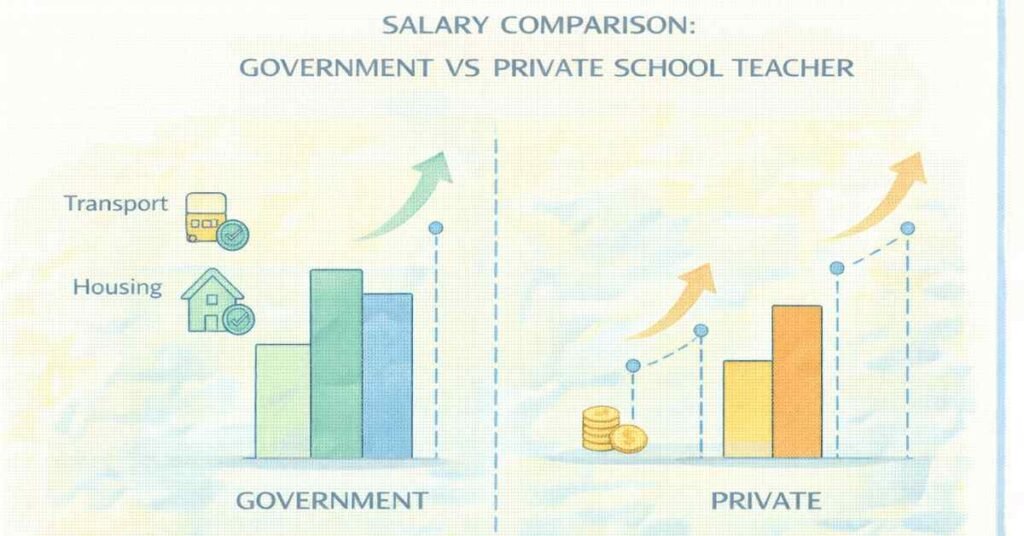
Government Teacher Salaries: Transparent and Structured
Government teaching offers remarkable salary clarity. Your compensation follows a fixed pay scale, meaning you know exactly what you’ll earn, how much it increases yearly, and what additional allowances you’ll receive.
Starting salaries for government teachers in 2025:
Primary Teachers (PRT) start with a basic pay of ₹35,400 per month, plus allowances like 12% Dearness Allowance (DA) and House Rent Allowance (HRA) of 10-30% depending on your posting location. Your gross salary (before tax) typically works out to ₹40,000-₹50,000 monthly. This means your take-home after income tax is approximately ₹35,000-₹42,000.
Trained Graduate Teachers (TGT) earn basic pay starting at ₹44,900 per month. With the same allowances and benefits, your gross salary reaches ₹50,000-₹65,000, with take-home around ₹42,000-₹55,000 monthly.
Post-Graduate Teachers (PGT) begin at ₹47,600 basic pay. Adding allowances, your gross salary is ₹53,300-₹70,000 monthly. The net after tax is typically ₹45,000-₹60,000.
Annual salary progression: Your salary isn’t stagnant. You receive 3% annual increments based on basic pay plus regular biannual DA revisions. After 5 years of service, expect your salary to increase by 40-50%. A PRT earning ₹40,000 monthly will earn approximately ₹55,000-₹60,000 after 5 years, and ₹70,000-₹80,000 after 10 years.
Allowances that matter: Beyond basic pay, government teachers receive House Rent Allowance (HRA) of 10-30% depending on location (higher in metro cities), Dearness Allowance (DA) at 12-13% currently (adjusted biannually), Travel Allowance (TA) of ₹1,600-₹2,400 monthly depending on tier city classification, Medical Allowance covering health expenses, and Leave Travel Concession (LTC) providing subsidized annual travel. These allowances significantly boost your actual take-home compared to basic pay alone.
Private School Teacher Salaries: Variable and Performance-Dependent
Private teaching salaries tell a different story—they’re far more variable, with wide gaps between entry-level and experienced teachers, and between premium and average schools.
Starting salaries for private teachers:
Fresh graduates in private schools typically earn ₹15,000-₹30,000 monthly, depending on school reputation and location. At first glance, this looks lower than government salaries. Entry-level teachers in smaller cities may earn as little as ₹10,000-₹15,000.
However, in premium CBSE schools in metros like Delhi, Mumbai, and Bangalore, fresh teachers might earn ₹30,000-₹40,000. International schools and top-tier private institutions pay even more—sometimes ₹40,000-₹50,000 for new hires.
Mid-career growth (5-10 years experience):
Private school teachers with proven track records earning ₹35,000-₹50,000 monthly. Experienced teachers in reputed institutions reach ₹55,000-₹80,000. In premier international schools, mid-career teachers command ₹70,000-₹1,00,000+.
Experienced teacher salaries (10+ years):
Senior teachers, especially those taking administrative roles, earn ₹80,000-₹1,50,000 monthly in top private institutions. However, this significant earning potential comes with conditions: you must be at a premium school, demonstrate consistent excellence, and maintain strong relationships with management.
Annual increment patterns:
Unlike government’s fixed 3% annual increases, private schools offer variable increments—typically 5-15% annually depending on performance reviews, additional qualifications, and school financial health. High-performing teachers at profitable schools might receive 15-20% annual raises. In struggling schools or during economic downturns, increments may be 2-3% or even frozen.
The Real Salary Comparison
Here’s the honest math:
A government PRT starting at ₹40,000 gross with benefits provides financial predictability. After 10 years, they’re earning approximately ₹70,000-₹80,000 monthly with guaranteed benefits.
A private school teacher starting at ₹25,000 might earn ₹55,000-₹65,000 after 10 years in a good school. But if they’re in a struggling school, they might earn only ₹35,000-₹45,000 after 10 years.
The advantage? Government salaries are lower initially but higher for mid-to-senior career stages due to strict pay scales. Private salaries are more variable but can exceed government salaries significantly in premium institutions.
Most importantly: 69% of private school teachers work without formal employment contracts, earning under ₹10,000 monthly in rural areas. This isn’t a theoretical concern—it’s a real struggle faced by millions of private teachers.
Part 2: Job Security—The Luxury You Can't Put a Price On
Salary is one thing, but knowing your job is genuinely safe is another—and this is where government and private teaching diverge dramatically.
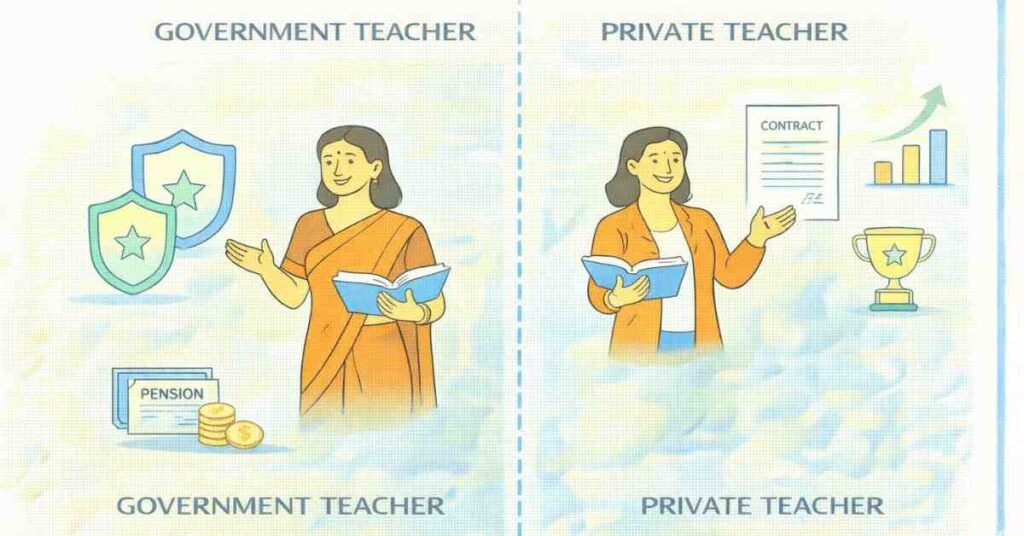
Government Teaching: Fortress-Level Security
Once you clear probation (typically 1-2 years), you become a permanent employee with job tenure until retirement. Let me be explicit: you cannot be fired except for serious misconduct, criminal activity, or gross dereliction of duty.
What this security means practically:
You can plan your life confidently. Buy a house knowing your income is secure for the next 30+ years. Plan family expenses without anxiety about sudden unemployment. Take planned leaves during festivals without worrying about contract renewal. Negotiate with confidence knowing you’re not replaceable at will.
Government teachers have protected leave benefits too: annual paid leave (typically 25-30 days yearly), sick leave (15 days), maternity leave for women, bereavement leave, and earned leave that accumulates. You can actually rest when ill without losing pay or fearing job loss.
The guarantee: Unlike private sector where performance reviews determine your continuity, government positions guarantee employment based on qualification and compliance with rules. Even underperforming teachers rarely face termination after probation (though this is changing with recent reforms).
Private Teaching: Constant Uncertainty
Private schools operate differently—they’re businesses requiring profitability. This creates a fundamentally insecure work environment.
The harsh realities:
69% of private school teachers in India work without formal employment contracts. No contract means no written agreement about tenure, salary, benefits, or termination conditions. Technically, management can terminate you without cause, sometimes even without compensation.
Even teachers in “prestigious” private schools face job insecurity. Changing management, financial downturns, student enrollment fluctuations, or simply management preference can lead to sudden termination. Teachers are frequently “asked to resign” rather than officially fired to avoid severance payments.
Performance-linked employment: Your job security depends on student results, parent satisfaction, and management’s perception of your capabilities. Underperforming classes, negative parent feedback, or conflicts with management can lead to contract non-renewal.
Seasonal uncertainty: Many private schools hire teachers on annual contracts renewable based on performance and school needs. This means every single year, you face potential non-renewal. Teachers with 10 years experience can be terminated if a new principal decides to restructure staff.
The psychological toll: Research shows private school teachers report moderate to high stress levels primarily driven by lack of job security. This constant anxiety affects mental health, family relationships, and overall well-being.
The Security Calculation
If you have dependents, mortgage obligations, or value peace of mind, government teaching’s security advantage is immense. The ability to plan decades ahead, knowing your income is guaranteed (barring national catastrophe), provides stability private sector rarely offers.
Conversely, if you’re young, ambitious, and can handle uncertainty, private school’s performance-based employment might not bother you. For some personalities, insecurity is actually motivation to constantly improve and prove value.
Part 3: Pension and Post-Retirement Benefits—The Long Game
Salary and job security are present benefits. What about 30 years from now when you stop working? This is where government and private sectors diverge dramatically.
Government Teacher Pensions: Guaranteed Security
Government teachers enjoy pension benefits that private teachers can only dream about. Here’s what you get:
Unified Pension Scheme (UPS) eligibility: After completing 10 years of government service, you become eligible for a guaranteed monthly pension. The minimum pension is ₹10,000 per month—guaranteed, for life.
For teachers completing 25 years of service, the pension is 50% of your average basic pay over the last 12 months before retirement. A PGT retiring after 25 years averaging ₹50,000 basic pay would receive ₹25,000 monthly pension for life. Additionally, your spouse receives 50% of your pension after your death, providing lifetime security for your family.
Retirement gratuity: Upon retirement, you receive a lump sum gratuity equal to 1/10th of basic pay plus DA for every completed six-month period of service. A teacher with 30 years of service and basic pay of ₹50,000 receives substantial gratuity—often ₹15-20 lakhs depending on final basic pay.
Medical benefits: Government provides lifetime medical coverage to retired teachers and sometimes their families. This is invaluable as medical expenses increase with age.
Inflation adjustment: Your pension is adjusted with DA revisions, meaning it doesn’t become worthless over decades due to inflation. Every 6 months, your pension increases slightly to account for rising costs.
To put this in perspective: A teacher retiring at 60 after 30 years of service with ₹25,000 monthly pension lives for another 25-30 years. That’s ₹9 lakh to ₹10.5 lakh in pension income alone, before accounting for DA adjustments that increase this further.
Private Teacher Retirement: Uncertain and Inadequate
Most private schools don’t provide pensions at all. This isn’t oversight—it’s a systemic problem.
The reality for private teachers:
70% of private school teachers have no pension scheme. No guaranteed monthly income after retirement. No gratuity upon leaving service. No employer-provided medical insurance. This means private teachers must self-fund their entire retirement through personal savings.
What this means practically: A private teacher retiring at 60 with no pension must have saved enough from salary (already lower than government) to last 30+ years. With inflation eroding value, a teacher who saved ₹50 lakhs might find it insufficient for 30 years of expenses.
Some private schools have started offering voluntary retirement contributions through National Pension Scheme (NPS), but this is rare and entirely teacher-funded. You must contribute from your own salary—the school doesn’t match.
The burden this creates: Private teachers often work past retirement age because they haven’t accumulated sufficient savings. Teachers in their 60s continuing in private schools primarily because pension gap forces them to. This creates dependency on employment even when physically exhausted.
The Long-Term Financial Picture
Over a 30-year career, the pension difference is staggering:
Government teacher scenario: ₹50,000 monthly basic pay becoming ₹70,000 by retirement. Pension of ₹35,000 monthly x 30 years = ₹12.6 lakhs, PLUS gratuity of ₹20 lakhs, PLUS inflation adjustments = total retirement security approaching ₹35+ lakhs.
Private teacher scenario: No guaranteed pension. If the teacher saved ₹30,000 yearly (aggressive by private school standards) over 30 years = ₹9 lakhs total savings. After 10 years in retirement, those savings are depleted.
The government pension advantage is practically impossible to quantify because it’s infinite—it lasts your entire lifetime and your spouse’s lifetime. Private teachers face a ticking retirement security clock.
Part 4: Work Culture and Daily Life—What You Actually Experience
Beyond salaries and benefits, what’s daily life actually like? This matters because you’ll spend 8+ hours daily in this environment for 30+ years.
Government School Work Culture
Government schools operate within established systems and hierarchies. Here’s what typical government teaching involves:
Fixed schedule predictability: You teach according to allocated classes, follow prescribed curriculum, conduct exams as per government dates, and complete paperwork as mandated. While this sounds rigid, it also means no surprises. You know exactly what’s expected.
Administrative burden: Considerable paperwork—attendance registers, mark sheets, lesson plans, files, periodic inspections from education department officials. This can be tedious but provides structure.
Limited innovation pressure: While you’re expected to teach well, there’s less pressure to constantly innovate or show results. Mediocre teaching exists in government schools, and teachers face minimal consequences. This can be liberating (no burnout) or frustrating (stagnation) depending on your perspective.
Strong teacher unions: Government teachers enjoy union protection, ensuring issues are collectively addressed. You have recourse if treated unfairly.
Leisurely pace: Government schools often follow relaxed academic calendars with numerous holidays, festivals, and administrative closures. Summer vacation, winter break, and continuous leave are more generous.
Collegial relationships: Colleague dynamics are generally supportive since job security isn’t competitive. Teachers help each other rather than compete.
Private School Work Culture
Private schools operate as competitive businesses where performance directly affects finances.
High performance pressure: Your results directly impact school reputation and student enrollments. Poor class results lead to immediate management scrutiny. Some schools monitor student marks monthly and call teachers for “performance improvement plans”.
Constant innovation expectations: You’re expected to use technology, employ engaging teaching methods, incorporate latest pedagogy, and continuously improve. What you did last year isn’t good enough—management expects innovation each year.
Extended working hours: Teaching hours might be 8am-4pm, but preparation, grading, parent communication, and meetings extend your day regularly to 6-7pm. Many private schools expect teachers to stay for additional activities, events, and meetings.
Heavy workloads: Private schools often operate with fewer staff, meaning teachers handle multiple subjects, co-curricular activities, and administrative responsibilities simultaneously. A typical private school teacher might teach 20+ periods weekly plus coordinate competitions, events, and clubs.
Limited holidays: Private schools minimize closures to maximize revenue. Vacations are shorter, holidays are fewer, and festival breaks depend on school calendar. Summer vacation might be 4-5 weeks versus government’s 6-8 weeks.
Performance-linked stress: Research confirms private school teachers report moderate to high stress, primarily from performance pressure, inadequate salaries, and lack of job security. 78% of private school teachers report feeling undervalued and unsupported.
Competitive dynamics: Unlike government schools where job security is equal, private schools create competition among teachers. Those with better results get preference, leaving others anxious.
Lack of infrastructure: While many private schools have better overall infrastructure than some government schools, individual teacher workspaces are often cramped. Staff rooms might be tiny with no personal space.
Which Culture Suits You?
If you prefer predictability, steady pace, and work-life balance, government teaching’s measured culture suits you. If you thrive under pressure, embrace constant learning, and find motivation in performance metrics, private schools offer that stimulation.impriindia+3
However, honest reflection is crucial: the stress in private schools isn’t healthy striving—it’s chronic pressure often causing mental health issues. Making that choice consciously is important.
Part 5: Infrastructure and Resources—Tools You Actually Use
What equipment and resources do you get to teach effectively? This significantly impacts your daily experience.
Government School Infrastructure: Rapidly Improving
Government schools have transformed dramatically over the past decade.
Current facilities (as of 2024): 90% of government schools have functional electricity (up from 45% in 2013), 51% have computers, 80%+ have functional toilets with water and handwash facilities, and 85%+ have libraries with basic resources. Rural government schools have surpassed urban schools in areas like ramp facilities and medical checkups.
What this means: You likely have reliable electricity for using projectors or computers, access to library resources for research, functional bathrooms, and basic technology infrastructure. While not cutting-edge, government schools now provide baseline modern facilities.
Limitations: Internet connectivity remains weak in many rural government schools, computer-to-student ratio is still low, and maintenance of existing infrastructure is irregular. You might have a computer lab, but it breaks down for months waiting for repairs.
Private School Infrastructure: Generally Better but Variable
Premium private schools often exceed government schools in infrastructure. However, “private” encompasses everything from elite international schools to cramped local coaching centers.
Premium private schools: Smart classrooms with interactive boards, excellent computer labs, science laboratories with modern equipment, comprehensive libraries, sports facilities, and technology-enabled staff rooms. Teaching becomes easier with these resources.
Average private schools: Basic infrastructure—functional classrooms, basic computers, limited laboratory equipment, smaller libraries. Similar to average government schools.
Budget private schools: Cramped classrooms, minimal resources, no computers, overcrowded facilities. Actually worse than government schools in many cases.
The variability: Your infrastructure experience depends entirely on which private school you join. Premium school equals excellent resources; budget school equals struggle.
Infrastructure Reality Check
Better infrastructure is nice, but doesn’t directly improve teaching quality. A passionate teacher in a cramped government school achieves better results than an indifferent teacher with smart boards. Infrastructure helps, but isn’t determinative.
Part 6: Career Advancement Paths—Where Do You Go From Here?
Beyond starting positions, how do your careers actually progress? Both sectors offer growth, but through different mechanisms.
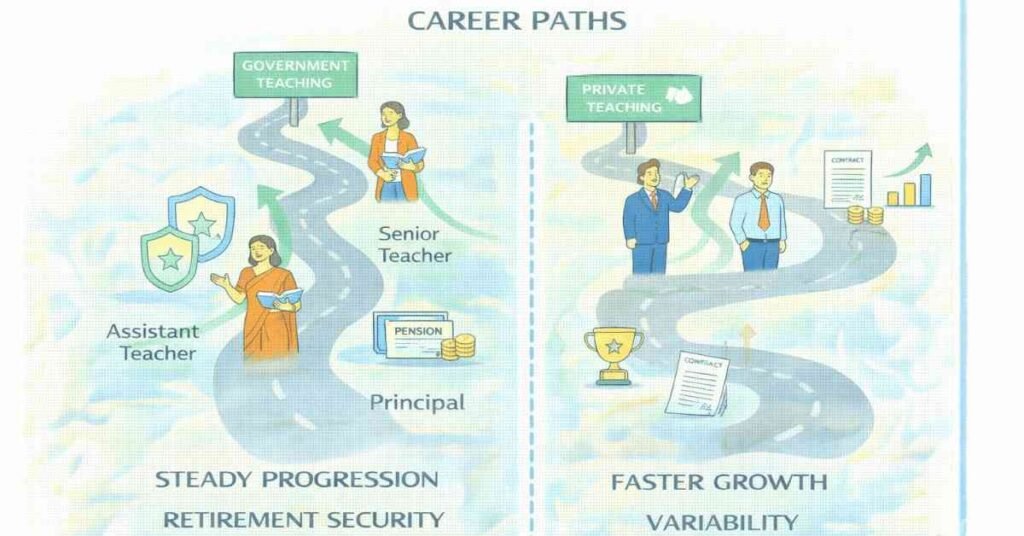
Government Teaching Progression
Career progression is structured and experience-based:
Years 1-5: Master your subject, build student relationships, develop good reports. Your salary increases 3% yearly with promotions happening gradually.
Years 6-10: Become Senior Teacher or Head of Department based on performance and tenure. Lead subject departments, mentor junior teachers, sit on curriculum committees.
Years 11-15: Progress to Vice Principal or Administrative roles. Manage school operations, coordinate academic policy, represent school officially.
Years 16-20: Become Principal of smaller or medium schools. Lead entire institution, manage budgets, implement policies.
Years 20+: Become Principal of larger schools, eventually reach top positions like Chief Education Officer or Director of Education at district/state level.
The advantage: Progression is relatively predictable—good performance, years of service, and taking relevant professional development courses get you promoted. You’re not fighting for positions; they come through seniority and qualifications.
Private Teaching Progression
Private school advancement is merit-based but less structured:
Years 1-5: Prove your teaching capability. High performers get slightly better responsibilities and increments; average performers stagnate.
Years 6-10: Top performers become Department Heads or Coordinators; average teachers might not advance. Advancement depends on performance reviews and management discretion, not tenure.
Years 11+: Exceptional teachers reach senior administrative roles or move to larger schools as department heads. Others plateau or leave for other careers.
The risk: Your advancement depends on management’s subjective assessment and school fortunes. A teacher who performs excellently but lacks “good relations” with management might never advance. School financial problems or policy changes can stall careers even for performers.
Progression Reality
Government teaching rewards loyalty and tenure. Private teaching rewards performance and relationships. If you’re ambitious and confident about your abilities, private can offer faster advancement in premium institutions. If you prefer predictability, government progression is steady.