
Common HR Interview Questions by Category
Table of Contents
Blog Content
You’re sitting in the HR interview waiting room, palms sweating slightly. You’ve prepared for technical questions, but now you’re wondering: “What exactly will they ask me in this HR round?”
Here’s the truth—HR questions follow predictable patterns. Once you understand these patterns, you can prepare answers that genuinely impress. Let me break down every category of HR questions you’re likely to encounter, along with proven answers and strategies.
Why HR Questions Follow Patterns
HR professionals use structured questioning because they want consistent information from all candidates. They’re not trying to surprise you or trick you. They’re following a playbook that has worked for their company for years.
By understanding these patterns, you gain a massive advantage. Instead of nervously waiting for “what comes next,” you’ll recognize the question type immediately and know how to respond confidently.
Category 1: Background and Experience Questions
Question 1.1: "Tell me about yourself"
Why They Ask This:
This is your foundation question. HR uses your answer to understand if you’re worth spending more time with. If your answer is vague or irrelevant, they’ve already made up their mind before the interview even begins.
What NOT to Do:
- Don’t tell your entire life story from childhood
- Don’t list every job you’ve ever had
- Don’t talk about personal hobbies that aren’t relevant to the job
- Don’t spend more than 3 minutes talking
The Winning Answer Format (Use This):
Follow the 4-section structure we discussed earlier:
Section 1: Present Role & Relevant Background (30 seconds)
“I’m currently a Content Marketing Specialist at Digital Wave Agency, where I’ve been working for the past 2.5 years. Before this, I worked as a Junior Content Writer at an EdTech startup for 1.5 years, which gave me deep exposure to the education sector.”
Why This Works: You’re immediately telling them:
- Your current role (relevant to the position)
- How long you’ve been there (shows stability)
- Your relevant previous experience (shows progression)
Section 2: Key Achievements That Matter for THIS Role (1 minute)
“In my current role, I’ve led a team of 3 writers and managed content strategy for 5 major clients. We increased organic traffic by 60% in one year through SEO-optimized content planning. I’ve also created content calendars that improved our client retention rate by 40% because clients could see the planning and strategy behind our work. What I’m particularly proud of is implementing a content audit system that helped identify which content types generated the most conversions for our clients.”
Why This Works:
- You’re using numbers (60%, 40%)—these are memorable
- You’re showing leadership (managed a team)
- You’re demonstrating impact on business metrics
- You’re highlighting relevant skills for the new role
Section 3: Why This Specific Role Excites You (45 seconds)
“I discovered Frontlines Edutech while researching companies that are making real impact in education technology. What impressed me most is your commitment to making quality education accessible to students across India. I’ve been following your blog on modern teaching methodologies, and I noticed you’re looking to expand your content strategy into new markets. That aligns perfectly with my experience growing EdTech platforms. This role feels like a natural next step where I can combine my content expertise with my passion for educational impact.”
Why This Works:
- You’ve done research (shows you’re serious)
- You’re connecting YOUR skills to THEIR needs
- You’re showing genuine interest (not just looking for any job)
- You’re explaining how you can add value
Section 4: What You’re Looking For in Your Next Role (30 seconds)
“I’m at a point in my career where I want to take on more strategic responsibility. I’m looking for a role where I can not only create great content but also contribute to the overall marketing strategy of a company I believe in. I want to work with a team that values both creativity and data-driven decision-making.”
Why This Works:
- You’re showing ambition (positive sign)
- You’re outlining your values
- You’re explaining what motivates you
Full Answer (Timed at 2.5-3 minutes):
“I’m currently a Content Marketing Specialist at Digital Wave Agency, where I’ve been working for the past 2.5 years. Before this, I worked as a Junior Content Writer at an EdTech startup for 1.5 years, which gave me deep exposure to the education sector.
In my current role, I’ve led a team of 3 writers and managed content strategy for 5 major clients. We increased organic traffic by 60% in one year through SEO-optimized content planning. I’ve also created content calendars that improved our client retention rate by 40% because clients could see the planning and strategy behind our work. What I’m particularly proud of is implementing a content audit system that helped identify which content types generated the most conversions for our clients.
I discovered Frontlines Edutech while researching companies that are making real impact in education technology. What impressed me most is your commitment to making quality education accessible to students across India. I’ve been following your blog on modern teaching methodologies, and I noticed you’re looking to expand your content strategy into new markets. That aligns perfectly with my experience growing EdTech platforms.
I’m at a point in my career where I want to take on more strategic responsibility. I want to work with a team that values both creativity and data-driven decision-making.”
Pro Delivery Tips:
- Speak naturally—don’t memorize word-for-word
- Make eye contact (if video call)
- Show enthusiasm when discussing the company
Pause between sections to breathe.
Question 1.2: "Walk me through your resume"
Why They Ask This:
Your resume is their road map. They want to hear YOU explain your journey, not just read what’s written on paper. This question tests whether you can articulate your career progression logically.
What They’re Really Asking:
“Help me understand the connection between your various roles. Why did you move from one job to another? How does this all fit together?”
The Winning Answer Strategy:
Instead of going through your resume chronologically, tell a STORY of progression:
Frame It as a Journey:
“Looking at my career, you’ll notice a clear progression focused on building expertise in digital marketing. I started as a Social Media Executive where I learned the fundamentals of audience engagement and platform mechanics. After 1 year, I took on a Content Coordinator role because I realized I wanted to understand the strategy behind social media—why we post certain content, how it drives results.
After 2 years in that role, I became a Digital Marketing Manager because I wanted to see the bigger picture—how content, social media, and SEO work together. In my current role at Frontlines Edutech for the past 1 year, I’ve been responsible for leading the entire digital marketing strategy, which has helped me develop leadership and strategic planning skills.
Each role built on the previous one. I wasn’t jumping around randomly—I was systematically building skills that led to this opportunity with your company. The reason I’m interested in your company’s Digital Marketing Head role is because it’s the natural next step where I can apply all these skills at a higher level.”
Why This Works:
- It shows intentional career growth (not job-hopping)
- It demonstrates self-awareness
- It connects your past to your future with the company
- It tells a coherent story
What If You Changed Jobs Frequently?
Be honest but strategic:
“I’ve had several roles in the past 4 years because I was exploring different areas of digital marketing to find my true passion. My first role in Social Media Management taught me I was interested in strategy, not just execution. My second role in SEO gave me deeper technical knowledge. My third role managing a team showed me that I enjoy leadership. Now I understand exactly what I’m looking for—a role where I can combine strategic thinking, technical expertise, and team leadership. That’s why I’m excited about this opportunity.”
This approach:
- Acknowledges the movement without apologizing
- Shows reflection and learning
- Explains the purpose behind changes
Points toward stability now
Question 1.3: "How has your experience prepared you for this role?"
Why They Ask This:
HR wants confirmation that you haven’t just applied randomly. They want to hear how your specific background makes you a strong fit for THIS specific position.
The Winning Answer Formula:
Match your experience to the job description requirements:
Step 1: Identify 3 Key Requirements from the Job Description
Let’s say you’re applying for a “Digital Marketing Manager” role. The job description emphasizes:
- Leadership experience (managing teams)
- SEO expertise
- Content strategy development
Step 2: Match Your Experience to Each Requirement
“Looking at the Digital Marketing Manager role, I see three key requirements. First, you need someone who can lead a team. In my current role at Frontlines Edutech, I’ve been leading a marketing team of 5 people, managing their workload, providing feedback, and helping them grow in their careers. This has given me practical experience in team leadership.
Second, the role requires strong SEO expertise. I’ve spent the last 3 years specializing in SEO optimization, from technical SEO to keyword research and content optimization. I’ve led SEO projects that increased organic traffic by 125% for our education platform.
Third, you need someone who can develop and execute content strategy. I’ve created content calendars, audit systems, and strategy frameworks that helped our team stay aligned and measured impact. I’ve also worked with stakeholders to develop long-term content strategies that support business goals.
All three of these areas are my core strengths, which is why I’m confident I can make an immediate impact in this role.”
Why This Works:
- You’re demonstrating that you’ve READ the job description (showing you care)
- You’re directly matching your experience to their needs
- You’re being specific with examples and results
- You’re building confidence that you can handle the role.
Category 2: Behavioral Questions (The STAR Method Questions)
These are the “tell me about a time when…” questions. HR uses these to understand your past behavior patterns—because past behavior is often the best predictor of future behavior.
What Is the STAR Method?
STAR stands for:
- Situation: Set the scene. What was the context?
- Task: What was your responsibility in this situation?
- Action: What specific steps did you take?
- Result: What was the outcome? Include metrics if possible.
Question 2.1: "Tell me about a time when you faced a conflict at work. How did you handle it?"
Why They Ask This:
Workplaces have conflicts. HR wants to know if you’re someone who runs away from problems or someone who faces them maturely and finds solutions.
The Winning STAR Answer:
Situation:
“In my previous role at Digital Wave Agency, we were working on a major project with a client—a content calendar for Q3 marketing. I was the content strategist, and we also had a graphic designer on the team named Priya.”
Task:
“I was responsible for outlining the content strategy and timelines. Priya was responsible for creating visuals for the content.”
Action:
“About 3 weeks into the project, I realized that Priya’s visuals didn’t match the brand guidelines we had established. Instead of just pointing out what was wrong, I called her for a one-on-one chat. I started by acknowledging that her designs were creative and visually appealing—because they were. Then, I showed her the specific brand guidelines we needed to follow and explained why they mattered for client consistency. I also asked if there were any challenges she was facing that made it difficult to follow the guidelines.
Turns out, she hadn’t received a clear copy of the brand guidelines during project kickoff. Once I shared them and explained the reasoning, she understood completely. Together, we updated all the visuals to match the brand guidelines, and I also made sure to include her in future brand guideline discussions.”
Result:
“The project delivered on time with consistent branding. More importantly, Priya and I built a stronger working relationship. She even started proactively asking about guidelines for future projects. The client was happy with the consistency, and my manager noticed that I had handled a potential problem maturely.”
Why This Answer Works:
- It shows maturity (you didn’t blame or argue)
- It demonstrates empathy (you understood Priya’s situation)
- It shows communication skills (you talked it out)
- It focuses on solutions (you fixed the problem)
- It has a positive outcome (everyone benefited)
- It shows learning (you changed the process for future projects)
Pro Tips for Behavioral Questions:
- Choose real stories from your actual experience
- Make sure the story showcases a skill relevant to the job
- Always end with a positive outcome or learning
- Don’t bad-mouth the other person in the conflict
- Focus on what YOU did, not what others did
- Use specific details (names, timeframes, numbers)
Practice your story so it sounds natural, not scripted
Question 2.2: "Tell me about a time when you failed. What did you learn?"
Why They Ask This:
This question reveals whether you’re someone who grows from mistakes or someone who makes excuses. HR wants to see self-awareness and a learning mindset.
The Winning STAR Answer:
Situation:
“In my second year as a Content Coordinator at an EdTech company, I was managing a blog publication schedule for our company website. We had committed to publishing 2 blog posts per week.”
Task:
“I was responsible for ensuring all posts were published on time and met our quality standards.”
Action:
“About 3 months into my role, I got overconfident. I thought I could handle everything without proper planning. I stopped using my content calendar and started managing posts through email and chat messages. As a result, I missed a publication deadline—we didn’t publish our Tuesday post that week. It wasn’t until our manager asked about the post that I realized my mistake.
Instead of making excuses, I immediately told my manager what happened. I also reviewed the situation to understand where I went wrong. I realized that I had created a process that worked initially, but when my confidence grew, I abandoned that process thinking I didn’t need it anymore.”
Result:
“I learned a critical lesson: processes exist for a reason, especially when managing multiple moving parts. I went back to my structured content calendar, even added more details to it, and actually created a backup system where I flagged posts 48 hours before publication as a reminder. This system worked so well that my manager later recommended it to other team members.
From that experience, I understood that systems and discipline don’t go away as you grow—they become more important. That’s a principle I’ve applied to every role since then.”
Why This Answer Works:
- It shows honest self-reflection (you owned the mistake)
- It demonstrates responsibility (you didn’t blame others
- It shows growth mindset (you learned from it)
- It proves you implemented change (you’re not stuck in the same pattern)
- It’s relatable (most people have made similar mistakes)
Common Mistakes to Avoid:
- Don’t choose a story where you didn’t actually learn anything
- Don’t pick a failure so catastrophic that it makes the interviewer question your competence
- Don’t spend too much time on the failure—focus on the learning and recovery
Don’t say “I’ve never really failed” (no one believes this)
Question 2.3: "Tell me about a time when you had to meet a tight deadline. How did you manage?"
Why They Ask This:
Every job has deadlines. HR wants to know if you panic under pressure or if you think strategically and deliver results.
The Winning STAR Answer:
Situation:
“Last year at Frontlines Edutech, we had just launched a new course in Data Analytics. Our CEO had a meeting with a potential corporate partner and wanted to present impressive statistics about the course performance. The meeting was scheduled for exactly 72 hours away.”
Task:
“I was assigned to create a comprehensive report showing course enrollment, student feedback, completion rates, and learning outcomes. This was a project that normally takes 2 weeks because it involves pulling data from multiple systems and creating visualizations.”
Action:
“I broke the project into smaller chunks and prioritized what mattered most:
Day 1 (24 hours): I identified which metrics the CEO actually needed for the pitch (not every metric, just the most impactful ones). I reached out to the data team and clearly communicated exactly what data I needed and by when.
Day 2 (24 hours): While waiting for data from the data team, I started creating the design and structure of the report. I prepared charts and visuals that were ready to be filled with data once it arrived.
Day 3 (24 hours): Once the data arrived, it was a matter of plugging it in and doing final reviews. I also did a quality check to ensure all numbers were accurate.
Throughout the process, I communicated status updates to the CEO every 12 hours so there were no surprises. I also asked for help from a colleague who knew the analytics better than I did when I had questions about data interpretation.”
Result:
“The report was delivered 6 hours before the meeting. The CEO used it in the pitch and the corporate partner was impressed by the metrics. The company signed a corporate partnership agreement that brought in 50 students as part of a corporate training program. That partnership is still active today and has been very successful.”
Why This Answer Works:
- It shows strategic thinking (you broke it down)
- It demonstrates prioritization (you focused on what matters)
- It proves collaboration skills (you asked for help)
- It shows communication (you kept stakeholders updated)
- It has impressive results (partnership deal)
- It’s specific with timelines (people remember timelines)
Why This Approach Works Under Pressure:
- Instead of panicking, you immediately identify what’s essential
- You work in parallel (preparing design while waiting for data)
- You communicate regularly so others can help if needed
- You’re honest about help (showing it’s not weakness to ask)
- You focus on the outcome that matteredyoutube
Category 3: Situational Questions (Hypothetical Scenarios)
These questions ask “what would you do if…” Instead of relying on past behavior, HR creates hypothetical situations to see your problem-solving approach.
Question 3.1: "What would you do if you were given conflicting priorities from two managers?"
Why They Ask This:
In most workplaces, conflicting priorities happen. HR wants to see if you have a logical way to handle them or if you just panic.
The Winning Answer:
“This is a realistic scenario, and I appreciate that you’re asking about it. Here’s how I would handle it:
Step 1 – Gather Information: I wouldn’t assume that both priorities are equally urgent just because both managers made the request. I would ask each manager:
- When exactly do you need this completed?
- What’s the business impact if this isn’t done?
- How long will this task take?
- Are there dependencies on other work?
Step 2 – Assess Urgency: Based on deadlines and business impact, I would determine which task is truly more urgent.
Step 3 – Communicate: I would schedule a brief meeting with both managers and explain:
- ‘I understand both of these are important. Based on the deadlines, Task A has to be completed first. I can complete Task B by [specific date]. Does this work for everyone?’
Step 4 – Document: I would send an email confirming what we discussed so there’s a written record of priorities and timelines.
Real Example: Last year, I was managing multiple content projects. My direct manager wanted me to focus on blog content, while the sales team wanted priority on landing page copy. I asked each team about deadlines—the landing page needed to be done in 3 days for a client pitch. I communicated to my manager that I’d prioritize the landing page for 3 days, then switch focus to blogs. Both teams appreciated the clarity, and nothing fell through the cracks.”
Why This Works:
- It shows maturity (you don’t panic)
- It’s systematic (you have a clear process)
- It demonstrates communication (you involve stakeholders)
- It includes a real example (it’s not just theoretical)
- It focuses on solutions (not problems)
Key Principle: When asked “what if” questions, always share your thinking process, not just your final answer. HR wants to understand HOW you think.
Question 3.2: "If a client complained about work quality, how would you respond?"
Why They Ask This:
This reveals whether you’re defensive or whether you’re solution-oriented.
The Winning Answer:
“First, I wouldn’t get defensive. If a client is complaining, there’s a reason, even if I believe the work was good. Here’s my approach:
Step 1 – Listen Without Interrupting: I would let the client fully explain their concern. Sometimes what sounds like a complaint about quality is actually about communication or misaligned expectations.
Step 2 – Understand the Specific Problem: I would ask clarifying questions:
- Which specific aspect of the work doesn’t meet your expectations?
- What were you expecting instead?
- Has this impacted your business in any way?
Step 3 – Take Responsibility: Whether it was my mistake or a miscommunication, I would own it. I’d say: ‘I understand your concern. Let me look into this and figure out how we can resolve it.’
Step 4 – Propose Solutions: I wouldn’t just apologize; I would offer concrete solutions:
- Quick revision if it’s a quick fix
- Replacement work if needed
- Adjustment to the agreement if expectations were misaligned
- Process changes to prevent this in the future
Step 5 – Follow Up: I would ensure the client is satisfied with the resolution and check in later to confirm everything is working well.
Real Example: A client once complained that our content blog wasn’t driving traffic as promised. Instead of defending our work, I dug into the data. I discovered that the real issue was that the client’s email list wasn’t engaged—it wasn’t about our content quality. I explained this clearly and proposed a solution: I’d help them build an SEO strategy to drive organic traffic while they worked on email list engagement. The client appreciated our transparency, and the partnership continued for another year.”
Why This Works:
- It shows emotional intelligence (you understand client frustration)
- It’s solution-oriented (you fix problems)
- It demonstrates accountability (you don’t make excuses)
- It includes a real example
It explains your thinking process
Category 4: Strengths Questions
These questions ask you to talk about what you’re good at. The trick? You need to be genuine and specific, not just listing generic strengths.
Question 4.1: "What are your greatest strengths?"
Why They Ask This:
HR wants to know what value you’ll bring to the team. They also want to see if you’re self-aware about your abilities.
What NOT to Do:
- Don’t say “I’m a perfectionist” (classic cliché)
- Don’t say “I’m a hard worker” (vague and true for most people)
- Don’t list 10 strengths (focus on 3-4 relevant ones)
- Don’t exaggerate abilities you don’t actually have
The Winning Answer Strategy:
Pick 3 strengths that are:
- Relevant to the job
- Backed by evidence
- Specific, not generic
Strength #1: Strategic Thinking
“One of my core strengths is strategic thinking. I don’t just execute tasks; I think about the bigger picture and how individual actions connect to overall goals.
For example, when I joined Frontlines Edutech, I didn’t just write blog posts. I asked: What are we trying to achieve? Who are we trying to reach? How does content fit into this? This approach helped me create a content strategy that didn’t just produce articles—it generated qualified leads for our sales team. Within 6 months, our blog-generated leads increased by 200%.”
Why This Works:
- It’s specific (not vague)
- It has evidence (numbers and results)
- It shows impact
- It’s relevant to most marketing roles
Strength #2: Team Collaboration
“I’m also someone who genuinely enjoys working with teams. I believe great work happens when people with different skills collaborate.
In my current role, I work closely with designers, developers, and sales team members daily. I make sure everyone’s voice is heard in planning meetings. I’ve been told by team members that I’m easy to work with because I explain my thinking clearly and I’m open to others’ ideas. This collaborative approach has resulted in our team being recognized as the highest-performing department in our company.”
Why This Works:
- It’s backed by feedback (team members have told you this)
- It shows you value others
- It has a positive outcome
- It’s genuine, not forced
Strength #3: Adaptability
“My third strength is adaptability. The digital marketing landscape changes constantly—platforms evolve, algorithms shift, trends emerge. I enjoy learning new tools and adapting strategies based on data.
When TikTok started becoming relevant for education content, our team wasn’t sure if we should focus there. I researched it, created a test campaign, and showed the team the results. Now we have a dedicated TikTok strategy that’s generating consistent engagement. This willingness to test new approaches and adapt based on results has made me valuable across different roles.”
Why This Works:
- It’s relevant to the industry
- It shows continuous learning
- It proves you drive results with new approaches
Complete Answer (2-3 minutes):
“I’d say my three greatest strengths are strategic thinking, team collaboration, and adaptability.
First, I’m someone who thinks strategically. I don’t just execute tasks; I think about the bigger picture. When I joined Frontlines Edutech, I didn’t just write blog posts. I asked: What are we trying to achieve? Who are we trying to reach? How does content fit into this? This approach helped me create a content strategy that generated qualified leads. Within 6 months, our blog-generated leads increased by 200%.
Second, I genuinely enjoy collaborating with teams. In my current role, I work with designers, developers, and sales team members daily. I ensure everyone’s voice is heard, and I communicate clearly. My team members have told me I’m easy to work with because I’m open to ideas. This collaborative approach resulted in our team being the highest-performing department.
Third, I’m adaptable. The digital marketing landscape changes constantly. When TikTok became relevant for education content, I researched it, created a test campaign, and showed the results. Now we have a dedicated TikTok strategy generating consistent engagement.”
Pro Tips:
- Speak with confidence (you know these strengths about yourself)
- Use specific metrics when possible
- Show how these strengths benefit others, not just yourself
- Choose strengths relevant to the job you’re applying for
Question 4.2: "What do you consider your greatest professional achievement?"
Why They Ask This:
This reveals what you value and what drives you. It also tells HR about your impact and work quality.
The Winning Answer Format:
Setup: Explain the challenge or situation
“In my second year at Digital Wave Agency, our biggest client was considering leaving because they weren’t seeing ROI from their content investment. The client had been with us for 3 years but was frustrated with stagnant results.”
Action: Explain what you did
“I volunteered to audit their entire content strategy. I spent 2 weeks analyzing their blog posts, social media, email campaigns, and conversion tracking. I discovered the real problem: they were creating content, but it wasn’t optimized for search engines. Most of their traffic came from direct visits, not organic search, which meant they were missing potential customers who were actively searching for their services.
I presented a new strategy: optimize all existing content for SEO, create a keyword-driven content calendar, and implement tracking to measure conversions per article. I also proposed a content audit system to identify underperforming content.”
Result: Explain the outcome with metrics
“Within 6 months:
- Organic traffic increased from 15% to 45% of their total traffic
- Lead generation from content increased by 180%
- The client re-signed their contract for another 2 years
- Based on this success, I was promoted to Content Strategy Manager
- This client success became a case study that helped us win 3 new clients”
Why This Matters: Explain the broader impact
“This achievement matters to me because it showed that when you combine strategic thinking with data analysis, you can turn a negative situation into a success story. It also taught me that most problems have solutions if you’re willing to dig deep and understand the root cause. As a team leader now, I apply this principle every day—not accepting surface-level explanations, always digging deeper.”
Complete Answer (3-4 minutes):
“My greatest professional achievement happened in my second year at Digital Wave Agency. Our biggest client was considering leaving because they weren’t seeing ROI from content. I volunteered to audit their entire strategy.
I spent 2 weeks analyzing their blog, social media, emails, and tracking. I discovered the problem: their content wasn’t optimized for search engines. Most traffic came from direct visits, missing organic search customers.
I presented a new SEO-driven strategy with a content audit system. Within 6 months, organic traffic increased from 15% to 45%, lead generation increased by 180%, and the client re-signed for 2 more years. This success led to my promotion to Content Strategy Manager and became a case study that helped us win 3 new clients.
This matters to me because it proved that combining strategic thinking with data analysis solves problems. I apply this principle every day as a team leader.”
Why This Works:
- It has a clear challenge (stakes are high)
- It shows problem-solving
- It has impressive results (with numbers)
- It explains why it matters to you (shows values)
- It demonstrates growth (led to promotion)
- It had broader impact (helped others)
Category 5: Weakness Questions
These are trick questions if you’re not careful. The goal isn’t to admit you’re incompetent—it’s to show self-awareness and commitment to growth.
Question 5.1: "What is your biggest weakness?"
Why They Ask This:
This reveals whether you have self-awareness and whether you’re committed to improvement.
What NOT to Do:
- Don’t say “I don’t have weaknesses” (no one believes this)
- Don’t say “I’m a perfectionist” (overused and not really a weakness)
- Don’t admit to a weakness that makes you unsuitable for the job
- Don’t spend 5 minutes talking about your weakness
- Don’t make it sound like a strength disguised as a weakness
The Winning Answer Strategy:
Pick a real weakness that:
- Is not critical to the job you’re applying for
- You’ve actively worked on improving
- Shows self-awareness and growth mindset
Formula:
- Admit the weakness honestly
- Explain how you discovered it
- Show what you’ve done to improve
- Demonstrate the progress you’ve made
Real Example:
Weakness: “Early in my career, I struggled with delegation. I had this belief that if I wanted something done right, I had to do it myself. This meant I was working 60-hour weeks, stressed out, and my team didn’t get to develop new skills.”
How you discovered it: “After about 2 years in a coordinator role, my manager sat me down and said, ‘You’re burning yourself out. Your team is capable of handling more. You need to delegate.’ At first, I was defensive, but then I realized she was right. I was bottlenecking my team’s growth.”
What you did about it: “I took a course on delegation and team leadership. I started small—I asked my junior team member to lead a low-stakes project while I supervised. It was uncomfortable at first because I wasn’t directly doing the work, but her output was actually excellent. Over time, I delegated more strategically. I also learned to give clear instructions and trust my team’s abilities.”
Progress you’ve made: “Now, as a team leader managing 5 people, delegation is one of my core strengths. I actively create opportunities for my team to develop new skills. In fact, two of my team members have been promoted to higher roles because they had opportunities to grow under my leadership. Ironically, my former weakness became one of my greatest assets.”
Complete Answer (2-3 minutes):
“I’d say my biggest weakness is that early in my career, I struggled with delegation. I believed if I wanted something done right, I had to do it myself. This left me stressed and working 60-hour weeks.
After 2 years, my manager pointed out that I was bottlenecking my team’s growth. She was right. I took a delegation course and started giving my team more responsibility. At first it was uncomfortable, but I realized their work was excellent.
Now, as a team leader, delegation is one of my strengths. Two of my team members have been promoted because they got opportunities to develop skills. My former weakness became an asset.”
Why This Works:
- It’s honest and self-aware
- It shows growth and improvement
- It demonstrates learning capacity
- It ends on a positive note
- It’s not critical to the new role
It proves commitment to personal development
Category 6: Motivation and Career Goals Questions
These questions explore what drives you and where you’re headed professionally.
Question 6.1: "Why do you want to join our company?"
Why They Ask This:
This reveals whether you’re genuinely interested in this specific company or if you’re just applying to any job. Interviewers can tell the difference between generic interest and real passion.
What NOT to Do:
- Don’t say “For a paycheck” (obvious but off-putting)
- Don’t say “You’re a big company” (not enough differentiation)
- Don’t mention only salary and benefits
- Don’t make up fake reasons
- Don’t give an answer that could apply to 100 different companies
The Winning Answer Strategy:
Show you’ve done research and connect THREE things:
- Something specific about the company (not generic)
- How it aligns with YOUR values or career goals
- What unique value YOU can bring
Real Example:
Research about the company: “I’ve been following Frontlines Edutech for about 8 months now. What stands out to me is your focus on making quality education accessible to underserved students across India. Last month, I read your case study about the scholarship program you launched in rural Telangana, and it genuinely impressed me.”
Alignment with your values: “I’m someone who believes technology should democratize access, not widen gaps. When I choose to work somewhere, I want to know that my work contributes to something meaningful. Your mission directly aligns with how I want to spend my career.”
Unique value you bring: “Given my experience growing EdTech platforms and creating content strategies that generate qualified leads, I can help you expand your reach while maintaining your commitment to quality. I’ve worked with similar organizations and understand the unique challenges of the education sector. I believe I can make a meaningful contribution to your marketing goals.”
Complete Answer (2-3 minutes):
“I’ve been following Frontlines Edutech for about 8 months. What stands out is your focus on accessible quality education for underserved students. Your rural Telangana scholarship program genuinely impressed me because it shows you’re not just talking about democratizing education—you’re actually doing it.
I’m someone who believes technology should democratize access. I want my work to contribute to something meaningful. Your mission aligns perfectly with this.
Given my experience growing EdTech platforms and creating lead-generating content strategies, I can help you expand while maintaining quality. I understand education sector challenges and can make a meaningful contribution to your marketing goals.”
Pro Tips:
- Visit their website, read their blog, check their LinkedIn
- Reference something recent or specific they’ve done
- Connect it to your personal values
- Show enthusiasm (genuine passion is attractive)
- End with how you can add value
Question 6.2: "Where do you see yourself in 5 years?"
Why They Ask This:
This reveals whether you’re ambitious, realistic about career progression, and whether you’re likely to stay with the company.
What NOT to Do:
- Don’t say “I don’t know” (shows lack of ambition)
- Don’t say “I want your job” (threatens the interviewer)
- Don’t describe an unrealistic jump in positions
- Don’t focus only on salary increase
- Don’t make it sound like you’re already ready for the next role (why would they hire you now?)
The Winning Answer Strategy:
Paint a realistic picture that:
- Shows growth in current role first
- Connects to career progression
- Emphasizes skills development
- Remains aligned with company goals
Real Example:
Year 1-2 at this company: “In the next 2 years, I want to become an expert in your platform and develop deep relationships with our clients and internal stakeholders. I want to lead successful campaigns that significantly impact lead generation and student enrollment.”
Year 3-4: “By year 3 or 4, I see myself taking on more strategic responsibility—perhaps leading a larger team or managing a bigger portion of the marketing strategy. I’d want to have mentored junior team members and contributed to hiring and developing talent.”
Year 5: “By year 5, I see myself as a senior leader in the marketing department, someone who’s not just executing campaigns but shaping overall marketing direction. I’d love to be someone who helps the company scale while maintaining our commitment to quality education. Whether that’s a Senior Manager or Director role, I’m not sure yet, but I’m clear that I want to grow into leadership where I’m developing people and strategy.”
Connection to company: “I’m particularly interested in growing within this company because your mission resonates with me. I’m not just looking for a job; I’m looking to build a career where my work contributes to meaningful impact.”
Complete Answer (2-3 minutes):
“In the next 2 years, I want to become an expert in your platform, develop strong relationships with clients and stakeholders, and lead campaigns that significantly impact enrollment.
By year 3 or 4, I’d like to take on more strategic responsibility—perhaps leading a larger team or managing bigger marketing initiatives. I want to mentor junior team members and contribute to talent development.
By year 5, I see myself as a senior leader shaping overall marketing direction, whether that’s as a Senior Manager or Director. I want to help you scale while maintaining your commitment to quality education.
I’m specifically interested in growing here because your mission resonates deeply with me. I’m not just looking for a job; I’m building a career where my work creates meaningful impact.”
Why This Works:
- It’s realistic (not an overnight jump to the top)
- It shows ambition (you want to grow)
- It emphasizes learning (you want to develop skills)
- It connects to the company (you want to contribute to their mission)
- It explains progression logically (role growth over time)
- It keeps door open (you’re not overly specific about exact title)
Category 7: Cultural Fit Questions
These questions assess whether you’ll mesh well with the team’s values, work style, and environment.
Question 7.1: "Describe your ideal work environment. What kind of team do you work best with?"
Why They Ask This:
Every company has a unique culture. HR wants to ensure there’s a match. If you prefer highly structured environments but they’re chaotic and creative, you’ll both be disappointed.
The Winning Answer Strategy:
Describe an ideal environment that’s:
- Honest about what you need
- Realistic to most professional workplaces
- Aligned with what you’ve learned about their culture
Real Example:
Structure and clarity: “I work best in environments where goals and expectations are clear. I appreciate when managers communicate the ‘why’ behind projects—how it connects to larger company goals. This clarity helps me stay motivated and make better decisions.”
Collaboration: “I’m energized by collaborative teams where people from different departments work together. I enjoy brainstorming sessions and being part of teams where diverse perspectives are valued. At the same time, I respect people who need focused work time.”
Learning culture: “I thrive in environments where continuous learning is encouraged. Companies that invest in their people’s development through training, mentorship, or conference attendance inspire loyalty. I’m someone who wants to grow, so I need room for that.”
Psychological safety: “Honestly, I need to work in an environment where it’s safe to make mistakes and learn from them. I don’t perform well under extreme blame culture. I respond better to feedback that’s constructive and focused on growth.”
Flexibility: “Given the nature of digital marketing, I appreciate some flexibility in how work gets done. I don’t need to be in an office 9-5 as long as work is completed well. Results matter more than hours to me.”
Alignment: “From what I’ve learned about Frontlines Edutech, your company seems to value team collaboration and continuous learning. That’s exactly the kind of environment where I do my best work. That’s part of why I’m excited about this opportunity.”
Complete Answer (2-3 minutes):
“I work best in environments with clear goals and expectations. I appreciate managers who communicate the ‘why’ behind projects.
I’m energized by collaborative teams where diverse perspectives are valued. I enjoy brainstorming and teamwork, but I respect people’s need for focused work time.
I thrive where continuous learning is encouraged. Companies that invest in employee development inspire loyalty and my commitment.
I need psychological safety—environments where mistakes lead to learning, not blame. Constructive feedback focused on growth works better for me than criticism.
I appreciate flexibility in how work gets done as long as results are strong.
From what I’ve learned about Frontlines Edutech, your collaborative and learning-focused culture aligns perfectly with what I need. That’s part of why I’m excited about this opportunity.”
Pro Tips:
- Be honest about your needs (honesty prevents bad fits)
- Avoid dealbreakers (don’t say “I need someone else to do my work”)
- Research their culture before answering
- Connect your ideal environment to theirs
- Focus on work environment, not just perks
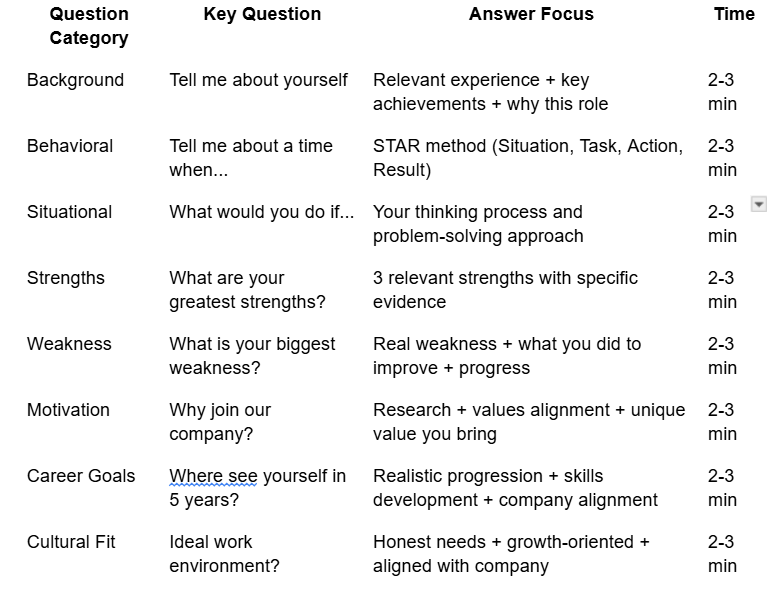
Quick Reference Summary Table
Master Your Answer Delivery
Before we wrap up this subtopic, here are universal tips for delivering ANY HR interview answer effectively:
- The 3-Second Rule
Take 3 seconds before answering to collect your thoughts. This pause shows you’re thoughtful, not reactive. - Structure Every Answer
Use a clear beginning, middle, and end. People follow stories better than rambling explanations. - Use Specific Numbers
Instead of “increased engagement,” say “increased engagement by 45%.” Numbers stick in people’s minds. - Show, Don’t Tell
Instead of “I’m a good communicator,” tell a story that demonstrates communication skills. - End with a Connection to the Role
Whenever possible, connect your answer back to how it’s relevant to the position. - Watch for Signals
If the interviewer starts nodding, you’re on the right track. If they look confused, simplify your explanation. - Speak Naturally
Don’t memorize your answers word-for-word. Practice enough that you can speak naturally and conversationally. - Mirror the Interviewer’s Tone
If they’re formal, be formal. If they’re casual, match that energy (while staying professional).
Your Action Plan Before the Interview
1 week before:
- Research the company thoroughly (website, LinkedIn, recent news)
- Identify 3-5 achievements from your past to use as STAR stories
- Practice saying your self-introduction out loud (not in your head)
3 days before:
- Write out your answers to common questions
- Practice with a friend or in front of a mirror
- Prepare your questions to ask the interviewer
Night before:
- Get good sleep (better than last-minute cramming)
- Lay out professional clothes
- Charge your devices
Morning of interview:
- Review your self-introduction one more time
- Eat a good breakfast (low blood sugar affects clarity)
- Arrive 5-10 minutes early (or test your video setup)