
Handling Interruptions and Challenges
Table of Contents
Blog Content:
The Moment Everything Goes Wrong
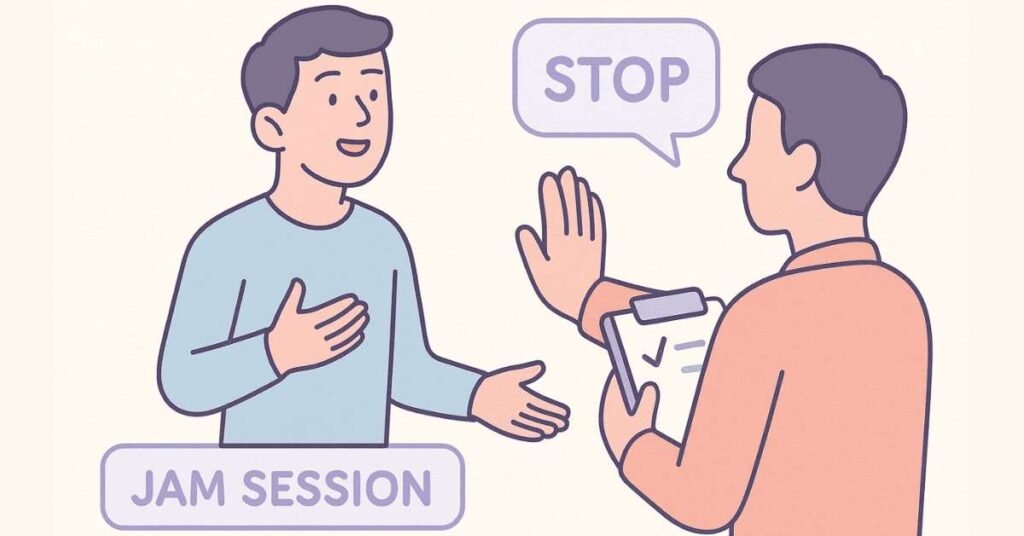
You’re 20 seconds into your JAM speech. You’re doing perfectly. Your pacing is good, your content is flowing… and then the evaluator interrupts: “Stop. Topic change.”
Your heart sinks. Your carefully prepared mental structure collapses. You freeze for a moment.
This is exactly where most students fail—not because they lack knowledge, but because they panic when things don’t go as planned.
The truth? Interruptions and challenges are intentional. Companies use them specifically to test your composure and adaptability. How you handle disruption matters more than the disruption itself.
Why Companies Interrupt During JAM
Interruptions simulate real workplace scenarios:
- A client changes project scope mid-meeting
- Your manager asks unexpected questions during presentations
- Market conditions shift, requiring rapid strategy adjustment
- Team members challenge your ideas unexpectedly
Companies want employees who stay calm, recalibrate quickly, and continue delivering value despite interruptions.
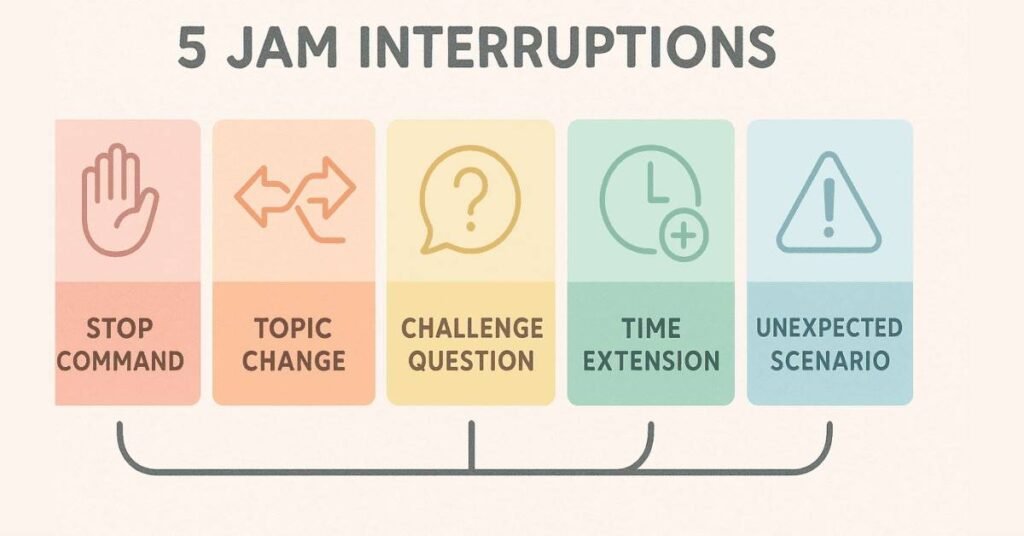
Understanding the Types of JAM Interruptions
Type 1: The “Stop” Command
The evaluator simply says “Stop” and you must halt immediately, even mid-sentence.
Why it happens: Testing if you can follow instructions precisely and handle disappointment gracefully.
Your response: Stop immediately without protest or frustration. Acknowledge the evaluator calmly and wait for the next instruction.
Type 2: The Topic Change
Mid-speech, you’re given a completely new topic and must pivot instantly.
Why it happens: Assessing your mental flexibility and ability to start fresh under pressure.
Your response: Take a 2-3 second breath, acknowledge the new topic, and begin speaking on it with the same structure and confidence as before.
Type 3: The Challenge Question
The evaluator interrupts with a question or asks you to clarify a point.
Why it happens: Testing your knowledge depth and ability to defend your ideas.
Your response: Answer directly, briefly, and then ask if you should continue your original speech or speak on a new direction.
Type 4: The Time Extension
Instead of 60 seconds, you’re asked to continue speaking longer.
Why it happens: Assessing your ability to maintain quality when pressure increases.
Your response: Take a mental pause and continue speaking, using the same frameworks and quality content.
Type 5: The Unexpected Scenario
“Speak about this topic, but imagine you’re speaking to kindergarteners” or “Speak as if you’re an expert consultant.”
Why it happens: Testing your adaptability and perspective-shifting ability.
Your response: Adjust your language complexity and tone accordingly while maintaining core content.
🔍 Explore structured learning resources designed to strengthen clarity and adaptability →
The Three-Step Recovery Framework
When interrupted, follow this protocol:
Step 1: Pause and Breathe (2-3 seconds)
Your first instinct might be to panic or rush. Instead, pause deliberately. This 2-3 second pause accomplishes multiple things:
- Allows your nervous system to regulate
- Gives your brain time to process the interruption
- Demonstrates composure to the evaluator
- Allows you to mentally regroup
During this pause, take one deep diaphragmatic breath (from your practice). Your body will naturally calm down.
Step 2: Acknowledge Clearly
Show the evaluator you understood the interruption. A simple, professional acknowledgment works best:
- “Understood. New topic: [repeat the topic]”
- “I’ll switch to discussing [new topic] now”
- “Clear. I’ll start fresh with [new direction]”
Why this matters: It signals that you’re capable of processing instructions and following directions—valuable workplace skills.
Step 3: Restart with Structure
Begin your new speech (if applicable) with your strongest framework. Use your opening techniques powerfully. The evaluator should feel like you’re just as prepared for the new topic as you were for the original one.
📘 Discover more preparation-focused content for improving performance under pressure →
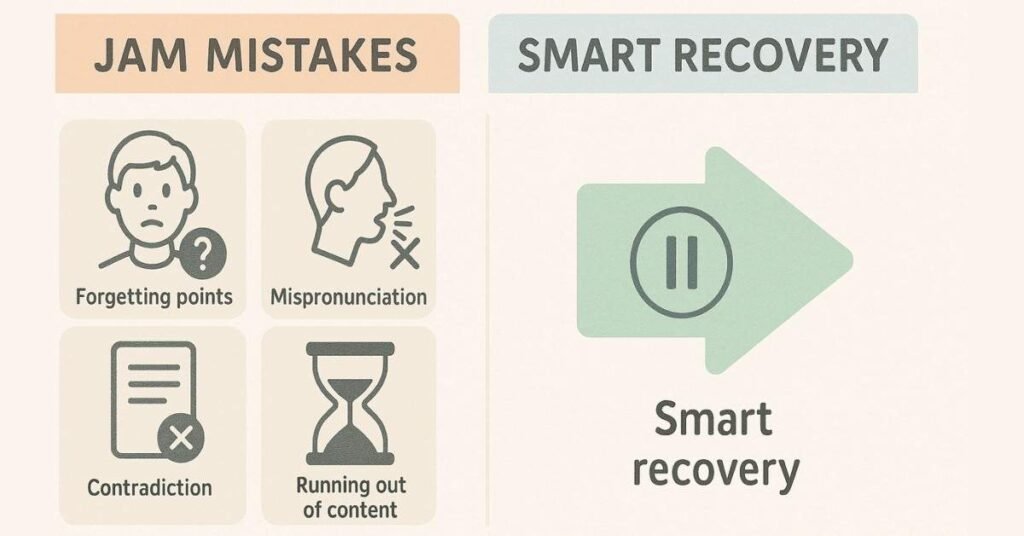
Recovering from Specific Mistakes
Mistake 1: You Forgot What You Were Saying
The moment you realize you’ve lost your train of thought:
Don’t:
- Say “I forgot what I was saying”
- Ask the evaluator “What was I talking about?”
- Fall into prolonged silence
- Start repeating previous points
Do:
- Use a transitional bridge: “Another important aspect to consider…”
- Pivot to a new but related point using your frameworks
- Maintain speaking momentum—silence makes it more obvious you’re lost
- Trust that your frameworks will help you generate relevant content
Example Recovery:
You’re speaking about “Technology in Education” and lose your train of thought after discussing online learning platforms. Instead of freezing, you say: “Building on that infrastructure, let’s consider the teacher’s perspective…” and continue with a new angle.
Mistake 2: You Mispronounce a Key Word
You said “enviroment” instead of “environment.”
Don’t:
- Apologize excessively (“I’m sorry, I meant…”)
- Stop and correct yourself repeatedly
- Say “Actually, let me say that again”
Do:
- Continue speaking without acknowledging the error
- Use the word correctly in subsequent sentences
- Move forward confidently
Why this works: One mispronunciation is forgiven by most evaluators. But stopping to correct yourself draws more attention to the error and breaks your flow.
Mistake 3: You Contradict Yourself
You said “Social media increases productivity” but later said “Social media decreases focus.”
Don’t:
- Say “Wait, I meant…” or “Actually, I contradicted myself”
- Freeze or show confusion
- Try to apologize
Do:
- Acknowledge the nuance: “Initially, social media provides instant productivity tools, but prolonged use creates focus challenges…”
- This shows sophisticated thinking—acknowledging complexity rather than error
- Continue confidently
The Professional Spin: Instead of admitting contradiction, you’re demonstrating nuanced thinking that acknowledges multiple perspectives.
Mistake 4: You Run Out of Content Before 60 Seconds
You’ve said everything you planned to say, but there’s still 20 seconds left.
Don’t:
- Repeat what you already said
- Say “I think that’s all I have to say”
- Fall silent
Do:
- Expand on your main points with additional examples
- Introduce a new angle using your frameworks (personal impact, societal impact, future implications)
- Use phrases like “To expand on that further…” or “Consider another perspective…”
- Ask yourself: “What’s one more thing about this topic that’s valuable?”
Quick Content Generation Formula:
If you have extra time, ask yourself these questions rapidly and speak your answers:
- “Who is most affected by this?”
- “What’s the long-term impact?”
- “What would I advise others about this?”
- “How has this changed over time?”
Each question can generate 15-20 seconds of content.
Mistake 5: You Speak Too Fast and Run Out of Time
You covered all your content but still have 25 seconds left and nothing planned.
Don’t:
- Stop and say “I’m done”
- Repeat content
- Mumble incoherently to fill time
Do:
- Slow your pace deliberately and emphasize key points
- Add pauses for emphasis and effect
- Restate your most important message with different wording
- Elaborate on examples with additional context
Example:
Instead of: “Time management is important.”
Say: “Let me emphasize this point again—time management… [pause] …is not just about being productive. It’s fundamentally about respecting your life and your priorities. When we manage time intentionally, we’re really managing our life choices. That’s why time management matters.”
That takes 15 seconds instead of 3.
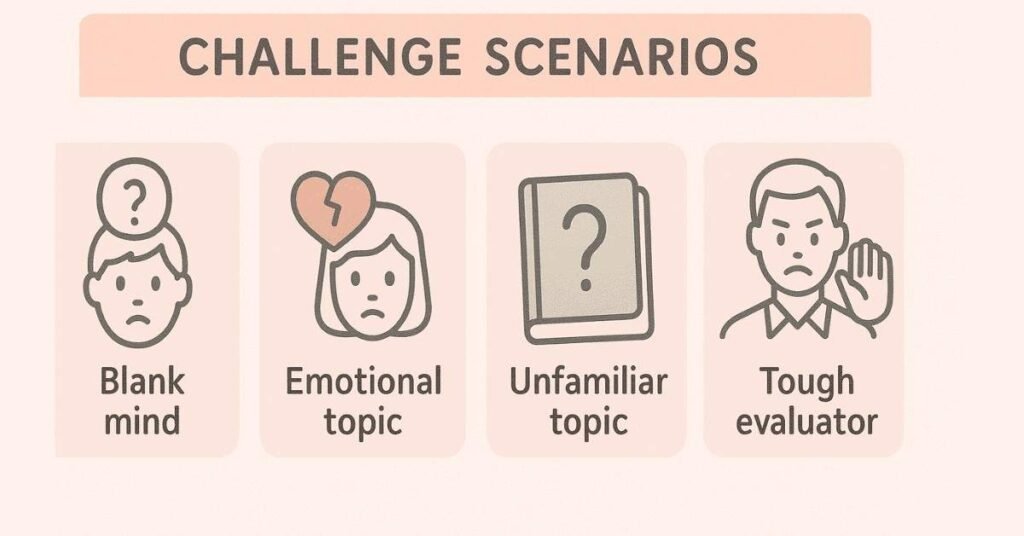
Managing Unexpected Challenges
Challenge 1: Technical Issues
Your mind goes completely blank mid-speech.
Response: Use transitional phrases to buy time: “An interesting aspect of this is…” “Let me expand on that…” “Consider another perspective…”
These phrases sound intelligent while your brain catches up. Most evaluators understand occasional brief pauses.
Challenge 2: Emotional Trigger
The topic personally upsets you or triggers anxiety.
Response: Take the 2-3 second pause and regulate. Speak about it professionally rather than emotionally. Acknowledge the emotional dimension objectively: “This topic naturally triggers strong emotions because…” This shows emotional intelligence.
Challenge 3: Unfamiliar Topic
You genuinely don’t know much about the topic.
Response: Use the rapid thinking frameworks you learned earlier. Ask yourself the diagnostic questions: definition, why it matters, different perspectives. Speak genuinely: “While I’m not an expert on this, what I understand is…” This honesty is better than fabricating knowledge.
Challenge 4: Challenging Evaluator
The evaluator seems hostile or keeps interrupting.
Response: Maintain professionalism and courtesy regardless. Don’t mirror their tone. Stay calm and respectful. Companies are observing how you handle difficult interpersonal situations—this is the actual test.
📂 Access complete learning materials that enhance confidence, delivery, and resilience →
The Composure Mindset
The key to handling all interruptions is developing a resilience mindset:
Belief 1: Interruptions Are Opportunities
When interrupted, you’re being tested on a valuable skill. Handling it well impresses evaluators more than perfect delivery.
Belief 2: Mistakes Are Universal
Every speaker makes mistakes. What matters is how you respond. Evaluators don’t expect perfection—they expect professionalism.
Belief 3: You Have More Knowledge Than You Think
Even on unfamiliar topics, your rapid thinking frameworks allow you to generate logical, relevant content. Trust the system.
Belief 4: Silence Is Your Enemy, Not Your Friend
Speaking is always better than silence during JAM. Even if you’re not 100% sure, speaking confidently beats uncertain silence.
Belief 5: The Evaluator Wants You to Succeed
They’re not trying to trick you. They want to see you handle pressure well. Approach interruptions as collaborative challenges, not attacks.
Practice Exercise: Controlled Interruptions
Get a friend or use a teacher, and practice JAM with deliberate interruptions:
Practice Set 1 (Week 1):
- 5 topics with 1 interruption each (topic change at 30 seconds)
- Focus on smooth transitions
Practice Set 2 (Week 2):
- 5 topics with 2-3 interruptions each
- Include both topic changes and “stop” commands
- Practice recovery immediately
Practice Set 3 (Week 3):
- Unpredictable interruptions
- Challenge questions mid-speech
- Time extensions
- Adapt to different scenarios
By Week 3, interruptions become normal, and your panic response diminishes significantly.
🧭 Continue your learning journey with more structured guidance and improvement-focused content →
Key Takeaways for Handling Interruptions
- Interruptions are intentional tests of composure and adaptability
- Pause and breathe (2-3 seconds) before responding
- Acknowledge clearly to show you understood the instruction
- Recover with structure using your established frameworks
- Common mistakes include stopping, apologizing, or going silent—avoid these
- Use transitional phrases to buy thinking time when your mind goes blank
- Maintain professionalism regardless of evaluator tone or difficulty
Practice controlled interruptions to build genuine resilience