
Rapid Thinking and Content Generation
Table of Contents

Blog Content:
The Challenge Every JAM Student Faces
You’re standing in front of the interviewer. They hand you a slip of paper with the topic: “Why do people fear failure?”
Your brain feels like it just short-circuited. You have maybe 10-15 seconds before you need to start speaking. Your mind goes blank. You can feel the pressure mounting.
This is exactly where most students struggle during JAM—not because they lack knowledge, but because they don’t know how to generate ideas quickly under pressure.
The good news? Rapid thinking is a skill, not a talent. And like any skill, it can be systematically developed.
🔍 Explore structured learning resources to strengthen clarity and thinking flow →
Why Traditional Thinking Doesn't Work for JAM
Here’s what most people do when given a new topic: They try to think of the “perfect” answer first, which takes forever. Their brain goes something like this:
“Hmm, let me think of the most intelligent way to explain this… Wait, what if I say something wrong? Let me reconsider… Actually, let me start with a definition… No, that sounds boring…”
By the time they’re ready to speak, 30 seconds have already passed—and their confidence is shot.
📘 Discover more preparation-focused content designed to enhance performance →
JAM requires a completely different approach.
Instead of seeking the perfect thought, you need to generate raw, unfiltered ideas quickly, then organize them on the fly.
Think of it like this:
- Traditional thinking = Slow, filtered, perfectionist (90% thinking time, 10% speaking time)
- JAM thinking = Fast, raw, adaptive (10% thinking time, 90% speaking time)
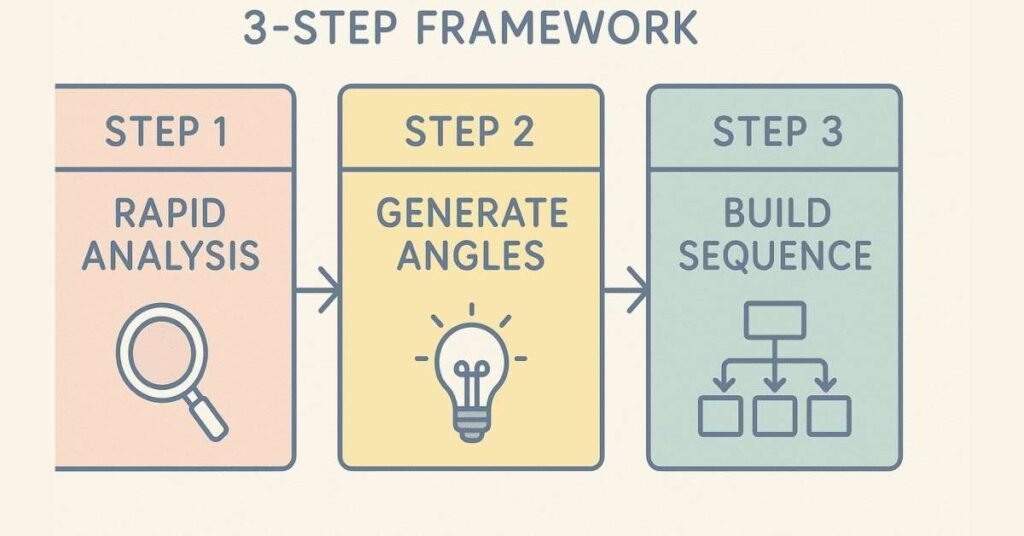
The Three-Step Framework for Rapid Content Generation
Here’s a battle-tested system you can use for ANY JAM topic:
Step 1: Rapid Topic Analysis (5 seconds)
The moment you receive a topic, immediately ask yourself these three diagnostic questions:
- What is the core definition?
“What does this topic basically mean in simple terms?” - Why does it matter?
“Why would someone care about this? What impact does it have?” - What are the main angles?
“What are 2-3 different ways to look at this topic?”
Let’s apply this to a real example:
Topic: “Social Media Addiction”
- Definition: Excessive use of social media platforms causing dependency
- Why it matters: Affects mental health, productivity, relationships, and society
- Main angles: Individual impact, societal impact, how to overcome it
That entire analysis takes about 5 seconds in your head. Now you have a clear starting point instead of a blank slate.
Step 2: Generate Multiple Content Angles (5-10 seconds)
Once you understand the topic basics, quickly generate 3-5 different angles or perspectives you could take. Don’t filter yourself—just let ideas flow.
Example: “Social Media Addiction” (continuing from above)
- Angle 1: Personal/Individual impact — How it affects daily life
- Angle 2: Health perspective — Mental health consequences
- Angle 3: Solutions-based — How toovercome addiction
- Angle 4: Generational view — How it impacts Gen Z differently
- Angle 5: Business perspective — Why companies encourage engagement
Now you have multiple entry points. Pick the one that feels most natural to you, and that’s your starting angle.
The beauty? You’re not forcing a perfect speech. You’re choosing a direction and committing to it.
Step 3: Build Content Sequentially (Practice)
Once you’ve chosen your angle, use the Building Block Method to add content progressively:
Block 1: Opening (First 10 seconds)
- Simple definition or personal observation
- Example: “Social media addiction is something most of us struggle with today…”
Block 2: Main Explanation (Next 20-30 seconds)
- Elaborate on your chosen angle with examples
- Example: “One major impact is on our mental health. Studies show…”
Block 3: Supporting Evidence (Next 15-20 seconds)
- Add data, examples, or real-world scenarios
- Example: “For instance, teenagers spend an average of 4-5 hours daily…”
Block 4: Closing Perspective (Final 10-15 seconds)
- Future outlook or call to action
- Example: “As we move forward, it’s important that…”
This creates a complete speech structure without sounding robotic. You’re simply building one piece at a time.
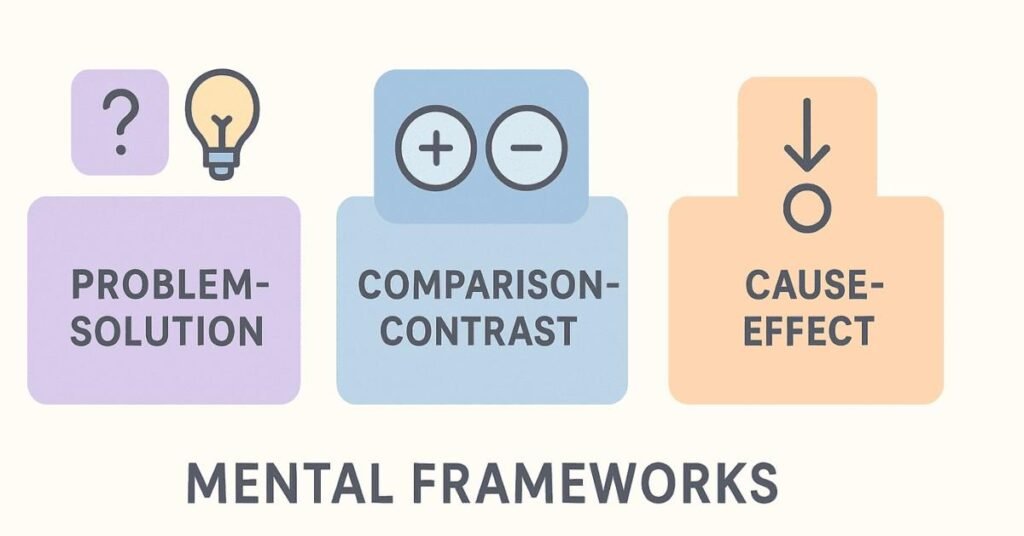
Mental Frameworks: Your Thinking Shortcuts
Here’s a professional secret: Successful speakers don’t think randomly—they use mental frameworks.
Think of frameworks as pre-built templates for organizing thoughts. Instead of creating from scratch, you slot information into existing patterns. This dramatically speeds up your thinking.
Framework 1: The Problem-Solution Method
Use when the topic is a challenge or issue:
- Problem: What’s the issue?
- Causes: Why does it exist?
- Consequences: What’s the impact?
- Solutions: How can we address it?
Example Topic: “Why teenagers waste time instead of studying”
- Problem: Many teenagers procrastinate instead of focusing on studies
- Causes: Social media, lack of motivation, unclear goals
- Consequences: Poor grades, lost opportunities, reduced self-confidence
- Solutions: Time management, removing distractions, setting clear goals
You now have a complete speech structure without breaking a sweat.
Framework 2: The Comparison-Contrast Method
Use when you can compare the topic with something familiar:
- What it is: Basic definition
- What it resembles: A similar concept people know
- How it differs: Key differences
- Why it matters: Significance
Example Topic: “Remote work”
- What it is: Working from outside a traditional office
- What it resembles: Freelancing (but with employment structure)
- How it differs: Regular schedule, company benefits, team collaboration
- Why it matters: Changing work culture and flexibility standards
Framework 3: The Cause-and-Effect Method
Use for topics involving processes or relationships:
- Starting point: What triggers or begins the topic?
- First effect: What happens immediately?
- Secondary effects: What follows next?
- Long-term impact: Where does it lead?
Example Topic: “Climate change”
- Starting point: Increased greenhouse gas emissions
- First effect: Rising global temperatures
- Secondary effects: Melting ice caps, altered weather patterns
- Long-term impact: Threat to ecosystems and human survival
These frameworks are incredibly powerful because they give your brain a track to run on. You’re not creating from zero—you’re filling in a proven structure.
- What is the core definition?
Handling Different Topic Types: Adaptive Strategies
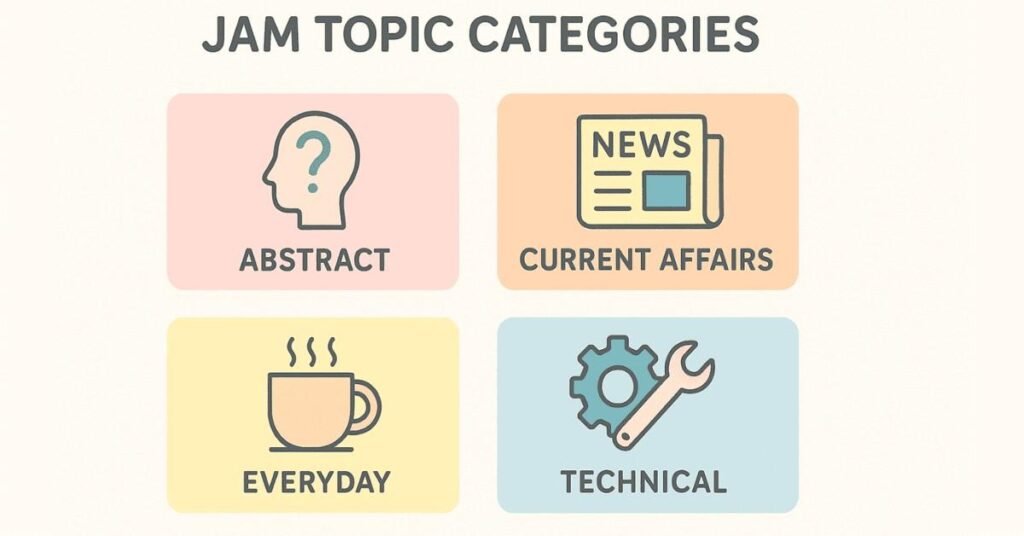
Not all JAM topics are the same. Here’s how to adapt your thinking based on topic type:
Abstract Topics (e.g., “Happiness,” “Success,” “Change”)
Strategy: Use personal examples and real-world manifestations
- Start with what the concept means to you
- Provide relatable examples
- Discuss how it manifests in everyday life
- Share perspectives on why it matters
Example approach to “Happiness”:
“Happiness is not just about feeling good—it’s about meaningful contentment. For me, happiness comes from three things: accomplishments, relationships, and personal growth. When I complete a project successfully, spend time with family, or learn something new, that’s when I truly feel happy. Society often defines happiness through money or status, but research shows real happiness comes from purpose and connection.”
Current Affairs Topics (e.g., “AI Impact,” “Climate Policy,” “Economic trends”)
Strategy: Show awareness + balanced perspective
- Acknowledge the current situation
- Present multiple viewpoints
- Share relevant statistics or examples if you know them
- Discuss future implications
Example approach to “AI Replacing Jobs”:
“AI is definitely changing the job market, but it’s not as simple as jobs disappearing. Yes, some routine jobs may get automated, but historically, new technologies create new types of jobs. AI is creating demand for data scientists, AI trainers, and tech specialists. However, there will be a transition period where some workers need reskilling. So the real issue is not AI replacing jobs—it’s how quickly we adapt our education system.”
Everyday Topics (e.g., “Why people procrastinate,” “Benefits of reading,” “Why exercise matters”)
Strategy: Use the “universal experience” angle
- Most people relate to this, so use that connection
- Provide practical insights
- Share personal or common observations
- End with actionable perspective
Example approach to “Procrastination”:
“Procrastination is something everyone does, right? But why? It’s not about laziness—it’s usually about anxiety or unclear direction. When a task feels overwhelming or we’re not sure where to start, we delay. I procrastinate most when I’m afraid of making mistakes. The solution isn’t motivation—it’s breaking the task into smaller pieces so it feels manageable. For example, instead of ‘write a report,’ I tell myself ‘write just the introduction,’ and suddenly it’s not so scary.”
Technical/Role-Specific Topics (e.g., “Blockchain,” “Quantum Computing,” “Digital Marketing”)
Strategy: Simplify without dumbing down
- Start with a simple analogy
- Explain core concepts in plain language
- Provide business or real-world application
- Discuss relevance to your field
Example approach to “Blockchain”:
“Blockchain is essentially a digital ledger that records transactions across multiple computers. Think of it like a shared notebook where multiple people write down transactions, and once something is written, nobody can erase it. The advantage is security and transparency. For example, in supply chain management, blockchain helps track products from manufacture to delivery, ensuring authenticity. This matters because companies and customers want to verify the origin and handling of products.”
The “Filler Framework”: What to Do When Your Mind Goes Blank
Even with preparation, sometimes you might forget what to say next. Here’s an emergency technique: Use transitional phrases to buy thinking time without losing momentum.
These phrases work as “bridges” that sound intelligent while your brain catches up:
- “That leads to another important point…”
- “Consider another perspective on this…”
- “To expand on that idea…”
- “An interesting aspect of this is…”
- “What makes this significant is…”
- “On a deeper level…”
- “This connects to the broader issue of…”
Example in action:
“Artificial Intelligence is transforming industries rapidly. [Brief pause—thinking] An interesting aspect of this is the ethical considerations involved. [Now your brain has caught up and you can continue with your next point]”
Notice how these phrases sound natural and don’t interrupt your flow? You’re not using “uh” or “um”—you’re using intellectual bridges.
Content Generation in Real-Time: The Live Practice Method
Here’s how to train your brain to generate content faster:
Daily Exercise (3-5 minutes)
- Set a timer for 60 seconds
- Pick any random topic (from news, your surroundings, etc.)
- Speak out loud for the full 60 seconds without stopping
- Don’t edit yourself—just keep talking
- Record yourself and listen back
Why this works: Your brain adapts to the time pressure. After 10-15 days of this practice, generating content becomes significantly faster and more natural.
The Rapid-Fire Challenge (Weekly)
Get a friend or use online resources with JAM topics. Do 5-10 topics back-to-back with only 10 seconds of prep time per topic. This builds mental stamina and quick-thinking muscles.

📂 Access complete learning materials to improve reasoning, delivery, and quick-idea generation
Building Your Personal Content Repository
The more examples and data points you have stored in your mind, the faster you can generate content. Start building this now:
Collect Information Daily:
- Read one news article and remember 2-3 key points
- Watch one short educational video (TED, YouTube) and note the main idea
- Read one interesting social media post and think about multiple perspectives
- Observe one real-world scenario and think about its implications
By the end of a month, you’ll have hundreds of examples and data points readily available in your mind. When a JAM topic comes up, your brain can instantly pull from this repository instead of starting from scratch.
Key Takeaways for Rapid Content Generation
- Rapid thinking is a learnable skill, not a talent
- Use the three-step framework: Topic analysis → Generate angles → Build sequentially
- Apply mental frameworks (problem-solution, comparison, cause-effect) to structure thoughts
- Adapt your strategy based on topic type (abstract, current affairs, everyday, technical)
- Use transitional phrases to maintain flow when your brain needs extra time
- Practice daily with timed exercises to build speed and confidence
Build your content repository by consuming diverse information