
Common GD Mistakes to Avoid
Table of Contents

Blog Content:
You’ve prepared. You know the techniques. But one small mistake could sink your entire GD performance.
The problem? Most students don’t know what their mistakes are. They repeat the same errors across multiple GDs without realizing it.
This section will help you identify and eliminate the most common pitfalls.
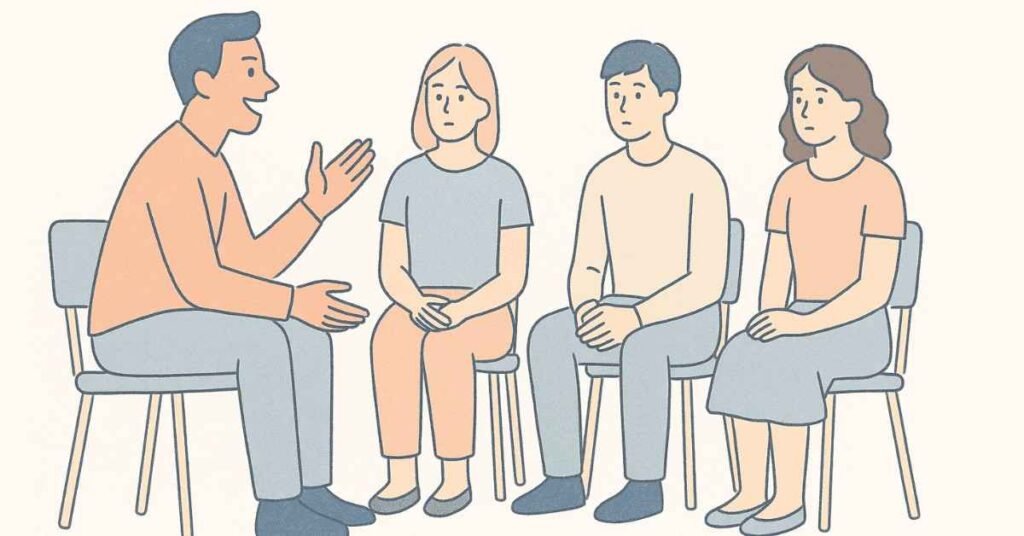
Mistake 1: Dominating the Conversation
This is the #1 mistake that gets candidates rejected.
What it looks like:
- You keep talking for 3+ minutes without pause
- You interrupt others frequently
- You restate points that have already been made
- You give the impression that your ideas are better than everyone else’s
Why it’s a red flag:
Recruiters are looking for team players. A person who dominates the GD is flagged as “difficult to work with” or “arrogant.” Even if your ideas are good, the domination overshadows it.
How to avoid it:
Set a mental rule: Speak for maximum 2 minutes at a time, then pause and let others speak.
If you’re naturally talkative, count in your head. After 90 seconds, wrap up your point.
Also, listen more than you speak. If you’ve spoken 5 times and someone else has spoken twice, you’re probably dominating.
The balance:
- Speak 40% of the time, listen 60% of the time
- Make your points clear and let them settle
- Don’t repeat what you’ve already said
- Encourage others: “Rohan, what do you think about this?”
🔍 Explore structured learning resources for improving communication clarity →
Mistake 2: Lack of Preparation
You can’t fake knowledge in a GD.
What it looks like:
- You use vague language: “I think it’s important because, um…”
- You have no examples to back your points
- You seem caught off-guard by follow-up questions
- Your points are shallow or obvious
Why it’s a red flag:
If you don’t prepare, you’ll sound unprepared. It’s that simple. And recruiters see this as a lack of seriousness or commitment.
How to avoid it:
- Spend 30 minutes reading about trending GD topics (use sources like The Hindu, BBC, Economic Times, LinkedIn articles)
- Prepare 2-3 personal examples for common topics
- Note down recent statistics you can recall (not to memorize, but to understand)
- Anticipate counter-arguments and prepare your response
Checklist before a GD:
☐ Read 3 trending news articles
☐ Prepare examples for 5 common GD topics
☐ Know 3-5 recent statistics
☐ Anticipate 2 counter-arguments to your position
☐ Practice speaking for 2 minutes on a topic
Mistake 3: Interrupting Others Rudely
We mentioned this before, but it deserves its own focus because it’s so common.
What it looks like:
- You cut people off mid-sentence
- You don’t wait for natural pauses
- You don’t acknowledge what the other person said before jumping in
- Your interruptions seem aggressive or dismissive
Why it’s a red flag:
Rudely interrupting signals poor listening skills and disrespect. Even if your point is valid, the way you delivered it is wrong.
How to avoid it:
Wait for natural pauses. If someone takes a breath, that’s your cue. If they’re still mid-sentence, don’t jump in.
If you absolutely must interject, use polite language:
- “I hear you. Can I add something?”
- “That’s a good point. I’d like to offer a different angle…”
- “I agree, and I think there’s another factor…”
The golden rule:
Acknowledge before you dispute. Never directly contradict someone without acknowledging their point first.
Bad: “No, you’re wrong. The statistic is actually 45%, not 30%.”
Good: “I see where you’re coming from with that number. According to the 2024 report, it’s actually closer to 45%. But your overall point about growth is still valid.”
See the difference? In the second example, you’re correcting the fact while respecting the person.
📘 Discover more preparation content designed to support better interaction and engagement →
Mistake 4: Being Too Passive (The Silent Contributor)
While domination is bad, being too quiet is equally bad.
What it looks like:
- You speak only 1-2 times in the entire GD
- You never raise your hand
- You nod along but never contribute your own ideas
- You seem disinterested or unconfident
Why it’s a red flag:
If you barely speak, recruiters can’t assess your communication skills or knowledge. They assume you either don’t know anything or lack confidence. Both are red flags.
How to avoid it:
You don’t need to speak 10 times. But you need to make meaningful contributions at least 3-4 times.
If you’re shy or introverted, use these strategies:
- Prepare at least 1 opening. Jump in early (in the first 2 minutes). Once you’ve spoken once, it gets easier to speak again.
- Ask questions. You don’t always need to have an answer. “Can you elaborate on that?” or “What do you mean by…?” counts as a contribution.
- Summarize others’ points. “So if I understand correctly, you’re saying…” This shows you’re listening and thinking.
- Agree and add. “I agree with that point, and I’d also add…”
The minimum threshold: Speak at least 3-4 times, with total speaking time of 5-7 minutes.
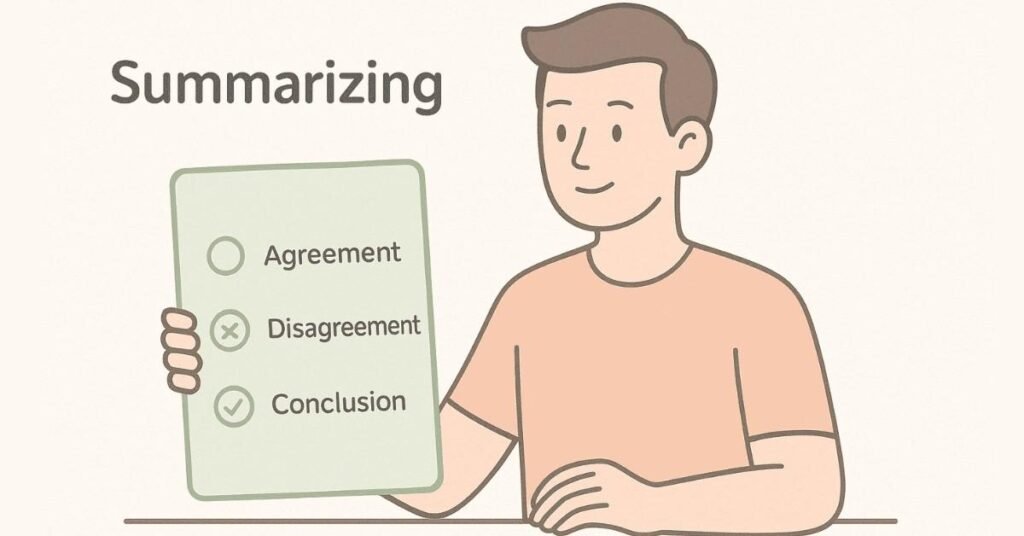
Mistake 5: Getting Emotional or Defensive
This is where professionalism gets tested.
What it looks like:
- Someone disagrees with you, and you get visibly upset
- You raise your voice
- You take disagreement personally
- You say things like “That’s stupid” or “You don’t understand”
Why it’s a red flag:
Emotional responses show poor emotional intelligence and poor conflict management. Companies want employees who stay professional even when stressed.
How to avoid it:
Remember: Disagreement is not personal. It’s professional.
When someone disagrees with you:
- Take a breath
- Acknowledge their point
- Calmly present your counter-argument
- Move on
Example:
You say: “I think remote work reduces innovation.”
Someone responds: “I disagree. Many companies innovate fully remote now.”
Don’t do this: “That’s not true. You’re clearly not understanding what innovation means.”
Do this: “I hear you. Companies like GitLab do innovate remotely. But I’d argue that’s because they’re software companies where collaboration is digital by nature. For hardware or product design teams, in-person collaboration still matters more. So maybe it’s industry-dependent?”
Now you’re not emotional—you’re analytical. That’s professionalism.
📂 Access complete learning materials focused on enhancing professionalism and decision-making →
Mistake 6: Focusing Solely on Winning the Discussion
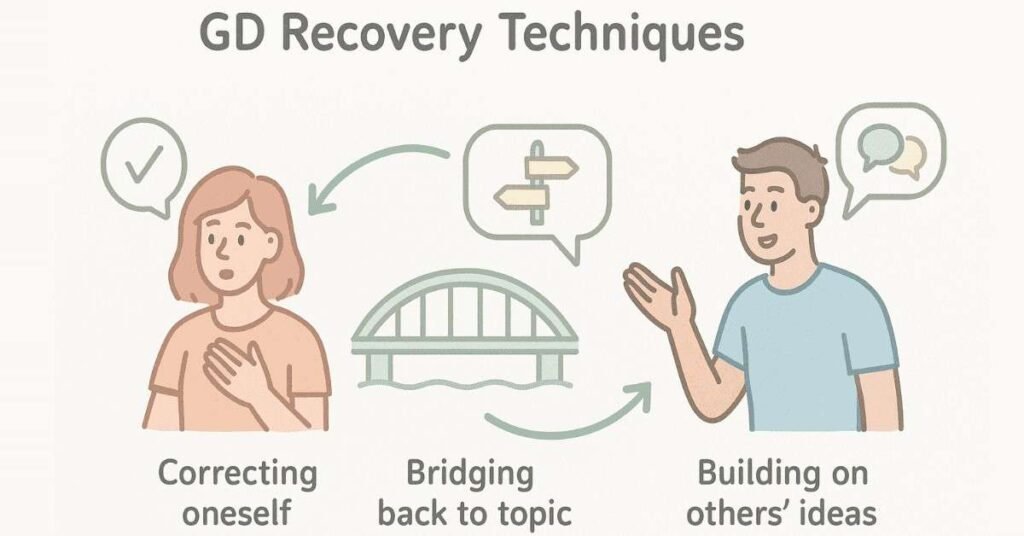
This is the mindset mistake.
What it looks like:
- You treat the GD like a debate
- You’re more interested in “proving people wrong” than finding solutions
- You get frustrated when others don’t agree with you
- You seem more concerned with being right than with collaboration
Why it’s a red flag:
GDs aren’t debates. No one “wins.” The goal is collaboration. If you seem combative, you’ll be flagged as “difficult to work with.”
How to avoid it:
Shift your mindset from “winning” to “collaborating.”
Instead of thinking: “I need to prove my point is better”
Think: “We need to reach a solution together”
This changes everything. Now you:
- Listen to understand, not to rebut
- Build on others’ ideas
- Look for common ground
- Propose compromises
Example mindset shift:
Winning mentality: “Remote work is bad because productivity decreases.”
Collaborative mentality: “Remote work is complex. It works for some roles and companies, but not for others. The best approach is probably hybrid—letting teams choose what works for them.”
The second one shows you can think beyond black-and-white thinking.
🧭 Continue your learning journey with more structured guidance and improvement-focused content →
Mistake 7: Irrelevant or Off-Topic Comments
Sometimes students make comments that are tangentially related or completely off-topic.
What it looks like:
- You share a story that has nothing to do with the topic
- You make jokes that don’t fit
- You bring up past experiences that aren’t relevant
- You seem to be thinking out loud instead of contributing purposefully
Why it’s a red flag:
It signals poor listening and poor ability to stay focused. In a workplace, this means you might miss the point of meetings or projects.
How to avoid it:
Before you speak, ask yourself: “Is this comment directly relevant to the current discussion?”
If the answer is “sort of” or “not really,” don’t say it.
Better approach:
Make every comment directly tie back to the topic or the point being discussed.
Bad contribution: “My sister works in tech, and she told me that AI is becoming important in her company.”
Good contribution: “That connects to what we discussed earlier—companies are actively implementing AI. According to a McKinsey survey from 2024, 35% of companies have AI in production. So adoption is accelerating.”
See? The second one is directly relevant and data-backed.
Mistake Summary Table:
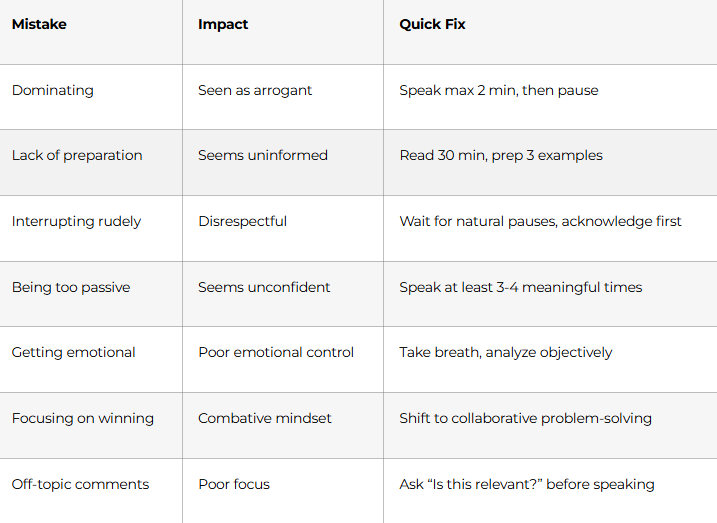
The Mistake Awareness Exercise:
After each practice GD (or real GD if possible), ask yourself:
- Did I dominate or was I too quiet?
- Was I prepared with examples and facts?
- Did I interrupt anyone rudely?
- Did I get emotional?
- Was I focused on winning or collaborating?
- Were my comments relevant?
Fix one mistake per practice session. In 3-4 weeks, you’ll have eliminated most common errors.