
Content Preparation and Knowledge Building
Table of Contents
Blog Content:
Here’s a tough reality: You can have perfect communication skills and incredible leadership qualities. But if your content is shallow, you’ll still fail the GD.
Content is king.
A recruiter hears 30 group discussions in a day. Guess whose they remember? The person who said something thoughtful and backed it up with facts—not the person who just repeated obvious statements.
In this guide, we’ll teach you how to prepare content that makes you stand out.
1. The Three Levels of GD Topics You'll Face
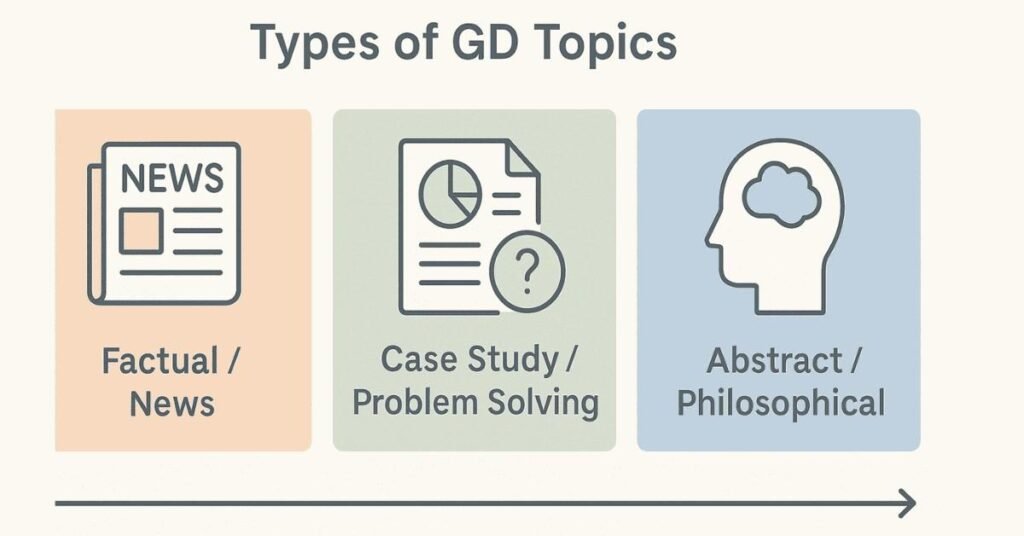
Not all topics require the same preparation. Understanding the topic type helps you prepare efficiently.
Level 1: Factual/News Topics
- “Should India focus on manufacturing or technology?”
- “Is cryptocurrency the future of finance?”
- “What should be India’s approach to climate change?”
Why it matters: These test your awareness of current affairs and real-world events. You need to know recent developments.
Level 2: Case Study/Problem-Solving Topics
- “A tech company’s algorithm is discriminating against minorities. What should the CEO do?”
- “A factory is polluting a river. Local residents are protesting. How do you resolve this?”
Why it matters: These test your analytical and decision-making skills. You need to think through multiple angles and consequences.
Level 3: Abstract/Philosophical Topics
- “Haste makes waste”
- “Consistency is key to success”
- “Food is more important than ethics”
Why it matters: These test your creativity and lateral thinking. You need to go beyond obvious answers.
🔍 Explore structured learning resources designed to strengthen foundational understanding →
2. The Research Framework: What You Actually Need to Know
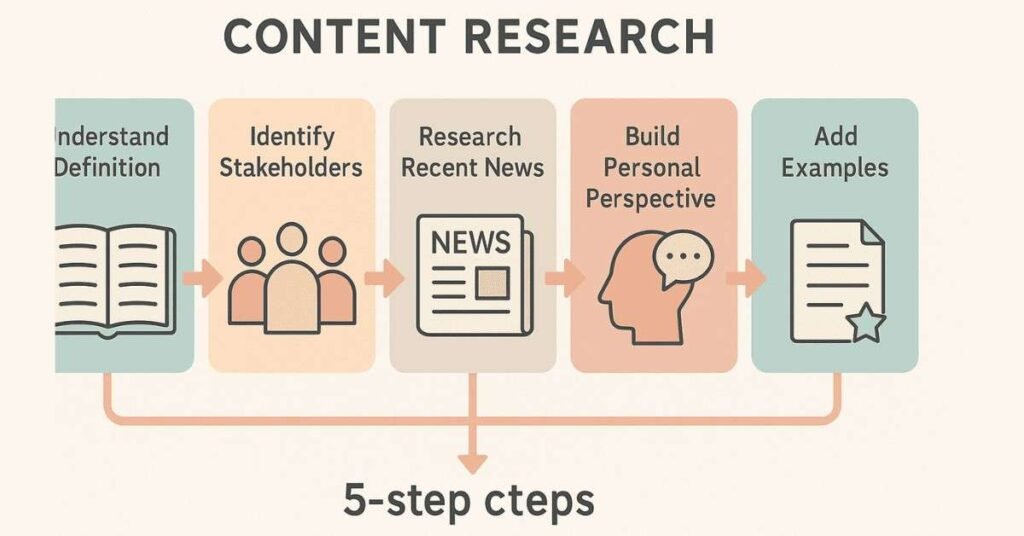
Here’s what students get wrong: They try to know everything about every topic. That’s impossible and unnecessary.
Instead, focus on this framework for each topic:
Step 1: Understand the Basic Definition
What is the topic really asking? Not the surface question, but the deeper question.
Example:
- Topic: “Should India adopt a 4-day work week?”
- Surface question: Is 4-day work week good or bad?
- Deeper question: How do we balance productivity with work-life balance? What’s the role of government vs. companies vs. workers?
Understanding the deeper question gives you direction.
Step 2: Identify the Key Stakeholders
Who’s affected by this issue?
Example for “4-day work week”:
- Employees (want more free time)
- Companies (want productivity and cost)
- Customers (want consistent service)
- Government (wants economic growth and worker welfare)
- Parents (affected by childcare needs)
When you list stakeholders, you automatically think of multiple perspectives. This makes your content richer.
Step 3: Research Recent News and Developments
You don’t need deep expertise, but you need to know what’s been in news recently. Here are trending GD topics in 2025:
- GST 2.0 Reforms
- Trump Tariff Wars and their impact on India
- Union Budget 2025 announcements
- Quick Commerce Boom and its impact on retail
- AI in education and jobs
- Climate change and India’s COP commitments
- Mental health in workplaces
- Remote work vs. office culture
How to research: Spend 30 minutes reading about a topic on reputable news sites (like BBC, Reuters, The Hindu, Economic Times). You don’t need to be an expert. Just know the basic facts and recent developments.
Step 4: Prepare a Personal Perspective with Examples
Don’t just memorize facts. Have your own perspective backed by examples.
Weak perspective: “Climate change is bad.”
Strong perspective: “While fighting climate change is important, India’s approach should balance it with economic growth. Why? Because 1 out of 2 Indians still lives on less than $3 per day. We can’t ask poor farmers to use expensive solar panels. Instead, the government should invest in grid-scale renewable energy while providing subsidized green energy to farmers. This way, we address climate without increasing poverty.”
See the difference? You have a clear perspective and reasoning.
Step 5: Keep 2-3 Recent Examples Ready
Facts alone are boring. Examples make them memorable and believable.
Example for “AI in jobs” topic:
Instead of saying, “AI will replace jobs,” say:
“The MIT study from 2024 found that while AI will displace 40 million jobs in developed countries, it will create 90 million new ones. But here’s the gap: the new jobs require different skills. So the real issue isn’t job loss—it’s skill mismatch. This means governments need to invest heavily in reskilling programs.”
Now you sound informed and credible.
📘 Discover more preparation content designed to support deeper learning and critical reasoning →
3. Building Arguments Using the PREP Method (But Better)
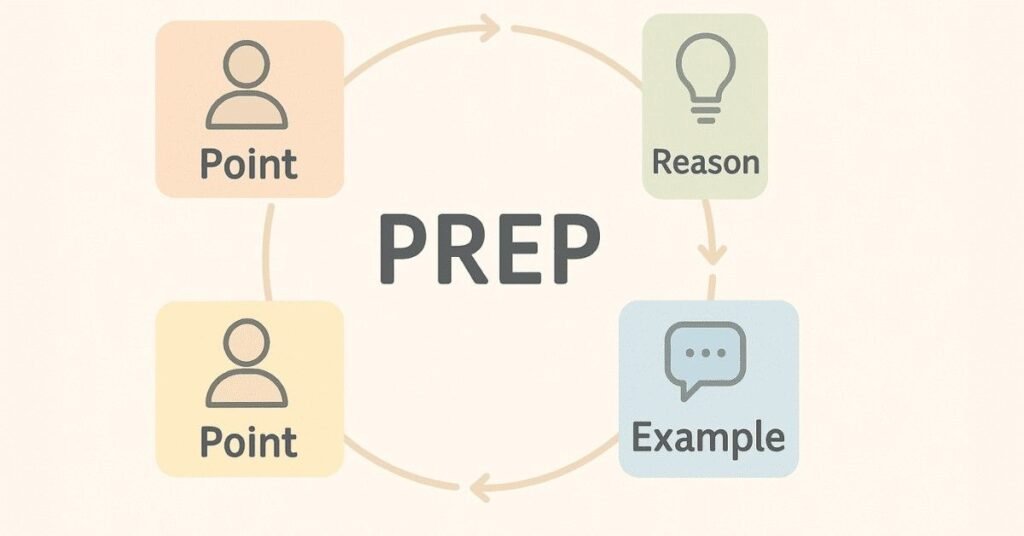
We mentioned PREP earlier. Here’s how to use it to build strong arguments:
P – Point (Your main idea)
Start with a clear statement. “I believe remote work reduces productivity in creative industries.”
R – Reason (Why you believe it)
Explain the logic. “Because creativity thrives through spontaneous collaboration. When people work from home, those water-cooler conversations don’t happen.”
E – Example (Evidence from real world)
Show it’s not just your opinion. “Meta found that remote-only teams had 30% lower innovation rates compared to hybrid teams in 2024.”
P – Point (Conclude)
Restate your main idea with nuance. “So while remote work is great for individual tasks and cost savings, companies prioritizing innovation should focus on hybrid models.”
📂 Access complete learning materials to enhance reasoning clarity and decision-making →
4. Preparing Balanced Perspectives on Controversial Topics
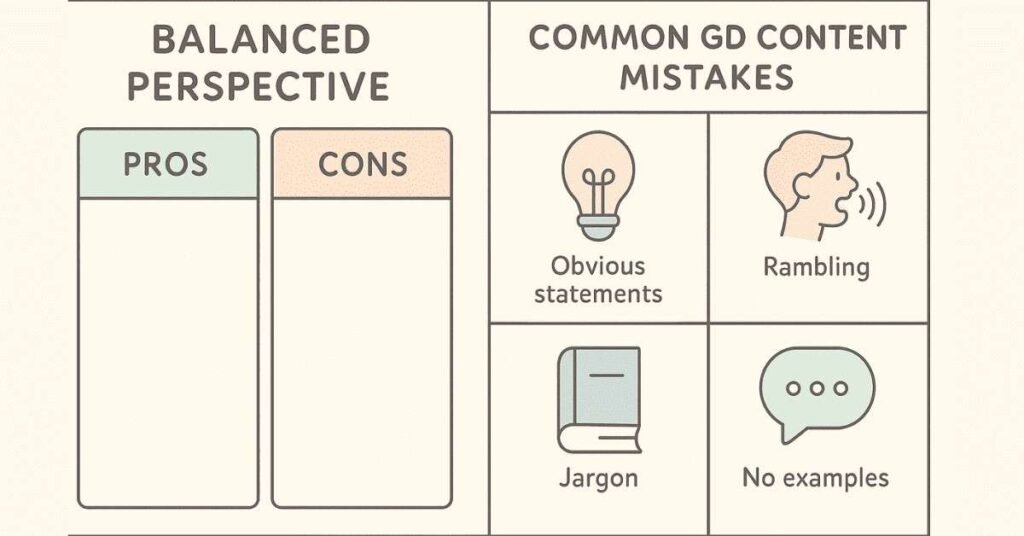
Controversial topics often have no “correct” answer. Your job is to present both sides fairly.
Topic: “Social Media: Blessing or Curse?”
Wrong approach: Say it’s only a curse. This shows you can’t think beyond obvious answers.
Right approach: Present both sides.
“Social media is a tool. Its impact depends on how we use it. Let me share both sides:
Blessings:
- Connects people across geography (migrants stay in touch with home)
- Gives voice to marginalized communities (social movements like #MeToo)
- Enables small businesses to reach customers (SMEs grew 5x due to Instagram)
Curses:
- Algorithm-driven content creates polarization
- Mental health issues in teenagers due to comparison and validation-seeking
- Misinformation spreads faster than truth (50% of pandemic misinformation came from social media)
My perspective: Instead of saying it’s good or bad, the real question is: How do we regulate it? I think we need:
- Transparency in algorithm design
- Fact-checking standards
- Age restrictions for teenagers
This way, we get benefits while minimizing harms.”
Notice how this approach:
- Acknowledges complexity
- Shows you can argue both sides
- Proposes practical solutions
- Sounds mature and balanced
5. Avoiding Common Content Mistakes
Mistake 1: Stating the obvious
❌ “Social media connects people, which is good.”
✅ “Social media democratizes information flow, but this also means misinformation spreads faster.”
Mistake 2: Rambling without structure
❌ “There are many reasons why AI is important. It helps in healthcare, and it also helps in finance, and also in manufacturing. And many companies are using it…”
✅ “AI impact can be categorized into three sectors: healthcare (improving diagnosis accuracy), finance (fraud detection), and manufacturing (automation). In each sector, the benefits are clear, but so are the job displacement concerns.”
Mistake 3: Using jargon without explaining
❌ “The macroeconomic implications of cryptocurrency will create paradigm shifts in the fintech ecosystem.”
✅ “Cryptocurrency could change how countries manage money, but it also creates new problems like tracking illegal transactions.”
Mistake 4: Having no examples
❌ “Many companies are doing AI now.”
✅ “Amazon uses AI to recommend products, Netflix uses it for content suggestions, and Tesla uses it for autonomous driving. All three face criticism—Amazon for data privacy, Netflix for algorithm bias, Tesla for safety concerns.”
Quick Preparation Strategy (Last-Minute Help)
If you have only 1 week to prepare:
- Day 1-2: Read about 3 trending topics on news sites (30 min each)
- Day 3-4: Prepare your perspective on 5-6 common GD topics with 2 examples each
- Day 5-6: Practice with friends. Discuss these topics for 20 minutes each
- Day 7: Review. Relax. You’re ready.
Content + Communication = Success
Remember: Shallow content with great communication might get you a “decent” performance. But strong content with good communication will get you selected.
The recruiters have heard thousands of GD answers. What makes someone stand out? Someone who clearly thought about the topic, researched it, formed a balanced perspective, and can explain it with real examples and reasoning.
That’s the person they hire.