
Today, every business of any size must have a clear strategy on how they are going to market online. Yet, in saying that, here is a step-by-step process that enables proper digital marketing strategy and alignment with the goals of your business and targeted reach.
Digital Marketing Strategy Definition
A digital marketing strategy is a comprehensive plan that demonstrates how a business will utilize the digital channels to reach its marketing goals. It could be something as simple as social media and email marketing or as complex as search engine optimization and content marketing. Clearly, businesses can use to connect with their audience and drive conversions.
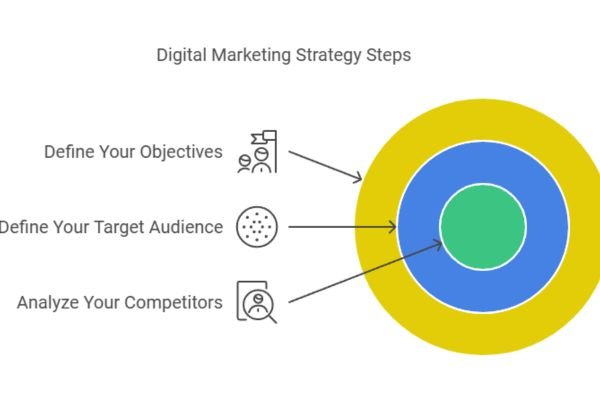
Step 1 – Define Your Objectives
Define what you want from the digital marketing you are seeking. What is your goal? You must set a SMART goal. The goal must be specific, measurable, achievable, relevant, and time-bound. Therefore, perhaps you want to have 30 percent more traffic on your website in six months, or you may want 100 leads per month.
Step 2: Define Your Target Audience
It is essential to know about your target audience in doing any kind of digital marketing strategy. hence, it is an important determinant of ideal customers and is also a basis of various interests and demographics along with their online behavior. The research on the market leads to the creation of buyer personas that are highly vital because they are imaginative presentations of your ideal customers.
Step 3: Analyze Your Competitors
So, pretty much, analyzing your competition is what goes very much into the digital strategy. You basically know what the heck your competitors are up to online. Which kind of platforms they’re using, what kind of content creation, etc. All that helps you analyze the competitor sites, keywords, and backlink. Therefore, understanding the same will help you see gaps in the market and opportunities for your business in that.
Step 4: Online marketing channels
There are so many channels that one can reach the customer with digital marketing. In fact, the wrong one can make or break the strategy. Here are a few of the most popular ones.
Social media marketing involves platforms like Facebook, Instagram, and LinkedIn that can be used to connect the audience to the brand.
Email Marketing: Sending targeted emails can help nurture leads and keep your audience informed about your products or services
Content Marketing: Creating valuable content, whether in the form of articles, videos, or infographics, which can capture and engage the attention of the target audience.
Search Engine Optimization: It makes the website appear to others, which attracts organic traffic to the site.
Choose those that will help your goals, as well as the places where your target is currently active.
Step 5: Develop Your Content Strategy
Any good digital marketing strategy relies on its core the content. Such created content must be value-added and relevant to what the target audience is interested in. First, come up with ideas then talk or answer your target audience’s questions and solve their pain points. Now choose between different forms-to express yourselves on, which might be blog posts, videos, podcasts, or infographics. So if you have such a content idea list, it’s never too late to plan each of them on what time and where to publish the content calendar-avoiding failure on any day or forgettting of information.
Step 6: Determine Your Budget.
Every digital marketing strategy requires budgeting with cost consideration. You will decide on how much you can allocate to every channel and tactic and consider the cost of advertising, content creation tools, and software. You know exactly what to prioritize with such a clear budget that will give you the best return.

Step 7: Implement Your Strategy
Take Action by knowing your goals, target audience, channels, content, and budget in place, now is the time to activate your digital marketing strategy. Go out there and launch your campaigns through these channels. The message too should be consistent with your company’s brand voice.
One needs to be careful at this point. Analytical tools have to be used for monitoring performance and gathering data about how your audience is engaging with your content.
Step 8: Monitor and Measure Performance
This needs to be tracked so that it can be analyzed: what will work, and what might not. Some available tools include Google Analytics, which provides insights from social media reports from mail marketing and can track traffic on one’s website or levels of conversion or engagement for the business.
Regular reviews of your data help to look at trends and patterns. This will enable you to take informed decisions regarding your strategy and also facilitate adjusting the things about your tactics that need to be changed.
Step 9: Sharpen your strategy
Now that you have this performance analysis, it is the time to fine-tune your digital marketing strategy. You only have to change things to get improvement in results. In many cases, you simply can just keep producing more of what is already working. If the channel isn’t producing something, then you will have to change your budget or do something else to make it work. The cycle of optimization is just like a never-ending cycle: keep trying new things, measure them, and adjust so that what you are doing is reaching your desired results.
Step 10: Stay Updated with Trends
The digital marketing landscape is always changing, and new trends and technologies keep popping up regularly. The competition must be kept in check by following the industry trends and, as a result, adjusting one’s strategy to stay ahead. Industry blogs should be followed, attend webinars, and engage in online communities to stay informed. Being updated keeps you empowered to discover new opportunities or a venue for adjustments to your digital marketing campaign.
Conclusion:
This is perhaps one of the most simplistic undertakings that any company should do in order not to have a shred of doubt about keeping the business alive in this digital world. The steps include defining goals, knowing the audience, analyzing competitors, choosing the medium, creating content strategy, defining budgets, implementing your strategy, monitoring performance, optimizing your approach, and keeping an eye on trends.
Remember that the successful digital marketing strategy is not one effort but a continuous process that requires regular assessment and adjustment. This will enable you to engage your audience, increase brand awareness, and finally hit the core business goals. A well-formulated digital marketing strategy cuts all the noise in the web at the very start. Maintain the mind open to goals, reach target audience, leveraging the right channels, and constantly optimize efforts toward forming a strategy that will resonate as being above the line in relation to business objectives but also resonates with your customers.