
What is Shared Hosting?
Shared hosting is a service that allows multiple websites to be hosted on the same physical server, sharing the same hardware and resources, such as CPU, RAM, disk space, and bandwidth. Among all the hosting solutions available, shared hosting is one of the most common and cost-effective solutions, especially for small businesses, personal websites, or startups with limited budgets or low traffic needs.
For example: Shared hosting is somehow like a public transport system. Where you ride the same bus on which other passengers are traveling on. In this analogy, the passengers represent the websites and the bus represents the server. How the passengers use the bus resources and space, so a website on shared hosting utilizes a server’s resources like band-width, memory, etc.
Advantages of Shared Hosting
Affordability
This is so because server maintenance costs will be spread out over several users. Since the unit costs are reduced, it becomes possible to assign whatever money you have to upgrading your account. This makes the hosting plan scale with changes in traffic and resource usage easily.
Ease of Use
Due to its user-friendliness, many individuals initially set up their websites using shared hosting. For example, shared hosting packages include a control panel for simple website management.
Moreover, hosting companies perform server upkeep on your behalf. They will manage the server updates, security fixes, and performance tracking. With shared hosting, you’ll concentrate on expanding and building your business.
Eco-friendly
Shared hosting is very ideal when your brand calls for minimal carbon footprint. For one, this kind of hosting would require less infrastructural servers to be serviced physically. This would eventually cause lower total energy consumption and decreased emission of greenhouse gases to the environment.
Disadvantages of Shared Hosting
Shared Resources
Split your resources with other websites shared within one server. This includes shared CPUs, memory, and bandwidth on shared hosting.
This can work up into a problem if there were suddenly a lot of visits made to your website. When it’s already supporting plenty of sites, a spike in traffic could slow it down or even crash. That isn’t all; if someone’s site is using the most of the resources of that server, it automatically harms your website’s speed.
Less Control
Shared hosting is limited in terms of customization. No installation of custom software or major changes to the server’s operation are possible. This is beneficial to those who do not wish to manage technical matters but frustrating to those who wish to have full control over their website.
Security Risks
Because you share a server with other sites, the activities of your “neighbors” can impact your website too.
For instance, if a different website experiences a hack, it may also affect the security of your site. Another example is that your server’s IP address might be blacklisted if someone else on the same server is sending spam.
What is Dedicated Hosting?
Dedicated hosting is used when the requirement for complete control over the resources arises. In this manner, a dedicated server is assigned to you, but the access level depends on the service provider. In this type of hosting, it becomes essential to administer the services registered in your name for the usage of the hosting. It is used for those websites having a high amount of content and traffic.
Advantages of Dedicated Hosting
Exclusive Resources
Dedicated hosting lets you use the entire server for your website, and this means that you own dedicated resources such as disk storage, computation, and RAM. In a high traffic condition, you can expect even fast loads and a dependable hosting environment. You will not also be worried about what other people or websites are doing on servers because they are not to your server.
Increased Security
Dedicated hosting environments offer better security to your website. Since you share no other user with this server, you limit cyber risks against your site. You can even install your own software to give maximum security.
Customization Options
A dedicated server provides for much personalization. You install any software that you may need and personalize your operating system so as to ensure that you meet specific requirements within a website for your business.
Disadvantages of Dedicated Hosting
Higher Cost
It is natural that higher resources and control would bring higher expenses. Dedicated servers usually start at $100 per month in 2024. That depends on the level of maintenance involvement that the hosting provider has.
Highly visited sites might be worth the money spent, but one should know whether dedicated hosting is affordable for him or her.
Technical Expertise
Another disadvantage of dedicated hosting is that it involves a rather high technical knowledge requirement. One needs to do things such as server configuration and setting security parameters.
If you need a technical input, then a team is required. You may go for the managed dedicated hosting plan. But then all of these will cost extra and thus increase the price.
Maintenance Tasks
Since you have full control of the server, you are going to maintain it. This involves updates, monitoring, and troubleshooting. For some businesses, this may be too time-consuming and expensive to handle.
Differences between Shared Hosting and Dedicated Hosting
| Shared Hosting | Dedicated Hosting |
|---|---|
| The risk of getting blacklisted is so high because numerous websites are being operated on a single server. | The chances of blacklisting events are not significant because the one website is running on only one single server. |
| It has low performance because of its usage of the whole server for most websites. | In the performance, it is much higher because it uses a full server in handling one website. |
| Shared with many other clients are your servers and resources. | No sharing of the server and resources with anyone. |
| Several web sites on one server. | One server is dedicated to one individual. |
| Bandwidth per user is limited. | It does not have bandwidth restrictions to use. |
| The choice for storage is kept minimal so as to provide equivalent portions. | Those server storage options are generally under the control of the user. |
| It is less expensive because it is shared between many consumers. | Consumer maintenance cost is more of a cost to the user. |
| More websites result in a slow response time. | It's short because it uses only one website. |
| It has low security as it shares resources. | Security is at its peak because it has only one user controlling the server. |
| Examples – Domain.com, Hostinger shared, iPage, etc. | Examples – Inmotion Hosting, Hostwinds, IONOS hosting, etc. |
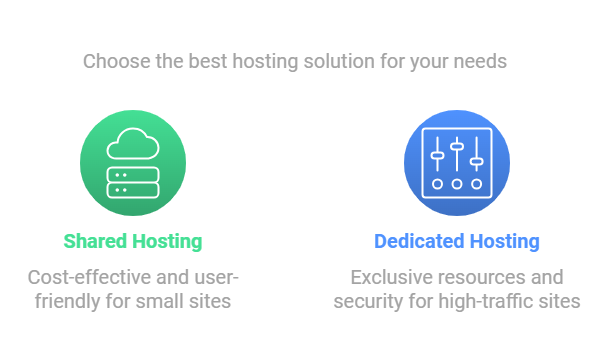
Which Is Better for My Business – Shared or Dedicated Hosting?
Before choosing between shared or dedicated hosting, website owners need to consider their specific needs, goals, and budget.
Shared hosting is an excellent choice for projects that expect modest traffic and resource use, beginners, or small businesses, including:
- Blogs and personal websites
- Small local businesses
- Freelancers
- Smaller non-profit organizations
- Landing pages for startups
- One-off event websites
Conclusion
Choosing between shared and dedicated hosting actually depends on your needs in terms of control, performance, security, and budget. Shared hosting will be the best for small sites with moderate traffic and less technical demands, whereas the best option for larger applications that require powerful performance and security measures will be dedicated hosting.