
Choosing the right academic degree is an important decision as the chosen degree would largely determine the career path of the student and personal development. For there are indeed lots of choices from Associate’s up to Bachelor’s and Master’s degrees. Therefore, should be made on focusing on the distinctions each degree can make for everyone to get an idea about its benefits and outcomes concerning work careers related to it.
Understanding Degree Types
1. Associate’s Degree
Overview
An associate’s degree typically takes two years to complete, and it is generally offered in community colleges and some universities. It is considered a basic qualification which can either directly place one into the workforce or position someone to proceed further into a bachelor’s degree program.
Fields of Study
Associate degrees cover a wide range of technical and vocational areas, including but not limited to:
- Information Technology
- Healthcare (ex: nursing, dental hygiene)
- Graphic Design
- Culinary Arts
These programs focus on providing practical skills and foundational knowledge that are directly applicable to specific job roles.
Career Prospects
Graduates with an Associate’s degree can pursue various entry level positions such as:
- Dental Hygienists
- Paralegals
- Mechanical Technicians
- Web Developers
Additionally, many students use their Associate’s degree as a pathway to transfer credits toward a Bachelor’s degree program, enhancing their educational qualifications.
Pros:
- Quick Entry into the Workforce: That’s getting an associate’s degree: it affords the ease to find a job within only two years from college. While providing the hands-on training and skills required in healthcare, IT, and skilled trades, it allows people to work directly as dental hygienists and web developers.
Such programs address the needs of the job market by offering a host of career opportunities like radiologic technicians, administrative assistants, among others, where students can relate their interests to the demands of the industry and, hence, start earning faster. - Lower Costs: Attaining an associate degree is less expensive than completing bachelor or master’s degrees, as community colleges and technical schools charge less tuition. A student will spend relatively less money on an associate degree, thus graduating with lower student loan debt and a better financial position. Grants, scholarships, and work-study opportunities do reduce the burden of educational costs of associate degrees.
- Transferable Credits: Many programs allow credits to be transferred toward a Bachelor’s degree.
Cons:
1. Highly restricted career development: Many professions at this level require higher education, hence advancement is quite limited.
2. Limited specialization: In some cases, it does not reach the depth found in a Bachelor’s or Master’s degree
3. Lower earning potential: This level is often associated with lower salaries than those who have higher degrees.
2. Bachelor’s Degree
Overview
A bachelor’s degree is 4 years study of undergraduate education obtained in a specific field. It is considered standard qualification for the majority of professional careers and a critical foundational qualification for potential higher education students.
Fields of Study
Bachelor’s degrees are offered in numerous disciplines, including:
- Bachelor of Arts (BA)
- Bachelor of Science (BSc)
- Bachelor of Commerce (BCom)
Programs typically combine general education courses with specialized coursework relevant to the student’s major.
Career Prospects
With a Bachelor’s degree, graduates can enter various fields such as:
- Engineering
- Business Administration
- Education
- Healthcare Management
This degree often serves as the minimum requirement for many entry level positions and is crucial for those looking to advance their careers or pursue graduate studies.
Pros:
1. Comprehensive Education: Provides both theoretical understanding and practical training.
2. Career Advancement Opportunities: Offers access to better positions and even higher pay.
3. Foundation for Graduate Studies: Required for pursuing Master’s or Doctoral degrees.
Cons:
1. Time Commitment: Requires four years of study, delaying entry into the workforce compared to an Associate’s degree.
2. Higher Costs: Tuition fee and related expenses can be considerable.
3. Master’s Degree
Overview
A Master’s degree is a more advanced qualification than what is offered at the Bachelor’s level, usually requiring anywhere between one and two years after completing the Bachelor’s degree. It specializes knowledge and skills in a certain field.
Fields of Study
Common Master’s degrees include:
- Master of Business Administration (MBA)
- Master of Technology (M.Tech)
- Master of Arts (MA)
These programs often emphasize practical applications and may include research components.
Career Prospects
Holders of a Master’s degree are often sought after for roles that require advanced expertise, such as:
- Senior Management Positions
- Research Scientists
- University Professors
- Specialized Healthcare Professionals
Master’s graduates frequently enjoy higher salary prospects compared to those with only a Bachelor’s degree.
Pros:
1. Specialized Knowledge: Prepares graduates for high-level positions in their fields.
2. Increased Earning Potential: On average, Master’s degree holders earn significantly more than those with only a Bachelor’s.
3. Career Advancement: Often necessary for leadership roles in many industries.
Cons:
1. Costly Investment: Tuition can be high, leading to significant student debt.
2.Time Intensive: Requires additional years of study, which may delay career progression initially.
3. Location and travel: Moving to a new city or another country to study disrupts personal life, and costs of living will be higher.
4. Over skilled: Higher education sometimes makes applicants overly qualified for several entry-level jobs within some sectors.
Factors to Consider When Choosing a Degree
1. Career Goals
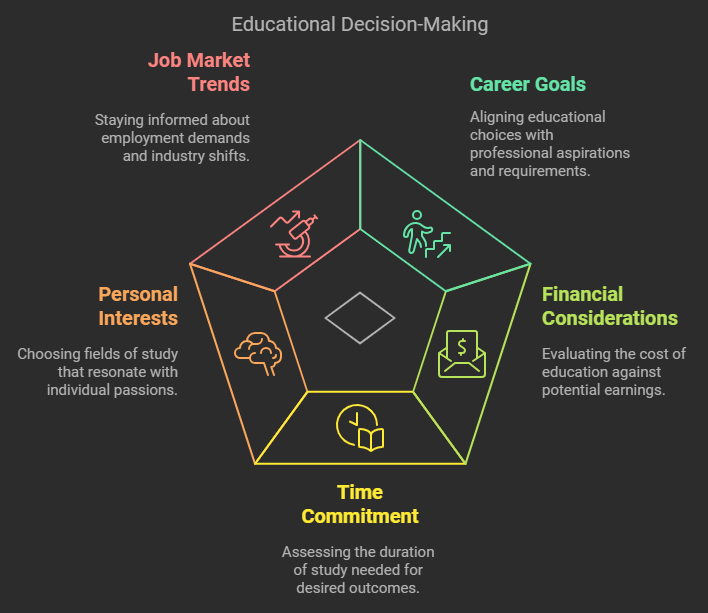
Your career goals should significantly influence your decision. Research the educational requirements for your desired occupation. Most careers require just an Associate’s or Bachelor’s degree, but more likely most occupations require more-advanced qualifications such as a Master’s or Doctorate.
2. Financial Considerations
Assess your financial situation when choosing a degree. Consider not only tuition costs but also potential earnings associated with each type of degree. While higher education often leads to betterpaying jobs, it also comes with increased debt.
3. Time Commitment
Evaluate how much time you are willing to invest in your education. If you are eager to enter the workforce quickly, an Associate’s degree is most suitable. On the contrary, if you are looking for long-term career growth and specialization, a Bachelor’s or Master’s may be worth spending the extra time studying.
4. Personal Interests
Align your educational path with your interests and passions. Engaging in studies that excite you will enhance your learning experience and increase your chances of success in your chosen field.
5. Job Market Trends
Stay abreast of trends in the market place as it relates to employment. In some fields, based on competition, companies will require graduate degrees. Review posts for open positions to determine what’s being requested.
6. Personal Interests and Strengths
Align your educational pursuit with your passions and strengths. In case you like working hands-on and would rather relate things to practical applications than theoretical knowledge, an associate’s program would come in much better than this long academic path.
Conclusion
Choosing between an Associate’s degree, Bachelor’s degree, or Master’s degree requires weighing a variety of factors that consist of career goals, financial implications, time commitment, and personal interests. Each of these degrees is designed to serve different purposes:
An Associate’s degree gets one into the workforce very quickly at less cost but offers less specialization. A Bachelor’s degree offers broad education that a student may need for professional tasks, taking much more time and money. A Master’s degree allows specialization and better returns in the pocket, but it definitely incurs major costs and time commitments.
The last step really depends on individual circumstances and aspirations. With careful researching and reflecting on personal goals, you are likely to make the best choice that steers you toward your future career track.
Written by: Zenith