
We all make critical decisions in our lives when we want to have an online presence by choosing a web host. Be it a personal blog, some e-commerce website, or portfolio, what we host directs the performance of our site, security, and success. With the availability of multiple hosting providers this is really a difficult task in making a choice between them.
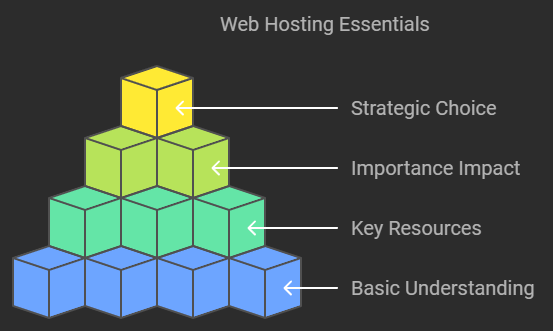
1. Understanding Web Hosting and Its Importance
That is, first of all, knowing what is web hosting and why one needs it.
Web hosting is defined as a service which enables any person or entity to post a web page or a website in the internet. This should include storage, bandwidth, and support of the technologies and resources required for the proper working of the website and which the web host allows .
Importance of choosing a web host
It determines how fast and reliable your website is and it has a direct impact on your site’s uptime, meaning your website is accessible 24/7.
It influences the general user experience, SEO rankings, as well as sales for a website.
2. Choosing Web Hosting Services
Before choosing a web host, determine what type of hosting is most suitable for you. There are different web hosting services available, including:
Shared Hosting for Smaller Websites
It is perfect for any new or low-traffic website.
Pros: Cheap, easy to handle, perfect for freshers
Cons: Resources are pooled, it implies less speed, less scalable.
VPS (Virtual Private Server): Hosting for Dev Websites
VPS hosting goes against the understanding of shared hosting
Pros: More control and speed; more dedicated resources
Cons: A little pricey, a bit technical
Dedicated Hosting to Big Businesses
Dedicated hosting means you get an entire server all to yourself.
Pros: Exceptional performance, total control, High security
Cons: Costly, still requires a little technical know-how
Cloud Hosting for Scaling
Cloud hosting is flexible and highly scalable.
Pros: Good uptime, scalable, and cost-effective for growing websites .
Cons: Sometimes hard to handle
Specialized Hosting (e.g., WordPress Hosting)
For one-specific platform like WordPress.
Pros: Optimised to specific CMS platforms with features that have been added .
Cons: It can be limited to just one platform.
3. Testing Performance and Speed Metrics
This means that in choosing a web host, the benchmarks are website speed and performance; hence, the kind of user experience and SEO ranking will come directly because of this fact.
Server Location: Choose an alternative hosting service whose server location is nearest to your target audience so as to reduce the time that it will take to load.
Content Delivery Network: These days, some host providers provide integration of CDN for hosting fast content easily.
Uptime Guarantee: Select web host, which ensures that your website is accessible all the time through its minimum guarantee of uptime of 99.9%.
Scalability: Opt for web hosting that also ensures that upgrading becomes smoother when your website grows.
Note that a web host with a good performance metric will also ensure your visitors enjoy a smooth browse.
4. Security Features of Web Hosting
One of the non-negotiables is that the hosting environment should be secure. Cyber attacks are now highly common, and your web host has to make sure it gives excellent security features to keep your website and data safe.
Key Security Features
SSL Certificate: Your host must provide SSL certificates either free of charge or for a low fee.
Scheduled Backups: Auto-backup guarantees to secure all data in case of unexpected bugs.
Antivirus Malware Protection: Scanning and removal of any virus or other malware
Firewall and DDoS Protection: Safeguard yourself against cyber-attacks using superior firewalls and DDoS protection.
Choose a web host that offers these features to protect your website against possible potential attacks.
5. Evaluating Customer Support Services
Even the most technologically savvy people will encounter problems that deserve specialist attention. Quality customer support is what makes the difference in a hosting provider.
What is Good Customer Support:
24/7 Access: Ensure that support is accessible at any time.
Multiple Contact Channels: Ensure that the hosting service company has a live chat, phone, and email channels.
Resource Center: It pays to have a well-documented resource center.
Choose hosting service companies that are responsive and active in solving a problem efficiently.
6. Price Comparison and Value for the Money
Web hosting prices can be diverse depending on the type of hosting service and the feature set. For many, the cheapest is the best choice, but this is appropriate only when measured in value for money.
What to consider in Pricing
Introductional vs Renewal: Most hosts which offer low introduction prices make higher renewal charges.
Hidden Fees: Look out for extra charges for add-ons like backups or email accounts.
Refund Policy: Choose hosts with a money-back guarantee to minimize risk.
Strike a balance between affordability and essential features when choosing a web host.
7. Checking for Easy-to-Use Features
User-friendliness is crucial, especially if you’re not tech-savvy. Look for these features to simplify website management:
Control Panel: Tools like cPanel or Plesk reduce the work involved in managing websites.
One-Click Installation: Easy setup of content management systems like WordPress.
Website Builder: Some web hosts even have drag-and-drop website building tools that require no coding.
Intuitive web hosting saves time and effort.
8. Scalability and Future Growth
Once your website grows, your hosting needs also increase. It is, therefore important to choose a web host which offers scalability to meet your future needs.
Options to Look for Scalability:
Resource Upgrades: Upgrading options that are hassle-free for storage, bandwidth or CPU.
Migration Support: Help in migration to a higher hosting plan.
Cloud Hosting Options: For those websites which are expecting spiky unpredictable traffic.
By choosing a web host that supports growth, you’ll avoid unnecessary downtime or migration headaches.
9. Reading Reviews and Recommendations
Before making a decision, take the time to research reviews and recommendations. Real-life experiences from other users can provide insights into the reliability and quality of a hosting provider.
Where to Find Reliable Reviews:
Web Hosting Forums: Forum where users share their experience.
Trusted Review Sites: Sites such as Trustpilot or G2 will contain reviews by other people which most probably will be transparent.
Word of Mouth: Keep asking your friends, or colleagues for help.
Pay attention to the recurrent themes of reviews regarding performance and support.
10. Bonus Tips for Picking a Web Host
To wrap it all in one, here are a couple more tips:
Free Trial or Demo: Test the hosting service before paying for the services.
Eco-Friendly Hosting: Search for web hosts who are committed for going green.
Additional Bonus Features: Some web hosting companies offer free domains or advertising credits.
Choosing a web host involves comparing your needs several times to the host’s features.
11. How to Calculate Your Bandwidth and Storage Needs
The second consideration when choosing a web host is bandwidth and storage needs. These determine the volume of information that your site can share and how much it can house, and they directly affect the functionality of your site.
Bandwidth: What You Should Know
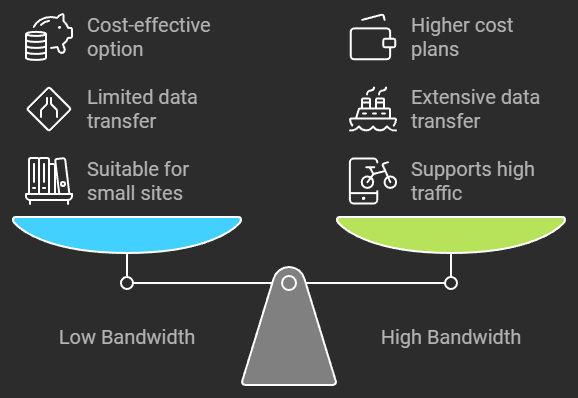
What Is Bandwidth? It is the amount of data your site can transfer to users within a fixed time period.
How Much Bandwidth Do I Need? Low bandwidth might be sufficient for a tiny blog or portfolio site, but if you anticipate having lots of traffic then choose higher bandwidth plans.
Unlimited Bandwidth Myth: Many hosts will display “unlimited” bandwidth, but there are often fair usage policies in place, so do read the fine print.
Storage: Balancing Need and Cost
SSD vs. HDD Storage: Web hosts that offer SSDs will provide so much more speed than with the traditional HDDs.
Scalable Storage Plans: Make sure that your hosting provider can add storage space as your site grows.
Backup Storage: Web hosting firm providing safe backup storage is surely an added layer of security
12. Integration and compatibility with tools
The tools and applications you would like to use with your site will require full integration with your host.
CMS Compatible
Supports your preferred CMS, such as WordPress, Joomla, or Drupal.
Look for preinstalled tools with easy setup and management
Third Party Integrations
Ensure the hosting supports popular integration with Google Analytics, email marketing tools, e-commerce platforms, etc.
If you have an online store, payment gateway integration is a must
Developer Tools
If you’re a developer or plan to work with one, ensure the host offers features like FTP access, SSH, and support for multiple programming languages (PHP, Python, Ruby, etc.).
By focusing on compatibility, you’ll avoid technical difficulties and create a more efficient workflow.
13. Environmental Impact of Hosting Providers
Sustainability has become an important issue for many people and businesses. So, choose a web host whose environmental policies align with your values.
Why Green Hosting Matters
Energy Consumption: Data centers consume huge amounts of energy; thus, a green host lowers carbon footprints.
Positive Branding: For businesses, being an eco-friendly organization can positively impact your brand.
Features of Green Hosting
Renewable Energy Usage: A host powered by wind, solar, or other green sources.
Carbon Offsetting: Some organizations invest in the offsetting of the carbon they produce.
Energy-Efficient Hardware: The latest, super-efficient servers, using less power.
With a sustainable hosting provider, your website runs with the preservation of the environment.

14. Customization and Flexibility in Hosting Plans
Not all websites have the same needs, and your hosting provider should allow flexibility to meet your specific needs.
Customizable Hosting Plans
Some hosts let you select only the features that you might need. This ensures cost-effectiveness.
Options on adding or removing services on email hosting, extra storage, or advanced security features.
Flexibility in changing plans
Ensure that your host gives you the flexibility to change plans without extended downtime.
Choose hosts that offer prorated billing to pay only for what you use.
Customizable hosting does not make you overpay for features you don’t need but provides you with the flexibility to grow.
15. Role of User Experience (UX) in Hosting Services
When choosing a web host, look for an environment that indeed makes a difference in the end-user experience.
Web Site Speed and Loading Times
A slow website means the users will leave sooner. Host a site with high response time from the servers to improve UX.
Mobile Responsiveness
Mobile traffic occupies the largest share of web visitors. A good hosting company should be able to make sure that mobile optimisation tools are supported.
Accessibility Features
Make sure your host supports accessibility guidelines for users with disabilities, such as text-to-speech, compatibility with a screen reader, etc.
Prioritizing UX doesn’t only enhance visitor satisfaction but also enhances the credibility of your site and increases its conversion rate.
16. Testing Hosting Reliability with Trials
Most web hosting services offer some kind of trial period or money-back guarantee. Keep an eye out for these and test the service before committing.
How to Compare In a Trial
Performance: Note your site’s speed, uptime, and whether the web hosting service delivers in terms of reliability.
User-friendliness: Test the control panel and other tools available to judge friendliness in use.
Support: Test support with questions to know how quickly you get reliable answers.
Trying out several web hosts before settling on one means not having long-term misery .
17. Moving To a New Web Host
If you do have a site but you are dissatisfied with your current hosting provider, it’s now time to switch to a new web host.
Transferring Considerations
Loss of Service: Minimize the loss of service during the transferring process. .
Migration Assistance: Most hosting providers offer free transfers to make it easy.
Data Integrity: Back up data before transfer to avoid losing your data.
When to Transfer
You have been experiencing persistent problems with your current hosting provider.
If You are paying too much for your hosting and not getting your money’s worth.
You do not have features or support anymore, as your requirements have changed.
Thoughtful migration will help you enhance your hosting scenario with minimal stress

18. Hosts Hidden Fees
Many web hosts go low on initial costs but then strike you hard with unexpected costs.
Common Hidden Fees
Domain Renewal Fees: Companies providing hosting for free for the first year often charge high when it comes to renewal.
Add-On Services: For instance, e-mail hosting and backups or extra storage will incur charges.
Resource Overages: Extra bandwidth or storage usage usually would incur additional penalties.
Read the terms and conditions to avoid any surprise later.
19. Hosting for Specific Niches
Each website is unique and might need something different. There are some hosting providers that cater for niche-specific needs.
Ecommerce Hosting
This needs SSL certificate, PCI compliance, shopping cart integration etc.
Media-Rich Websites
This involves a lot of bandwidth as well as storage. This usually falls under the category of websites that have loads of images or video content.
Personal Blogs or Portfolios
This usually requires budget-friendly shared hosting plans along with all the basic features.
Choosing a hosting company in your niche will ensure that you take advantage of the features best suited for your needs along with adequate support.
Conclusion
In the Market there is no one providing host services suitable to all. You’ll need to take into account your website’s current and future needs along with the features of hosting providers, among other considerations, including security, performance, and environmental impact. Within this work, these more involved topics are covered together with the core factors that ensure your website runs well.
Remember that the proper host supports your website as well as holds the most important position in it. So, take time, and do good research on this matter to make a well-informed decision.
Written by : Ravi Teja